Category Archive 'Republicans'
18 Oct 2013


William Galston, in the Wall Street Journal, sees the recent shutdown struggle as evidence of a crucial internal struggle for the soul of the Republican Party.
More than a decade ago, before the post-9/11 national fervor set in, Walter Russell Mead published an insightful essay on the persistent “Jacksonian tradition” in American society. Jacksonians, he argued, embrace a distinctive code, whose key tenets include self-reliance, individualism, loyalty and courage.
Jacksonians care as passionately about the Second Amendment as Jeffersonians do about the First. They are suspicious of federal power, skeptical about do-gooding at home and abroad; they oppose federal taxes but favor benefits such as Social Security and Medicare that they regard as earned. Jacksonians are anti-elitist; they believe that the political and moral instincts of ordinary people are usually wiser than those of the experts and that, as Mr. Mead wrote, “while problems are complicated, solutions are simple.”
That is why the Jacksonian hero defies the experts and entrenched elites and “dares to say what the people feel” without caring in the least what the liberal media will say about him. (Think Ted Cruz. )
The tea party is Jacksonian America, aroused, angry and above all fearful, in full revolt against a new elite—backed by the new American demography—that threatens its interests and scorns its values. …
Supporters of the tea party… see President Obama as anti-Christian, and the president’s expansive use of executive authority evokes charges of “tyranny.” Mr. Obama, they believe, is pursuing a conscious strategy of building political support by increasing Americans’ dependence on government. A vast expansion of food stamps and disability programs and the push for immigration reform are key steps down that road.
But ObamaCare is the tipping point, the tea party believes. Unless the law is defunded, the land of limited government, individual liberty and personal responsibility will be gone forever, and the new America, dominated by dependent minorities who assert their “rights” without accepting their responsibilities, will have no place for people like them.
For the tea party, ObamaCare is much more than a policy dispute; it is an existential struggle. …
Many tea-party supporters are small businessmen who see taxes and regulations as direct threats to their livelihood. Unlike establishment Republicans who see potential gains from government programs such as infrastructure funding, these tea partiers regard most government spending as a deadweight loss. Because many of them run low-wage businesses on narrow margins, they believe that they have no choice but to fight measures, such as ObamaCare, that reduce their flexibility and raise their costs—measures to which large corporations with deeper pockets can adjust.
It’s no coincidence that the strengthening influence of the tea party is driving a wedge between corporate America and the Republican Party. It’s hard to see how the U.S. can govern itself unless corporate America pushes the Republican establishment to fight back against the tea party—or switches sides.
15 Oct 2013

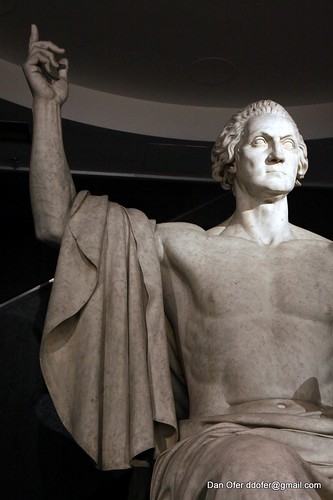
Detail, Horatio Greenough, George Washington Attired in Roman Toga, 1841, National Museum of American History
Stratfor’s George Friedman thinks seriously about what the founders would have thought about the partisan stalemate in Washington.
The founders needed to bridge the gaps between the need to govern, the fear of tyranny and the uncertainty of the future. Their solution was not in law but in personal virtue. The founders were fascinated by Rome and its notion of governance. Their Senate was both a Roman name and venue for the Roman vision of the statesman, particularly Cincinnatus, who left his farm to serve (not rule) and then returned to it when his service was over. The Romans, at least in the eyes of the founders if not always in reality, did not see government as a profession but rather as a burden and obligation. The founders wanted reluctant rulers.
They also wanted virtuous rulers. Specifically they lauded Roman virtue. It is the virtue that most reasonable men would see as praiseworthy: courage, prudence, kindness to the weak, honoring friendship, resolution with enemies. These were not virtues that were greatly respected by intellectuals, since they knew that life was more complicated than this. But the founders knew that the virtues of common sense ought not be analyzed until they lose their vigor and die. They did not want philosopher-kings; they wanted citizens of simple, clear virtues, who served reluctantly and left gladly, pursued their passions but were blocked by the system from imposing their idiosyncratic vision, pursued the ends of the preamble, and were contained in their occasional bitterness by the checks and balances that would frustrate the personal and ideological ambitions of others.
The Founding Father who best reflects these values is, of course, George Washington. Among the founders, it is he whom we should heed as we ponder the paralysis-by-design of the founders’ system and the current conundrum threatening an American debt default. He understood that the public would be reluctant to repay debt and that the federal government would lack the will to tax the public to pay debt on its behalf. He stressed the importance of redeeming and discharging public debt. He discouraged accruing additional debt and warned against overusing debt.
However, Washington understood there would be instances in which debt had to be incurred. He saw public credit as vital and therefore something that ought to be used sparingly — particularly in the event of war — and then aggressively repaid. This is not a technical argument for those who see debt as a way to manage the economy. It is a moral argument built around the virtue of prudence.
After these excellent observations, though, George reaches a dubious conclusion.
I think the founders would have questioned the prudence of our current debt. They would ask if it were necessary to incur, and how and whether it would be paid back. They would also question whether economic growth driven by debt actually strengthens the nation. In any case, I think there is little doubt they would be appalled by our debt levels, not necessarily because of what it might do to the economy, but because of what it does to the national character. However, because they were moderate men they would not demand an immediate solution. Nor would they ask for a solution that undermines national power.
As for federally mandated health care, I think they would be wary of entrusting such an important service to an entity they feared viscerally. But they wouldn’t have been fanatical in their resistance to it. As much as federally mandated health care would frighten them, I believe fanaticism would have frightened them even more.
The question of a default would have been simple. They would have been disgusted by any failure to pay a debt unless it was simply impossible to do so. They would have regarded self-inflicted default — regardless of the imprudence of the debt, or health care reform or any such subject — as something moderate people do not contemplate, let alone do.
So, by this analysis (which I think is drawn unconsciously from the poisoned well of the establishment media), even though Obamacare and an ever-increasing and unsustainable public debt are both classic examples of the kind of fundamentally destructive perils to the Republic which the framers devised the Constitution specifically to avoid, good men must refrain from fully utilizing the House’s power of the purse to restrain the radicals and the corrupt because refusing to write checks to cover the debts they irresponsibly and uncontrollably pile up would mean the good men were being “immoderate.” Uh, huh!
Sorry, but I think it is appropriate to quote Justice Jackson to Mr. Friedman: “The Constitution is not a suicide pact.” And a one-sided political philosophy which demands that the forces of conservatism, liberty, and fiscal prudence must be moderate and cannot fight totally ruthless opponents who shrink from nothing with all their means simply guarantees that the democrats are always going to win.
When we have one of these policy confrontations, I would say, “Republicans, what would the democrats do?” The answer is: everything and anything necessary to win. In political wars, it is desirable to maintain a standard of behavior. It is desirable to set an example of moderation. But to set any kind of example, to have any impact on the future, to be remembered by history, you actually do have to win. Nobody, long years afterwards, says, they lost, but they were so well-mannered and restrained in their manner of being defeated that we are building them this monument.
We have, in this country, an ongoing political struggle between two parties. The Republican Party is commonly comprised of well-meaning, civic-minded and moderate men, successful businessmen, Rotarians who went on into public service. The democrat party, on the other hand, is full of machine politicians, of ruthless bastards with limitless ambition, of demagogues and crooks. Republicans would like to do politics in the genteel way you play a game of croquet. Democrats are professional, organized, and utterly and totally determined to win every time at any cost. We are doing politics as an obligation and a duty. They are doing politics to make a living. If a typical Republican leaves office, he is happy to go home. If a typical major democrat pol were to leave politics, he’d be in the gutter or in jail. The Republican Party is going to keep losing until its leaders realize that they are really fighting for the survival of the Republic and that they have to fight these people with no holds barred.
Read the whole thing.
19 Jun 2013
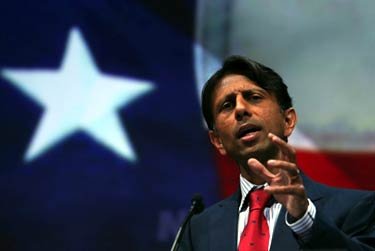
Bobby Jindal yesterday took issue with the calls for reforming the GOP in order to make it less conservative and more appealing to Obama voters.
At some point, the American public is going to revolt against the nanny state and the leftward march of this president. I don’t know when the tipping point will come, but I believe it will come soon.
Why?
Because the left wants: The government to explode; to pay everyone; to hire everyone; they believe that money grows on trees; the earth is flat; the industrial age, factory-style government is a cool new thing; debts don’t have to be repaid; people of faith are ignorant and uneducated; unborn babies don’t matter; pornography is fine; traditional marriage is discriminatory; 32 oz. sodas are evil; red meat should be rationed; rich people are evil unless they are from Hollywood or are liberal Democrats; the Israelis are unreasonable; trans-fat must be stopped; kids trapped in failing schools should be patient; wild weather is a new thing; moral standards are passé; government run health care is high quality; the IRS should violate our constitutional rights; reporters should be spied on; Benghazi was handled well; the Second Amendment is outdated; and the First one has some problems too.
Their philosophy does not work and it got our nation into the mess it’s in.
Eventually Americans will rise up against this new era of big government and this new reign of politically correct terror.
07 Sep 2012

David Frum departs from his usual beat to imagine (rather accurately, I thought) what a typical ordinary GOP convention delegate would think about criticisms of his party’s lack of diversity.
The polls tell me that something like 100% of black Americans will vote for Barack Obama. Are they bigots because they rally to their guy? So why are we supposed to be bigots because maybe 60% of us rally to our guy?
Like all white Americans, I’m a mutt: a little English, a little Irish, a little German. Probably got some Cherokee up there too, but you don’t hear me making a big whoop out of it for an affirmative action board, unlike some Democrats I can mention. My wife’s half-Italian. My son’s married to a Chinese girl, and my grandkids will be half Chinese. Doesn’t bother me. I just want us all to be Americans.
But let’s face it: this president has no idea what it means to be American, and I don’t care whether he was born in Hawaii or Kenya or Indonesia or Uzbeky-beky-beky-stan. To be an American means to work for everything you get. When’s he ever worked for anything? It was all handed to him! And now he wants to hand my work over to somebody else.
Read the whole thing.
Hat tip to Bird Dog.
07 Aug 2012

Wikipedia edits July 30-August 6
Michah L. Sifry has a suggestive indicator.
The Romney campaign wants you to download its mobile app to be among the first to find out who Mitt is going to pick as his running mate, but if past history is any guide, you might want to instead be looking at Wikipedia — and whether any of the leading contenders’ entries are being suddenly brushed up.
Sarah Palin’s Wikipedia page was updated at least 68 times the day before John McCain announced her selection, with another 54 changes made in the five previous days previous. Tim Pawlenty, another leading contender for McCain’s favor, had 54 edits on August 28th, with just 12 in the five previous days. By contrast, the other likely picks — Romney, Kay Bailey Hutchison — saw far fewer changes. The same burst of last-minute editing appeared on Joe Biden’s Wikipedia page, Terry Gudaitis of Cyveillance, told the Washington Post.
03 Jul 2012

Marc A. Thiessen discusses the differences in result between democrat and Republican Supreme Court appointments and speculates on just why Republican appointments produce such ideologically unreliable results.
Chief Justice John G. Roberts Jr.’s decision to side with the court’s liberal bloc and uphold Obamacare raises an important question for conservatives: Why are Republicans so awful at picking Supreme Court justices? Democrats have been virtually flawless in appointing reliable liberals to the court. Yet Republicans, more often than not, appoint justices who vote with the other side on critical decisions.
Just compare the records over the last three decades. Democrats have appointed four justices — Ruth Bader Ginsberg, Stephen G. Breyer, Elena Kagan and Sonia Sotomayor. All have been consistent liberals on the bench. Republicans, by contrast, have picked seven justices. Of Ronald Reagan’s three appointees (Sandra Day O’Connor, Antonin Scalia and Anthony M. Kennedy) only Scalia has been a consistent conservative. George H.W. Bush appointed one solid conservative (Clarence Thomas) and one disastrous liberal (David Souter). With George W. Bush’s appointments of Samuel A. Alito Jr. and Roberts, conservatives thought finally they had broken the mold and put two rock-ribbed conservatives on the bench — until last week, that is, when Roberts broke with the conservatives and cast the deciding vote to uphold the largest expansion of federal power in decades.
So Democrats are four-for-four — a perfect record. Republicans are not even batting .500.
Read the whole thing.
08 Mar 2012

Hat tip to Theo.
23 Feb 2012

I didn’t watch the whole thing, but in the portions I witnessed I thought everyone did rather well. It seemed to me that the contest for the GOP nomination process had really accomplished a few things: weeding out some less prepared and less articulate contenders and polishing the performances of the survivors.
My only dissatisfaction really revolved around so many of candidates attacking one another, and trying to gain a personal edge by means of cheap shots and obviously opportunistic assaults on one another’s previous statements and records. If it were up to me, I’d have boat-hooked Ron Paul out of there on the basis of a real excess of that kind of thing.
Personally, I still like Gingrich best. I think he tends characteristically to draw upon a broader understanding of history and political theory than anybody else, and I am much attracted by his imagination. Assuming we win in November, the next president’s task is going to consist of presiding over a major reconsideration of the federal government’s role and responsibilities, developing a much more serious approach to budgeting, and –in essence– managing the transition from the Welfare Entitlement State to a new version of an American growth and opportunity state. I think Gingrich’s superior knowledge and intellect would be strong assets, and I think his fecundity in producing new ideas and new approaches would be invaluable.
Romney, as I’ve noted before, delivers consistently the smoothest, most professional, and most attractive portrayal of presidential leadership. He speaks passionately in defense of capitalism. He is obviously a highly competent and thoroughly responsible guy, and though he has not run for office or governed previously as much of a conservative, his current embrace of, practically amounting to a death-grip on, conservative principles seems sincere. Watching Romney perform, one is forced to conclude that he would do a decent job. His would not be a really revolutionary administration. He would funk and compromise all the really tough calls, but he would generally do just fine.
It seems remarkable how much Rick Santorum has grown into the role of conservative movement champion and front-running candidate. In some earlier debates, he seemed a somewhat irrelevant dark horse outsider, and even more of a cranky traditionalist scold than Michele Bachmann. Now, he has picked up the mantle of the hero and he’s wearing it well. He is the living embodiment of clean cut, ordinary old-fashioned Americanism, and he expresses himself reasonably and with admirable clarity.
It is generally fun to hear from Ron Paul. He no longer really belongs up there, I thought, but it is a pleasure to see libertarian positions as totally heretical from the establishment perspective as going back to the gold standard and simply abolishing the EPA, advocated seriously in a presidential debate. Ron Paul has his own distinctive manner of speech and presentation. He reminds one of some very bright, well-loved, and barking mad uncle, who can (and will) speak for hours on his own particular bizarre obsessions and can actually entertain you in the process, despite your knowing perfectly well just how far from the reality we inhabit is the home of Uncle Ron. I do wish, though, that Ron Paul would climb down off his sanctimonious libertarian high horse, and quit abusing all his opponents in extravagant terms for conventional previous behavior or votes. There is an annoying streak of Puritan hypocrite in Ron Paul.
I don’t think last night’s debate changed the situation much. Jim Geraughty, in his emailed Morning Jolt, had the most to say about Romney:
Romney is, bit by bit, proving to be a better debater than people thought. Yes, he’s pretty shameless about going after opponent’s inconsistencies and unpopular positions that he himself held earlier in his career — but the audaciousness of it tends to leave the opposition flustered and infuriated.
Last night, he jabbed at Santorum, “When I was fighting to save the Olympics, you were fighting to save the Bridge to Nowhere.” Really, after lines such as that, people doubt Romney’s willingness to go after Obama? If nominated, Romney will probably lacerate Obama on the individual mandate, not cutting spending, insufficient support for drilling, demonizing the wealthy, and so on. Obama may coolly point out Romney’s past support for those positions, and I suspect Romney will just ignore it and point out that those positions are the wrong ones, and the American public opposes them. Would voters prefer the consistent man who stands for ideas they oppose? Or will they prefer a flip-flopper who currently holds the positions they support?
You and I — who have watched Romney debate as a passionately pro-choice candidate, brag that he would be better for Massachusetts gays than Ted Kennedy in 1994 — look at his current emphatic finger-pointing during these debates, and think, “He might just be saying what he needs to get the nomination. I don’t know if I trust him. He sounds sincere now, but Massachusetts liberals probably thought he agreed with them in 2002, too.” But I suspect casual voters ignore anything before, say, last weekend. I suspect they put a whole lot more into a candidate’s nonverbal communication, and whether that conveys sincerity and constancy, than anything that would require them to, you know, read something. If you doubt me, look at Obama’s election.
02 Feb 2012
Former democrat congressman (he lost in 2010) Alan Grayson is a loudmouth bolshevik, but he’s right on the results of the Florida GOP Primary.
[T]he GOP is leaving Florida worse than it arrived.
“I think there has been lasting damage,†he said. “I think that when Newt Gingrich parades around the country saying Mitt Romney is a liar and Mitt Romney parades around country saying Newt Gingrich is a liar, the conclusion most people draw is they’re both liars.â€
I’d say though that it started in South Carolina, when the Gingrich campaign took the low road and started attacking Mitt Romney using the left’s anti-capitalist, class warfare arguments.
The massive counter-attack on Gingrich, featuring prominent Republicans, former Congressional colleagues, and conservative pundits, which stooped to utilizing bogus democrat party ethics charges fabricated in the late 1990s for purely partisan advantage was effective and appalling.
We came into this presidential campaign, essentially with an economy-based free “Elect One President” card which ought to have made this race a relative walk-over and a complete sure thing.
Our only problem has been the conspicuous absence, for many years, of a respected, confident and articulate, national figure conservative candidate. For some unaccountable reason, no one has come along to occupy the role once filled by Barry Goldwater and later by Ronald Reagan. Newt Gingrich, for instance, did not really enter the race with that credential. I tend to think that Sarah Palin may yet grow into the role, though she is not there yet. Her declining to run prematurely speaks well for her judgment, and Palin has since 2008 been doing the kind of thing no conservative since Reagan has done: she has functioned as a reliable and effective voice for the conservative movement, and has had regular impact on the national political debate from outside elective office.
We Republicans and conservatives ought to be filled with optimism and resolve at a point in history when it is clear that we are going to have an opportunity to change the country’s direction for the better, but instead we seem to have no leadership, no principles, no really satisfactory candidates, and no class. We clearly have too damn many slime mold professional campaign operators, too many spiteful and grudge-bearing has-beens, and too little genuine leadership.
The Republican Party, the Conservative Movement, and the country want the kind of leader who makes, not only our economy, but our politics better, the kind of man who leads and inspires.
If Gingrich and Romney persist in what they’ve been doing, they may yet re-elect Obama.
29 Jan 2012
Inspired by trailers for “The Artist” (2011):
20 Jan 2012
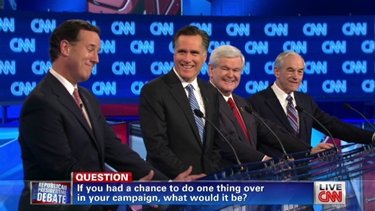
I caught most of yesterday evening’s debate, missing only the opening portion.
Personally, I found all the candidate’s positions generally agreeable and it was refreshing to hear, openly expressed, so many heresies from the consensus of the elect. All the GOP candidates acquited themselves well. I thought Romney has mastered playing the role of still-young-and-vigorous mature father figure to perfection. His voice and manner are remarkably pleasant and agreeable. One reflects that watching him spout generalities and persiflage at press conferences for four-to-eight years would probably be less painful than other alternatives.
Newt Gingrich, of course, is everyman’s bright, but bratty, younger brother grown old. Rick Santorum astutely identified Newt’s special instability and unpredictability, pointing out his lack of complete domestication as a drawback. Santorum was right, of course, that Newt Gingrich is a bit of a loose cannon, but I think myself that we are facing a crucial watershed moment in which what is vitally needed is a radical and far-reaching change of direction and fundamental revisions and reforms. I think that an unconventional person capable of original thought and willing to flout established opinion is precisely what the times require. Electing an enthusiastic nerd has genuine appeal as a proposition, I think.
Newt Gingrich is my favorite candidate, despite my having literally cursed his name and cast him out of my regard more than once, specifically because I think he has earned the front running position in the race. Newt Gingrich has, again and again, elevated the level of the conversation, clarified the issues, and moved the conversation beyond the media’s range of comfort. We should be supporting the candidate who makes the national conversation more intelligent.
Rick Santorum, despite my personal prejudices against traditionalists, deeply impressed me with his sincerity, intelligence, and combativeness. I did think he was a bit appalling in his position on illegal immigration, a regionally characteristic streak of Pennsylvania (Presbyterian-culture) fascism, came out in him on that one. I recognize exactly where this kind of morally delusive interest in following the rules for the sake of following the rules comes from. I grew up in the same state. People like Santorum are actually generally better than they sound. Beneath the (totally insane) insistence on always following all and every one of the laws and rules, they are generally quite good-hearted. Fill out the form they are insisting on being completed correctly, and they’ll give you the shirt off their back.
Even Ron Paul (who has frequently been the most self-righteous and obnoxious of the candidates) was pleasant to listen to. Ron Paul tends to remind me of a different back-home type, one’s clever, but slightly crazy, uncle, who has lots of theories and knows a whole lot about certain things, and who is very eager to tell you all about them. For a change, I thought Ron Paul added more pleasantness and good lines to the debate than extravagant accusations, and I was even beginning to lean to seeing him as a useful and creditable contributor.
Watching the debate conclude last night left this conservative Republican feeling happy and optimistic. I grew up in the same state as Rick Santorum, but I’ve come to appreciate the South. I’m decidedly comfortable with a key role, perhaps the decisive role, in selecting the Republican nominee being played by South Carolina.
Your are browsing
the Archives of Never Yet Melted in the 'Republicans' Category.
/div>
Feeds
|