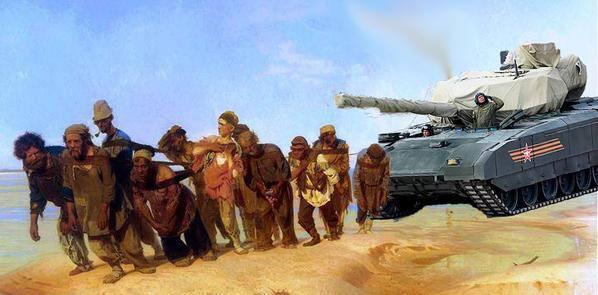
After Ilya Repin, Бурлаки на Волге [Barge-Haulers on the Volga], 1873, Russian State Museum, St. Petersburg.
The Telegraph reports on Mr. Putin’s embarrassing failure.
A new Russian tank announced with much fanfare as superior to Western machines stalled during a dress rehearsal for Victory Day celebrations in Moscow on Thursday.
The T-14 Armata, making only its second public appearance, ground to a halt on Red Square, opposite Vladimir Lenin’s mausoleum.
Sergei Shoigu, Russia’s defence minster, was reportedly forced to approach the tank to find out what had happened; servicemen then tried to hook it up to another military vehicle and tow it away. …
The stalled tank – which was stationary for about 15 minutes – was an embarrassment for the military. Dmitry Rogozin, the deputy prime minister in charge of defence, called the T-14 “a beauty†earlier this week, and Russian experts have been lauding its superiority to Western rivals such as the US Abrams and British Challenger.
The T-14 Armata is to be the main battle tank of Russia’s ground forces, and 2,300 are expected to be produced for the army by 2020. It has a remotely-controlled turret with an automatic weapons loading system and an armoured capsule for the three-man crew.
“One of the coolest parts of our trip to Russia was a chance to check out scale model miniatures of some classic firearms. Everything from a FG43, Suppressed AKM, 1911, Thompson and everything in between.”
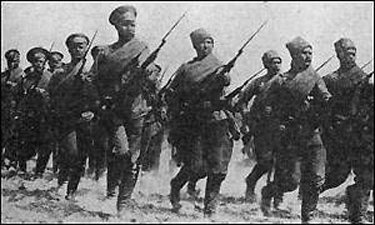
Detal from Jan Matejko, Battle of Grunwald, 1878, National Museum, Warsaw: Grand Duke Witold (your typical Lithuanian) breaking through the German line.
Kat Argo thinks Lithuanian special forces injected into the Ukraine conflict would rapidly clean the Russian militias’ clocks.
There has been a lot of strong rhetoric from the Lithuanian government in reference to the Ukrainian Crisis. The small country by the Baltic Sea has been one of Kyiv’s greatest allies in the EU and NATO. Their ambassador, at an emergency meeting of the UN Security Council in response to the separatist Donetsk People’s Republic’s parade of captured Ukrainian Soldiers at bayonet-point, had said, “… instead of seeking the solution, Russia has been escalating the situation as flow of weapons, equipment, mercenaries and now troops continue across Russia’s borders into the territory of Ukraine. Let us be clear; weapons don’t fall in the hands of rebels out of blue skies.â€
Likewise, Lithuanian officials have made their anti-Russia stance completely clear.
What little experience I have with Lithuanians is with their most elite soldiers in Afghanistan – the Aitvaras, or their Special Forces (LITHSOF) – and I know that if they were to respond to the Ukrainian Crisis, it would change.
The LITHSOF were the mechanized horsemen of the Apocalypse – where they rode, death would come after.
Instead of horses, they had four motorcycles, and wore a black and white kerchief over their nose and mouth with the outline of a skull. The Taliban feared them.
They had a blatant disregard for US regulations, such as the 10km/h speed limit around the base or the need to constantly wear helmets and reflective belts. If the rule was stupid, they didn’t follow it. Their sense of independence, and unit autonomy drove many an American commander insane.
Once, the Lithuanians were refueling a vehicle on base, and a young American sergeant approached to correct their lack of helmets and protective gear. The driver shrugged and claimed “No English!†and drove off (too fast), leaving the young sergeant standing in his dust.
With only dozens of LITHSOF in Afghanistan, they made their numbers count. They became the terror of the Taliban in Zabul Province. It was the single justification of their existence, and the basis of their legend. They were amazing fighters, vicious and joyful in the combat, living in a constant, controlled recklessness.
They criticized the American’s unwillingness to go outside the wire, and the accompanying safety regulations that degraded common sense.
“You want to play safe in war? That is how you lose…†or more directly, “We are soldiers. Not children.â€
They would go out on a dime if called upon. No fear. No excuses. They bent the rules if it helped the mission.
For all that viciousness, they were gracious hosts. They opened their compound to a few of us who would spend our evenings smoking cigars in their “cave†– a place that became a sanctuary for many of us.
They made us loose-leaf chamomile tea from fresh flowers or coffee from fresh grounds with fresh honey (imported from their home). Each newcomer has to try their sauna, which they were very proud of. Through my time, I often asked for permission to steal a cup of coffee or grab some of their tea, until they became frustrated and said, “Katyte, you don’t understand,†using the nickname they had picked out for me, which was the cute form of the word cat, “Our cave is your cave. Feel free, don’t hesitate. Stop asking!â€
Around the base, their commander was called Leonidas (but never to his face) which was a reference to his striking resemblance to the Spartan King, as played by Gerard Butler. The name also suited his reputation.
Leonidas once sat me down to teach me numbers, days, months in his native Lithuanian language – which, by the way, was not easy. Late at night, when I couldn’t sleep, he would sit with me in the common room and we would talk about life, about family, and he would try to impart his brotherly advice.
“We are a big family in this cave,†Leonidas said, “We spend more time with each other than even our real family. We fight, we get angry at each other, but we are family. And I think we are your family too.â€
Leonidas once told me that Americans were too used to a comfortable life – in prosperity we had lost our perspective. We were a comfortable, fat, super power and losing our sight of the world.
Leonidas lamented the Russian invasion of Lithuania.
He explained to me that their society had been prosperous, comfortable and fat too. They gave up their liberties for continued comfort until the day they were invaded when they had no more of their liberty left to trade.
“The Russians were allowed to take over without firing one single shot,†he said.
It was shameful to him, and he spoke with great resolve, declaring that it would never happen again. The little country of Lithuania would never allow themselves to be taken cheaply again and, through the conviction of his dark eyes, I came to believe that Putin would have to pry Lithuania’s liberty from Leonidas’ cold, clenched fist.
Max Fisher identifies the key term in Vladimir Putin’s rhetoric.
Russian President Vladimir Putin just dropped the biggest, scariest dogwhistle of the Ukraine crisis: “Novorossiya.”
The word literally means “new Russia” — it was an old, imperial-era term for southern Ukraine, when it was part of the Russian Empire, and is now a term used by Russia ultra-nationalists who want to re-conquer the area.
Putin has used the word twice during the crisis. First, he used it in April, about a month after Russia had invaded and annexed the Ukrainian region of Crimea, subtly suggesting that the annexation was justified because Crimea was in Novorossiya and thus inherently part of Russia.
He used it again on Thursday, in an official presidential statement addressed to the eastern Ukrainian rebels that have seized parts of the country — and whom he addressed as “the militia of Novorossiya.”
——————————–
Anne Applebaum, who has written a book on the totalitarian genocides committed in Europe’s Eastern Borderlands during the last century, tells us that she suddenly feels as if she is living in the Summer of 1939, and warns, on the basis of familiarity with the kinds of things which appear in the Russian press which the New York Times is never going to report, just how scary the thoughts are that Russia is thinking.
A few days ago, Alexander Dugin, an extreme nationalist whose views have helped shape those of the Russian president, issued an extraordinary statement. “Ukraine must be cleansed of idiots,†he wrote — and then called for the “genocide†of the “race of bastards.â€
But Novorossiya will also be hard to sustain if it has opponents in the West. Possible solutions to that problem are also under discussion. Not long ago, Vladimir Zhirinovsky — the Russian member of parliament and court jester who sometimes says things that those in power cannot — argued on television that Russia should use nuclear weapons to bomb Poland and the Baltic countries — “dwarf states,†he called them — and show the West who really holds power in Europe: “Nothing threatens America, it’s far away. But Eastern European countries will place themselves under the threat of total annihilation,†he declared. Vladimir Putin indulges these comments: Zhirinovsky’s statements are not official policy, the Russian president says, but he always “gets the party going.â€
A far more serious person, the dissident Russian analyst Andrei Piontkovsky, has recently published an article arguing, along lines that echo Zhirinovsky’s threats, that Putin really is weighing the possibility of limited nuclear strikes — perhaps against one of the Baltic capitals, perhaps a Polish city — to prove that NATO is a hollow, meaningless entity that won’t dare strike back for fear of a greater catastrophe. Indeed, in military exercises in 2009 and 2013, the Russian army openly “practiced†a nuclear attack on Warsaw.
Is all of this nothing more than the raving of lunatics? Maybe. And maybe Putin is too weak to do any of this, and maybe it’s just scare tactics, and maybe his oligarchs will stop him. But “Mein Kampf†also seemed hysterical to Western and German audiences in 1933. Stalin’s orders to “liquidate†whole classes and social groups within the Soviet Union would have seemed equally insane to us at the time, if we had been able to hear them.
The Financial Times reports that the Permanent Court of Arbitration in The Hague, after nine years of deliberation, made a record damages award of $50 billion to Yukos shareholders, finding that
Through inflated tax claims, the ruling said, senior officials set out to destroy Russia’s then biggest oil company, transfer its assets to a state-controlled competitor – Rosneft – and put Mr Khodorkovsky in jail. …
Collecting may not be easy.
Though Russia cannot appeal against the award, Moscow said it would pursue all legal avenues for trying to get it “set asideâ€. It can try to argue in a Dutch national court that – contrary to the tribunal’s findings – it was not bound by the Energy Charter Treaty, the agreement regulating cross-border energy business which Russia signed but never ratified, and withdrew from in 2009.
Even if the ruling stands, shareholders face a tortuous battle trying to enforce it. If Moscow refuses to pay, they must pursue Russian sovereign commercial assets in the 150 countries that are party to the so-called 1958 New York Convention on enforcing arbitration awards.
But the real kicker in the story is this:
One person close to Mr Putin said the Yukos ruling was insignificant in light of the bigger geopolitical stand-off over Ukraine. “There is a war coming in Europe,†he said. “Do you really think this matters?â€
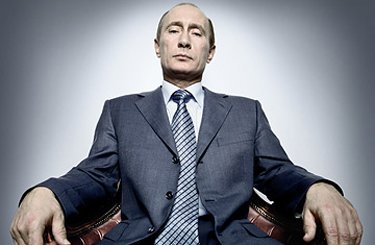
Ben Judah, in Newsweek, has an intriguing profile describing the private life, work habits, and outlook of Russian President Vladimir Putin.
The President behaves as though he is made of bronze, as if he shines. He seems to know that they will flinch when meeting his eye. There is a silence around him. The voices of grown men change when they speak to him. They make their voices as low as possible. Their faces become solemn, almost stiffened. They look down: worried, Ânervous, alert.
“He doesn’t talk,†the interpreter says. “He feels no need to smile. He doesn’t want to go for a walk. He doesn’t want to drink… At anyone time there are 10 people around him… You cannot get more than 3m close to him because the space is guarded so carefully. He is endlessly surrounded by whispering aides, cameramen, bodyguards.
“The politicians whisper when he is in the room. They stay very attentive. There is next to nobody close enough to joke with him. When he enters a room the sound level drops. There was a time when I spoke loudly – ‘ladies and gentlemen of the delegation we must move to the next room for the signature’ – and a minister grabbed my hand. ‘Shut up,’ he hissed. ‘He is here.’â€
The President has no time to think. He goes from gold room, to gold room, in an endless sequence of ceremonial fanfare, with the lightest ballast of political content. The photoshoot. The reception. The formalities that enthrall those new to the summit of power, but irritate those long enchained to it. He thinks very little on his feet: the speeches are all pre-written, the positions all pre-conceived, the negotiations mostly commercial in nature.
The ministers have arrived with him. There are very few close enough to address him directly, fewer still able to joke in his presence. But he takes little interest in them and the moment he can he retires to the sealed and secured bedroom. Because he has seen all this before.
The ministers like to imitate the ÂPresident. They like to imitate his gestures and affect that world-weary air. They like to pretend they too disdain technology. They like to imitate his tone and parrot his scoffing remarks. But, unlike him, the ministers laugh and drink with the night. Their half-shadowed faces become puffy and garrulous. But he is nowhere to be seen.
“He looks emotionless, as if nothing really touches him,†the interpreter remembers. “As if he is hardly aware of what happens around him. As if he is paying little attention to these people. As if he is worn out… He has spent so long as an icon he is not used to anyone penetrating… He is not used to anything not being so perfectly controlled for him. He is isolated, trapped.â€
“The impression… you get from being close to him is that he would have been quite happy to step down. But he knows he has failed to rule Russia in anything else but a feudal way. And the moment his grip falters… it will all come crashing down and he will go to jail… and Moscow will burn like Kiev.â€
There are courtiers who claim to have heard him speak frankly. There was one who remembers one warm summer evening where he began to talk openly about the fate of his country. The President asked those, whose business it was to be with him that night at Nov-Ogaryovo, who were the greatest Russian traitors.
But he did not wait for them to answer: the greatest criminals in our history were those weaklings who threw the power on the floor – Nicholas II and Mikhail Gorbachev – who allowed the power to be picked up by the hysterics and the madmen, he told them.
Those courtiers then present, claim, that the President vowed never to do the same.
Russian scientists got their first look inside the mysterious crater in Yamal, Siberia on Wednesday, July 16, while the Siberian Times took a helicopter ride to get another look down into the hole.
Based off of the original video of the crater, it was estimated that the crater could have been up to 80 meters wide. However, Andrey Plekhanov of the State Scientific Centre of Arctic Research told The Siberian Times that the hole is about 30 meters wide and the outer portion that includes the soil emission is around 60 meters in diameter. The researchers were also able to get their first look at the icy lake that exists at the bottom of the 70-meters-deep hole. Soil, air, and water samples have been taken in order to help determine the cause.
Preliminary results indicate that the hole was formed within the last two years and satellite data is being examined to try and identify exactly when it first appeared. Plekhanov told the Siberian Times that it was an ejection from within the permafrost, but it was not an explosion as there was not a release of heat.
Some had initially speculated that natural gas had been trapped underground in ice, as the area had been locked in permafrost for thousands of years. However, as the ground thawed and the gas became warmer, the increased pressure may have ejected outward and caused the hole. The summers of 2012 and 2013 were especially warm in the region, but the researchers still have more work to do before naming a specific cause.
I think you can see by the ground coloration that this crater occurred along an underground watercourse.