Category Archive 'Thanksgiving'
22 Nov 2012

As published in the Massachusetts Centinel, Wednesday, October 14, 1789
22 Nov 2012


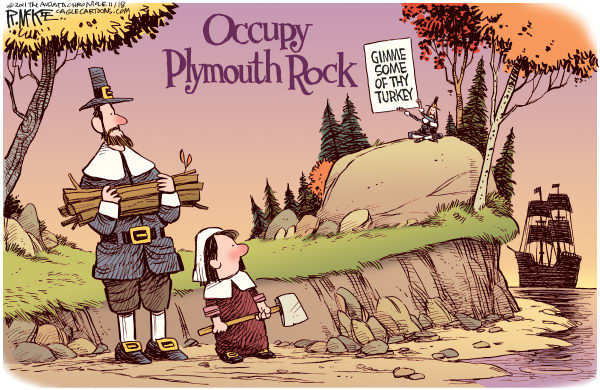
Mike Franc, at Human Events in 2005, identified the real reason for celebration at the first Thanksgiving.
Writing in his diary of the dire economic straits and self-destructive behavior that consumed his fellow Puritans shortly after their arrival, Governor William Bradford painted a picture of destitute settlers selling their clothes and bed coverings for food while others “became servants to the Indians,†cutting wood and fetching water in exchange for “a capful of corn.†The most desperate among them starved, with Bradford recounting how one settler, in gathering shellfish along the shore, “was so weak … he stuck fast in the mud and was found dead in the place.â€
The colony’s leaders identified the source of their problem as a particularly vile form of what Bradford called “communism.†Property in Plymouth Colony, he observed, was communally owned and cultivated. This system (“taking away of property and bringing [it] into a commonwealthâ€) bred “confusion and discontent†and “retarded much employment that would have been to [the settlers’] benefit and comfort.â€
Just how did the Pilgrims solve the problem of famine? In addition to receiving help from the local Indians in farming, they decided allow the private ownership of individual plots of land.
On the brink of extermination, the Colony’s leaders changed course and allotted a parcel of land to each settler, hoping the private ownership of farmland would encourage self-sufficiency and lead to the cultivation of more corn and other foodstuffs.
As Adam Smith would have predicted, this new system worked famously. “This had very good success,†Bradford reported, “for it made all hands very industrious.†In fact, “much more corn was planted than otherwise would have been†and productivity increased. “Women,†for example, “went willingly into the field, and took their little ones with them to set corn.â€
The famine that nearly wiped out the Pilgrims in 1623 gave way to a period of agricultural abundance that enabled the Massachusetts settlers to set down permanent roots in the New World, prosper, and play an indispensable role in the ultimate success of the American experiment.
A profoundly religious man, Bradford saw the hand of God in the Pilgrims’ economic recovery. Their success, he observed, “may well evince the vanity of that conceit…that the taking away of property… would make [men] happy and flourishing; as if they were wiser than God.†Bradford surmised, “God in his wisdom saw another course fitter for them.â€
The real story of Thanksgiving is the triumph of capitalism and individualism over collectivism and socialism, which is the summation of the story of America.

24 Nov 2011

Hat tip to Michael Lawler.
24 Nov 2011
As published in the Massachusetts Centinel, Wednesday, October 14, 1789
24 Nov 2011
Mike Franc, at Human Events in 2005, identified the real reason for celebration at the first Thanksgiving.
Writing in his diary of the dire economic straits and self-destructive behavior that consumed his fellow Puritans shortly after their arrival, Governor William Bradford painted a picture of destitute settlers selling their clothes and bed coverings for food while others “became servants to the Indians,†cutting wood and fetching water in exchange for “a capful of corn.†The most desperate among them starved, with Bradford recounting how one settler, in gathering shellfish along the shore, “was so weak … he stuck fast in the mud and was found dead in the place.â€
The colony’s leaders identified the source of their problem as a particularly vile form of what Bradford called “communism.†Property in Plymouth Colony, he observed, was communally owned and cultivated. This system (“taking away of property and bringing [it] into a commonwealthâ€) bred “confusion and discontent†and “retarded much employment that would have been to [the settlers’] benefit and comfort.â€
Just how did the Pilgrims solve the problem of famine? In addition to receiving help from the local Indians in farming, they decided allow the private ownership of individual plots of land.
On the brink of extermination, the Colony’s leaders changed course and allotted a parcel of land to each settler, hoping the private ownership of farmland would encourage self-sufficiency and lead to the cultivation of more corn and other foodstuffs.
As Adam Smith would have predicted, this new system worked famously. “This had very good success,†Bradford reported, “for it made all hands very industrious.†In fact, “much more corn was planted than otherwise would have been†and productivity increased. “Women,†for example, “went willingly into the field, and took their little ones with them to set corn.â€
The famine that nearly wiped out the Pilgrims in 1623 gave way to a period of agricultural abundance that enabled the Massachusetts settlers to set down permanent roots in the New World, prosper, and play an indispensable role in the ultimate success of the American experiment.
A profoundly religious man, Bradford saw the hand of God in the Pilgrims’ economic recovery. Their success, he observed, “may well evince the vanity of that conceit…that the taking away of property… would make [men] happy and flourishing; as if they were wiser than God.†Bradford surmised, “God in his wisdom saw another course fitter for them.â€
The real story of Thanksgiving is the triumph of capitalism and individualism over collectivism and socialism, which is the summation of the story of America.
25 Nov 2010
Mike Franc, at Human Events in 2005, identified the real reason for celebration at the first Thanksgiving.
Writing in his diary of the dire economic straits and self-destructive behavior that consumed his fellow Puritans shortly after their arrival, Governor William Bradford painted a picture of destitute settlers selling their clothes and bed coverings for food while others “became servants to the Indians,†cutting wood and fetching water in exchange for “a capful of corn.†The most desperate among them starved, with Bradford recounting how one settler, in gathering shellfish along the shore, “was so weak … he stuck fast in the mud and was found dead in the place.â€
The colony’s leaders identified the source of their problem as a particularly vile form of what Bradford called “communism.†Property in Plymouth Colony, he observed, was communally owned and cultivated. This system (“taking away of property and bringing [it] into a commonwealthâ€) bred “confusion and discontent†and “retarded much employment that would have been to [the settlers’] benefit and comfort.â€
Just how did the Pilgrims solve the problem of famine? In addition to receiving help from the local Indians in farming, they decided allow the private ownership of individual plots of land.
On the brink of extermination, the Colony’s leaders changed course and allotted a parcel of land to each settler, hoping the private ownership of farmland would encourage self-sufficiency and lead to the cultivation of more corn and other foodstuffs.
As Adam Smith would have predicted, this new system worked famously. “This had very good success,†Bradford reported, “for it made all hands very industrious.†In fact, “much more corn was planted than otherwise would have been†and productivity increased. “Women,†for example, “went willingly into the field, and took their little ones with them to set corn.â€
The famine that nearly wiped out the Pilgrims in 1623 gave way to a period of agricultural abundance that enabled the Massachusetts settlers to set down permanent roots in the New World, prosper, and play an indispensable role in the ultimate success of the American experiment.
A profoundly religious man, Bradford saw the hand of God in the Pilgrims’ economic recovery. Their success, he observed, “may well evince the vanity of that conceit…that the taking away of property… would make [men] happy and flourishing; as if they were wiser than God.†Bradford surmised, “God in his wisdom saw another course fitter for them.â€
The real story of Thanksgiving is the triumph of capitalism and individualism over collectivism and socialism, which is the summation of the story of America.
26 Nov 2009
As published in the Massachusetts Centinel, Wednesday, October 14, 1789
26 Nov 2009
Mike Franc, at Human Events in 2005, identified the real reason for celebration at the first Thanksgiving.
Writing in his diary of the dire economic straits and self-destructive behavior that consumed his fellow Puritans shortly after their arrival, Governor William Bradford painted a picture of destitute settlers selling their clothes and bed coverings for food while others “became servants to the Indians,†cutting wood and fetching water in exchange for “a capful of corn.†The most desperate among them starved, with Bradford recounting how one settler, in gathering shellfish along the shore, “was so weak … he stuck fast in the mud and was found dead in the place.â€
The colony’s leaders identified the source of their problem as a particularly vile form of what Bradford called “communism.†Property in Plymouth Colony, he observed, was communally owned and cultivated. This system (“taking away of property and bringing [it] into a commonwealthâ€) bred “confusion and discontent†and “retarded much employment that would have been to [the settlers’] benefit and comfort.â€
Just how did the Pilgrims solve the problem of famine? In addition to receiving help from the local Indians in farming, they decided allow the private ownership of individual plots of land.
On the brink of extermination, the Colony’s leaders changed course and allotted a parcel of land to each settler, hoping the private ownership of farmland would encourage self-sufficiency and lead to the cultivation of more corn and other foodstuffs.
As Adam Smith would have predicted, this new system worked famously. “This had very good success,†Bradford reported, “for it made all hands very industrious.†In fact, “much more corn was planted than otherwise would have been†and productivity increased. “Women,†for example, “went willingly into the field, and took their little ones with them to set corn.â€
The famine that nearly wiped out the Pilgrims in 1623 gave way to a period of agricultural abundance that enabled the Massachusetts settlers to set down permanent roots in the New World, prosper, and play an indispensable role in the ultimate success of the American experiment.
A profoundly religious man, Bradford saw the hand of God in the Pilgrims’ economic recovery. Their success, he observed, “may well evince the vanity of that conceit…that the taking away of property… would make [men] happy and flourishing; as if they were wiser than God.†Bradford surmised, “God in his wisdom saw another course fitter for them.â€
The real story of Thanksgiving is the triumph of capitalism and individualism over collectivism and socialism, which is the summation of the story of America.
And it looks like we’re about to receive another lesson of the same kind. For what we are about to receive, may we be truly thankful.
27 Nov 2008

A contemporary reenactment portrays Reverend Robert Hunt leading the first settlers in prayers after coming ashore on May 13, 1607.
The Christian Broadcasting Network relocates the holiday’s origin to a more deserving locale.
In 1619, two years before the colonists arrived in Massachusetts, a band of English settlers landed in Virginia, at what is now known as the Berkeley plantation. History says the travelers immediately fell to their knees to thank God for their safe arrival. Here is a closer look at the role these settlers had in shaping what we know today as Thanksgiving.
Most people think of the Pilgrims on Thanksgiving day: 1622, the Mayflower, Squanto and his tribe sharing a feast with the Puritans at Plymouth Rock.
But the children at Stonebridge School in Virginia present a different picture. With colonial hats and feathered headbands, these children re-enact what it must have been like back in the 1600s, marking the events surrounding the first Thanksgiving at a very different time and place.
It all began on the shores of Cape Henry in Virginia. In 1607, the first English colonists arrived: 105 English men and boys, and 39 sailors, among them the Reverend Robert Hunt. He was the first minister in America. According to Jamestown site historian, Dianne Stallings, he was instrumental in establishing the protestant faith in the new world.
Following a mandate from the king of England, Hunt pitched a cross and led the men in prayer on the beaches of Cape Henry.
“Reverend Hunt would have had the Book of Common Prayer as well as the Bible,†says Stallings. “And this would be a general prayer of thanksgiving that would have been read at that period of time.â€
Titled simply, the “General Thanksgivingâ€, this prayer, in one of it’s various versions , reads as follows:
“Almighty God, Father of all mercies, we thine unworthy servants do give thee most humble and hearty thanks for all thy goodness and loving-kindness to us and to all men.
We bless thee for our creation, preservation, and all the blessings of this life; but above all for thine inestimable love in the redemption of the world by our Lord Jesus Christ, for the means of grace, and for the hope of glory.â€
For two weeks the men combed the shores of the James River, scouting out the perfect place for their new settlement. Finally they decided on Jamestown.
And according to Stallings, the settlers came for three reasons: God, glory, and gold.
“England was very concerned that the protestant faith be established in the new world, and, of course, they were dedicated to the fact that they wanted to Christianize the Indians,†she says.
Perhaps the most famous Indian at the settlement was Pocahontas. Through her the Powhatan Indians and the colonists made peace. She would bring the colonists food, and some historical accounts say she even saved Captain John Smith’s life from her own people. Eventually, Pocahontas was held hostage by the colonists. It was then that she converted to Christianity and married one of the Jamestown leaders, John Rolfe. She was baptized into the Christian name, Rebecca.
Through Pocahontas, the settlers saw their goal of spreading the protestant faith begin to come to fruition. Years later she returned to England with her husband. Sadly, at just 22 years old, she died. It was two years after Pocahontas’ death that another group of English colonists landed in Virginia. After ten weeks at sea, they finally landed here at the Berkeley Plantation. Virginia Historians claim that this is where the real first Thanksgiving took place. The plantation sits just a few miles from the original Jamestown settlement.
“The Virginia Company had directives given to the settlers and the directives were that upon landing, they were to give thanks and every year thereafter make it an annual celebration in thanks to the Lord for a safe passage,†says Barbara Awad, president of the Virginia Thanksgiving Festival.
This was about seventeen months before the pilgrims landed in Plymouth. And while the Pilgrims celebrated with a feast, much like the traditional meal Americans eat on Thanksgiving, the settlers at Berkeley Plantation had a meager meal.
“It wasn’t quite the abundant festival, the cornucopia that we usually see on Thanksgiving,†says Awad.
Historians say their feast included bacon, peas, cornmeal cakes, and cinnamon water. But regardless of the menu, to these settlers, the first Thanksgiving was much more than turkey and pumpkin pie. It was all about prayer.
27 Nov 2008
Mike Franc, at Human Events in 2005, identified the real reason for celebration at the first Thanksgiving.
Writing in his diary of the dire economic straits and self-destructive behavior that consumed his fellow Puritans shortly after their arrival, Governor William Bradford painted a picture of destitute settlers selling their clothes and bed coverings for food while others “became servants to the Indians,†cutting wood and fetching water in exchange for “a capful of corn.†The most desperate among them starved, with Bradford recounting how one settler, in gathering shellfish along the shore, “was so weak … he stuck fast in the mud and was found dead in the place.â€
The colony’s leaders identified the source of their problem as a particularly vile form of what Bradford called “communism.†Property in Plymouth Colony, he observed, was communally owned and cultivated. This system (“taking away of property and bringing [it] into a commonwealthâ€) bred “confusion and discontent†and “retarded much employment that would have been to [the settlers’] benefit and comfort.â€
Just how did the Pilgrims solve the problem of famine? In addition to receiving help from the local Indians in farming, they decided allow the private ownership of individual plots of land.
On the brink of extermination, the Colony’s leaders changed course and allotted a parcel of land to each settler, hoping the private ownership of farmland would encourage self-sufficiency and lead to the cultivation of more corn and other foodstuffs.
As Adam Smith would have predicted, this new system worked famously. “This had very good success,†Bradford reported, “for it made all hands very industrious.†In fact, “much more corn was planted than otherwise would have been†and productivity increased. “Women,†for example, “went willingly into the field, and took their little ones with them to set corn.â€
The famine that nearly wiped out the Pilgrims in 1623 gave way to a period of agricultural abundance that enabled the Massachusetts settlers to set down permanent roots in the New World, prosper, and play an indispensable role in the ultimate success of the American experiment.
A profoundly religious man, Bradford saw the hand of God in the Pilgrims’ economic recovery. Their success, he observed, “may well evince the vanity of that conceit…that the taking away of property… would make [men] happy and flourishing; as if they were wiser than God.†Bradford surmised, “God in his wisdom saw another course fitter for them.â€
The real story of Thanksgiving is the triumph of capitalism and individualism over collectivism and socialism, which is the summation of the story of America.
27 Nov 2008
Where Massachusetts goes, California follows.
KABC-TV:
There is a costume controversy in Claremont. The school board changed a decades-long tradition of students dressing up to celebrate Thanksgiving, and some parents are outraged.
The tradition involves kindergarten students at Mountain View and Condit elementary schools. The kids usually dress up in costumes. Each school takes turns dressing up as pilgrims and Indians, and then join together for a Thanksgiving feast.
This year, however, there is a big change. The school board decided to continue holding the feast, but they are not allowing the students to dress up. The board is concerned the Indian costumes may have negative connotations.
“Out of respect for the native American heritage, we have made the decision to ask the children not to dress up,” said Devon Freitas, assistant superintendent for human services, Claremont Unified School District.
That decision has infuriated many parents. Some of them have ignored the school board and dressed their kids up anyway.
2:23 video
27 Nov 2008
“Plimoth” Plantation advertises itself as portraying:
Plymouth as it was in the 17th century
Native Wampanoag and Colonial English men and women living their lives, as if it were the 1620s. It is living off the land. It is cooking over the fire. It is managing conflict and navigating political relations in an uncertain time. See it, smell it, hear it and experience it here.
That experience is complete with 21st century political correctness doled out by professional “Native Americans,” the kind of people who leave suburban split levels, not wikiyups, get into automobiles, not onto ponies, and go out to work as administrators in non-profit organizations equipped with degrees from state universities, rather than hoeing corn.
The guy who used to mow my yard in Connecticut also had three hundred year old New England descent, but he didn’t make his living on the strength of it or parade grievances about the cruel Episcopalians whose remote ancestors made England disagreeable enough for his Puritan forbears to feel obliged to emigrate to the New England wilderness.
CNS News:
A nine-year-old girl was recently asked to remove her “Indian†costume before entering the Wampanoag Homesite of the Plimoth Plantation, a historical site that allows visitors to experience Plymouth, Mass., as it was in the 17th century.
The outdoor museum features a 1627 English village beside a Wampanoag home site. The purpose of the museum is to educate visitors (school-children and adults) about what happened between the Native Americans and the colonists, especially during the first Thanksgiving.
The nine-year-old was one of thousands who flock to the colonial museum during the Thanksgiving season. She dressed as an Indian and her friend dressed as a pilgrim to celebrate the occasion.
Linda Coombs, associate director of the Wampanoag Indigenous Program, asked the girl to remove her homemade beaded costume before visiting the site, reducing the child to tears and upsetting her mother, the Boston Globe reported on Nov. 24.
“Native people find it offensive when they see a non-native person dressed up and playing Indian. It’s perceived as us being made fun of,†Coombs told CNSNews.com.
Coombs said she understands it was not the girl’s intention to be offensive – that she was only trying to “honor the Indians.â€
“I could see that she’d put a lot of effort into making this dress and that it meant something to her … I could see by taking this dress off, I was dashing this whole thing that was going on in her mind,†Coombs said.
So she gave her a necklace from the gift shop in exchange.
“I wanted to acknowledge that she was giving up something that meant something to her and that I could appreciate everything she was feeling,†said Coombs. “Typically, in our culture, you give something away to show you appreciate what someone else has given up. And I wanted to mark that moment with her.â€
Coombs said good intentions do not matter because she and the other Native staff members perceive the costumes as mockery before the wearer has a chance to explain his or her intent.
“Costumes are offensive because of what has happened in history – the Hollywood pseudo Indians, the Italian actors playing Indians, the crappy dress they put them in, the Halloween costumes. When other people dress up as Native people it’s offensive, period,†Coombs said.
She compared people wearing Native American costumes to white entertainers who put on blackface in old minstrel shows.
Your are browsing
the Archives of Never Yet Melted in the 'Thanksgiving' Category.
/div>

Feeds
|