Category Archive 'US Military'
25 Feb 2007


The London Times tells us that the Pentagon is riddled with pacifists, cowards, and traitors.
Some of America’s most senior military commanders are prepared to resign if the White House orders a military strike against Iran, according to highly placed defence and intelligence sources.
Tension in the Gulf region has raised fears that an attack on Iran is becoming increasingly likely before President George Bush leaves office. The Sunday Times has learnt that up to five generals and admirals are willing to resign rather than approve what they consider would be a reckless attack.
“There are four or five generals and admirals we know of who would resign if Bush ordered an attack on Iran,” a source with close ties to British intelligence said. “There is simply no stomach for it in the Pentagon, and a lot of people question whether such an attack would be effective or even possible.”
A British defence source confirmed that there were deep misgivings inside the Pentagon about a military strike. “All the generals are perfectly clear that they don’t have the military capacity to take Iran on in any meaningful fashion. Nobody wants to do it and it would be a matter of conscience for them.
“There are enough people who feel this would be an error of judgment too far for there to be resignations.”
Can you imagine the unmitigated gall of more than one US military officer confiding a lack of confidence in the elected civilian administration they are serving to foreign journalists?
Cowardice in the face of the enemy has been traditionally treated as a capital offense by the military. These generals could be court-martialed, then taken out, stood up against the wall, and shot.
But, from the point of view of the good of the service, their separation ought to be regarded as so significant a benefit that I’d even say their lives should be spared, and they should be permitted quietly to resign.
01 Feb 2007
Collected by Austin Bay.
Examples:
Air jockey: Fighter pilot or a fixed-wing pilot. On rare occasions, might refer to a helicopter pilot.
Ali Baba: Slang for enemy forces. Originated in the Persian Gulf War.
Battle rattle: Slang for combat gear. “Full battle rattle” means wearing and carrying everything (helmet, body armor, weapons).
Beltway clerk: A derisive term for a Washington political operative or civilian politician.
Bilat: A bilateral conference between coalition military units and local people. (“We’re going on a bilat to discuss the security situation with Haji.”)
Blackwater: Specifically, a private security firm operating in Iraq. Used as slang, can mean any private security firm. “Gone to Blackwater” indicates that a soldier quit the armed services and went to work for a private security firm.
Blue canoe: Slang for a portable toilet.
Read the whole thing.
28 Jan 2007
Bill Roggio thinks the Karbala raid leading the kidnapping-murder of five US soldiers may very possibly have an Iranian operation performed in retaliation for recent US raids on Iranian embassies in Baghdad and Irbil.
This raid required specific intelligence, in depth training for the agents to pass as American troops, resources to provide for weapons, vehicles, uniforms, identification, radios and other items needed to successfully carry out the mission. Hezbollah’s Imad Mugniyah executed a similar attack against Israeli forces on the Lebanese border, which initiated the Hezbollah-Israeli war during the summer of 2006…
Mahawil (where abandoned vehicles & the victim’s bodies were found) is in Babil province, about 27 miles directly west of Karbala. While it is impossible to prove, the attackers may have been making a bee-line towards the Iranian border.
The Karbala raid makes sense in light of the U.S. raids on the Iranian diplomatic missions in Baghdad and Irbil, where Iranian Qods Force agents were captured, along with documentation that divulged Iran’s involvement with and support of Shia death squads, the Sunni insurgent, and al-Qaeda in Iraq and Ansar al-Sunnah. Five Iranians from the Irbil raid are still in U.S. custody, and captured U.S. soldiers would provide for excellent bargaining chips
IF it is confirmed that Iran’s Qods Force was responsible, the news that the United States has authorized the death or captured of Iranian agents inside Iraq, as well as in Afghanistan and Lebanon makes all the more sense.
Perhaps they were trying to carry the US soldies over the border to Iran, and abandoned the vehicles and killed their prisoners because their pursuers got too close, and they considered it too risky to try to reach the border.
11 Dec 2006
The leftwing journalism side of the Wall Street Journal has a sob story today about the poor Army running out of money under the strain of expenses of combat operations in Iraq.
Would you just look at these examples?
It may seem hard to believe that a country which allocated $168 billion to the Army this year — more than twice the 2000 budget — can’t cover the costs of the wars in Iraq and Afghanistan. But the two pillars of the Army, personnel and equipment — both built to wage high-tech, firepower-intensive wars — are under enormous stress:
The cost of basic equipment that soldiers carry into battle — helmets, rifles, body armor — has more than tripled to $25,000 from $7,000 in 1999.
The cost of a Humvee, with all the added armor, guns, electronic jammers and satellite-navigational systems, has grown seven-fold to about $225,000 a vehicle from $32,000 in 2001.
Those M4 carbines cost $1382 a piece! And before adding another $8800 worth of sights! Let’s drop those ugly suckers, and buy some nice new Ruger Mini-14 Ranch Rifles in the stainless steel synthetic stock configuration. We can get them retail for $600 a pop, and I bet if we buy a few hundred thousand we can probably get some kind of discount. These rifles shoot the same identical cartridge, and even come with useable sights.
True, they won’t each and every one have nearly nine thousand dollars worth of high-tech infrared shoot-them-in-the-dark sighting equipment, but we could probably get by well enough just purchasing that level of technology for a small number of snipers. Nobody had any of that kind of equipment in WWII and we still won.
If Ruger is not able to supply every Ranch Rifle we need tomorrow, we can just temporarily rough it with the same AK-47s we must have captured by the box car load from the Iraq Army, and which you can pick up cheap in any souk or bazaar in the Middle East. AK-47s are notoriously rugged and reliable.
$225,000 Humvees? It seems impossible to suppose that a large portion of the US Army could get by for basic vehicular transportation on lesser SUVs. How about some nice Ford Expeditions @$27,042 – $38,702. We can pull out all the stops, but the Eddie Bauer model with Convenience Package and power lift gate, add a terrific stereo and soup up the air conditioning, and still come out way ahead.
Looking at that picture of the contemporary soldier, tricked out with every high tech gee gaw anybody can think of. The thought inevitably comes to mind that we are not fighting technically advanced adversaries from Outer Space, or the German Army. We don’t have to achieve the absolute state of the art to be technically far ahead of our Islamic enemies. This conflict features us against people from the Middle Ages with guns. Kalashnikovs, RPGs, IEDs hooked up to washing machine timers are as high-tech as they get.
When you think about what the US Army is spending, we could probably just take out Mafia contracts on all our jihadi and insurgent adversaries on an individual basis, and still come out ahead.
And there is another obvious, and more realistic, alternative: just take all counter-insurgency operations away the Army (with its bloated and over-luxurious TO&E), and turn them over to the Marine Corps.
27 Nov 2006
Wit and wisdom from the military manuals and flight records:
A slipping gear could let your M203 grenade launcher fire when you least expect it. That would make you quite unpopular in what’s left of your unit. — Army’s magazine of preventive maintenance
Aim towards the enemy. — Instruction printed on U.S. rocket launcher
When the pin is pulled Mr. Grenade is not our friend. — U.S. Marine Corps
It is generally inadvisable to eject directly over the area you just bombed. — U.S. Air Force Manual
Whoever said the pen is mightier than the sword obviously never encountered automatic weapons. — General MacArthur
Five-second fuses only last three seconds. — Infantry Journal
If your attack is going too well, you’re walking into an ambush. —Infantry Journal
No combat-ready unit has ever passed inspection. —Joe Gay
Any ship can be a minesweeper. Once. — Unknown
The three most common expressions (or famous last words) in aviation are: “Why is it doing that?”, “Where are we?” and “Oh S…!”
Airspeed, altitude, and brains. Two are always needed to complete the flight successfully.
If something hasn’t broken on your helicopter, it’s about to.
Basic Flying Rules: Try to stay in the middle of the air. Do not go near the edges of it. The edges of the air can be recognized by the appearance of ground, buildings, sea, trees, and interstellar space. It is much more difficult to fly there.
Hat tip to ES.
——————————————————————————————————

There are many new ways to make your company more efficient online. Business email hosting is one way to streamline your business. A hosted exchange is another great idea for a small or big company.
01 Nov 2006

And conservative talk radio was alive today (I was out running errands a lot) with the wives of soldiers and marines serving in Iraq, seething with indignation at Kerry’s slur. Sean Hannity compared Kerry’s “I botched a joke aimed at Bush” explanation to his explanation that “it was somebody else’s medals he threw away,” and to Kerry’s “I don’t own an SUV. The family has it.”
It’s true. Kerry has built up an impressive record of obvious and shameless lies, brazenly advanced whenever he finds himself in trouble. How anyone can choose to believe Kerry over his fellow Swift Boat Veterans about his service in Vietnam is beyond me.
Hat tip to LGF.
N.Z. Bear puts his finger on just why Kerry got into so much trouble for what was just a passing remark.
Why are some folks being so sensitive about Kerry’s remarks — and why are they right to be so?
The key phrase we’re looking for here is “never again”. If people like Kerry — and indeed Kerry himself — had not been responsible for destroying the morale and reputation of the American military after Vietnam, we wouldn’t have to be sensitive to jokes like his failed one. But they did, and we do, because we absolutely cannot allow what happened to the soldiers of that era to begin happening to those of ours.
And the source here matters. If John McCain had made Kerry’s remarks, we’d be astounded, but McCain’s history would argue in his favor and we’d grant him the benefit of the doubt. But Kerry’s history does the opposite: his past exploits and efforts to drag the reputation of American soldiers through the mud are absolutely relevant and mean he doesn’t get to pretend that nobody could ever think he’d say something denigrating about the military. If you’ve never been known to raise your hand in anger towards a woman, you can crack a joke about beating your wife and get away with it (even if you shouldn’t). But if you’ve got a history of beating your wife, you don’t get to make jokes about beating your wife without bringing the full weight of society’s suspicion and opprobrium down on you.
31 Oct 2006
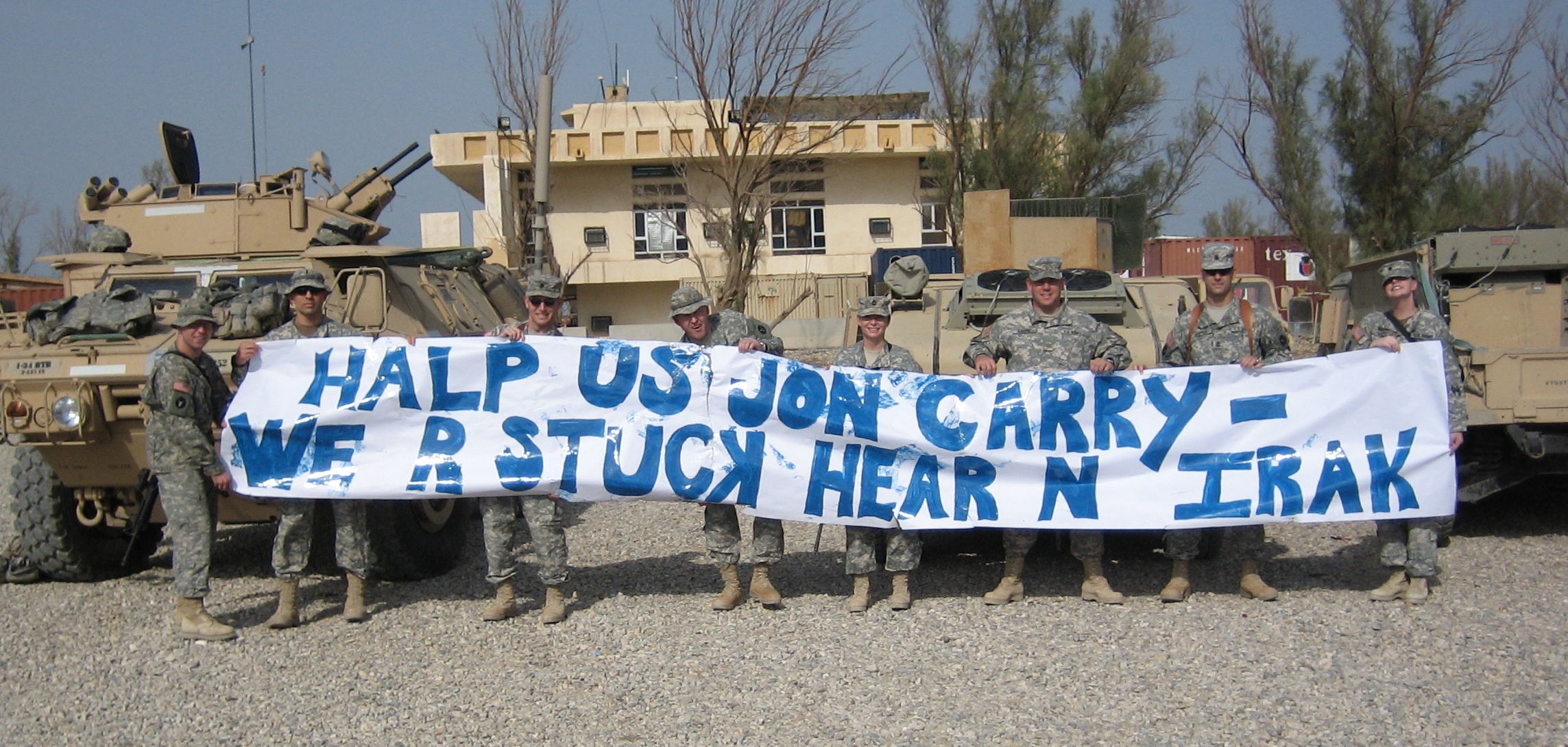
John Kerry is a smooth article, but the soft life of ultra-privilege has taken its toll. Yesterday, while bloviating away before a youthful audience (in typical politico fashion) on the desirability of education, Kerry spectacularly put his foot in it.
video
And he did this days before a bitterly contested election deciding control of both houses of Congress.
Naturally, his adversaries behaved precisely as John Kerry would have in their position, seeing a floundering adversary in trouble, they proceeded to hand him a rock.
Republicans criticized his remark, and demanded an apology. Kerry fought back, attempting a clever save by claiming his condescending reference was really aimed at President Bush. Right, John. Two points for chutzpah.
Allahpundit has a nice summary of the truckload of bricks landing on the deserving Mr. Kerry.
Well, he is a fellow Yalie, so I feel obliged to offer Senator Kerry a little advice: apologize; reveal that you were molested as a child and consequently have self-esteem issues leading to your belittling all your fellow Americans who did not attend St. Paul’s, become president of the Yale Political Union, and get tapped for Bones; then announce that you will at once be entering rehab.
06 Oct 2006

The US Air Force reports a family story from Iraq.
Traditions run deep in the military, and for this father and daughter, traditions are what brought them together in Iraq.
Col. Steven Dreyer, 4th Expeditionary Air Support Operations Group commander, at Camp Victory, Iraq, reunited with his youngest daughter, 1st Lt. Kathrine Dreyer, 777th Expeditionary Airlift Squadron, Balad AB, Iraq.
The visit marked not only the end of Colonel Dreyer’s final deployment, but also the beginning of Lieutenant Dreyer’s first deployment. During the visit, the colonel presented his daughter with the family’s American flag.
“This flag symbolizes our family’s dedication to serving in the military,” said the colonel, who enlisted in the Marines in 1970. “I have carried this flag during my deployments over the years; my oldest daughter, SSgt. Kristine Dreyer, carried it to Iraq in 2003, and now my youngest daughter is stepping up to continue the tradition.”
The flag, originally flown in front of the home of Colonel Dreyer’s father, a retired Army WWII and Vietnam veteran, has accompanied the colonel on every deployment.
25 Sep 2006
Jim Dunnigan’s Strategy Page reports:
September 24, 2006: Earlier this year, the U.S. Department of Defense began a search for a new .45 caliber combat pistol. Now that search has been mysteriously called off. The Department of Defense has announced, without any explanation, that is no longer looking for a new combat pistol.
Big mistake.
24 Sep 2006

Carl Philipp Gottfried von Clausewitz (June 1, 1780 — November 16, 1831)
Tony Corn, in Policy Review, waltzes dazzlingly through the Strategy curriculum in the course of a hyper-caffeinated diatribe quarreling with the ascendancy in contemporary American military culture of the viewpoint of that old rascal Carl von Clausewitz.
Some samples:
Strategism is synonymous with “strategy for strategy’s sake,” i.e., a self-referential discourse more interested in theory-building (or is it hair-splitting?) than policy-making. Strategism would be innocuous enough were it not for the fact that, in the media and academia, “realism” today is fast becoming synonymous with “absence of memory, will, and imagination”: in that context, the self-referentiality of the strategic discourse does not exactly improve the quality of the public debate. At its worst, strategism confuses education with indoctrination, and scholarship with scholasticism; in its most extreme form, it comes close to being an “intellectual terrorism” in the name of Clausewitz.
and
With its unresolved tensions between its theologia speculativa and theologia positiva parts, On War, to be sure, is ideally suited for endless, medieval-like scholastic disputatio. But while Clausewitz-Centered Chatter (ccc) can be entertaining (how many ayatollahs can dance on a Schwerpunkt?), there are undeniable opportunity costs for an officer corps already “too busy to learn.”
A decade ago already, U.S. Army War College professor Steven Metz remarked: “Like adoration for some family elder, the veneration heaped on Clausewitz seems to grow even as his power to explain the world declines. He remains an icon at all U.S. war colleges (figuratively and literally) while his writings are bent, twisted, and stretched to explain everything from guerilla insurgency (Summers) through nuclear strategy (Cimbala) to counternarcotrafficking (Sharpe). On War is treated like holy script from which quotations are plucked to legitimize all sorts of policies and programs. But enough! It is time to hold a wake so that strategists can pay their respects to Clausewitz and move on, leaving him to rest among the historians.”
and
For the neutral observer, then, the problem with the “neocon chickenhawks” is not so much that they lacked an understanding of irregular warfare13 as that they seriously underestimated the sterilizing effect, on the American military mind and over a generation, of three dozen Clausewitzian cicadas for whom counterinsurgency was synonymous with “derisive battle.” A contrario, the intellectual agility since the end of the Cold War of a Marine Corps largely exempt from the Clausewitz regimen (from General Krulak to General Mattis) would tend to prove that the problem is not with the officer corps itself, but with the (largely civilian) Clausewitzian educators. If the Clausewitzian text is indeed so filled with fog and friction, if On War is so hard to teach from that even most educators can’t teach it properly, then surely thought should be given to retiring Clausewitz, or the educators — or both.
The “cognitive dissonance” among Clausewitizians consists in maintaining the most dogmatic approach concerning Clausewitz as the True North, while deploring — like Gray — that “American military power has been as awesome tactically as it has rarely been impressive operationally or strategically…. the German armed forces in both world wars suffered from the same malady” (as if the two were somehow unrelated). If, as Gray rightly points out, “strategy is — or should be, the bridge that connects military power with policy,” what kind of a bridge is On War, which devotes 600 pages to military power and next to nothing to policy? Between the “strategy for strategy’s sake” of the Clausewitzians, and the “tacticisation of strategy” of Network-Centric Warriors, genuine strategic thinking seems to be forever elusive — missing in action as much as in reflection.
Why such an irrational “resistance” (in the Freudian sense) on the part of military educators? After all, it does not take an Einstein to realize that, from Alexander the Great to Napoleon, the greatest generals for 20 centuries had one thing in common: They have never read Clausewitz. And conversely, in the bloodiest century known to man, the greatest admirers of Clausewitz also have had one thing in common: They may have won a battle here and there, but they have all invariably lost all their wars. One suspects that the Prussian Party is in fact not so much interested in meditating Clausewitz (their endless exegeses of Clausewitz in the past 30 years has yielded no new insight beyond the interpretations of a Raymond Aron and a Carl Schmitt) as such, as in maintaining a “Prussian folklore” in the U.S. military. One can understand their hostilite de principe to the idea of teaching irregular warfare: from Marshall Bugeaud to General Beaufre, from Marshall Gallieni to Marshall Lyautey, from Colonel Trinquier to Lieutenant Galula, the majority of the leading theoreticians on the subject happen to be, not Prussian but — horresco referens — French. And as is well-known by anyone who gets his military history from Hollywood rather than Harvard, the French, since 1918 at least, have proven utterly incapable of fighting.1
Ironically, and Prussian fantasies notwithstanding, what the post-Gulf War American Army has come to resemble is the post-World War i French Army: In both cases, victory breeds complacency, and this in turn can lead to a solid but unimaginative army capable of holding its own against an equally solid but unimaginative opponent — but is not necessarily a match for an innovative military, be it in the form of the German “blitzkrieg” yesterday or Chinese “unrestricted warfare” tomorrow. No wonder that a particularly bold usmc colonel felt compelled recently to argue that the “Shock and Awe” doctrine could prove to be America’s twenty-first-century Maginot Line.
Read, and savor, the whole thing.
————————-
Hat tip to Karen Myers.
20 Sep 2006
Jim Dunnigan’s Strategy Page reports the Judge Advocate General Corps’ military lawyers have grown far more numerous and influential, and that far too many of its members are on the wrong side:
Big brawl going on in the Pentagon between the JAGs (Judge Advocate General, the lawyers) and the operators (combat and intelligence types.) JAGs have become more important, decade by decade, over the last sixty years. This has happened in parallel with the growing influence of lawyers in civilian society. However, lawyers doing what they do has brought them into conflict with the operators. For example, the war on terror has created a murky legal area for captured terrorists. Many JAGs want to give the captured terrorists most of the privileges of civilians, or even soldiers, accused of criminal acts. This creates a conflict with the combat and intel officers, who do not want to give the terrorists access to the identity of informants within terrorist organizations, or other information they have on the terrorists, and how they got it. In the civilian world, the prosecution has to let the defense know all this stuff. That’s why there’s a witness protection program, or cases where the government will not prosecute in order to preserve valuable intel. But such procedures don’t work when most of your witnesses are living in a combat zone, and many of your intelligence collection techniques will be worthless if the enemy knows what they are, putting your own troops at greater risk.
On top of all this, the size of the JAG force has grown some ten percent since the end of the Cold War, while everyone else has shrunk by about a third. As a result, the senior JAGs in each service wants to be three star generals, instead of the current two star.
Now the JAGs are aware of the circumstances under which U.S. troops are fighting, and the importance of OPSEC (Operational Security, keeping info about your activities from the enemy). Even so, many JAGs seem to lose their perspective, and advocate strongly for giving the terrorists the information. Operators believe the JAGs are grandstanding, especially by saying one thing to uniformed people, and something else to the media and Congress. The situation has divided the JAG community as well, and it’s getting ugly.
20 Sep 2006
Lindsey Graham (R-SC) has got to be an idiot. AP reports that Graham said:
If it‘s seen that our country is trying to redefine the Geneva Convention to meet the needs of the CIA, why can‘t every other country redefine the Geneva Convention to meet the needs of their secret police?” Graham asked.
The entire point of the Geneva Conventions is reciprocity. A signatory only promises to take prisoners, treat them decently, not use germ warfare or poison gas, not because they are trying to prove who is more humanitarian than whom, but merely so that their own troops will enjoy the decent treatment and the enemy’s restraint.
But our enemies, in recent years, have rarely been civilized European states, like Germany, who are signatories. Our enemies lately have been terrorists and illegal combatants, who simply torture, murder, and mutilate the remains of any Americans so unfortunate as to fall alive into their hands.
It is the misapplication of the Geneva Convention, and the unwarranted extension of its privileges to latrunculi (pirates and brigands), which jeopardizes US troops, by preventing just punishment for violation of the customs and usages of war. Obviously, the way you protect your own troops is to deny Geneva Convention protections to those who do not live up to its prescriptions, not by giving away Geneva Convention status to to our adversaries, however they choose to behave.
“Oh, I say, old boy, go right ahead and kill every prisoner out of hand. Use poison gas and germ warfare, if you like. Butcher all the non-combatants you please. But we Americans are simply too good, and fine, and pure to stoop to mistreating you. Keep the secret of the location of the diabolical device which will blow up one of our major cities, and kill a hundred thousand Americans. We certainly won’t beat it out of you.”
Your are browsing
the Archives of Never Yet Melted in the 'US Military' Category.
/div>

Feeds
|