Category Archive 'Yale'
26 Feb 2017


Yale Classmate Seattle Sam writes:
I created a course that I think will be in next year’s Yale course catalog.
Math for the Social Justice Major
Mathematics was devised by old white men who sought to oppress the uneducated masses. In this course we will explore a more empathetic approach to the subject.
The course will explore questions such as:
How does the number 6 make you feel?
If John has 6 marbles and Sue has 2, isn’t that unfair?
How can there be any “incorrect†answers?
Isn’t identifying a number as “positive†or negative†stereotyping?
If you identify with 5 more than 4, why shouldn’t that be a solution to 2+2=?
What did Euclid know and when did he know it?
Isn’t a null set non-inclusive?
What should you do if the solution to an equation make you feel unsafe?
Shouldn’t we just deem the Parallel Postulate proved?
What’s the point of carrying pi out to more than two decimals?
Aren’t < and > judgmental symbols?
Who are you to determine that a fraction is improper?
Why do you think prime numbers have only a token even member?
Why shouldn’t an inverse tangent have the same value as a cosine?
Aren’t right angles reactionary?
Are there really any absolute values?
Why should binomials and polynomials be considered deviants?
Isn’t a Real Number just your perception?
Just because a number can’t be expressed as a ratio of integers, why should it be called irrational?
17 Feb 2017

Leah Libresco Sergeant Y’11 contemplates Yale’s renaming of Calhoun College, and observes that, in a peculiar way, the Jacobins and their toadies are really honoring John C. Calhoun.
Late last week, Yale announced that it would remove the name of John C. Calhoun from one of its residential colleges—but clarified that the name would not be expunged wherever it was literally written in stone as part of the building’s architecture. While the college will officially bear the new name of Grace Hopper College, honoring a pioneering computer scientist and veteran, to chisel off Calhoun’s name would be to neglect the “obligation not to efface the history.†(It would be expensive, to boot.)
Other than the physical presence of the name, there’s little else to erase about Calhoun. The drawn-out fights (and serial committees) questioning the appropriateness of Calhoun’s name miss how little tradition exists to be expunged—in Calhoun’s namesake college, or in any of the other Yale colleges.
When I was an undergraduate, John C. Calhoun went largely unmentioned and unthought of in residential college life. If the college had instead been named (as a puckish friend suggested) for William Barron Calhoun (Yale class of 1814, a lawyer and politician from Massachusetts, ardent opponent of slavery), nothing about the day-to-day life of the college would have been different.
Yale’s residential colleges derive very little personality from their namesakes, or from anything else. Freshmen are assigned to them randomly, which prevents the colleges from developing reputations (as “the arty one†or “the sporty oneâ€). And Yale’s goal in recent years has been to homogenize the residential colleges even further, pooling money that alumni had given to their own colleges and distributing it equally, so that no college may have more or do more than another. …
Why have a namesake at all, if the college is not to be colored by his or her character? In my own college, Jonathan Edwards, there was never a mention of the Puritan preacher’s theology—except that our intramural team was called the Spiders, a reference to his “Sinners in the Hands of an Angry God†sermon. Jonathan Edwards’s theology exists for J.E. students only as a quaint, even comical, historical artifact. Why give a man the trappings of honor without ceding him any respect?
John C. Calhoun, in being removed, was awarded an odd sort of honor: His ideas were treated as relevant and dangerous. …
13 Feb 2017
Some News Agency reported yesterday:
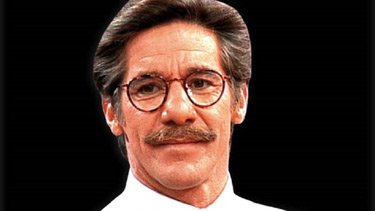
Fox News personality Geraldo Rivera says he resigned from a voluntary position at Yale University after the school decided to change the name of a residential college that honors a slavery supporter.
Rivera said Sunday on Twitter that he resigned as an associate fellow of Calhoun College. He said the position was an honor “but intolerant insistence on political correctness is lame.”
Calhoun College was named after 19th century alumnus and former Vice President John C. Calhoun, an ardent supporter of slavery. After years of debate, Yale announced Saturday it is renaming the college after trailblazing computer scientist Grace Murray Hopper.
Yale said in a statement Sunday that it respected Rivera’s decision, but said its choice to rename the college was based on principle, not political correctness.
We might have saved John Calhoun’s college for him if we had just managed to convince Peter Salovey that Calhoun was actually a Muslim.
See: Georgetown Prof Defends Islamic Slavery
12 Feb 2017
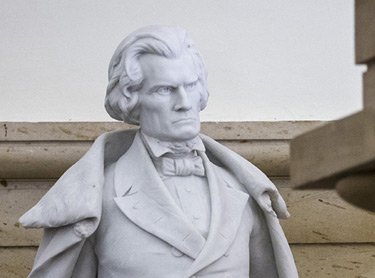
Detail, statue of John C. Calhoun in U.S. Capitol.
The little bolsheviks at the Oldest College Daily gleefully report that the inevitable has happened.
Yale President Peter Salovey and the other invertebrates making up the Yale Corporation on Saturday acted upon the recommendation of Salovey’s hand-picked committee of SJWs and re-named Calhoun College. In future, the Yale residential college formerly bearing the name of the 19th century statesman holding the highest rank in American Government of any deceased Yale graduate at the time the original ten colleges were named will be renamed in favor of Grace Hopper, a black* female who attended Yale Graduate School, taught Mathematics at Vassar, and then served in the Navy Reserve.
Yale’s traditional primary emphasis on the undergraduate college, in 1930, would have excluded any mere Graduate School alumn from consideration for such an honor, but Peter Salovey himself went to Stanford and only attended Yale grad school. Under Salovey, two newly-built residential colleges were recently named for Ben Franklin, whose only connection to Yale was his receipt of an honorary degree, and for some black lesbian (whom nobody not a communist had ever heard of) who went to Yale Law School.
Poor old John Calhoun has been singled out as an exceptional advocate of Slavery by today’s Radical Activist Left based on their hyper-simplified Howard-Zinn-comic-book view of American history. They haven’t, so far, figured out that Elihu Yale traded slaves, that Reverend Davenport owned slaves, that Samuel F.B. Morse was a keener defender of Slavery than John Calhoun, that Benjamin Silliman‘s Yale tuition was raised by the sale of some slaves, that Bishop Berkeley has a college because he kindly gave Yale a plantation equipped with slaves, and so on.
What is important about this farce is the tragic fact that both the Yale President and the Yale Corporation have proven themselves both too cowardly and too intellectually nugatory to stand up to the childish demands of the activist campus mob. They feel themselves obliged to follow the lead, and to take moral instruction, from the Radical Left simply, in the final analysis, because the Left has strong moral opinions, and they, “men with empty chests,” as C.S. Lewis put it, have none at all.
God help Yale, God help America, when the highest of places in the national establishment are occupied by such completely useless nonentities and poltroons.
—————————–
Correction: Grace Hopper wasn’t black, merely female. I was misled by her photograph in old age. Thanks to Joel Pomerantz.
04 Feb 2017

John Caldwell Calhoun (1782-1850), Yale Class of 1804, 7th Vice President of the United States 1825-1832.
Peter Salovey’s hand-picked committee of Social Justice Warriors has deliberated and, what do you know? They decided that John C. Calhoun should be singled out among all nine slave-owner and slavery defender namesakes of three quarters of the original twelve Yale residential colleges for elimination.
Oldest College Daily:
A University task force has recommended that Calhoun College be renamed, according to Yale officials with knowledge of the group’s report.
The recommendation from the task force, which was charged with applying the University’s newly created principles on renaming to the Calhoun debate, positions the Yale Corporation to rename the college when it meets the weekend of Feb. 10 and 11.
University President Peter Salovey formed the Calhoun task force in December, after the Committee to Establish Principles on Renaming released its report. The task force consisted of two faculty members, history professor John Gaddis and English and African American Studies professor Jacqueline Goldsby GRD ’98, and one alumnus, G. Leonard Baker ’64. Both Gaddis and Goldsby signed a faculty petition last spring calling for the renaming of Calhoun, named after slavery proponent John C. Calhoun, class of 1804.
On Jan. 13, the task force submitted its recommendation — which came in the form of a report running less than 10 pages — to Salovey, who will present it to the Corporation at the February meeting.
Last month, Salovey told the News that he did not plan to release the recommendation until after that meeting. Salovey was not involved in the task force’s deliberations, although he did have some input on the final draft of the report.
“The task force did their work independently, and their analysis and recommendations are their own,†Salovey said in January. “They gave me the courtesy of letting me see a next-to-final draft of their report, and make some comments. But my comments to them were really only about sort of clarifying the way their findings were expressed.â€
If the Corporation accepts the task force’s recommendation, the University trustees would be voting to reverse their decision last April to keep Calhoun’s name. The April renaming decision incited months of student and faculty backlash, and helped unite Yale activists and New Haven community members in a growing “change the name†movement.
Last August, primarily in response to faculty criticism of the decision to keep the name of Calhoun, Salovey charged the CEPR with outlining broad guidelines for all renaming disputes at the University, starting with Calhoun. The committee released its 24-page report on Dec. 2, calling on administrators to consider historical context as they determine whether the legacies of controversial namesakes like Calhoun justify renaming campus buildings.
Vice President for Communications Eileen O’Connor declined to comment on the nature of the task force’s recommendation, but said the Corporation will decide the Calhoun issue at its meeting later this month.
“We have a process, we’re following the process, and we’ll take all the information into account when we make a decision in the best interests of the University,†O’Connor said.
Why stop there? Roger Kimball asked last August in the WSJ:
I have unhappy news for Mr. Salovey. In the great racism sweepstakes, John Calhoun was an amateur. Far more egregious was Elihu Yale, the philanthropist whose benefactions helped found the university. As an administrator in India, he was deeply involved in the slave trade. He always made sure that ships leaving his jurisdiction for Europe carried at least 10 slaves. I propose that the committee on renaming table the issue of Calhoun College and concentrate on the far more flagrant name “Yale.â€
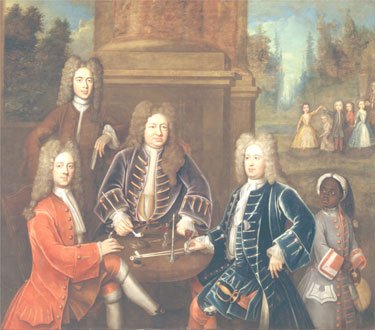
Elihu Yale had a little black page.
23 Jan 2017

South Court of Berkeley College, where Karen and I used to live.
Judge Jose Cabranes took a public stand against Yale’s drift toward PC Totalitarianism
Writing for the Yale Law & Public Public Review (via CampusReform), US Circuit Judge Jose Cabranes (who was previously Yale’s general counsel) referred to Encounter Books’ recent decision to republish copies of the Woodward Report, a Yale document affirming its commitment to freedom of expression. In 1975, the university adopted the report as official school policy.
Cabranes says that their decision to reprint the report was a response to the institution’s fading commitment to its contents. Last year, Yale students petitioned to abolish its course on “Major English Poets,†which has existed since 1920, because they found it “hostile to students of color.†In the days prior, two professors resigned amid a scandal revolving around the “cultural appropriation†of offensive Halloween costumes.
Yale students also protested Milo Yiannopoulos, whose speaking engagement was canceled over last-minute venue changes, exorbitant security fees and a variety of other restrictions that the Conservative firebrand deemed “absurd.â€
The federal judge also highlighted his concern with Yale’s commitment to “civility.â€
“’Civility’ sounds innocuous enough, and, indeed, we can all agree that we should strive to be civil to each other,†said Cabranes. “But problems arise when we are told that ‘uncivil’ speech has turned the campus, or parts of the campus, into a ‘hostile environment’—and, more dangerously still, when we are told that university officials have a duty to make campus ‘safe’ again by suppressing alleged incivility.â€
“In the fight against incivility, university officials too easily morph into monitors of acceptable speech—and, ultimately, into the unhappy role of ‘Civility Police,’†he said.
“We can toss our hands up and say that the malaise so palpably evident at Yale is simply part of larger cultural phenomena, national and international,†said Cabranes. But, he added, Yale’s job is not to be “swept along by a national tide†but rather to lead by example.
17 Dec 2016

Andrew Letendre, class of ’58:
Back in the 1950s, smoking a pipe was as much the fashion at Yale as button-down Gant shirts and scuffed white bucks. The pipe smoker set in New Haven was big enough to support two local purveyors: Johnny’s Pipe Shop at College and Chapel streets, and the older and more upscale Owl Shop, around the corner on College. Johnny’s is gone now, but the Owl Shop is still smoking.
Every year, Johnny sponsored a pipe-smoking contest in association with WYBC, the college radio station. The top prize, which usually was an expensive pipe, went to the smoker who could keep his pipe going the longest.â€
“I set off for the WYBC studio. By the time I got there, the room was filled with hopeful contestants and a variety of smoking devices. Every imaginable size and shape of pipe was on display, from corncobs and classic clay pipes, to a variety of traditional briars, to a Sherlock Holmes–style calabash and a yellowed meerschaum pipe so delicate the smoker wore gloves so as not to stain the exterior with the oils from his fingers. There even were a few Turkish water pipes!â€
“An hour into the match (no pun intended), several green-faced competitors backed out in search of fresh air and a place to chuck.
[Johnny’s] best advice had to do with avoiding nausea, which was sure to well up after an hour or so of puffing. He advised me to take a sip of Coke every now and then to settle my stomach.
So far, I was holding my own. I had used only one match. My pipe was still smoking and the Coke quieted my stomach. More competitors gave up the fight, either from nausea or because their pipes burned out. The field was shrinking.
The guy with the Turkish water pipe was still gurgling away. The last matches were being struck all around me. We were all getting to the bottom of the bowl. Could I hang on? Did I really want to hang on?â€
I was getting a bit dizzy. I used my last pipe cleaner and was sickened by what it cleaned out of the stem of my pipe! I was swallowing this gook! I looked around and saw that the room was emptying fast. I was among the last five or six contestants when Johnny showed up, knowing from experience that the contest end was near.
A WYBC reporter returned prepared to interview the grand winner. I was now suffering from a severe headache and a rancid taste in my mouth. My tobacco’s glow was dimming. I tried to restore it with a few deep puffs, only to suck in a mouthful of licorice-flavored tars.
That did it. I got up from my chair and indicated to the proctors that I was finished. They took my name and noted my finishing time, which I don’t remember. All I know is that I was happy to leave the smoke-filled room and get out into the damp New Haven night. I got back to my room, drank another Coke and rushed into the bathroom to barf.
More photos here.
I preferred Johnny’s to the Owl Shop, better tobacco, better priced pipes. I bought my first pipe, a GBD, from Johnny, and my all-time favorite blend was his Aromatic Cavendish. I still have an ancient humidor smelling of the stuff.
Smoking is, of course, in today’s namy-pamby era streng verboten. In my day, we had ash trays in every classroom. I had one Nietszche professor who routinely bummed Luckies from me. I took a graduate seminar on “Structuralist Approaches to a Theory of Architectural Form” one year in which eleven of the twelve males participating had beards (only I was beardless) and everyone smoked a pipe.
17 Nov 2016

Yale Bulldogs:
The Yale University Athletics Department today announced the arrival of its new mascot, Handsome Dan XVIII.
The Olde English Bulldog was born on Sept. 23, 2016, and is a true New Englander, coming from a breeder in Maine. He was part of a litter that included a brother and five sisters.
Yale athletics conducted a national search for the next mascot after the passing of Sherman (Handsome Dan XVII), who was a beloved figure on the sidelines at games, and served as the most famous mascot in college sports for more than nine years.
Going into the search process, the athletic department was aware of current breeding concerns of English bulldogs. Chris Getman ’64, the caretaker of four Yale mascots, recommended looking for an Olde English Bulldogge – a larger, stronger, and healthier version of the breed that got its name herding bulls.
Handsome Dan XVIII will now attend a training school befitting an Ivy League icon before assuming the arduous role of big man on the Yale campus. Yale fans will be able to follow him on Instagram @HandsomeDanXVIII and Twitter @HandsomeDan18.
The new keeper of the mascot is Kevin Discepolo ’09, a former lacrosse player who is now Yale’s Assistant Athletic Director of Facilities, Operations and Events. Handsome Dan XVIII will come to work at Ray Tompkins House, and Discepolo will take Dan on daily walks around campus, as well as to the many contests hosted by Yale.
“It’s an honor to be involved with such a long-standing Yale tradition,” said Discepolo. “For over a century, Handsome Dans have provided excitement for Yale students, faculty and our fans. While this puppy might be the cutest mascot in college athletics, or rather the most handsome, I’m confident he will grow into a strong and courageous bulldog who will inspire our student-athletes for many years.”
The history of Handsome Dan dates to 1889, when Andrew Graves ’92S, a football player and rower during the days of Walter Camp, first named Yale’s mascot. The Bulldog tradition began a few years earlier, in 1890, when Harper, a champion English bulldog, was brought to football games to inspire the athletes.
Full story.
Finally some good news out of Yale.
15 Nov 2016
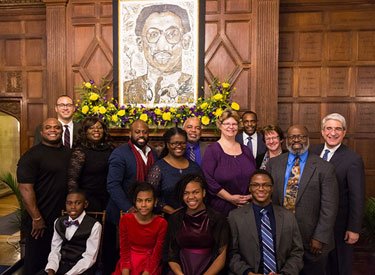
Up at Yale yesterday, they renamed the dining hall of Calhoun College for Roosevelt Thompson, a Yale student of color of the Class of 1984 who got killed in a car crash his senior year.
John C. Calhoun, a non-colored Yale graduate of the Class of 1804, was originally the namesake of the Yale residential college and dining hall which opened in 1933. Calhoun was singled out for that honor on the basis of having been Vice President of the United States, and thus being, as the college’s Wikipedia entry notes, “the only Yale graduate to be elected to a federal executive office in the school’s first two centuries, until the election of U.S. President William Howard Taft in 1909.”
John C. Calhoun served additionally as Secretary of State and Secretary of War. He was elected four times to the House of Representatives, and twice to the U.S. Senate. In the Senate, the strength of his ideas and his rhetorical powers won Calhoun the very exceptional place in History of being traditionally regarded as one of the three all-time giants, along with Daniel Webster and Henry Clay, as the “Great Triumvirate” or the “Immortal Trio,” of that legislative chamber.
John C. Calhoun, beyond his political career, was distinguished as the greatest and most influential writer on Political Philosophy ever produced by Yale. Calhoun was on the losing side of history, as a supporter of Secession and States’ Rights, and as an agrarian defender of Slavery as a benevolent institution and a positive good. His opinions on those issues were defeated on the battlefield, and History has turned the page, but his spirited defense of the rights of minorities to be protected as “concurrent majorities” by limitations on the numerical power of the majority still deserves contemporary consideration and respect.
Roosevelt Thompson is demonstrably considered worthier of (so far, only) Calhoun’s Dining Hall simply on the bases of being born with melanin in his skin, being a popular and successful student, and having died young. Whether the appropriation of John C. Calhoun’s honors at Yale stops with the dining hall remains to be seen. Yale President Peter Salovey mendaciously announced last April that Calhoun College would be keeping its name, then, in late summer, announced the appointment of a “Committee to Establish Principles of Renaming.” Salovey’s Stalinist Renaming Committee is stocked fully with Social Justice Warriors and opponents of hierarchy, Southern Agrarianism, States’ Rights, and John C. Calhoun, so the fix is in.
Yale News
29 Oct 2016
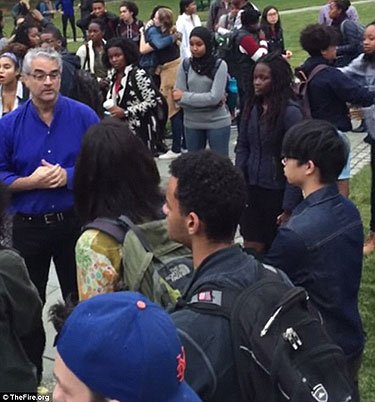
Nicholas Christakis ordered by Shrieking Student to resign.
A year later, Erika Christakis discusses how her one little email questioning the appropriateness of an official stance on Halloween costumes brought the full wrath of the snowflakes of color down upon her own and her husband’s heads, and drove them out of their cushy jobs at one of the grandest universities in the land, while all the while the Yale Administration stood by telling the world it was affirming free speech rights by washing its hands.
Nearly a thousand students, faculty and deans called for my and my husband’s immediate removal from our jobs and campus home. Some demanded not only apologies for any unintended racial insensitivity (which we gladly offered) but also a complete disavowal of my ideas (which we did not) — as well as advance warning of my appearances in the dining hall so that students accusing me of fostering violence wouldn’t be disturbed by the sight of me.
Not everyone bought this narrative, but few spoke up. And who can blame them? Numerous professors, including those at Yale’s top-rated law school, contacted us personally to say that it was too risky to speak their minds. Others who generously supported us publicly were admonished by colleagues for vouching for our characters. Many students met with us confidentially to describe intimidation and accusations of being a “race traitor†when they deviated from the ascendant campus account that I had grievously injured the community. The Yale Daily News evidently felt obliged to play down key facts in its reporting, including about the two-hour-plus confrontation with a crowd of more than 100 students in which several made verbal and physical threats to my husband while four Yale deans and administrators looked on.
One professor I admire claimed my lone email was so threatening that it unraveled decades of her work supporting students of color. One email. In this unhealthy climate, of which I’ve detailed only a fraction of the episodes, it’s unsurprising that our own attempts at emotional repair fell flat. …
[T]he concept of campus civility now requires adherence to specific ideology — not only commitment to respectful dialogue. …
Certain members of the community used me and my family as tinder for a mass emotional conflagration by refusing to state the obvious: that the content of my albeit imperfect message fell squarely within the parameters of normal discourse and might even have been worth considering on its merits as an adjunct to prevailing campus orthodoxy. There was no official recognition that the calls to have us fired could be seen as illiberal or censorious. By affirming only the narrow right to air my views, rather than helping the community to grapple with its intense response, an unfortunate message was made plain: Certain ideas are too dangerous to be heard at Yale.
Read the whole thing.
Yet despite everything that has happened, I suspect Mrs. Christakis will continue to support “Diversity,” will continue to vote for democrats, and will remain a proper bien pensant with no enemies to the Left on any other occasion.
26 Oct 2016
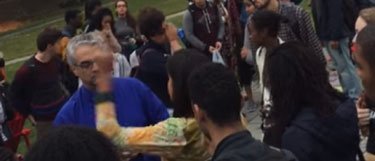
Former Silliman College Master Nicholas Christakis told by Shrieking Student to resign. He promptly went on sabbatical and then did resign.
Richard Epstein contemplates the shame of Yale’s sexual misconduct star chamber tribunals along with the hypocrisy of President Peter Salovey’s claim that Free Speech flourishes at Yale.
Salovey takes great pride in noting “the Yale administration did not criticize, discipline, or dismiss a single member of its faculty, staff, or student body for expressing an opinion.†That sentence may be technically true, but it does not explain why Salovey did not mention the unfortunate fate of Nicholas and Erika Christakis, both of whom resigned from Yale under massive pressure after student protestors demanded that Nicholas be removed from his position as master of Silliman College. Why? Because Erika had written an email that took issue with a letter from Yale’s Intercultural Affairs Committee that warned students against various insensitive forms of behaviors, like wearing offensive Halloween costumes. The letter noted, like Salovey’s op-ed, that Yale values “free expression as well as inclusivity.†But the massive level of abuse directed at Nicholas and Erika Christakis reveals how strongly Yale weighs one imperative over the other.
Read the whole thing.
Yale surrendered to the Obama Justice Department’s Russlyn Ali, immediately upon receipt of her infamous “Dear Colleague letter,” which threatened withholding of federal funds to universities which failed to establish
Sexual Harassment Inquisitorial procedures forthwith.
President Salovey announced last Fall that he was firmly behind the Christakises, when outraged student demonstrations erupted after Mrs. Christakis wrote an email questioning the appropriateness of an Intercultural Student Affairs edict warning against students wearing Halloween costumes which could be interpreted as belittling or culturally appropriative: no sombreros, no blackface, no turbans. Both Christakises, nonetheless, were out of the Master’s House in Silliman in short order and out of New Haven. A decent interval, up until the next Mid-Summer, was allowed to go by to save Yale’s face, before Nicholas Christakis’s permanent resignation was announced. Way to go, Free Speech at Yale!
18 Oct 2016
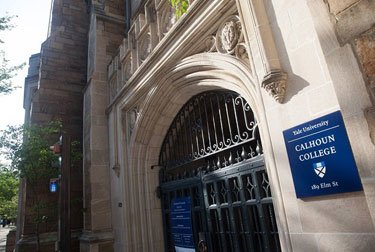
When Yale established the residential college system in emulation of the independent colleges of Oxford and Cambridge, one of the then ten colleges established was named for Class of 1804 alumnus and one-time Vice President, Secretary of State, Secretary of War, illustrious Senator and political theorist John C. Calhoun.
Wikipedia puts it blandly:
Because of his political, military, and intellectual achievements, Calhoun was venerated as an illustrious Yale alumnus beginning in the mid-nineteenth century. He was the only Yale graduate to be elected to a federal executive office in the school’s first two centuries, until the election of U.S. President William Howard Taft in 1909.
But the reality is, Southerner and intellectual father of the Lost Cause though he was, John C. Calhoun, in the era preceding the radical left’s Long March through the Culture and the Universities, was universally regarded as one of the three all-time giants of the Senate, and the single most important American statesman and political thinker to have ever graduated from Yale.
Last April 27th, Yale President Salovey announced that the University was declining to comply with demands from snowflakes of color that Calhoun College be renamed. This rebuff was, however, accompanied by other payoffs: the traditional title of “Master” for the distinguished senior faculty member who presided over a Yale residential college would be henceforward changed to “Head,” lest some dimbulb darkie confusing an ancient academic title with a reference to Antebellum Slavery be offended, and one of the two new residential colleges under construction would be named for some African-American leftist dyke whom no non-communist had ever previously heard of.
The fate of John C. Calhoun’s college seemed to be settled, but, no! it turned out that Salovey was a welsher. Just a few months later, when August rolled around, Salovey announced the formation of an Orwellian “Committee to Establish Principles of Renaming.”
The membership of that committee included a variety of individual SJWs, all obviously keenly committed to contemporary political perspectives intensely hostile to the culture and institutions of the Antebellum Southern United States and passionately opposed to the sectional and anti-egalitarian views of the late Senator Calhoun. There will be found on that committee not one single conservative, one defender of the Southern perspective, one admirer of Calhoun, or even one Old Blue traditionalist. The renaming committee is still currently holding meetings, but to say that its ultimate report is a foregone conclusion would be an massive understatement.
1997 alumnus Alexander Zubatov is the kind of graduate who ought to be in charge, but is not. Zubatov writes indignantly:
[T]he very name, “Committee to Establish Principles on Renaming,†…sounds like something Josef Stalin would have come up with while attempting to whitewash Soviet history of references to tsars, saints and that sort of thing. The act of erecting a one-issue litmus test for whitewashing American universities of references to slavery is equally myopic and dystopian. Undoubtedly, those immersed in the committee’s mission would believe the difference is that they are doing the good Lord’s work in furtherance of a just cause, and yet, wouldn’t they have to concede that Soviets visionaries and bureaucrats surely shared that view?
This nation has become obsessed with race, racism, slavery, discrimination and the cancer of regressive, zero-sum, winner-take-all identity politics, with the result that ideologues on the left and right are ensuring Americans are divided, polarized and pitted against each other based on their most superficial identifications. Yale, like many institutions of higher education in America, appears to have lost sight of the fact that part of the mission of an educational institution should be to avoid trend-hopping and to remain above the fray, to stand back from the dust cloud of our present-day turmoil and avail itself of the more nuanced and distanced vantage points conferred by academic disciplines such as history and philosophy, which further deep reflection rather than shallow proclamations and knee-jerk actions. By contrast, a university that is constantly bobbing and weaving in fear as a response to every whim of impulsive students who have not yet acquired the ability to stand back and think is a university that has lost sight of its educational mission. It is a university being run by spineless technocrats and cynical profiteers afraid of losing a few dollars for a few days on account of being branded “racist†in some hysterical student screed, YouTube video, or viral Tweet.
I have no doubt whatsoever that those who act most rashly today will be judged most harshly by history tomorrow. What we need today is not the renaming of buildings but a re-framing of the entire debate so that the question is not under what conditions we should or should not rename buildings, but rather, why it is that we have come to a point in our culture where so many people have become so over-determined by what Max Weber referred to as their “status groups†(races, gender affiliations, sexual proclivities, etc.) that they are blinded to the common good of our society as a whole.
Read the whole thing and shed a tear for Yale and another for the late Senator from South Carolina.
/div>

Feeds
|