Last year, a Yale student couple broke up during Spring Break. A few days later, the girl texted her former boyfriend, informing him she was drunk, inviting him to her room, and telling him: “Don’t let me try to seduce you though, because that is a distinct possibility.â€
Sex ensued (of course). And, over a year later, upon returning to Yale after taking a year off, the young lady filed a complaint with the University accusing her former boyfriend of rape. He had taken advantage, she said, of her being drunk, and seeing him around campus made her “want to cry or vomit.”
After initiating formal procedures and supplying the complainant with her former boyfriend’s class schedule (so that she could avoid seeing him and therefore crying or throwing up), an independent fact-finder was hired. The two parties were interviewed four times along with some witnesses to the young lady’s drinking on the night in question. Statements were exchanged. All the majesty of Yale marched up to the top of the hill and then down again, and a 3-and-1/2 hour hearing was finally conducted, with all the technical facilities and formality of a Nuremburg war crimes trial.
As the result of the hearing, a faculty panel voted and wrote a report, concluding (reasonably enough) that “the preponderance of the evidence” proved that the male student had not violated university policy by taking advantage of the young lady while she was incapacitated. They then formally advised the two young people to avoid one another.
It appears that, in the end, it all came out alright, since the panel’s report was confirmed by the Dean of Yale College, and the complainant decided to forgo appealing the decision.
Ruth Marcus, at the Washington Post, thought that this incident should alarm everyone.
This seems the just outcome, but one that, given the low “preponderance of evidence†standard of proof and Yale’s stringent consent rules, could have gone the other way.
And at what a traumatic cost. To a young woman who sincerely believes she has been raped but seems, at least from afar, to have been pushed by the prevailing culture into viewing a bad choice as a quasi-criminal event. To a young man who lived under the shadow of accusation and expulsion.
This is a cautionary tale about a still-evolving, still-uneasy balance in dealing with sexual assault on campus. The Yale episode demonstrates: Parents of boys should be every bit as nervous as parents of girls about what can happen to the not-quite-adults they send off to college.
Yale plays Harvard today. In connection with which, a bit of history. In the old days, Yalies encouraged their team’s efforts with a Long Cheer, featuring a quotation from a play by Aristophanes. Frank Gibson, a cheerleader from the Class of ’48 instructs Peter Salovey, then Dean, in the Long Cheer.
I’m afraid it was already extinct by 1966 when I arrived as a freshman.
“I know the croaking chorus from The Frogs of Aristophanes.”
–the Modern Major General in The Pirates of Penzance.
Hopefully she will be allowed to speak this evening at Yale, but you shouldn’t count on that.
The Muslim Student Association at Yale and 35 other groups signed a letter objecting to Ayan Hirsi Ali being invited to speak at Yale tonight. Truthrevolt.org:
The Muslim Students Association at Yale University has written a letter expressing concern that the William F. Buckley, Jr. Program on campus is hosting women’s rights activist Ayaan Hirsi Ali to speak about Islam. The Somali-born Hirsi Ali is an outspoken critic of organized religion, specifically Islam, which was used as justification for genital mutilation and attempting forced marriage.
In an email obtained exclusively by TruthRevolt, Abrar Omeish, an MSA board member, asks for campus organizations to stand against Hirsi Ali’s proposed talk. Hirsi Ali is “a speaker who is very well known for her hateful comments towards marginalized groups, especially the Muslim community. It is making many Muslims on campus feel unwelcome and uncomfortable,†she wrote.
“We would like to point out though that her main source of fame – or, rather, infamy – has been her inflammatory comments about Islam and its followers. Not only are these comments hateful, but they are also very hurtful to the Muslim community, particularly to Muslim students at Yale,†she continued.
Through its efforts, the MSA managed to recruit 35 other campus groups and student organizations to stand against Hirsi Ali’s talk because she “is being invited to speak as an authority on Islam despite the fact that she does not hold the credentials to do so.” Hirsi Ali is scheduled to to give a lecture titled “Clash of Civilizations: Islam and the West†on Monday September 15th. …
In the letter, the groups wrote that “The comments Ms. Hirsi Ali has made on Islam have been classified as hate speech and have been considered unprotected libel and slander. She has been condemned for them by national organizations and universities. The Muslim community and its allies are disappointed that our own fellow Yalies would invite such a speaker knowingly and that she would have such a platform in our home.”
Cosigners to the letter include: Students for Justice in Palestine (SJP), J Street U, The Arab Students Association (ASA), Women’s Leadership Initative (WLI), The Women’s Center, Asian American Student Alliance (AASA), Black Church at Yale (BCAY), The Slifka Center, Council on Middle Eastern Studies (CMES), and the Yale Atheists, Humanists, and Agnostics (AHA).
—————————-
The Yale Daily News reports that Mr. Omeish and the AMA were demanding to limit the topics Hirsi Ali could address and wanted their own speaker included in the program to rebut her remarks.
[Abrar] Omeish [’17] said that the group and their Islamic values uphold freedom of speech.
“The difference here is that it’s hate speech, [which] under the law would be classified as libel or slander and is not protected by the First Amendment. That’s what we’re trying to condemn here.â€
After becoming aware of the Buckley Program’s plan to bring Hirsi Ali to campus, Omeish met with [Buckley Program president Rich] Lizardo [’15] last week to discuss Hirsi Ali’s speaking engagement and the MSA’s requests. According to Omeish, the MSA never intended to disinvite Hirsi Ali, but instead requested the invitation of a second speaker with academic credentials on the subject. The MSA also asked that Hirsi Ali’s speech be limited to her personal experience and professional expertise.
But Lizardo responded that the Buckley Program would not adopt the MSA’s requests and would not change the format or content of the lecture.
—————————-
David Gelernter (who was persuaded by the Unibomber to become openly conservative) responded yesterday with some nifty sarcasm to the Muslim students’ demands.
Your inspired suggestion, having Official Correctors speak right after Ali to remind students of the authorized view of Muslim society, is the most exciting new development in Free Speech since the Inquisition — everyone will be talking about it! You have written, with great restraint, about “how uncomfortable it will be†for your friends if this woman is allowed to speak. Uncomfortable nothing. The genital mutilation of young girls is downright revolting! Who ever authorized this topic in a speech to innocent Yale undergraduates? Next thing you know, people will be saying that some orthodox Muslim societies are the most cruel and benighted on earth and that Western societies are better than they are (better!) merely because they don’t sexually mutilate young girls! Or force them into polygamous marriages, countenance honor killings, treat women as the property of their male relations, and all that. Can’t they give it a rest? You’d think someone was genitally mutilating them.
We all know that Free Speech doesn’t mean that just anyone can stand up and start spouting. Would you let your dog talk for an hour to a Yale student audience? What’s next, inviting Dick Cheney? Careful study of contemporary documents makes it perfectly clear that when the Bill of Rights mentions Free Speech, it is alluding to Freedom of Speech for the Muslim Students Association at Yale. We all know that true free speech means freedom to shut up, especially if you disagree with your betters. And true free thought means freedom to stop thinking as soon as the official truth is announced by the proper Authorities — and freedom to wait patiently until then.
Yale’s William F. Buckley Jr. Speaker Program announced recently that, in its third year of operation, it would be expanding its speaker program to host 8 speakers in the Fall semester. The most interesting guest speaker scheduled this Fall will probably be Ayaan Hirsi Ali, a Somali-born victim of genital mutilation famous for her public criticism of certain Muslim practices.
The Oldest College Daily’s article, however, noted that not everyone approved of the speaker program.
Students who are not involved in the program have mixed feelings about its presence on campus — especially its conservative bent.
Helen Price ’18 said that although she appreciates the effort the program makes to promote intellectual diversity, in practice such an effort can be problematic.
“When you invite very conservative speakers here who perhaps have controversial views on Islam or homosexuality, you essentially make Yale a very uncomfortable place for a large percentage of the people here on campus, and everyone should feel at home at college,†Price said.
———————————————-
The freshman Ms. Price received national attention for her expressed discomfort at the airing of controversial, i.e. politically incorrect, views.
Eric Owens, at the Daily Caller, pounced all over her.
Who is Helen Price? According to her Twitter profile, she’s quite a ritzy, jet-setting princess. She describes herself as a “Yale student, leftie, Berliner, Brit, blogger†with not one and not two but three locations: â€Berlin, New Haven, England.â€
She thinks incredibly highly of herself, too, let her just tell you:
Since my last birthday I’ve got into Yale, Oxford etc, been published in the Guardian, captained my national debating team & moved to Berlin
— Helen Price (@HelenPrice1994) November 5, 2013
Her Twitter profile also includes language from a May 17, 2014 tweet she composed:
And I’m wearing a tee that says “My Marxist Feminist Dialectic Brings All The Boys to the Yardâ€, so that isn’t going down well.
— Helen Price (@HelenPrice1994) May 17, 2014
It’s not clear if Price understands how such casual mentions of Marxism might make someone — from, say, Cambodia, or North Korea, or Ukraine — “very uncomfortable.â€
The young Marxist’s 15-minutes-of-fame has clearly occasioned some further discomfort as the young lady’s Twitter feed has since become “Protected,” meaning that access to her current and older tweets is now specifically limited to followers she approves.
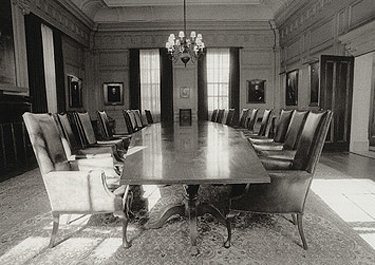
Woodbridge Hall, meeting room where Yale’s top officials make decisions.
K.C. Johnson, at Minding the Campus, describes the truly Orwellian system of adjudicating complaints of sexual assault which has evolved at Yale as the result of threats of sanctions by Barack Obama and Eric Holder’s Department of Justice’s Office of Civil Rights.
Yale, as part of an agreement with OCR (Office of Civil Rights), revised its procedures and promised biannual reports from Yale deputy provost Stephanie Spangler.
Over the past three years, these Spangler documents have provided a first-hand illustration of what passes for due process at one of the nation’s leading universities. From them, we learned that more than a half-dozen Yale students (including former quarterback Patrick Witt) had been found culpable for sexual assault under “informal complaint†procedures that provide no grounds for an accused student to present evidence of his innocence. The latest Spangler report has now been released. It suggests that due process still stands in short supply on the New Haven campus. …
Seven cases this semester have gone through the “informal†process—which can best be seen as a kind of “Scarlet Letter†approach. That is: given the limitations on the accused student’s ability to present evidence, it’s almost impossible for an “informal complaint†to end without the accused student being branded a rapist. But beyond the branding, Yale allows only limited punishment through the informal procedure. Of the six students (one case remains pending) who faced charges of sexual assault through the “informal complaint†process, each received the same punishment—“counseling†and a prohibition on contacting the accuser.
For one student last spring, the allegation was just the beginning. Yale’s “formal complaint†procedure prevents the accused from having an attorney as part of the process; brands the accused a rapist based on a 50.01 percent finding from a panel specially trained panel; and denies the accused any right to cross-examine the accuser. Even under these guilt-tilting procedures, one accused student was found not culpable—meaning that Yale’s disciplinary panel concluded that it was more likely than not he was the subject of a false allegation.
The outcome of the case? The accused student was punished. He received a no-contact order with his accuser (there was no reciprocal order)—meaning that if the two happen to enroll in the same course, the accused student would need to drop the class; or if the two happened to be assigned to the same dorm, the accused student would have to move.
Yale also referred the accused student for “sexual consent training.†(Yale’s website contains no description of what this “training†entails, but here’s a summary from a feminist blog.) Again: Yale concluded that it was more likely than not that the accused student was the victim of a false allegation. Yet even though Yale’s own accuser-friendly procedures concluded that it was more likely than not the accuser leveled a false allegation, the accused was punished, while the accuser received no punishment of any sort.
In the several years of Spangler reports, there never has been any indication that Yale has punished even one student for filing a false claim of sexual assault. …
One of the Title IX cases from the spring provides a sense of the Orwellian nature of the Title IX coordinator’s work. “A third party reported,†according to Spangler, “that more than one female [Yale] student, whom the reporter would not identify, [emphasis added] was sexually assaulted by a male Yale student.â€
Or, in plain English, a Yale student is now being investigated as a serial rapist, with the possibility of sanctions—even though none of the females he allegedly raped have filed a complaint, or have even been identified. How any student could defend himself against such a charge is unclear.
Read the whole thing, and feel your blood run cold.
As a financial-aid kid whose life-prospects were significantly bolstered by attending an elite school, this subject is very personal for me, too. I come from a family of construction workers and laundry-owners in Brooklyn, the descendants of Italian and Chinese immigrants, respectively. My father is a laborer and my mother a human resources worker; they’ve both changed jobs across the years, owing to the recession and family circumstances. We don’t occupy an enviable financial situation by any means, and I’d hate to think our unsteady progress from working- to middle-class somehow makes me, as Deresiewicz puts it, “an entitled little shit.†He may have sleepwalked into college, but it’s wrong to assume we all did
“Lizbeth Mara” depicts herself in several places on the Internet by a stock photo of a pretty brunette muzzled by a pair of grimy male hands. Who knew that moral philosophers ever got their hands dirty?
Charlotte Allen reports, and reflects at length, upon all the sturm und drang, and also the delicious ironies attendant on the story emerging this month of the public shaming of a much-philandering Yale professor of Moral Philosophy and Global Justice by an irate female grad student, furious at having been seduced, now avenging herself via the extra-judicial methods of Internet grassroots appeals and social media.
Ms. Allen finds much entertaining reading in the now widely-distributed anonymous complaints of the alleged victim.
She reported that she began to get suspicious when the professor declined to leave his partner in order to be with her—or even, in fact, to tell his partner that she existed. Then she found out about the “22-year-old virgin†who’d been his former secret mistress, plus the “PhD student in India, who wears a sexy negligee,†and the “other young female scholars that he hosts in his apartment.†Anonymous concluded sadly: “He will continue giving his lectures about justice around the world, pretending not to eat meat for moral reasons, inviting young women to his hotel room for philosophical discussions, and I’m just among the other young women scorned by the moral philosopher, who devotes his life to justice.â€
All this would make for a merry tale illustrating the adage “Hell hath no fury like a woman who discovers that her man has been whispering the same sweet nothings into the ears of other females as he’s been whispering into hers.†It would also make for a merry tale of hypocrisy among sanctimonious progressives in academia. “Global justice†typically involves requiring citizens of wealthy First World countries to hand over their income and assets (via taxes) for “redistribution†to impoverished Third World countries, on the theory that they’re complicit in Third World poverty. It’s always fun to see a vegetarian guru of redistribution who also happens to occupy a cushy position at a prestigious East Coast university doing a bit of redistribution of his own on the side. Anonymous lamented: “I falsely assumed that the man who calls affluent westerners human rights violators would treat women with dignity.†Surprise, surprise!
And finally, this ought to be an inspirational tale for grad-school nerds laboring in the library stacks trying to finish their philosophy dissertations: Get yourself a job in “global justice,†and you’ll have more progressive females in sexy negligees throwing themselves at you than there are stars in the sky or Third World kleptocrats.
But Allen is also a bit alarmed at the dark side of all of this, as one example of an increasing number of cases of feminist warfare against academic departments of Philosophy, and she notes that Internet shaming and mobbing has been, in this case, quite effective.
[W]ithin days of the appearance of Anonymous’s article in Thought Catalog, he was specifically identified by a number of feminist activists—including Anonymous herself—as a Yale professor who had allegedly made sexual overtures to a female Yale undergraduate while serving as her senior-essay adviser and, after her graduation in 2010, employing her as a researcher and translator. That woman is reportedly preparing to sue both the professor and Yale itself, which, according to a September 30, 2011, article in the student newspaper, the Yale Daily News, had found “insufficient evidence to support the allegation of sexual harassment†and merely issued the professor a reprimand for improper business practices.
In short, the global justice professor has been effectively “outedâ€â€”linked irrevocably not just to a taste for trysts in hotel rooms around the world but to a concrete allegation of sexual harassment on his own campus. He may win the lawsuit if it is ever filed (those cases are hard to prove), but that’s beside the point. Everyone in the philosophy world is now pretty certain who he is (he has been named on several philosophy blogs), and his career in academia, if not formally finished, may well be mortally wounded. Several well-known philosophers at other universities are more or less calling for his head. Global justice, indeed.
The dining hall where I used to eat dinner in New Haven.
L.V. Anderson (who did not go to school in New Haven. I looked it up.) finds the way in which alumni of certain Ivy League colleges (and, who knew? apparently even Stanford) commonly respond to inquiries about where they attended school with modest evasion decidedly annoying.
Then I solicited the opinions of my Slate colleagues, many of whom have degrees from universities that rank highly on U.S. News and World Report’s annual list. I discovered that many of them had personally heard this wink of a noncommittal response, and, more alarmingly, some of them had uttered some version of it themselves. (“I’m not proud of it, but I have once or twice said Connecticut instead of Yale,†admitted one Eli.)
Having thus learned that this is still a thing, I must, at this moment when many undergraduates are headed home for the summer, urge all Yale, Princeton, and Harvard students and alumni—and anyone else tempted to use a geographical euphemism to describe their august alma mater—to please stop doing this. Cease and desist. Cut it out. I’m sure you are a kind and smart person, but this verbal habit makes you look like a patronizing, self-serious jerk. …
lite alumni’s main justification for this habit is that some people act weird and make uncomfortable or hostile comments when they learn you went to Harvard, Yale, or Princeton. Indeed, Harvardians frequently refer to telling people you went to Harvard as “dropping the H-bomb,†which is perhaps the most cringeworthily hyperbolic expression in the English language. The unwieldy conversational power of the H-bomb is a recurring topic of analysis in the Harvard Crimson. See, for instance, this 2002 piece by MSNBC reporter Irin Carmon with the excellent subtitle “Does it help or hinder the mack?†(The gender politics of the H-bomb are complicated.) Princetonians, similarly, talk about the “P-bomb,†a term that implies that the two syllables in “Princeton†can derail small talk and obliterate nascent social connections in one fell swoop.
Certainly, some small number of people—insecure people who perhaps have not yet learned that Ivy League schools confer degrees on plenty of idiots every year—may react inelegantly upon hearing that you went to Harvard, Yale, or Princeton. But it is not your job to anticipate and preemptively manage another person’s emotional response to your biography. If you tell people you went to Harvard and they respond by freaking out, that reflects poorly on them.
If, on the other hand, you refuse to tell someone you went to Harvard, that reflects poorly on you—it implies that, on some level, you buy into the overblown mythos of Harvard and the presumption of Ivy League superiority. To fear the effects of the word “Harvard†is to take Harvard way too seriously. Once you understand that Harvard is just a college, and that getting into Harvard probably had more to do with your socioeconomic background and the luck of the draw than with your merits vis-à -vis people who didn’t get into (or, more likely, just didn’t apply to) Harvard, the cagey “college in Boston†response starts to sound very, very silly.
Or look at it this way: Saying you “went to college in Boston†or “went to college in New Haven†functions as an elitist dog whistle. There are people who pick up on the hint, people who, like you perhaps, spend a lot of time around snotty people who went to prestigious schools. But if your interlocutor understands the dog whistle, he will probably be offended that you have judged him incapable of gracefully handling the news about where you went to school. And if your interlocutor doesn’t understand the dog whistle, he will simply wonder why you are being so evasive and weird—and then, if he does eventually find out you went to Yale, he will be offended that you have judged him incapable of gracefully handling that fact. Either way, you’ll look like a shmuck.
Actually, people do this all the time. If your interlocutor did not go to Yale (or some near equivalent in New Jersey or Massachusetts), one simply naturally feels that he may find it pretentious, or even intimidating, for you to respond with Yale.
If he did himself go to Yale (or some close simulacrum), he will understand perfectly well what you mean, when you say “New Haven” or “Davenport College.” If he didn’t, he will presumably be contentedly put off and assume that you attended New Haven University or some sort of Calhoun, Saybrook, D-port, or Jonathan Edwards sort of college he’s never heard of.
No offense intended. L.V. Anderson’s problem is simply the result of hanging around Slate and becoming too clever by half. She has learned the code words, but does not understand the perspective of those who use them.
Let me get this straight… Ivygate reports that two Yale students complained of being “sexually assaulted” while attending a BDSM Party. What did they think those riding crops were for?
Last week, Yale students received two university-wide Clery Act emails informing them that two Yale students were victims of “sexual assault by an acquaintance, who is also a Yale student†at the Sigma Phi Epsilon house on February 8th. February 8th was the night of the annual “Dom†party thrown by the Women in Power Society (WIPS), a secret society, which was held in the SigEp house.
The “Dom†party is an infamous, no-cellphones-allowed event. From what we hear, people dress up in BDSM gear and porn is projected on the walls as hot freshmen guys pass around drinks. Interestingly, it’s also generalized as one of the safer party SigEp hosts: there is a closed guest list with doors closing at 11 pm and everyone (besides those hot freshmen boys) is over 21-years-old.
For two assaults to happen on a night that typically gets by without major public notice is surprising–but only considering its history of safety. Dom is a party full of porn, S&M, and lots of alcohol, after all.
Yale Police Department Chief Ronnell Higgins reported the two statements in separate emails to the University community on Feb. 19 and Feb. 21. The messages stated that the alleged assaults occurred at the Sigma Phi Epsilon fraternity house, and the second email corrected the first by reporting that they were both said to have taken place on Feb. 8.
“I write to let [the University community] know that the Yale Police received an anonymous report today that a second Yale student was the victim of a sexual assault by an acquaintance, who is also a Yale student,†Higgins said in the Feb. 21 email.
On Feb. 22, President of the Yale Sigma Phi Epsilon chapter Andrew Goble ’15 issued a statement saying the fraternity allowed another student group to lease a room in its house for a private event on Feb. 8. The statement said the event was open to guests of that organization, which remained unnamed.
“The members of Yale’s SigEp chapter were shocked and saddened to hear allegations that sexual assault may have occurred in our facility on an evening when the chapter had leased event space to another campus organization,†Goble said in the statement. “At this time, SigEp does not believe that the allegations are against members of their chapter.†…
On the same night of Feb. 8, a private party in connection with the Women in Power Society (WIPS) senior society, took place at the SigEp fraternity house. Nine students interviewed said that party had a “dominatrix†theme. Several attendees declined to provide additional details about the annual party.
The WIPS said in a statement to the News, “We are not commenting out of respect for the privacy of the individuals involved in this situation.â€
A student who attended the party and spoke on the condition of anonymity said the WIPS’ mission is to promote female empowerment.
Mark Edmundson (who teaches English at UVA) has a very amusing, slightly rueful memoir in the Chronicle of Higher Education recalling his youthful animosity to tweeds, Bones, the American reactionary establishment and his enthusiastic embrace of the theoretical tools of deconstruction as a means of sticking it to the Man.
You couldn’t see Skull and Bones from the seminar room in Linsly-Chittenden Hall, though it was directly across the street. But the building was much on my mind the afternoon of the reception and had been from the day I got to New Haven. To my 26-year-old self, it seemed nearly impossible that literature—Keats, Shelley, Shakespeare, Whitman—was sharing space with Skull and Bones. I did not know much about Bones, but I took it to be a bastion of reactionary America. The society reached out its withered hand to tap future Wall Street pirates, CIA agents, and the sort of State Department operatives who had leveraged us into Vietnam, where a number of my high-school buddies had gone to be maimed and worse.
At least the Skull and Bones building looked its part. They called it the Crypt—and it did look like it was designed by Edgar Allan Poe. It was all stone and metal, with no real windows, and doors of enormous weight. Those doors must have closed with the grimmest finality, though never in my five New Haven years did I see them open or shut.
The Crypt was a monument to the dark. It looked like the temple of a demon—Moloch or Beelzebub—one of the devils we discussed in our Milton seminar in the elegantly decomposing room of the Munchkin party.
One day I saw that the Crypt’s front door and the wall next to it were blotched with red: the red of the anarchist flag, the red of rage and retribution. Someone had taken a couple of cans of yowling crimson paint and thrown them at the facade of Skull and Bones. I loved it. Perhaps that night people would mass in front of the building, carrying rakes, scythes, and wrenches. A strike force would arrive armed with five-pound sledgehammers and the requisite silver stakes to take care of the nightwalkers inside.
All right, I got a little carried away. I knew that wasn’t really going to happen. But something might. The university and the community were finally showing distaste for the monument to plutocracy and (why not say it?) death.
This was not what I associated with American education. I’d come from Bennington College, a small liberal-arts school in Vermont, where people worshiped Martha Graham and poetry. After I graduated, I taught at the Woodstock school, a Bennington for high-school students. Woodstock was about playing music and smoking weed, writing spontaneous bop poetry and reading Marx and Kerouac. When they completed the curriculum, the kids applied to college, and things being what they were in America circa 1977, they tended to get in—though not to Yale.
I’d been deluded. I thought that university education entailed reading Whitman during the week and listening to the Grateful Dead on weekends. (“I never cared about money,†the New York Times columnist Maureen Dowd once wrote. “It was not what Country Joe and the Fish taught me to value.â€) It seemed that here at Yale, education might be about William Howard Taft and Averill Harriman, all the time. I knew that Yale was renowned for Wall Street connections; I knew that it sent recruits to the CIA; but I thought—what did I think? I thought that the English department, in conjunction with the spirits of Emerson and Whitman, would be at war with what was dark and outdated about Yale. I thought that the English department would win, hands down. But there was the Crypt across the street, and no one was doing anything about it. No one even talked about it.
Then I discovered the opposition at Yale—or at least I thought I did. When I arrived, I was devoted to literature straight out, and my goal was to become learned enough to pass my affection on to students. That was about it. (Though I also liked the hours that professors were rumored to work—I was an expert at engaging in prolonged bouts of doing nothing.) “What we have loved,†Wordsworth says to his friend Coleridge in The Prelude, “others will love, and we will teach them how.†I could teach others how to love Whitman and Ginsberg and be paid for it, if only a pittance. Sign me up.
To my 26-year-old self, it seemed nearly impossible that literature—Keats, Shelley, Shakespeare, Whitman—was sharing space with Skull and Bones.
But the stuff that had the aura of subversion about it wasn’t literature, it was theory. Maybe that was the true alternative to Bonesmanship. After a while, I dropped any illusions I might have had about running the Bones gang out of town. Still, there had to be some kind of alternative culture to Bones culture, to succor the grad students and maybe even save an undergraduate or two from being swallowed alive by Moloch. Maybe theory was 1968 by other means.
Jameson, Hartman, Bloom, Derrida, de Man: All seemed rebellious, and all were right here at Yale.