Archive for May, 2013
04 May 2013


Emily Hacker whipping for Melvin Poe’s Bath County Hounds
When I am an Old Horsewoman
When I am an old horsewoman
I shall wear turquoise and diamonds,
And a straw hat that doesn’t suit me
And I shall spend my social security on
white wine and carrots,
And sit in my alleyway of my barn
And listen to my horses breathe.
I will sneak out in the middle of a summer night
And ride the old bay gelding,
Across the moonstruck meadow
If my old bones will allow
And when people come to call, I will smile and nod
As I walk past the gardens to the barn
and show instead the flowers growing
inside stalls fresh-lined with straw.
I will shovel and sweat and wear hay in my hair
as if it were a jewel
And I will be an embarrassment to all
Who will not yet have found the peace in being free
to have a horse as a best friend
A friend who waits at midnight hour
With muzzle and nicker and patient eyes
For the kind of woman I will be
When I am old.
-By Patty Barnhart, originally published in The Arabian Horse World magazine in l992.
Hat tip to Bird Dog.
04 May 2013

Biologist Daniel De Granville photographing Giant anaconda (Eunectes murinus) underwater in Brazil.
Hat tip to Vanderleun.
04 May 2013

Phys.org:
Researchers from the University of Warwick and the Université François-Rabelais Tours have identified the first manuscript known to have belonged to the eminent French essayist, Michel de Montaigne.
Read more at: http://phys.org/news/2013-05-manuscript-discovery-montaignes-library.html#jCp
Of Montaigne’s celebrated library, thought to have contained around 1,000 books, only 101 are known to have survived. Until now, no manuscript (other than Montaigne’s own annotations in printed works) was known to bear the mark of the writer’s provenance.
The sixteenth-century manuscript, held at the Herzog August Bibliothek at Wolfenbüttel, contains copious notes by an unknown individual based on lectures on Roman law by the distinguished jurisprudent and historian François Baudouin. Montaigne’s Latin signature ‘Michaël Montanus’ is clearly visible on the manuscript’s title page.
Ingrid De Smet of the Centre for the Study of the Renaissance, University of Warwick, explained the significance of her discovery:
“The identification of Montaigne’s ownership of this work is exciting for the study of sixteenth-century French intellectual culture. It confirms Montaigne’s legal interests and potentially opens new vistas for the reading of his essays and the understandings of his political views.”
03 May 2013
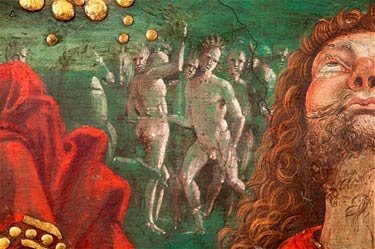
Bernardino di Betto, called Pintoricchio or Pinturicchio, Detail from The Resurrection, 1494, Musei Vaticani
Restoration of a painting of the Resurrection of Christ by Pinturicchio, commissioned by Pope Alexander VI to ornament his Papal apartments found that the painting’s background features “nude men, who are decorated with feathers and seem to be dancing.”
Antonio Paolucci, the director of the Vatican Museums, announced that these figures have been recognized as representations of Native Americans which were painted on the basis of their description by Christopher Columbus in 1494, in the direct aftermath of his first voyage of discovery to the New World.
The painting had been long neglected because of the unsavory character of Rodrigo Borgia (Alexander VI). Subsequent popes closed and abandoned his apartments, which were only re-opened for the first time after his death in 1503 in 1889 by Pope Leo XIII.
Telegraph story.
Via the Dish.
03 May 2013
Hat tip to Clarice Feldman.
02 May 2013

On this day in History:
May 2, 1863, was one of the greatest days of Robert E. Lee’s military career. It was also one of the worst. A little after 5:00 that afternoon a Confederate flank attack led by Lt. Gen. Thomas J. “Stonewall†Jackson had slammed into the Union right flank at the Battle of Chancellorsville. It was key to what would be Lee’s greatest victory. But later that night General Jackson, Lee’s “right arm,†was badly wounded in a case of mistaken identity.
The attack should not have worked. General Lee divided his army in the face of an enemy that had more than twice his numbers. It was something a military leader should never do. The Union army even saw the flanking march being made. Instead of attacking, which likely would have brought disaster upon the Southern forces, maybe even destroying the Army of Northern Virginia, the Federals were happy with what they thought was a Confederate retreat.
When Jackson’s men burst out of the woods upon the unsuspecting Union flank, the soldiers in blue crumbled. The attack overwhelmed them and the Rebels pushed hard, taking advantage of their success. The only thing stopping them was the fading light.
The men were tired from their twelve-mile dusty march through the Wilderness and the following attack. Darkness brought on a welcome reprieve, but it wasn’t to last. Jackson, always aggressive, was not finished. He had the enemy ahead of him on the ropes and he wanted to finish him off.
Night attacks in the Civil War were rare. But Jackson saw an opportunity to inflict a damaging blow to the enemy. The following night was to be a full moon, so on the 2nd it should be quite bright. In preparation for the continued assault, Jackson, Maj. Gen. A. P. Hill, and a party of aides and guides rode out in front of the Confederate line to reconnoiter.
Read the whole thing.
Two months later, had Jackson survived the Battle of Chancellorsville, he would have been in command of his Corps, which would have arrived down the Carlisle Pike in the middle of the afternoon of July 1st at Gettysburg on the flank of Buford’s Cavalry and the Union First Corps who were, at that point, beginning to retreat.
Jackson would have seized the opportunity aggressively, unlike his successor Ewell, and would undoubtedly have pursued and driven the Union forces, denying them possession of the high ground of Cemetery Ridge and Culp’s Hill. The First Day of Gettysburg would then have been the only day of Gettysburg, and would have represented a significant Confederate victory on Northern soil. There would have been no Second Day: no indecisive struggle at the Peach Orchard, Devil’s Den, and Little Round Top, and no Third Day: no Pickett’s Charge.
Mead would have retreated to the Pipe Clay Creek in Maryland, but he would soon have found himself under intense pressure from Lincoln to attack the Confederates in order to save Northern cities, like Philadelphia, from occupation. A Northern attack on well-chosen Confederate defensive position would probably have led to another debacle like Fredericksburg. Two major defeats on Northern soil, the destruction of the railroad bridge over the Susquehanna which linked the East and West, the fall of a major Northern city, such a string of events might well have brought European recognition and a negotiated peace.
The bishop of New Orleans reputedly began a prayer shortly after the war: “O Lord, when Thou didst decide to defeat the Confederate States of America, Thou first had to remove Thy servant Stonewall Jackson.”
02 May 2013

Cougar Mountain Zoo, Issaquah, Washington, October, 2011, Taj, a 370-lb. Bengal Tiger responds to toddler pressing her hands on the glass of his cage with obvious feline gestures of affection.
At zoos, one sometimes sees a side of large, dangerous animals which is essentially identical to the behavior of your pet at home. One day, at the Chicago Zoo, I watched with amazement as a White Rhino the size of a delivery van manifested recognizable ecstacy while a teenage zookeeper stroked her back with a large push broom.
Via Fred Lapides.
01 May 2013
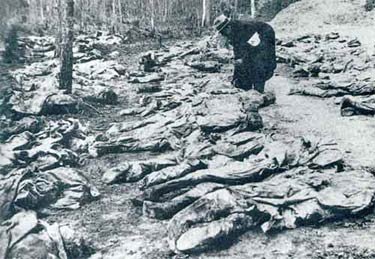
Bodies of Polish officers executed at Katyn Forest.
Evan Pokroy reminds us of what the Left is celebrating today.
It’s the first of May again and … the Workers of the World are commemorating … something. So, if you know any you might want to remind them:
20 Million Kulaks starved to death by Stalin.
A million Russians killed in the “Great Purge”.
50,000 Mongolians killed by Stalin in 1937.
21,000 massacred by the Soviets at Katyn Forrest.
A million killed in Mao’s land reform.
45 Million killed during the “Great Leap Forward”.
15 Million murdered during the Cultural Revolution.
20,000 Tortured to death at Tuol Sleng by the Khmer Rouge.
2 Million killed by the Khmer Rouge in Kampuchea/Cambodia
100,000 killed during forced collectivization in Bulgaria.
100,000 murdered by the East German regime.
100,000 killed during forced collectivization in Romania.
800,000 tortured and murdered during “land reforms” in Vietnam.
500,000 killed during the Red Terror in Ethiopia.
250,000 Crimean Tartars forcibly deported during Stalin’s ethnic cleansing (almost half died).
100,000 Tibetans murdered by China.
27,000 murdered by the Communist Democratic Republic of Afghanistan at Pul-e-Charkhi prison.
1 million murdered by the Russian Cheka during Lenin’s Red Terror.
3 million ethnic minorities deported to Siberia by Stalin. About 45% died.
350,000 Poles died during Stalin’s deportations after invading Poland.
500,000 Cossacks killed by Lenin in 1919-20
14 Million Russians who went through the Gulags and millions who died there.
4 Million killed by the North Koreans.
10,000 people die every year in North Korean re-education and slave labor camps.
6,500 Catholic clergy murdered by Communists during the Spanish Red Terror in 1936.
50,000 murdered during the Spanish Red Terror.
Over 100 Million people have been intentionally starved to death, tortured and murdered by Communists in the last 100 years.
Communism kills every time it’s tried.
01 May 2013

Winston Churchill as a boy owned, played with, and undoubtedly cast and painted lead soldiers. He owned something like 1500 hundred of them –probably one of the largest juvenile collections ever on the planet–, and no one ever thought Churchill intellectually impaired.
The Left, as we all know, has Science on its side, and its regime of experts intends to govern us guided by the insights delivered by established science.
The Left’s supposedly science-based policies, however, have a tendency to resemble primitive superstition, frequently incorporating Ousiaphobia (My own neologism: “the fear of substances”) which in every way resembles the sort of fear that primitive natives manifest toward things declared taboo by tribal witchdoctors.
Our own witchdoctors come with Ph.D.s, of course, and our politicians enthusiastically embody taboos in legislation. One particularly notorious example was the Consumer Product Safety Improvement Act (CPSIA) of 2008 which banned ever-more-minute levels of the taboo element LEAD (symbol: Pb) in children’s toys, &c.
That particularly absurd piece of legislation had much more far-reaching implications than banning the importation of toys painted with lead paint from China. It effectively prohibited the sale of used (and antique) toys carrying traces of the forbidden metal, and when the law (passed under George W. Bush, mind you) went into effect early in 2009, it was thought also to ban all children’s books printed before 1985, because (oogah, boogah!) back then printers’ ink contained minute quantities of lead. The act banned lead in levels of 300 parts per million, and the Consumer Product Safety Commission promised that it would enforce the ban since “[g]iven the way that kids tear and chew through library books… it’s unlikely that libraries have many children’s books that are more than 24 years old.”
Our federal government has declared all children’s books printed before 1985 taboo on the basis of the belief that children customarily eat books.
Apparently, the book purge is still underway, four years later. A commenter on a publishing blog (read by my wife) reported yesterday.
My regional library system got hit hard by the requirement to riff all the older kids books (lead in the ink, natch). That really flubbed up their budget. I suspect they are not alone in this. The Friends of the Library group has stepped up and done a lot, but I’ve noticed the number of new acquisitions is declining.
Most people in America go to school for sixteen long years. They get science courses, and learn that Darwin proved that life arose spontaneously by chance, and that Natural Selection is good as a basis for rejecting traditional religion, but is absolutely not to be tolerated in human society. I presume everyone gets Chemistry courses and learns that lead is an element, is a metal, and is heavy. Chemistry courses probably inform people today that compounds of heavy metals tend to be very poisonous, but it is clear that the relationship, or lack thereof, between very poisonous and “300 parts in a million” is very evidently not made clear. Neither is the obvious necessity of employing common sense and testing theories against historical fact.
If exposure to books with infinitesimal amounts of lead in the ink they are printed with really impacted children, every youngster who was so foolhardy as to devote significant time to reading would have to be presumed to have damaged his intelligence. In reality, it’s the children who read a lot who went on to get scholarships to Yale.
Winston Churchill monkeyed around with lead during his childhood on a scale which would obviously appall today’s scientific experts. You can bet that he handled, fondled, ordered and re-ordered, and played with every single one of those 1500 lead soldiers. He undoubtedly was additionally equipped with molds for making more of them, and he doubtless, like most hobbyists of his ilk, poured melted lead and cast his own lead soldiers which he then trimmed, tidied up, and painted. The boy Churchill’s hands were, you can count on it, soiled with lead on many a day.
I fished with lead sinkers as a boy, and during some periods, I too used a lead pot, casting my own sinkers. I also learned to handload ammunition, and cast bullets. Amazingly Churchill lived to the age of 90, and I’ve made it into my sixth decade myself.
/div>

Feeds
|