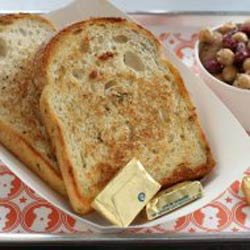
John Gravdis, in Pacific Standard, tracks down the strange, but oh-so-California, origin of the left coast’s latest food craze: $3-4 a slice artisanal toast.
All the guy was doing was slicing inch-thick pieces of bread, putting them in a toaster, and spreading stuff on them. But what made me stare—blinking to attention in the middle of a workday morning as I waited in line at an unfamiliar cafeÌ—was the way he did it. He had the solemn intensity of a Ping-Pong player who keeps his game very close to the table: knees slightly bent, wrist flicking the butter knife back and forth, eyes suggesting a kind of flow state.
The coffee shop, called the Red Door, was a spare little operation tucked into the corner of a chic industrial-style art gallery and event space (clients include Facebook, Microsoft, Evernote, Google) in downtown San Francisco. There were just three employees working behind the counter: one making coffee, one taking orders, and the soulful guy making toast. In front of him, laid out in a neat row, were a few long Pullman loaves—the boxy Wonder Bread shape, like a train car, but recognizably handmade and freshly baked. And on the brief menu, toast was a standalone item—at $3 per slice.
It took me just a few seconds to digest what this meant: that toast, like the cupcake and the dill pickle before it, had been elevated to the artisanal plane. So I ordered some. It was pretty good. It tasted just like toast, but better.
Behind every foodie breakthrough, there is a PC sob story. Go ahead and fork over $4 for that slice of toasted bread, it’s for a good cause!
I went to The Mill for breakfast today and got a black cup of coffee and a single slice of toast topped with butter and sour strawberry jam. For $6.
It was an experiment in upper-middle class lifestyle consumerism. In San Francisco, flaunting your wealth has been elevated to new lows, if you will. The labels aren’t the usual lineup of foreign design houses; rather, we pay $300 for simple denim jeans or $200 for plain black yoga pants. We don’t go to the opera; we overspend on the simplest facets of life.
Coffee. Water. Bread. Housing. The kinds of things our pioneer forebears made themselves and considered basic necessities or small comforts.
And the tech community is largely to blame, in this writer’s opinion.
Here’s the cycle:
Someone creates a business for consumers with too much money and pretensions of superior taste. It might be a physical good, like toast; it might be a service, like black-car, chauffeured rides.
Tech folks, being one of the largest demographics in the city with ample disposable income, patronize, promote, and even invest in said business. (See: Blue Bottle coffee.)
Aforementioned business prospers and grows its profile.
People both within and outside the tech community are inspired to create more bourgie businesses that cater to the bored and overprivileged, peppering their descriptions with buzzwords like “organic†and “fair trade†and “artisanal,†the most meaningless of them all. Rarely are these goods and services truly accessible and affordable.
San Francisco becomes saturated with overpriced crap that is comparable in quality to less overpriced crap.
Middle class and working class families and individuals in the community find themselves priced out of goods and services. Small businesses in those sectors languish.
Good toast and a plain cup of coffee shouldn’t cost $6. But I can’t imagine the tech community putting the brakes on this trend any time soon. We’re obsessed with false ideas of quality. We fetishize the precious processes and benchmarks and prices that, in reality, have no bearing on how good something is.
This chart shows the lexical distance — that is, the degree of overall vocabulary divergence — among the major languages of Europe.
The size of each circle represents the number of speakers for that language. Circles of the same color belong to the same language group. All the groups except for Finno-Ugric (in yellow) are in turn members of the Indo-European language family. …
The original research data for the chart comes from K. Tyshchenko (1999), Metatheory of Linguistics. (Published in Russian.)
What a Deal!….I got an email the other day from a Nigerian prince.
nigerian prince
He’s got a MILLION DOLLARS
and he wants to give it to me for FREE!
All I have to do is give him all my bank account
numbers so he can make it happen!
I was about to do it, but then I got ANOTHER email,
this time from a KENYAN prince.
Kenyan prince
He wants to give me FREE healthcare for life!…
All I have to do is give him all my bank account
numbers so he can make it happen!
Daily Beasts’ Caitlin Dickson and Abby Haglage take the curious, but recognizably leftist position, that one needs to appear in nude in public oneself in order to find Lena Dunham’s extraordinarily numerous displays of unattractive nudity in bad taste.
[L]ike everyone else who has endured listening to this senseless debate since the show first premiered, [“Girls”‘ producers] have had enough. No one, especially those who watch any of HBO’s other gratuitously sexual shows, seems to have a problem with nudity as long as the bodies shown are unrealistically sculpted. Game of Thrones’ practice of spicing up boring scenes with nudity is notorious enough to have warranted its own word: “Sexposition.†If anyone is angry about seeing Khaleesi’s naughty bits, we’ve yet to hear about it. True Blood’s Sookie Stackhouse and Boardwalk Empire’s Lucy Danziger are welcome to get down with their bad naked selves all day long. A “thigh gap” and/or “bikini bridge” are practically a free ticket to nakedville. But normal-bodied characters, please keep your clothes on.
It’s only when faced with the fleshy body of a real life human being—one perhaps uncomfortably similar to the one they have (or are afraid of having)—that people start to freak out. The deluge of questions about Dunham’s nudity conveys the message that imperfect bodies should be hidden in shame.
The point, which unfortunately needs reiterating, is that Girls is a show about the experience of a group of 20-something Brooklynites. Their trials and tribulations might not always be 100 percent realistic or relatable to the majority of Americans. They’re not supposed to be.
What anyone can relate to is the need—not to mention desire—to be naked. Dunham’s body, and the fact that Hannah, like everyone else, has to shower, get dressed, and have sex in the nude—no matter how curvy, bony, or lumpy they are—is the most realistic part of the show.
Anyone who still has questions for Dunham about her nudity should be forced to ask them in the nude.
The notion that a character in a television series must be displayed to nation-wide audience nude and/or engaged in a variety of normally private activities and bodily functions for the sake of realism is, of course, just so much piffle.
Any artistic depiction of human life will inevitably exercise a variety of principles of selection, and will include only scenes and episodes required for some specific story-telling purpose.
The unidentified reporter at tthe 2014 Winter Television Critics Association panel discussion who asked why Lena Dunham’s character is “often naked at random times for no reason†was merely asking an obvious question which has undoubtedly occurred to the overwhelming majority of the show’s audience.
The show’s producers, and their allies at Daily Beast’s, response reveals that Dunham’s unseemly and unattractive nudity is purposeful. It is ideological. It is the practical assertion of a radical left-wing form of egalitarianism which would insist that ugly people should be considered just as worthy of admiration and attention as beautiful people, that a fat and homely girl is just as entitled to display her body to a nationwide audience as a slender and beautiful model or movie star.
Reading this rather outrageous nonsense, I thought that Ayn Rand had actually overlooked one form of villainous leftism which she could have devastatingly featured in Atlas Shrugged: the Lena Dunham nude scene.
AEI describes how private industry used government force to kill the traditional light bulb for higher profits.
The [incandescent bulb] ban is crony capitalism in its most seductive form—when it’s disguised as green. Major light bulb manufacturers supported the ban from the outset. The profit margin on old-style bulbs was pitifully low, and consumers just weren’t buying the higher-margin efficiency bulbs. New standards were needed, a lobbyist for the National Electrical Manufacturing Association told Congress in 2007, “in order to further educate consumers on the benefits of energy-efficient products.â€
So Philips Electronics and other manufacturers joined with environmental groups to push for tighter lighting standards. As the New York Times Magazine explained in 2011, “Philips told its environmental allies it was well positioned to capitalize on the transition to new technologies and wanted to get ahead of an efficiency movement that was gaining momentum abroad and in states like California.†After much negotiation, a classic “bootleggers-and-Baptists†coalition was born. Industry and environmental groups agreed to endorse legislation to increase lighting efficiency by 25 to 30 percent.
The light-bulb ban is an example of how political coalitions are formed to force regulations on the general public that benefit a few large producers. A recent survey found that six out of every ten Americans are still in the dark about the latest bulb ban. Meanwhile, the dimwitted light-bulb policy just became the law of the land. The lesson here is straightforward: When industry and environmental groups claim that a regulation will solve all problems, consumers beware. It’s probably green cronyism in disguise.
There are all sorts of reasons to read books. In some cases, we may select our reading matter simply on the basis of its past selection by a reputable and respected publisher.
Karyn Reeves has a blog discussing her personal indulgence of reading one older edition (pre-1970) Penguin paperback per week.
I sympathize. I always buy unfamiliar old Penguins myself whenever I run into one with a promising title at a book sale or antiquarian book shop.
——————————
My capricious choice of Penguin cover, I find, was not felicitous. Efandrich wrote a terrific review, well and truly demolishing this one.
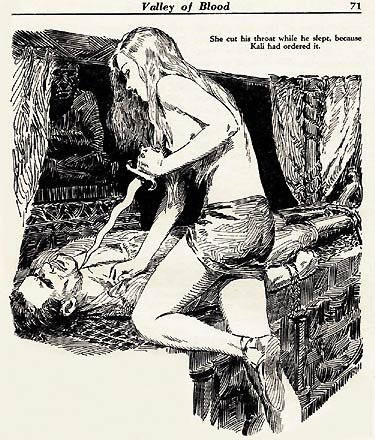
Our four characters are sailing the mysterious South Pacific seas, not humming Bali Hai because Rogers and Hammerstein haven’t written the song yet. Anyhow, clever Arnold discovers two things. One, Judy is a doctor. He deduces this from the way she hands her cousin a scissors to slit some book pages. (Tidbit for youngsters …This is a time when book pages have to be slit apart. If you go into a library and find an old book with unslit pages you know the book hasn’t been read, no matter how many times it may have been checked out. But I digress ….). Apparently Judy slapped the scissors into her cousin’s hand the way a surgeon would. And clever Arnold concluded Judy was not a surgical nurse because she looked more like a doctor. Okay….. The second thing Arnold discovered was that “THERE WAS PLAGUE ON THE SHIP.” Now, to give Judy some credit here, she noticed that bodies were being dropped overboard after dark and thought something was odd, especially since some of the bodies, including the doctor, weren’t really, most sincerely dead. Besides, a rat dramatically expires at the entrance to the dining room. Most of the passengers just figured it had eaten some of their dinner.
WHAT TO DO!!!! Should Judy reveal she is a doctor and come to the aid of the passengers who are becoming sick??? Not our Judy!! Screw the Hippocratic Oath! Let’s get off this damn ship! So Judy and the two heroes plan their escape when the ship docks at a small village. They have to sneak off the ship because there is a cholera epidemic in the village so passengers can’t disembark! (Talk about the headache and upset stomach dilemna….plague or cholera, maybe even both!) Quietly, Judy prepares. She takes some quinine, lots of money, and dresses in her prettiest outfit with silk stockings and lovely dancing slippers. Then they hail a passing canoe and climb aboard, only to be discovered by Mrs. Mardick. Afraid she will blow the whistle on their escape and thwart them (neat word, thwart), they force her into the canoe. Didn’t think to tie her up and stuff her in a life boat where she would be discovered the next morning. Nope, much better to bring her along.
THE VILLAGE The plan was to hire a fishing boat to sail up the coast 30 miles to a port where they can get connections to Europe. They will be on their way home before their passenger ship gets out of quarantine. Now they face their first major obstacle. The village fishermen won’t sail them up the coast because they are “fighting” with the fishermen up the coast. Now, considering this is a very, very poor village and that our heroes’ pockets are stuffed with money, wouldn’t it be sensible to “rent” or even “buy” one of the little fishing boats? It would probably be more money than the villagers saw in a lifetime and both Judy and Stewart are world-class sailors.. Noooo… There would be no novel if this happened. Instead, they hire a guide who speaks a sort of English and head into the jungle!!!!! Let me stress, THERE IS NO REASON TO HEAD INTO THE JUNGLE!!! So our six adventurers.. ..Deotlan the faithful Indian companion, the faithful guide and his beautiful native girlfriend Wan Nau……and our four Europeans head into the deep, dark, dank, dim, dismal, damp and dangerous jungle. (Guess which two do not survive, bearing in mind that “white is right”.)