Archive for January, 2014
12 Jan 2014

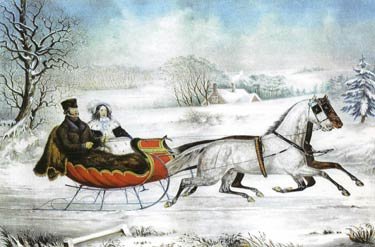
Winter in Rumford, Maine brings out the best of Sippi‘s repartee.
Winter came like a postcard a long time ago. The snow drifted down in slow motion, the big, fat flakes parachuting in and accumulating gently on the frosted earth. There was a lot, all at once, and in the morning the birdhouse wore a pope’s hat, and the birdbath was a cheesecake. The sun shone and the trees wore their coat of flakes like ermine.
Then the rain came. It turned the pope’s hat to a drunkard’s fedora, and the cheesecake to a dog’s breakfast. It came down mechanically, at an angle that could be measured anywhere along its route, as methodical as a secret policeman; the icicles on the eaves turned from a little fringe to dragon’s teeth. The trees threw their coats on the ground with their shivering, and left craters like the moon in the slumping snow.
Then it did it all again. Snow fell on top of the icy film over the styrofoam snow, and brought Currier and Ives back to town. Then the ice came and put Currier and Ives in the stocks in the town square for the crime of being jolly out of turn, and pelted them with everything handy. The roads turned to suggestions. The pavement was just the bottom layer of an arctic lasagne of sand and ice and mud and snow and general corruption. My wife’s car and my truck told me to shove it more than once when I turned their keys.
Then the thermometer began a truth or dare phase. It had been ten degrees below normal for months, but now it wanted to impress people. Pinch the unwary. Show you who’s in charge around here. Twice it showed me twenty below and kept going, and days ticked off the calendar, one after another, without ever reaching the number one. The ladder to spring had been drawn up into the calendar’s treehouse. We’d have to set a spell and wait for it.
There is no heat but what we can make. I shoveled the logs into the stove like a man in the belly of some great, dripping, iron ship, while icebergs passed by the portholes in first class. Nothing you could do could touch twenty below. You could set your house itself on fire and not raise the temperature in the living room ninety degrees. What chance do you and your disassembled birches and beeches have? But one bails a leaky rowboat whether you have a bucket or a teaspoon.
11 Jan 2014

Beowulf prepares to behead Grendel
Stanford medievalist Elaine Treharne was doubtless moved by the perception of a similarity of compressed concision between Twitter tweets and Old English alliterative poetry to try to produce a Twitter version of the Beowulf epic. The Atlantic admired the elegance of her result.
Her Beowulf-in-a-hundred-tweets blog is here.
Sample:
“You guard my hall, Beowulf,” said Hrothgar, stumbling to bed. Our hero disarmed: “Hand-to-hand we fight. God let win who he will.”
11 Jan 2014
Some years ago, one broilingly hot July day, I was in New Haven going to the air-conditioned Sterling Memorial Library to do some research for a writing project.
Beside the front entrance steps, a colored Yale maintenance staff employee was working in the hot sun, perspiration pouring down his face, chipping out the aged mortar from between sandstone blocks in preparation for re-pointing them. It was a nasty job, picking out the old cement using a small sledgehammer and a cold chisel, and it was an exponentially nastier job when performed in 100+ degree weather under a bright sun.
As I approached, I couldn’t help noticing that the entire crowd of typically left-wing, conspicuously socially conscious liberals passing directly past the maintenance guy were utterly oblivious to his predicament and to his very existence. He might as well have been a potted plant or a steel trashcan standing beside the library’s elaborate oaken doors for all the attention he was receiving.
I also could not help but perceive that that workman was aware of how thoroughly he was being ignored (and implicitly despised). He was doing a man’s work, a difficult, painstaking, and unpleasant job under extraordinarily adverse conditions. Being only human, he naturally desired some kind of fraternal sympathy from his fellow man, and some recognition that he was doing an unusually tough job under unusually bad conditions. It was impossible not to see that finding himself invisible, divided from the dozens of fellow representatives of humanity passing with a few feet of him by barriers of class as obdurate and inflexible as the stones he was working on, was bitterly alienating and insulting. He was holding himself with an air of resentment, and I could see him muttering angrily to himself under his breath.
So I deliberately slowed, and paused next to him, and said: “It is sure a hot day to be doing that kind of work!” “Sho’ is,” he responded smiling happily and taking a moment to pull out his handkerchief and wipe his face. “Damn hot.” I nodded in the direction of the passing faculty and students. “Some people don’t know what a day’s work is like.” I said, and he laughed appreciatively.
It only took a few seconds, but I’d managed to give him the sense of human solidarity he obviously needed, while reassuring him that at least one passerby recognized the nature and cost of his personal contribution to physical survival of the University.

Anthony Esolen, who teaches English at Providence College, is also the kind of guy who has doubtless worked with his hands, and who is therefore capable of perceiving the yawning chasm between professoriate and the proletariat, between the people in America who actually work up a sweat and the members of the community of fashion elite who call all the shots.
We professors at Providence College have for two years now been working in the midst of invisible men, men… who in these times are almost as insane and as morally blinkered as the professors they serve. The men have built a large and handsome Center for the Humanities, out of brick and stone. They have had to transform a hill and a parking lot to get the project started. They have turned an old field into a new facility for soccer, field hockey, and track, complete with bleachers and a press house, and eighty foot tall lights for events at night. They have laid hundreds of yards of concrete pathways. They have cleared out a useless hill thicketed with scrub trees and made it into a decorative border for the campus. They have built temporary parking lots and torn them out again and replaced them with sod. They have dug out stumps and planted trees. They have worked with jackhammers, drills, chisels, backhoes, saws, scaffolding, trowels, wheelbarrows, sledges, and the indispensable hands, arms, legs, shoulders, and back. They have done all this while remaining as quiet and unobtrusive as they could be.
They work hard, at work that takes its toll on their bodies, in all seasons and in all but the filthiest weather. Yet I doubt that the feminist professor – and most professors are feminist – gives them a passing thought. Without men like them, we would have nothing; nothing to eat, no metal for our cars, no bricks, no stone, no wooden planks, no houses, no roads, no public buildings, no clean running water, nothing. They do work that is more than desirable. It is absolutely necessary. I teach English poetry; that is not necessary. I will not trouble to discuss sociology, feminist or otherwise.
We might be apt to shrug and say, “What of it? They are well paid,†and some of them are. Some of them are not, but then, don’t college graduates deserve to make more money than workers on the land, of the land, and under the land? And they do have the vote, don’t they? Everyone gets one vote, and that makes everyone equal.
Well, no, it doesn’t, no more than if everyone enjoyed the privilege of spitting once into a national spittoon. We are looking for equality as men, so that we can say what Mr. Morgan said. And the common laborers enjoy no such thing. They have virtually no influence over what their children are taught in school, and how. Their sons are regularly badgered for being boys, and bullied into ingesting drugs to conform their boyish natures to the ideal of mannerly servility. They are not pillars of their communities, because there are no more communities; there are political abstractions called “towns†and “cities,†whose leaders take their cultural instructions from the media and from the national government, and who themselves are less and less likely to have grease under their fingernails or freckles of carbon in their faces. They are not the masters in their own homes; the effeminate vices peddled by their “betters†have seen to that. They are likely to have fathered children out of wedlock, or to have been divorced, sometimes with good cause, far more often without. They ingest the poisons peddled by mass entertainment. Their sons surf the internet for porn, get fat, wear their pants around their thighs so as to look like dwarfs stretched on a rack, can’t dig a post-hole or sing a hymn, and are given comic books in school instead of Moby-Dick. Our need for these fathers is total, yet their authority is minuscule even in their own localities, and their influence upon national politics is zero.
If such men ever took it into their heads to strike, not against the owner of the coal mine, but against their masters in the media, the classrooms, the board rooms, the state capitols, and Washington, who knows what might happen? We might have a republic again. But I’m not holding my breath. A John Dickinson, mild-tempered though he was, would be at a loss for words to fathom the depth of our servility, both moral and political. What, after all, were a couple of pence on a bag of tea, compared with thousands of unread pages managing every facet of medical treatment for three hundred million people? Slaves do sometimes rise up. Pampered slaves, never.
Hat tip to Bird Dog.
10 Jan 2014

Cracked.com
Hat tip to Randy Barnett.
09 Jan 2014
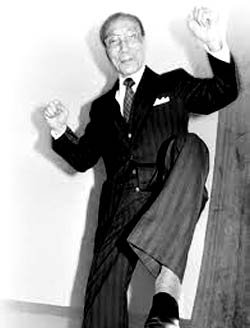
The great Run Run Shaw, Hong Kong producer of countless examples of martial arts cinema, who brought Chinese culture and flying Kung Fu masters to the world, passed away, allegedly at the admirable age of 106. Quentin Tarantino is basically his disciple, and Tarantino acknowledges the debt by routinely prefacing his own films with the Shaw Brothers logo.
Variety:
Shaw’s birthday and his exact age have long been clouded in mystery — his widow Mona Shaw (aka Mona Fong) has often refused to clarify the issue — and other sources put his age at 107. He died at 6.55am local time in Hong Kong on Jan 7, 2014.
From his early work doing odd jobs around theaters and cinemas controlled by his older brothers, Shaw went on to establish and run the leading production studios in Asia by the 1950s. Along the way he ushered in significant technical progress into Chinese film.
Shaw is best known for the Shaw Brothers’ martial arts output of the 1960s, but he should rightly also be given credit for pioneering a form of Asian musical film and for putting Hong Kong on the global cinema map.
The Shaw Brothers company was in its heyday in the 1960s and 1970s and was influential in both the Asian and Western film industries. He personally has credits on some 360 films, ranging from martial arts classics to Ridley Scott’s “Blade Runner.â€
/div>

Feeds
|