[T]hese are a few of a growing number of guerrilla stickers that have recently appeared on the network.
They use the same fonts and designs as London Underground’s famous branding.
But they subvert the intended message making often amusing but sometimes serious points about anything from overcrowding to Tube etiquette.
Some commuters are amused by the stickers, including London blogger, Annie Mole, who says: “A number of them are funny and it breaks up the journey a bit.”
But British Transport Police (BTP) warned: “The costs of graffiti are substantial for the railway industry in terms of repairs and clean-up, and can leave permanent scars on the infrastructure.”
In the American Scholar, Jessica Love admits that the English language is particularly rich in words for colors, tastes, and textures, but laments our language’s “lexical void” with respect to words for smells.
The solution, she explains, would be for English to follow its usual practice and borrow some words from the vocabulary of another language. In this case, we want to plunder the language used by about 1000 hunter gatherers in West Malaysia.
[A] new study by Majid and Burenhult… [identifies] Jahai, a language spoken by a [very small] hunter-gatherer group in Malaysia that has a sizeable vocabulary to characterize scents. Jahai has more than a dozen basic odor terms, including words that translate roughly to “having a stinging smell†(used to describe the odors of petrol, bat poop, and ginger root) and “having a bloody smell that attracts tigers†(used to describe, among other things, the odor of crushed head lice).
The researchers confirmed the Jahai olfactory lexicon by comparing the performances of Jahai speakers and English speakers on two different tasks: color-naming and scent-naming. Color-naming required individuals to describe 80 different colored chips as best they could, while scent-naming required them to sniff odors extracted from lemons, turpentine, smoke, and the like, and do the same. As a group, the English speakers all tended to agree—and pithily—on color terms, just as we’d expect given how strongly color terms are encoded in English. But they were stumped by scents, offering disagreeing, and long-winded, responses. Jahai speakers, on the other hand, experienced much less difficulty describing the odors, finding them just as codable as colors (though interestingly, they showed poorer agreement on color terms than English the speakers did).
Although the volunteers tended to describe each smell and color in their own words, it quickly became clear that Jahai speakers could describe colors and odors with equal precision, while English speakers showed much less aptitude for smells than for colors. While Jahai speakers’ ability to distinguish smells averaged out just a few percentage points below their ability to distinguish colors, English speakers’ odor-naming precision averaged out to less than one tenth of their color distinction specificity.
Just as English has precise color terms like “mauve†and “cerulean,†Jahai has highly precise terms for smells – such as cŋεs, “the smell of petrol, smoke and bat droppings,†itpɨt, “the smell of durian fruit, Aquillaria wood, and bearcat,†pʔus “a musty smell, like old dwellings, mushrooms and stale food,†and plʔεŋ, “a bloody smell that attracts tigers.†English speakers, meanwhile, tended to rely on broader smell terms like “smoky,†“sweet,†“piney†and so on.
The odious Yale Administration recently responded to the technological progress which transferred the printed-on-paper Course Critique (which my colleagues and I on the Yale Daily News first produced in the Fall of 1967) to a more flexible searchable electronic version on the Internet to tyrannically exercise the university’s power as webhost to censor and shut it down.
One has to shake one’s head over the fact that Yale continues to manage to hire and put power into the hands of people who are both so inclined to misuse power and simultaneously so lame. Dean Dodo who made the decision to take that website down obviously had only the dimmest reptilian understanding of the possibilities of technology and the enterprise and skill of the Yale undergraduate.
In January 2012, two Yale students named Harry Yu and Peter Xu built a replacement to Yale’s official course selection website. They it called YBB+ (Yale Bluebook Plus), a “plus†version of the Yale-owned site, called Yale Bluebook. YBB+ offered different functionality from the official site, allowing students to sort courses by average rating and workload. The official Yale Bluebook, rather, showed a visual graph of the distribution of student ratings as well as a list of written student reviews. YBB+ offered a more lightweight user interface and facilitated easier comparison of course statistics. Students loved it. A significant portion of the student body started using it.
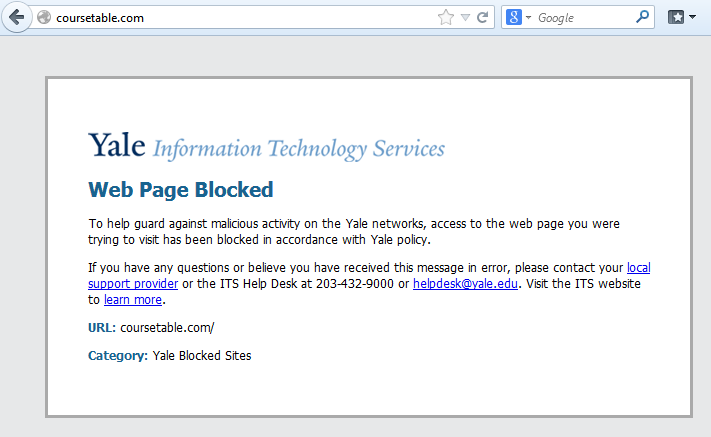
Fast-forward two years. Last Friday (1/10/14), Yale blocked YBB+’s IP address on the school network without warning. When contacted, Yale said that YBB+ infringed upon Yale’s trademark. Harry and Peter quickly removed the Yale name from the site, rebranded it as CourseTable and relaunched. Yale blocked the website again, declaring the website to be malicious activity.
Later that weekend, Yale’s administration told the student developers that the school didn’t approve of the use of its course evaluation data, saying that their website “let students see the averaged evaluations far too easilyâ€. Harry and Peter were told to remove the feature from the CourseTable website or else they would be referred to the school’s punishment committee. …
What if someone made a piece of software that displays Yale’s course evaluation data in a way that Yale disapproves of, while also (1) not infringing on Yale’s copyrights or trademarks, (2) not storing any sensitive data, (3) not scraping or collecting Yale’s data, and (4) not causing damages to Yale’s network or servers? If Yale censors this piece of software or punishes the software developer, it would clearly characterize Yale as an institution where having authority over students trumps freedom of speech.
Guess what? I made it last night.
I built a Chrome Extension called Banned Bluebook. It modifies the Chrome browser to add CourseTable’s functionality to Yale’s official course selection website, showing the course’s average rating and workload next to each search result. It also allows students to sort these courses by rating and workload. This is the original site, and this is the site with Banned Bluebook enabled (this demo uses randomly generated rating values).
Banned Bluebook never stores data on any servers. It never talks to any non-Yale servers. Moreover, since my software is smarter at caching data locally than the official Yale course website, I expect that students using this extension will consume less bandwidth over time than students without it. Don’t believe me? You can read the source code. No data ever leaves Yale’s control. Trademarks, copyright infringement, and data security are non-issues. It’s 100% kosher.
My intent behind Banned Bluebook is to demonstrate two points to Dean Miller and the Yale administration:
If Yale grants students access to data, the university does not have the right to specify exactly how students must view the data.
Censorship through IP blocking and Deep Packet Inspection is not only unethical, it’s also futile.
Don’t the Nazi tools they hire to run Yale even go to the cinema? If Dean Wurmser has seen Josh Wheedon’s “Serenity” (2005), he or she would have heard the line from Mr. Universe: You can’t stop the signal, Mal.
Oberlin’s most famous alumna, Lena Dunham, appeared in Vogue this month, prompting Jezebel to offer a $10,000 reward for copies of the pre-Photoshopped images of Dunham.
Vogue [now] has a woman who rightfully declares that her appearance, with all of its perceived imperfections, shouldn’t be hidden and doesn’t need any fixing. Lena Dunham has spoken out, frequently, about society’s insane and unattainable beauty standards. Dunham embraces her appearance as that of a real woman; she’s as body positive as they come. But that’s not really Vogue’s thing, is it? Vogue is about perfection as defined by Vogue, and rest assured that they don’t hesitate to alter images to meet those standards. It doesn’t matter if any woman, including Lena, thinks she’s fine the way she is. Vogue will find something to fix.
To be very clear: Our desire to see these images pre-Photoshop is not about seeing what Dunham herself “really” looks like; we can see that every Sunday night or with a cursory Google search. She’s everywhere. We already know what her body looks like. There’s nothing to shame here. Nor is this rooted in criticism of Dunham for working with Vogue. Entertainment is a business, after all, and Vogue brings a level of exposure that exceeds that of HBO.
This is about Vogue, and what Vogue decides to do with a specific woman who has very publicly stated that she’s fine just the way she is, and the world needs to get on board with that. Just how resistant is Vogue to that idea? Unaltered images will tell.
—————————–
$10,000 works. Jezebel reports: “Within two hours of offering $10,000 for unretouched images from Annie Leibovitz’s photography session with the HBO star, we received six allegedly unaltered images.”
The elephant (sorry, Lena!) in this room of rage is that, let’s face it, Lena Dunham really isn’t that pretty.. Even glammed up for Vogue, those monster thighs lobster-clawing the neck of the guy who’s bearing her on his shoulders really do have some “perceived imperfections.†The best that you say about Dunham is that she has nice hands and wouldn’t be too bad-looking if she lost a few and paid a visit to Dr. Tattoff.
But nobody can say that–because “body positivityâ€â€“considering yourself a raving beauty no matter how much you weigh or what you actually look like–is a central tenet of feminism. That’s apparently why Dunham gets naked in nearly every episode of Girls, why Jezebel is going all pious (it’s Vogue’s fault!), and why Slate’s Katy Waldman feels compelled to call Dunham “lovelyâ€:
Jez is not trying to expose Dunham—it’s continuing its crusade against the fashion magazines that make us all feel like crap and have, in many ways, contributed to a pop culture in which Dunham’s perfectly lovely physique is so outside the norm.
Yes, the point of fashion magazines is to “make us all feel like crap.†That’s why Vogue has 1.3 million subscribers. But let’s go on pretending.
People collect all sorts of things. Outside reports on one very expensive item which came right out of a trash heap.
A tattered, soiled shoe unearthed in the backyard of a Eugene, Oregon, home sold for $1,500. That’s actually a fair price considering the backyard belonged to Nike co-founder Bill Bowerman, and the shoe was one of the first shoes to sport the Nike swoosh—ever.
Jordan Geller, an avid shoe collector and owner of ShoeZeum in California, purchased the artifact from Jeff Wasson, a utilities worker from Oregon. In 2010, Wasson and Bill Bowerman’s son, Tom, unearthed a buried trash pile containing dozens of shoes and an original waffle iron that was used to mold soles. Although the majority of the archeological dig is now preserved in Nike’s historical archives, Wasson asked for one piece of corporate history, and the younger Bowerman obliged.
“This is the first real prototype that I’ve ever seen come to market. It’s a once-in-a-lifetime find,” Geller told ESPN. “This shoe is really special … because Bill Bowerman made this from his hands.”
This baby animal has markings rather like those found on baby wild boars. Can you identify the critter? It actually took me a couple of tries to figure it out.