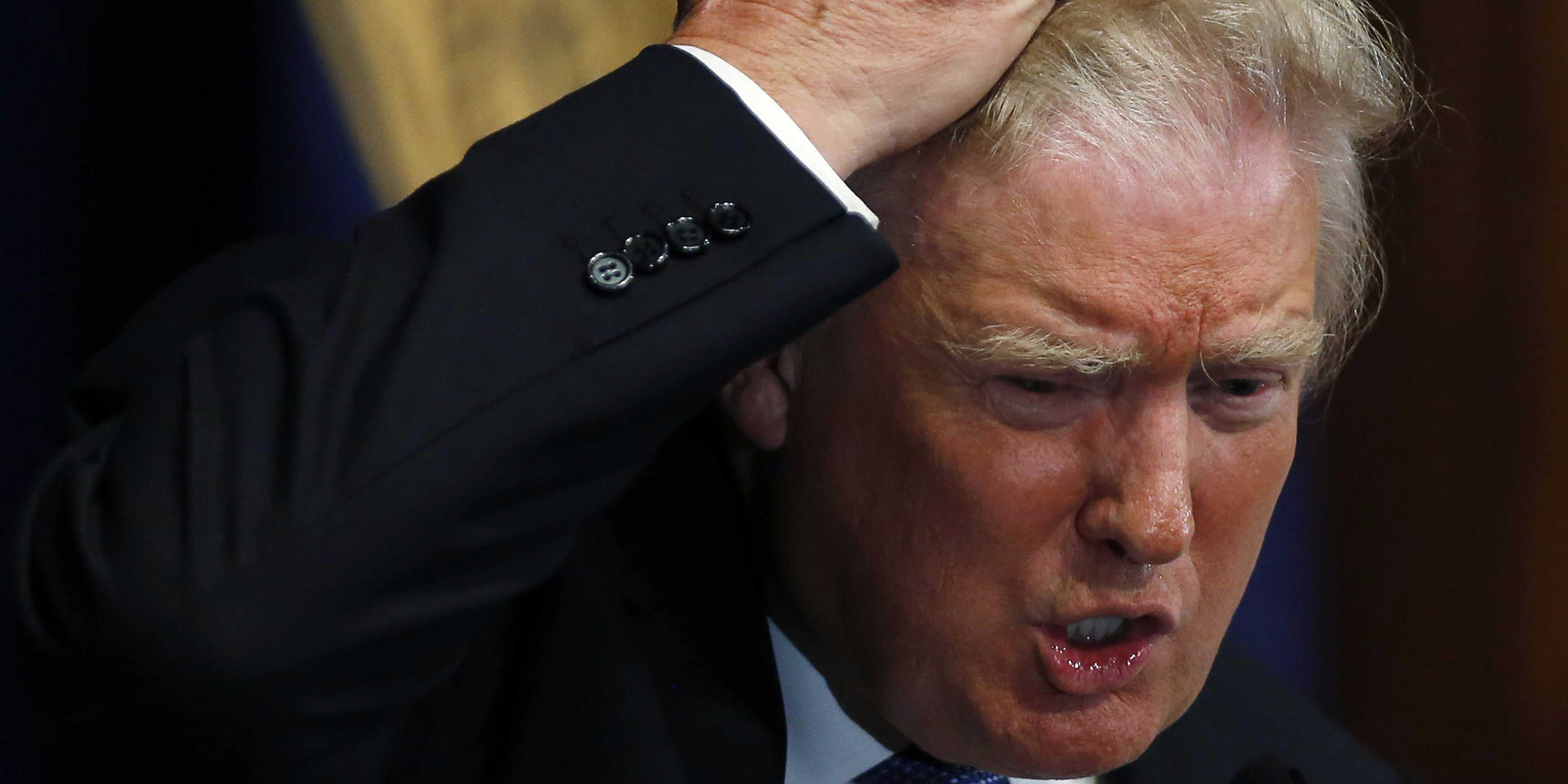
John Smith was an ardent Trump supporter since the billionaire first threw his hat in the ring. However, that might change after the local ironworker was shot by Trump on 5th avenue this weekend.
Sitting in his hospital bed, John ran through the reasons why he might have to switch his vote. “I just dunno anymore. I mean, one second I’m just walking across 5th avenue during my lunch hour and the next second, Donald comes up to me, says something about ‘it’s going to be huge’, and shoots me in the gut.â€
“However, I don’t know who else I can vote for,†he added. “None of the other candidates really excite me the way Trump does. He’s the only guy who is willing to build that wall and stand up for American workers like…oh… Ouch! Ouch! Ouch! Could you call the nurse?â€
This is not John’s first encounter with a presidential candidate. The week before, he was courted by Vermont Senator Bernie Sanders who clubbed him on the back of the head and stole his wallet, and this past Monday, he was kicked in the shins by former Maryland governor Martin O’Malley.
Ed Straker, at American Thinker, analyses exactly why Donald Trump got schlonged in Iowa.
Donald Trump does everything in a big way. Even losing. Not only did he lose to Ted Cruz in Iowa, but he came very close to a humiliating third place behind Marco Rubio. As recently as yesterday, Donald Trump was saying he wanted to win in Iowa, and if he didn’t, that it would all have been a big waste of time.
“Unless I win, I would consider this a big, fat, beautiful – and, by the way, a very expensive – waste of time,” Trump said this weekend, speaking to supporters during a whirlwind tour of Iowa.
Well, I guess it was a big waste of time, then. …
Laziness. Donald Trump was too lazy to campaign the traditional way, avoiding bus tours, small towns, and one-on-one meetings with voters. Instead, he flew in on Trump Force One, spoke for an hour, and then flew home to his bed in New York. He felt he didn’t have to follow the traditional rules of campaigning because he is Donald Trump. In a state where personal contact with the candidate is expected, Trump was wrong.
Not only was Trump lazy, but his supporters were lazy, perhaps taking a cue from their idol. On websites they would yell in all caps, “TRUMP WILL WIN! TRUMP WILL WIN!,” but they were so busy jamming down their caps lock keys that many of them didn’t even bother to vote.
It was said that a record turnout would guarantee a Trump victory. There was a record turnout, all right, but it was a record turnout for Ted Cruz.
Tintoretto, Presentation of Jesus at the Temple, 1550-1555, Gallerie dell Accademi, Venice
From Robert Chambers, The Book of Days, 1869:
From a very early, indeed unknown date in the Christian history, the 2nd of February has been held as the festival of the Purification of the Virgin, and it is still a holiday of the Church of England. From the coincidence of the time with that of the Februation or purification of the people in pagan Rome, some consider this as a Christian festival engrafted upon a heathen one, in order to take advantage of the established habits of the people; but the idea is at least open to a good deal of doubt. The popular name Candlemass is derived from the ceremony which the Church of Rome dictates to be observed on this day; namely, a blessing of candles by the clergy, and a distribution of them amongst the people, by whom they are afterwards carried lighted in solemn procession. The more important observances were of course given up in England at the Reformation; but it was still, about the close of the eighteenth century, customary in some places to light up churches with candles on this day.
At Rome, the Pope every year officiates at this festival in the beautiful chapel of the Quirinal. When he has blessed the candles, he distributes them with his own hand amongst those in the church, each of whom, going singly up to him, kneels to receive it. The cardinals go first; then follow the bishops, canons, priors, abbots, priests, &c., down to the sacristans and meanest officers of the church. According to Lady Morgan, who witnessed the ceremony in 1820:
‘When the last of these has gotten his candle, the poor conservatori, the representatives of the Roman senate and people, receive theirs. This ceremony over, the candles are lighted, the Pope is mounted in his chair and carried in procession, with hymns chanting, round the ante-chapel; the throne is stripped of its splendid hangings; the Pope and cardinals take off their gold and crimson dresses, put on their usual robes, and the usual mass of the morning is sung.’
Lady Morgan mentions that similar ceremonies take place in all the parish churches of Rome on this day.
It appears that in England, in Catholic times, a meaning was attached to the size of the candles, and the manner in which they burned during the procession; that, moreover, the reserved parts of the candles were deemed to possess a strong supernatural virtue:
‘This done, each man his candle lights,
Where chiefest seemeth he,
Whose taper greatest may be seen; And fortunate to be,
Whose candle burneth clear and bright: A wondrous force and might
Both in these candles lie, which if At any time they light,
They sure believe that neither storm Nor tempest cloth abide,
Nor thunder in the skies be heard, Nor any devil’s spide,
Nor fearful sprites that walk by night,
Nor hurts of frost or hail,’ &c.
The festival, at whatever date it took its rise, has been designed to commemorate the churching or purification of Mary; and the candle-bearing is understood to refer to what Simeon said when he took the infant Jesus in his arms, and declared that he was a light to lighten the Gentiles. Thus literally to adopt and build upon metaphorical expressions, was a characteristic procedure of the middle ages. Apparently, in consequence of the celebration of Mary’s purification by candle-bearing, it became customary for women to carry candles with them, when, after recovery from child-birth, they went to be, as it was called, churched. A remarkable allusion to this custom occurs in English history. William the Conqueror, become, in his elder days, fat and unwieldy, was confined a considerable time by a sickness. ‘Methinks,’ said his enemy the King of France, ‘the King of England lies long in childbed.’ This being reported to William, he said, ‘When I am churched, there shall be a thousand lights in France !’ And he was as good as his word; for, as soon as he recovered, he made an inroad into the French territory, which he wasted wherever he went with fire and sword.
At the Reformation, the ceremonials of Candlemass day were not reduced all at once. Henry VIII proclaimed in 1539:
‘On Candlemass day it shall be declared, that the bearing of candles is done in memory of Christ, the spiritual light, whom Simeon did prophesy, as it is read in. the church that day.’
It is curious to find it noticed as a custom down to the time of Charles II, that when lights were brought in at nightfall, people would say—’ God send us the light of heaven!’ The amiable Herbert, who notices the custom, defends it as not superstitious. Some-what before this time, we find. Herrick alluding to the customs of Candlemass eve: it appears that the plants put up in houses at Christmas were now removed.
Down with the rosemary and bays,
Down with the mistletoe;
Instead of holly now upraise
The greener box for show.
The holly hitherto did sway,
Let box now domineer,
Until the dancing Easter day
Or Easter’s eve appear.
The youthful box, which now hath grace
Your houses to renew,
Grown old, surrender must his place
Unto the crisped yew.
When yew is out, then birch comes in,
And many flowers beside,
Both of a fresh and fragrant kin’,
To honour Whitsuntide.
Green rushes then, and sweetest bents,
With cooler oaken boughs,
Come in for comely ornaments,
To re-adorn the house.
Thus times do shift; each thing in turn does hold;
New things succeed, as former things grow old.’
The same poet elsewhere recommends very particular care in the thorough removal of the Christmas garnishings on this eve:
‘That so the superstitious find
No one least branch left there behind;
For look, how many leaves there be
Neglected there, maids, trust to me,
So many goblins you shall see.’
He also alludes to the reservation of part of the candles or torches, as calculated to have the effect of protecting from mischief:
‘Kindle the Christmas brand, and then
Till sunset let it burn,
Which quenched, then lay it up again, Till Christmas next return.
Part must be kept, wherewith to tend
The Christmas log next year;
And where ‘tis safely kept, the fiend Can do no mischief there.’
Considering the importance attached to Candlemass day for so many ages, it is scarcely surprising that there is a universal superstition throughout Christendom, that good weather on this day indicates a long continuance of winter and a bad crop, and that its being foul is, on the contrary, a good omen. Sir Thomas Browne, in his Vulgar Errors, quotes a Latin distich expressive of this idea:
‘Si sol splendescat Maria purificante,
Major erit glacies post festum quam fait ante;
which maybe considered as well translated in the popular Scottish rhyme:
If Candlemass day be dry and fair,
The half o’ winter’s to come and mair;
If Candlemass day be wet and foul,
The half o’ winter’s gave at Yule.’
In Germany there are two proverbial expressions on this subject: 1. The shepherd would rather see the wolf enter his stable on Candlemass day than the sun; 2. The badger peeps out of his hole on Candlemass day, and when he finds snow, walks abroad; but if he sees the sun shining, he draws back into his hole. It is not improbable that these notions, like the festival of Candlemass itself, are derived from pagan times, and have existed since the very infancy of our race. So at least we may conjecture, from a curious passage in Martin’s Description of the Western Islands. On Candlemass day, according to this author, the Hebrideans observe the following curious custom:
The mistress and servants of each family take a sheaf of oats and dress it up in women’s apparel, put it in a large basket, and lay a wooden club by it, and this they call BrÃd’s Bed.; and then the mistress and servants cry three times, “BrÃd is come; BrÃd is welcome!†This they do just before going to bed, and when they rise in the morning they look among the ashes, expecting to see the impression of BrÃd’s club there; which, if they do, they reckon it a true presage of a good crop and prosperous year, and the contrary they take as an ill omen.
detail, frontispiece of Thomas Hobbes, Leviathan, 1651.
In Iowa today, we are beginning participation in ritual activities intended to persuade us that we are a free people electing our own government which governs with our assent. Jason Brennan, a professor at Georgetown, recently posted a short essay arguing that the degree of consent we actually have in a mass democracy is so limited as to be, in most real circumstances, practically non-existent.
In general, our relationship as individuals to our government doesn’t look much like a consensual relationship.
If you don’t vote or participate, your government will just impose rules, regulations, restrictions, benefits, and taxes upon you. Except in exceptional circumstances, the same outcome will occur regardless of how you vote or what policies you support. So, for instance, I voted for a particular candidate in 2012. But had I abstained or voted for a different candidate, the same candidate would have won anyways. This is not like a consensual transaction, in which I order a JVM and the dealer sends me the amp I ordered. Rather, this is more a like a nonconsensual transaction in which the dealer decides to make me buy an amp no matter whether I place an order or not, and no matter what I order.
If you actively dissent, the government makes you obey its rules anyways. For instance, you can’t get out of marijuana criminalization laws by saying, “Just to be clear, I don’t consent to those laws, or to your ruleâ€. This is unlike my relationship with my music gear dealer, where “no†means “noâ€. For government, your “no†means “yesâ€.
You have no reasonable way of opting out of government rule. Governments control all the habitable land, and most of us don’t have the resources or even the legal permission to move elsewhere. Governments won’t even let you move to Antarctica if you want to. At most, a privileged few of us can choose which government we live under, but the vast majority of us are stuck with whatever government we’re born with. This is unlike buying an amp from Sweetwater.com, which, by the way, I highly recommend as a dealer.
Finally, governments require you to obey their rules, pay taxes, and the like, even when they don’t do their part. The U.S. Supreme Court has repeatedly ruled that the government has no duty to protect individual citizens. Suppose you call the police to alert them that an intruder is in your house, but the police never bother dispatch someone to help you, and as a result the intruder shoots you. The government still requires you to pay taxes for the protection services it chose not to deploy on your behalf.
So, in summary, it looks like in general our relationship to our governments lacks any of the features that signify a consensual transaction.
None of this is to say that governments are unjust or illegitimate, or that we ought to be anarchists. There are other reasons to have governments. Nor is it to say that democracies are not in some way special. Democracies in fact do a much better job than alternative forms of government of responding to their concerns and interests of most of their members. But it’s a stretch to say that democracy rests on the consent of the governed, or, more precisely, it’s a stretch to say that you consent to democratic rule.
Flower Shell is a 12-gauge shotgun shell that is loaded with flower seeds instead of shot. When paired with a shotgun, Flower Shell can be used to forcefully scatter seeds or blast them into the ground. Flower Shell was designed by Per Cromwell of Studio Total, a Swedish innovation studio. Cromwell is raising funds for the project on Indiegogo.
Nguyen Hoa Giai, a former Viet Cong guerilla fighter, discusses eight common misconceptions about the War in Vietnam, thereby providing an interesting read.
Once the fighting started, a lot of people died, well over a million on our side alone. For the war to continue, a constant stream of new fighters had to join up, and they didn’t have the benefit of such luxuries as “functional equipment” or “the slightest idea what to do.” Over 90 percent of these new recruits were teenagers or younger. Many of them weren’t even particularly invested in the “cause” itself. Supporting Communism or the dream of a united Vietnam was less a motivator than wanting revenge for the death of a parent, loved one, or child. The Viet Cong (literally: the National Liberation Front or just “the front”) were just a means for securing that revenge.
Most of them were aware that Stalin and Mao each had movements named after them (Stalinism and Maoism), so they just assumed Socialism was named after a guy named Social and Communism was named after a guy named Commun. A distressing number of my co-soldiers still thought we were fighting France. They knew of Ho Chi Minh, but only in vague propagandistic terms, not the man’s actual history. When we told them we wanted a Socialist society, they just said yes because they were mostly poor, grieving peasants living through a shortage of damns, and thus had none to spare for politics.