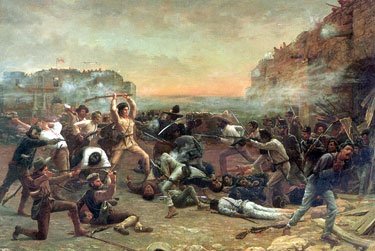
In today’s America, nincompoops and leftist demoniac fanatics have everywhere somehow managed to rise to the tippy-top of every establishment institution, even in Texas.
Texas Monthly reports that Texas Social Studies Educational Advisory Board has advocated removing the adjective “heroic” from a reference to the defenders of the Alamo.
The concept of defenders of the Alamo being heroic is engrained in the history of this state—and in the psyche of most Texans. The Alamo has been compared to the ancient Battle of Thermopylae, in which an outnumbered Greek army fended off a much larger Persian army for several days before being annihilated. But a committee streamlining the state’s history curriculum standards has removed the word “heroic†from a proposed revision of the curriculum because it is “a value-charged word.â€
Last month, the advisory group, called the State Board of Education Social Studies TEKS Streamlining Work Groups and made up of educators and historians, voted to approve a final recommendation making a number of changes to the state’s history curriculum standards. The paragraph in the seventh-grade curriculum, in which Texas history is taught, currently reads as follows:
explain the issues surrounding significant events of the Texas Revolution, including the Battle of Gonzales, William B. Travis’s letter “To the People of Texas and All Americans in the World,†the siege of the Alamo and all the heroic defenders who gave their lives there, the Constitutional Convention of 1836, Fannin’s surrender at Goliad, and the Battle of San Jacinto.
But the committee is recommending to the state board that it delete several of these passages and add one so now the standards, if adopted, would read like this:
explain the issues surrounding significant events of the Texas Revolution, including the Battle of Gonzales, the siege of the Alamo, the Constitutional Convention of 1836, Fannin’s surrender at Goliad, and the Battle of San Jacinto and Treaties of Velasco.
“‘Heroic’ is a value-charged word,†the group explains in recommending the elimination of the word. The group went on to explain that “all ‘defenders’ is too vague.†Similarly, the ten-person group recommends deleting the current standard that requires students be able to explain Travis letter from the Alamo. The streamline committee said the letter can be mentioned as context for lessons about the siege of the Alamo so that “teachers will spend less time on the analysis of the letter.†There are fewer than 250 words in that letter, but they go to the heart of what Texans think about themselves and about this state. Sometimes called the “Victory or Death†letter, it has been compared to Alfred, Lord Tennyson’s “Charge of the Light Brigade,†which immortalized a British battle in its defeat by Russians in the Crimean War.
To the People of Texas and all Americans in the world: I am besieged by a thousand or more of the Mexicans under Santa Anna…The enemy has demanded a surrender…I have answered the demand with a cannon shot… I shall never surrender or retreat …
— William B. Travis
The recommendations regarding the Alamo come as several committees work to streamline the standards that are at the heart of the state’s Texas Essential Knowledge and Skills test. They have been at this process for the better part of a year, said SBOE spokeswoman Debbie Ratcliffe. The state board does not control curriculum in Texas, but they do set the standards that are the foundation of the state’s curriculum. And, in this case, they are addressing complaints that the standards in a variety of courses are too long. So committees of educators and interested parties such as historians have been reviewing the standards with the goal of streamlining them. In the case of standards surrounding the teaching of the Texas revolution, including the Battle of Alamo, the committee estimates it will shave off 90 minutes of teaching time
2) Send Texas Rangers to apprehend every current member of that committee and take them to the state border and there instruct them to leave Texas and tell them that there is a rope and a tree waiting for any and all of them if they ever come back.
John Ellis does not approve of drinking IPAs, Heineken, Yuengling, Blue Moon, or Guiness. Not one of these widely popular choices rises to his standard.
His analysis goes:
1) IPAs don’t taste like beer.
Well, they are all ales, not beers, and representatives of a distinctly different genre, liking which does represent a specific, idiosyncratic taste. It is, I think, possible to feel that there are too many IPAs these days and one IPA is pretty much like an other, except some are even bitter-er and hopp-ier than others.
2 Heineken is bland and is not really a superior beer.
Screw Heineken. They support Gun Control. I’ll never buy or drink another Heineken. But I will note in passing that what he really means by “bland” is that Heineken is a Pilsener-style pale lager, a type of beer that is not dark, heavy, full of floating debris, and loaded with complicated earthy tastes. in other words, not the style of beer beer snobs dote upon.
3. He doesn’t like Yuengling either because Yuengling is a reasonably priced lager.
He is just prejudiced against all lager beers and all mass marketed beers. Yuengling is really pretty neat and almost everyone likes it. Yuengling is the oldest brewery in America, dating back to 1829, and is still owned by the original family. It comes from Pottsville, Pennsylvania, the county seat of Schuylkill County, in the very heart of the Anthracite Coal Region, and today’s Yuengling, honest to God! tastes kind of like, only definitely better than, the Yuengling I used to find on tap for fifteen cents a glass in local bars when I started drinking as a teenager. It has a distinctive character and authenticity and it isn’t premium priced. Yuengling is a better beer than Bud or Michelob and it’s just as cheap. What does this guy want? An egg in his beer? as they’d say back in the Coal Region.
4. He’s down on Blue Moon because he allegedly knows of some superior Belgian-style wheat beers and you ought to be drinking those.
Jesus, this guy is a snob. Well, outside the Metropolis, we are lucky if we can find Blue Moon. Raised-Pinkie-Finger Craftbier witbier made in Florida, Maine, or Washington State is not likely to be found in your supermarket in rural Virginia or at the local beer distributor in Central PA. Besides, Blue Moon (though pricey) is actually pretty good.
5. Guinness is not stout-y enough.
Americans customarily drink light lager beers. Guinness is dark, heavy, and bitter and is an acquired taste for Americans. And, according to Ellis here, getting used to Guinness is simply not enough. You have to get used to drinking the kind of stout that you could grow plants in.
Frankly, all this pretension and display of connoisseurship is beside the point. It’s only beer. It’s not Premier Cru Bordeaux or Napoleon cognac. You drink a beer after mowing your lawn or while watching idiots run into each other in the Superbowl. Beer is never haute cuisine. Beer really belongs in the unpretentious, mass-marketed workingman’s realm.
This John Ellis guy ought to leave Brooklyn and walk into a bar in Minersville or Hazleton, order a beer, and then turn up his nose and start telling everyone how this stuff is swill and they ought to be drinking $25-a-bottle craft beers with stuff swimming in them made by monks in Belgium from a medieval recipe.
Somebody has to try these things for the rest of us. Jason Gay did.
I ate a $180 steak sandwich. Not for me; don’t be ridiculous. I did it for journalism.
Let’s dispense with the obvious: A $180 steak sandwich is an indefensible purchase. It is a foodstuff strictly for vulgarians, a decadent symbol of 21st-century gluttony and the over-luxurification of everything. To buy it is to wallow in one’s privilege, one’s shameless indifference to the plight of humankind.
Other than that, it’s pretty tasty. …
Unlike, say, the beignets at New Orleans’ Cafe du Monde, the Don Wagyu $180 sandwich seems to be less of a foodie’s bucket-list experience than a freak-show curiosity: How could a sandwich cost as much as a plane ticket to Florida? This is, after all, the type of thing that makes the rest of the planet think New Yorkers are out of their minds. Was the $180 sandwich a legitimate food experience or some kind of commentary on late-stage capitalism?
I should call the sandwich by its real name: the A5 Ozaki. The “A5†is a reference to the summit-grade of Japanese beef, and “Ozaki†is the farm from which Don Wagyu gets the meat (the only U.S. establishment to receive it, the server says while I’m there). Don Wagyu also serves more affordable Katsu sandos—there’s a $22 off-menu burger, for example—but the $180 Ozaki is the cleanup hitter at the bottom of the menu. It is served medium-rare.
Ordering the A5 Ozaki is not a showy experience. The lights do not dim, the kitchen does not clap; it does not require much more of a wait than a turkey club at a diner. A slice of beef is encrusted with panko, fried, placed on toasted white bread and served quartered, like a preschooler’s PB&J. Nori-sprinkled french fries and a pickle spear are the only accompaniments.
Breaking news: I liked it. I’m not a food critic. I hardly know my cuts of meat, and I cannot offer a detailed analysis of why the A5 Ozaki is $100 more of an event than the closest-priced item, the A5 Miyazaki. I will not try to justify paying such an absurd amount for a single piece of food, especially one that can be tidily consumed in the space of five minutes. But the A5 Ozaki was light and buttery to the point of being almost ethereal, as if the sandwich knew the pressure of delivering on its comical price.
Which, of course, it does not. There is no sandwich that is possibly worth $180. But that’s the thrill (and the crime) of extravagance, is it not? Eating this thing felt right and completely wrong—more like a caper than a lunch.
The extreme nature of the ornamentation on this sword, combined with the unusual (for Scandinavia) motifs coupled with the apparent lack of a fuller (lenticular, ‘grooveless’ sword blades being a common hallmark of swords from Constantinople) may indicate that this sword was manufactured in Byzantium and may have belonged to a Varangian Guardsman or may have been gifted to a Nordic person held in esteem by the Romans.
With double-edged blade of gradual taper; inlaid on both sides in gold and silver with decorative patterns, one side bearing a gradually tapering geometric-architectural design in five stages and the other bearing a gradually tapering palmette design. The hilt comprising down-curved cross guard, sturdy tang and five-lobed pommel riveted to the upward-curving upper guard; the cross-guard, upper guard and pommel all inlaid in silver with decorative knotwork and tracery and in gold with dots.
Overall length: 94 cm (37″); Blade length: 80.6 cm (31.75″)
This rare Viking sword, the hilt of Petersen Type O, has a cross-guard with decorative devices reminiscent of those on one of the three swords that were found in the rich ship burial of about 900 at Hedeby in Denmark when it was subsequently excavated in the 1950s. More of these ‘rabbit ear’ or ‘knotted rope’ characters may be found on three of the ‘Hiltipreht’ group of swords, namely one in the Wallace Collection, London (Inv. No. A456), the Ballinderry sword in the National Museum of Ireland, Dublin (Inv. No.1928.382) and the example from Malhus in the Trondheim Museum, Norway (Petersen, Abb.89).
The credentials of this prestigious weapon are further enhanced by the decoration upon the blade. On one side there is a palmette design of inlaid silver with traces of gold that is very similar to that on a fragmented blade from the River Bann in Ireland and illustrated in Bøe. This should be compared with the inlay on a sword from the Waal near Nijmegen (Oakeshott, Records of the Medieval Sword, p.47). On the other side, the inlaid precious metals may well represent a schematic plan view of a building, as is believed to have been intended upon another silver inlaid sword illustrated and described by Ewart Oakeshott (Records of the Medieval Sword, pp.28-29).
You cannot imagine the Harvard Lampoon or the Yale Record, back in the brave old days of yore, retracting an issue because the featured humor was too raunchy or in questionable taste. Hey! we were in college.
But things are different today. Today’s students are precious, sensitive snowflakes, all woke and everything. They get triggered by references to women being rawed on basement mattresses in fraternity houses. Tasteless humor, today, is Streng verboten! meine Herren. Streng verboten!
[T]his weekend, the Rumpus crossed a line. Editors were forced to retract the publication’s annual first-year issue on Saturday in response to backlash from staff members who took offense at jokes about sexual assault that had made it into the issue.
“The black out/hooking up w freshmen jokes are really not funny,†one staffer wrote in an internal Rumpus group chat on Saturday morning, as writers and editors distributed hundreds of issues across campus. …
The staffers were reacting to an editor’s note, or “Rump’s View,†that made light of sexual assault, and to a square on the publication’s traditional “Hookup Bingo†page that included the option “Freshman’s first blackout (FREE).â€
“We here at Rumpus are happy for you and would also like to congratulate you on losing your virginity,†read the editor’s note, which was addressed to the class of 2022. “Now, before you think, ‘Shit, does Rumpus know I blacked and let a senior on the baseball team raw me on that foul mattress in the Sig Nu basement?’ the answer is yes, but we’ll unpack that later.â€
On Saturday morning, Rumpus reporters and editors went into damage control mode, scrambling across campus to remove copies of the new issue from residential college dining halls.
In a statement posted on the Rumpus’ Facebook page on Saturday afternoon, Kaylor and Kristina Cuello ’20, the other editor-in-chief, apologized for publishing “unacceptable content†and said the new issues were pulled from dining hall shelves immediately after a staffer raised concerns about the material.
“As editors-in-chief, we are deeply sorry that we allowed this content to be published,†the statement said. “Its presence in the issue was a major editorial oversight entirely on the part of the editors-in-chief, who were the only ones to have access to the final version of the issue.â€
Twelve students have quit the publication since Saturday’s incident, according to Kaylor and Cuello. Nearly half the staffers who left were not actively involved in the publication, the editors said. Kaylor and Cuello said they plan to stay on as editors-in-chief.
Brazil’s oldest and most important historical and scientific museum has been consumed by fire, and much of its archive of 20 million items is believed to have been destroyed.
The fire at Rio de Janeiro’s 200-year-old National Museum began after it closed to the public on Sunday and raged into the night. There were no reports of injuries, but the loss to Brazilian science, history and culture was incalculable, two of its vice-directors said.
“It was the biggest natural history museum in Latin America. We have invaluable collections. Collections that are over 100 years old,†Cristiana Serejo, one of the museum’s vice-directors, told the G1 news site.
Marina Silva, a former environment minister and candidate in October’s presidential elections said the fire was like “a lobotomy of the Brazilian memoryâ€.
Luiz Duarte, another vice-director, told TV Globo: “It is an unbearable catastrophe. It is 200 years of this country’s heritage. It is 200 years of memory. It is 200 years of science. It is 200 years of culture, of education.†TV Globo also reported that some firefighters did not have enough water to battle the blaze.
It wasn’t immediately clear how the fire began. The museum was part of Rio’s Federal University but had fallen into disrepair in recent years. Its impressive collections included items brought to Brazil by Dom Pedro I – the Portuguese prince regent who declared the then-colony’s independence from Portugal – Egyptian and Greco-Roman artefacts, “Luziaâ€, a 12,000 year-old skeleton and the oldest in the Americas, fossils, dinosaurs, and a meteorite found in 1784. Some of the archive was stored in another building but much of the collection is believed to have been destroyed.
Ernest Hemingway’s infatuation with the teen-age Venetian Adriana Ivancich inspired the great writer’s only awful book, “Across the River and into the Trees,” which reads, alas! like the cruelest kind of parody.
In the Spectator, Nicholas Shakespear greets the British release with the kind of savage wit that the Brits are famous for.
One rainy evening in December 1948, a blue Buick emerged from the darkness of the Venetian lagoon near the village of Latisana and picked up an Italian girl — 18, jet black wet hair, slender legs — who had been waiting for hours at the crossroads. In the car, on his way to a duck shoot, was Ernest Hemingway — round puffy face, protruding stomach and, at 49, without having published a novel in a decade, somewhat past his sell-by. He apologised for being late, and offered the rain-sodden girl a shot of whisky which, being teetotal, she refused.
So did Papa, that ‘beat-up, old-looking bastard’, encounter the siren he called ‘my last and true love’: Adriana Ivancich, a mingling of Lolita and Tadzio, who appeared to him ‘as fresh as a young pine tree in the snow of the mountains’ and who went on to serve as Hemingway’s regenerative muse for his remaining 12 years.
Of course, snark is only good when it is accurate snark. Adriana Ivancich did marry well, to a rich Count, despite her youthful flirtation with the aged Papa, and her suicide in 1983 obviously had little or no connection to events nearly 40 years earlier.
From my great uncles right down to my cousins today lots of my family were in the strike-breaking Coal and Iron Police (above) and then in their successor the Pennsylvania State Police.
Watching the media coverage of McCain’s presidential campaign against Barack Obama, I was surprised that he didn’t personally beat up black orphans on stage during campaign stops. Watching the media coverage of McCain’s funeral, I was surprised that he didn’t rise on the third day.