Sci Fi novelist Larry Correia takes on Congressman Eric Swalwell’s contention that the Second Amendment is obsolete as a defense against the federal government.
Last week a congressman embarrassed himself on Twitter. He got into a debate about gun control, suggested a mandatory buyback—which is basically confiscation with a happy face sticker on it—and when someone told him that they would resist, he said resistance was futile because the government has nukes.
And everybody was like, wait, what?
Of course the congressman is now saying that using nuclear weapons on American gun owners was an exaggeration, he just wanted to rhetorically demonstrate that the all-powerful government could crush us peasants like bugs, they hold our pathetic lives in their iron hand, and he’d never ever advocate for the use of nuclear weapons on American soil (that would be bad for the environment!), and instead he merely wants to send a SWAT team to your house to shoot you in the face if you don’t comply. …
First, let’s talk about the basic premise that an irregular force primarily armed with rifles would be helpless against a powerful army that has things like drones and attack helicopters.
This is a deeply ironic argument to make, considering that the most technologically advanced military coalition in history has spent the better part of the last two decades fighting goat herders with AKs in Afghanistan and Iraq. Seriously, it’s like you guys only pay attention to American casualties when there’s a republican in office and an election coming up.
Nobel Peace Prize Winner Barack Obama launched over five hundred drone strikes during his eight years in office. We’ve used Apaches (that’s the scary looking helicopter in the picture for my peacenik liberal friends), smart bombs, tanks, I don’t know how many thousand s of raids on houses and compounds, all the stuff that the lefty memes say they’re willing to do to crush the gun nut right, and we’ve spent something like 6 trillion dollars on the global war on terror so far.
And yet they’re still fighting.
So yes, groups of irregular locals can be a real pain in the ass to a technologically superior military force. That’s pretty obvious.
Now here is the interesting part. Best estimates are that any given time in Iraq we’ve been fighting about 20,000 insurgents at most. …
Okay, so let’s say Congressman Swalwell gets his wish, and the government says turn them in or else. And even though the government has become tyrannical enough to send SWAT teams door to door and threaten citizens with drones and attack helicopters, rather than half the states saying fuck you, this means Civil War 2, instead we’ll stick to the rosiest of all possible outcomes, and say that most gun owners comply.
In fact, let’s be super kind. Rather than a realistic number, like half or a third of those people getting really, really pissed off and hoisting the black flag, let’s say that 99% of them decide to totally put all their faith into the government, and that the all-powerful entity which just threatened to kill their entire family will never ever turn tyrannical from now on, pinky swear, so what do they have to lose? And a whopping 90% of gun owners go along peacefully.
That means you are only dealing with six and a half MILLION insurgents. The entire active US military is about 1.3 million, with about 800,000 reserve. Which is also assuming that those two Venn diagrams don’t overlap, which is just plain idiotic, but I’ll get to that too.
Let’s be super generous. I’m talking absurdly generous, and say that a full 99% of US gun owners say won’t somebody think of the children and all hold hands and sing kumbaya, so that then you are only dealing with the angriest, listless malcontents who hate progress… These are those crazy, knuckle dragging bastards who you will have to put in the ground.
And there are 650,000 of them.
To put that into perspective, we were fighting 22,000 insurgents in Iraq, a country which would fit comfortably inside Texas with plenty of room to spare. This would be almost 30 times as many fighters, spread across 22 times the area.
And that estimated number is pathetically, laughably low.
Barack Obama condescended to America and to every public figure he’s ever met at an Obama Foundation conference last Monday. He was relaxed, expansive, necktie-less, and –as usual– perfectly sure that he’s the smartest man in the world.
I’m not alone in finding Obama unbearably arrogant, John Hinderaker does, too.
This is the central conceit of liberalism: we know how to solve the world’s problems–socialism!–but those pesky conservatives just won’t go along and make it unanimous. The truth is the opposite: policy debates rage across a broad range of issues, and conservatives usually win them.
The context of former President Obama’s comments, “climate change,†is a good example. The liberal/hysteric global warming theory has been refuted, and global warming advocates now admit that their models–the only basis for hysteria in the first place–are wrong. But, like a dead frog whose legs continue to kick, clueless liberals like Barack Obama parrot the pro-government line, not because it makes any scientific sense, but because it supports their statist desires.
Which brings us to the rest of Obama’s riff: Americans are “confused, blind, shrouded with hate, anger, racism, mommy issues.†This is more or less insane. What do hate and anger have to do with scientific debates about the influence of carbon dioxide on the earth’s atmosphere? Nothing, except that hate and anger are directed against all who publish scientific data that undercut the liberals’ politically-motivated narrative.
And racism? How does race have anything to do with global warming? It doesn’t. “Racism†is now an epithet that usually has nothing at all to do with race. It is merely a term of opprobrium, like “jerk†or “a**hole,†that liberals apply to those who disagree with them.
And, finally, “mommy issues.†I have no idea what Obama was referring to here. What do “mommy issues†have to do with global warming? News accounts indicate that his audience laughed, and reporters say he was referring to President Trump. I have no clue. My only observation is that liberal journalists constantly tell us that President Trump has debased our political culture. Seriously? The debasement, as I observe it, comes almost entirely from the other side.
Has President Trump ever ascribed his political opponents’ positions to “mommy issues� Not that I recall. It is hard to imagine any former president employing such childish tropes in attacking his successors. Former Presidents Reagan and Bush–George H. W. and George W.–certainly never tried to demean their Democratic successors by asserting such stupid slanders as “mommy issues.†Not to mention racism, hate and anger.
Wherein #Obama dismisses the value of every political figure he’s dealt with in the entire world in one minute and nineteen seconds. Amazing therefore that the “world’s smartest man†accomplished absolutely nothing in eight of the longest years in history. pic.twitter.com/hMg3iK3jlN
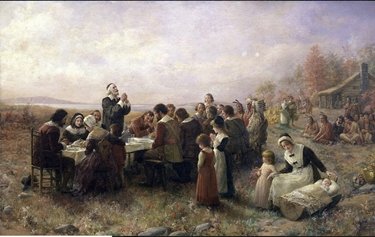
Mike Franc, at Human Events in 2005, identified the real reason for celebration at the first Thanksgiving.
Writing in his diary of the dire economic straits and self-destructive behavior that consumed his fellow Puritans shortly after their arrival, Governor William Bradford painted a picture of destitute settlers selling their clothes and bed coverings for food while others “became servants to the Indians,†cutting wood and fetching water in exchange for “a capful of corn.†The most desperate among them starved, with Bradford recounting how one settler, in gathering shellfish along the shore, “was so weak … he stuck fast in the mud and was found dead in the place.â€
The colony’s leaders identified the source of their problem as a particularly vile form of what Bradford called “communism.†Property in Plymouth Colony, he observed, was communally owned and cultivated. This system (“taking away of property and bringing [it] into a commonwealthâ€) bred “confusion and discontent†and “retarded much employment that would have been to [the settlers’] benefit and comfort.â€
Just how did the Pilgrims solve the problem of famine? In addition to receiving help from the local Indians in farming, they decided allow the private ownership of individual plots of land.
On the brink of extermination, the Colony’s leaders changed course and allotted a parcel of land to each settler, hoping the private ownership of farmland would encourage self-sufficiency and lead to the cultivation of more corn and other foodstuffs.
As Adam Smith would have predicted, this new system worked famously. “This had very good success,†Bradford reported, “for it made all hands very industrious.†In fact, “much more corn was planted than otherwise would have been†and productivity increased. “Women,†for example, “went willingly into the field, and took their little ones with them to set corn.â€
The famine that nearly wiped out the Pilgrims in 1623 gave way to a period of agricultural abundance that enabled the Massachusetts settlers to set down permanent roots in the New World, prosper, and play an indispensable role in the ultimate success of the American experiment.
A profoundly religious man, Bradford saw the hand of God in the Pilgrims’ economic recovery. Their success, he observed, “may well evince the vanity of that conceit…that the taking away of property… would make [men] happy and flourishing; as if they were wiser than God.†Bradford surmised, “God in his wisdom saw another course fitter for them.â€
The real story of Thanksgiving is the triumph of capitalism and individualism over collectivism and socialism, which is the summation of the story of America.
A tight helmet with grotesque face (masked visor), Germany or Italy, early 16th century and later. Height: 9.44″/24 cm. Typical modified helmet for the Gioco del Ponte. Provenance: Collection of the Royal Dynasty of Hanover, Marienburg, auctioned at Sotheby’s, October 2005
Christie’s — Sale 17162 — Russian Literary First Editions & Manuscripts: Highlights from the R. Eden Martin Collection, London, 28 November 2018.
Lot 68
DOSTOEVSKY, Fyodor (1821-1881). Brat’ia Karamazovy. [The Brothers Karamazov.] St Petersburg: Brothers Panteleev, 1881 [but December 1880].
Estimate
GBP 22,000 – GBP 30,000
(USD 28,754 – USD 39,210)
The first edition of Dostoevsky’s masterpiece, in a superb contemporary cloth binding – arguably the most attractive surviving copy of ‘the most magnificent novel ever written’ (Freud). Dostoevsky’s lifetime publications were typically issued in sober cloth bindings; this colourful and decorative binding is otherwise unrecorded and may have been commissioned by the publisher for presentation. Karamazov in any contemporary cloth is very rare; RBH and ABPC record only one: a set with only volume 1 bound in cloth (sold, Christie’s, 21 May 2014, lot 56). Kilgour 286.
Four parts in two volumes, octavo (210 x 143mm). With the half-titles and the final blank in vol. 1 (occasional light scattered spotting, mainly to the edges and some margins.) Contemporary decorative green cloth by V. Kiun with his printed label in the first volume; front covers with a large decorative block in gold, black and red incorporating the text ‘Sochineniia Dostoevskago’ [Works of Dostoevsky]; covers with a black foliate border; spines titled in gilt and tooled in gilt and blind; plain endpapers (negligible rubbing); custom brown morocco backed clamshell case. Provenance: ‘I 36’ (penciled press mark).
Live Science has an interesting vertebrate paleontology story.
About 315 million years ago — long before dinosaurs roamed the Earth — an early reptile scuttled along in a strangely sideways jaunt, leaving its tiny footprints embedded in the landscape, new research finds.
It’s anyone’s guess why this ancient, clawed critter walked sideways (although experts have several ideas), but one thing is certain: The animal’s prints represent the oldest-known vertebrate track marks ever discovered in Grand Canyon National Park, said Stephen Rowland, a professor of geology at the University of Nevada, Las Vegas, who is studying the fossilized trackway.
The trackway is so old, that it was made a mere 5 million years after the first known reptiles emerged on Earth, just as the ancient supercontinent Pangaea was forming. “This is right in that little window of the very first reptiles,” Rowland told Live Science. “We don’t know much about that real early history.” [Photos: Dinosaur Tracks Reveal Australia’s ‘Jurassic Park’]
The research, which has yet to be published in a peer-reviewed journal, was presented at the annual Society of Vertebrate Paleontology meeting in Albuquerque, New Mexico, on Oct. 17.
The trackway — preserved on a slab of sandstone measuring about 3.2 feet long and 18 inches wide (1 meter by 45 centimeters) — contains 28 prints from the mystery animal’s front and back feet. A friend of Rowland’s first noticed the fossilized tracks in 2016 while hiking along the Grand Canyon’s Bright Angel Trail, located on the Manakacha formation in northern Arizona.
When Rowland visited the site in May 2017, the 2-inch-long (5 cm) prints befuddled him. At first glance, the track marks looked as if they were left by two animals walking side by side, “which is very bizarre for an early reptile,” he said. After lying awake at night, turning the images over in his mind, Rowland had an epiphany: The animal that left the tracks was moving sideways.
When Kurt Luther walked into Pittsburgh’s Heinz History Center in 2013 to attend an exhibition about Pennsylvania during the Civil War, he didn’t expect to be greeted by his great-great-great-uncle. A computer scientist and Civil War enthusiast, Luther had been drawn to researching his own family’s connection to the conflict, gradually piecing together information over years and years. But his searches had always failed to turn up a photograph, and Luther was ready to give up on the possibility of ever seeing his ancestors’ faces. It was only through sheer happenstance that, walking through the History Center that day, Luther had spotted an album of portraits of the men of Company E, 134th Pennsylvania––his great-great-great-uncle’s unit. Laying eyes on his relative’s face for the first time, he later wrote, felt like “closing a gap of 150 years.â€
Five years later, Luther launched Civil War Photo Sleuth, a web platform dedicated to closing the gap a little further. Together with Ron Coddington (editor of the magazine Military Images), Paul Quigley (director of the Virginia Center for Civil War Studies), and a group of student researchers at Virginia Tech, Luther crafted a free and easy-to-use website that applies facial recognition to the multitude of anonymous portraits that survive from the conflict, in the hopes of identifying the sitter. When a user uploads a photograph, the software maps up to 27 distinct “facial landmarks.†Users are further able to refine their searches by adding filters for uniform details that could offer clues about rank. (Three chevrons and a star, for instance, indicates a rank of ordnance sergeant for both the Union and Confederate armies, while shoulder straps with an eagle were worn by Union colonels.) From there, the program cross-references the photo with the other images in CWPS’s growing database. The final search results present an array of possible matches (and possible names) for consideration.
A miniature Furuyaishi rock, the grey stone of the mountain riven by a wide white torrent and a narrow waterfall. With a hardwood stand and a box inscribed ‘Waterfall Rock’.
November 17, 2018 Sale, Lot 289: VIANNEY HALTER Antiqua
Description: Case: Rose gold case; Dial: Hours and minutes silver dial, date display, silver-coloured month and year dial, silver weekday display; Movement: Automatic movement, Mov. no.: 8R, Case no. 99.8R.132, Cal. VH198, 43mm, black leather strap with pin buckle.
Why would anybody spend so much money on such a weird watch? GaryG explains.
[A]t first I’d be tempted to characterize the Antiqua as a “patronage†piece: one purchased in recognition of and in support of the great work of one of the most skilled independent watchmakers.
Upon reflection, however, I’m going to classify it as a member of the “investment†category: a watch that, regardless of its prospects for future financial appreciation, can be a foundational element of a carefully curated collection. For me, the Antiqua merits a spot in the watch box of any serious collector of independent watches, and I know that I’m certainly not alone in my view.
The truth is that I fell for the Antiqua when I first saw one more than a dozen years ago; while many of my friends will freely confess that at the time they were at first put off by its looks, I was smitten from the start. It took me a number of years to save up the money and find the right piece, but for me buying an Antiqua was just a matter of time.
I’ll start with one word: steampunk.
The steampunk ethic really appeals to me, and I appreciate Halter’s use of something he calls the Futur Anterieur (roughly, “the future as seen from the pastâ€) as a guiding design principle. Because we cannot truly see the future, at any point in time we envision it through the lens of present-day items and technologies. As seen from the 1860s’ vantage point of Jules Verne, building a submarine or spaceship with heavy, riveted windows would have made perfect sense; and for the occupants of those vessels as imagined by Halter, a matching watch would be just the thing to have.
I think that it’s also fair to say that the Antiqua began the modern design movement in watches. A leading independent watchmaking impresario once told me that he considers the Antiqua “the missing link between traditional and contemporary watchmaking.â€
I’m of like mind, and for this reason alone, for me the Antiqua is one of the few most important independent watches ever made.