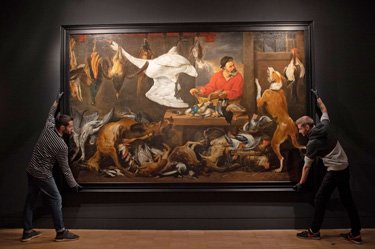
A Cambridge college has removed a 17th century painting from the wall of its dining hall after students complained it was putting them off their food.
Hughes Hall reportedly received complaints from vegetarians students about The Fowl Market, which shows a collection of dead animals hanging from hooks.
The painting, by Flemish artist Frans Snyders, was on long-term loan from the university’s Fitzwilliam Museum but has now been taken down.
It has been replaced in the dining room by a work by Damian Hirst.
A spokesman for the museum told the Daily Telegraph: “Some diners felt unable to eat because it was on the wall. People who don’t eat meat found it slightly repulsive. They asked for it to come down.â€
Millennials keep setting new records in pussification, don’t they?
The irony of replacing a Flemish still-life essentially depicting comestible abundance with some artwork by “Maggots Hatching into Flies,” “Sliced-up Cow and Calf,” “Dead Shark in Formaldehyde,” “Human Skull Covered in Diamonds” Damien Hirst is downright exquisite. Now, it will be the people who know good art who will suffer from deranged digestion.
Auctions Imperial LLC, November 30, 2019, 9:00 AM PST
Cheyenne, WY, Lot 250: A FINE GREEK BLUNDERBUSS OF LORD BYRON
Est: $7,000 – $8,000
Opening Bid: $3,500
An exceptional example of a tromboni made in Epiros, covered entirely in superbly embossed and engraved silver displaying naturalistic flowering vinework. The brass buttplate and triggerguard engraved en suite. The fine matched flintlock mechanism and barrel with flared muzzle elegantly chiseled in relief with vinework and a stand of arms highlighted with gold. Set on the left side of the stock with a silver plaque with foliate border engraved, GGB for George Gordon Byron. From the Samuel Gridley Howe Collection. Early 19th century. Very minor wear.
George Gordon Byron, Sixth Lord Byron, was England’s greatest Romantic Era poet. He led an adventurous, often dangerous, existence and at age 35 journeyed to Greece to join the revolution and fight the Ottomans. Given command over a brigade of Suliots, he was preparing an attack on the Ottoman stronghold of Lepanto, but died in Missolonghi on April 19, 1824. Byron’s passing was mourned throughout the world. He became a national hero to the Greeks and his renown as a poet grew in England, Europe and America.
Samuel Gridley Howe M.D. (1801-1876,) noted American abolitionist, was so inspired by Lord Byron’s cause, that he sailed for Greece in 1824 with the intention of fighting by Byron’s side. Howe arrived just weeks after Byron succumbed to fever; he nonetheless fought for six years against the Ottomans at Missolonghi, Crete, and other locations, and assisted Byron’s close friend and protege, Alexandros Mavrokordatos, among other Greek notables. Howe acquired Byron’s helmet, sword and a number of other military effects before returning to the U.S. in 1830; the helmet was repatriated to Greece in 1926, donated to the Ethnographic Museum, Athens (now the National Historical Museum) by Howe’s daughter, Maud Howe Elliot, which memorialized her father’s service to Greece as well. Howe’s eldest daughter, Laura Elizabeth Richards, celebrated American author, presented the blunderbuss to her son, Henry Howe Richards, at the beginning of the 20th century.
Late 18th-early 19th century. Minor wear. Overall length 51.4cm. Condition II
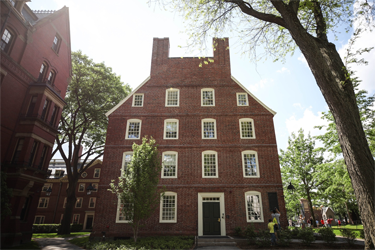
The Crimson reports on the latest vital and totally relevant administrative initiative up there at the little commuter school of the Charles.
University President Lawrence S. Bacow announced the creation of a University-wide initiative to address and further research the school’s ties to slavery in an email sent to Harvard affiliates Thursday.
Bacow selected Radcliffe Institute for Advanced Study Dean Tomiko Brown-Nagin to be the head of a new University-wide faculty committee that will lead the initiative. The University has designated $5 million for the program, according to Bacow’s email.
“It is my hope that the work of this new initiative will help the university gain important insights about our past and the enduring legacy of slavery — while also providing an ongoing platform for our conversations about our present and our future as a university community committed to having our minds opened and improved by learning,†Bacow wrote.
Bacow wrote that the Radcliffe Institute will work closely with library and museum staff to host both programs and academic opportunities related to the issue.
“By engaging a wide array of interests and expertise, as Radcliffe is uniquely suited to do, this initiative will reflect the remarkable power of bringing together individuals from across Harvard in pursuit of a common purpose,†he wrote.
Other faculty on the 12-person committee include former Law School Dean Martha L. Minow and former Dean of the College Evelynn M. Hammonds.
Bacow’s announcement comes as the University continues to grapple with its ties to slavery. In March, Connecticut resident Tamara K. Lanier filed a lawsuit against Harvard alleging the University unlawfully owns and profits off photos of enslaved people who she says are her ancestors.
Earlier this month, the prime minister of Antigua and Barbuda penned a letter to Bacow demanding reparations from Harvard for its historical ties to slavery.
In his letter, Bacow also wrote about efforts that former University President Drew G. Faust spearheaded several years ago like installing memorials commemorating enslaved individuals at Wadsworth House and Harvard Law School, and creating a faculty committee to study the University’s ties to slavery.
In February 2016, former Dean of the Faculty of Arts and Sciences Michael D. Smith announced that faculty leaders of the 12 undergraduate houses would be renamed “Faculty Deans†— a shift away from the former term “House Master,†which some students associated with slavery.
A month later, the Harvard Corporation — the University’s highest governing body — agreed to remove the Law School’s controversial seal, which featured the crest of a slaveholding family. The decision came after pieces of black tape were found over the portraits of black Law School professors in November 2015 and months of student protests.
The initiative announced Thursday will focus on researching further the connections Harvard has to the slave trade and to abolition movements, Bacow said in his email.
“Harvard has a unique role in the history of our country, and we have a distinct obligation to understand how our traditions and our culture here are shaped by our past and by our surroundings — from the ways the university benefitted from the Atlantic slave trade to the debates and advocacy for abolition on camp,†Bacow wrote.
After all, hey! it’s only been a mere 236 years since Massachusetts abolished Slavery in 1783!
The great discovery of our Enlightened Age is the principle that the Universe revolves around left-wing sob stories.
Too bad that the metal detectors got greedy and fell afoul of the authorities. The Guardian has pictures and the story.
On a sunny day in June 2015 amateur metal detectorists George Powell and Layton Davies were hunting for treasure in fields at a remote spot in Herefordshire.
The pair had done their research carefully and were focusing on a promising area just north of Leominster, close to high land and a wood with intriguing regal names – Kings Hall Hill and Kings Hall Covert.
But in their wildest dreams they could not have imagined what they were about to find when the alarm on one of their detectors sounded and they began to dig.
Powell and Davies unearthed a hoard hidden more than 1,000 years ago, almost certainly by a Viking warrior who was part of an army that retreated into the Anglo-Saxon kingdom of Mercia after being defeated by Alfred the Great in 878.
There was gold jewellery including a chunky ring, an arm bracelet in the shape of a serpent and a small crystal ball held by thin strips of gold that would have been worn as a pendant. Beneath the gold were silver ingots and an estimated 300 silver coins.
The law is clear: such finds should be reported to the local coroner within 14 days and failure to do so risks an unlimited fine and up to three months in prison. Any reward may be split between the finder, land owner and land occupier.
Powell and Davies, experienced detectorists from south Wales, chose a different route. Two days later they went to a Cardiff antiques centre called the Pumping Station and showed some examples of their find to coin dealer Paul Wells. He immediately knew they were very special.
The crystal ball pendant turned out to be the oldest item, probably dating from the 5th or 6th century, while the ring and arm bracelet are thought to be 9th- century. They were described as priceless in court. Nothing like the arm bracelet has ever been seen by modern man before.
But if anything, the coins turned out to be even more significant. Among them were extremely rare “two emperor†coins depicting two Anglo-Saxon rulers: King Alfred of Wessex and Ceolwulf II of Mercia. They are important because they give a fresh glimpse of how Mercia and Wessex were ruled in the 9th century at about the time England was morphing into a single united kingdom.
Still, the pair did not contact the authorities. Instead Powell got in touch with another treasure hunter, Simon Wicks from East Sussex, and two weeks after the find he presented himself at upmarket coin auctioneers Dix Noonan Webb in Mayfair, central London.
Wicks put a selection of the coins found in Herefordshire, including a pair of the two emperors, in front of one its leading experts. The expert gasped when he saw the coins and suggested the two emperors could be worth £100,000 each.
Meanwhile, whispers that Powell and Davies had struck gold had begun to circulate and on 6 July – 33 days after their discovery – the Herefordshire finds liaison officer, Peter Reavill, contacted Powell and Davies and gently asked if they had anything to tell him about.
Powell initially replied with a firm denial but they eventually handed over the gold jewellery and an ingot. However, they insisted they had only found a couple of damaged coins that they did not need to declare.
But the net was closing in. Police visited Wells’ house and he showed them five coins from the hoard that had been stitched into his magnifying glass case. When he was arrested he said: “I knew it would come to this.â€
“ ‘This university has stolen my mental health.’ … ‘You want me to pay full tuition that those white students are paying, for what? For a university that stole my mental health? I hate it here.’
Another student yelled ‘I hate it here,’ and protesters joined him in chanting these words.”
Campus Reform reports that the students’ key demand is for self-segregation.
The Chancellor at Syracuse University has stated that he will actively work with a group of students who have issued several demands meant to address a racism issue at the school, including the institution of a new policy that would require students be offered an option to choose that their roommate share the same race.
The demand to allow “students of color” to elect not to room with students of other races was one of several such demands issued by a group of protesting students who aired their concerns about racism on campus during an ongoing sit-in. Syracuse Chancellor Kent Syverud spoke at the sit-in in a live-streamed exchange.
Calling themselves “#NotAgainSU,†this group of protestors is calling for the chancellor to resign if he does not sign a document conceding to the list of demands by Wednesday. Even before the given deadline, over 1,000 protesters have already petitioned for his resignation online.
“The general consensus is that black students, and we’re talking specifically on behalf of Black students, may feel safer and better rooming with other Black students rather than saying the same race has an implementation of a profile system or a portal system. That includes interests as well as race,†a representative of the student protesters said during the meeting. …
Syracuse University students increased their list of demands after racist graffiti was found in a student dormitory on Nov. 7. The following week, more racist graffiti was found in the campus physics building, along with two swastikas found elsewhere, and an anonymous email sent to Student Association members justifying the incidents.
The university also recently announced their suspension of all social activities within Greek Life for the rest of the semester, after some members of a fraternity hurled a “verbal racial epithet†at an African American Student. Other reports have surfaced of people using racist slurs against individual students.
Among the additional demands is the insistence that the university change its anti-harassment policy to a zero-tolerance policy for “hate speech.†Syverud told the crowd of protestors that he has spoken with people who believe there is a “hazy, unclear line between free speech and hate speech,†and that he is not going to take a position on this policy at the moment.
Students are also demanding that the university spend $1 million on the creation of a “unified, required curriculum that educates students on diversity issues, specifically anti-racism.†Syverud has already agreed to this demand, stating his belief is that “required staffers and planning are not going to be under $1million.â€
The university already spent $5 million on a social justice center in 2018.
The protesters are also calling on the university to institute a clause in all new contracts with faculty and staff that mandates diversity training with “new diversity hires,†and for a student-led reform of an existing mandatory diversity course for first-year students. …
The students have occupied Syracuse University’s Barns Center since Nov. 13. They plan to remain in the building all day and night until Wednesday.
“Participation in a peaceful protest given the events that have happened and the dialogue that needs to continue should not be subject to any discipline,†said Chancellor Syverud.
The protestors enjoyed a visit from an emotional support dog and were provided with pizza by the university. Someone even brought toy blocks for students to play with. Protesters continue to shout-down university administrators when they try to field their questions.
“Let’s talk about spending $23,000 to have Sean Spicer come here,†one student yelled, referring to the university funding the College Republicans’ hosting Sean Spicer this coming spring. “That’s gonna make me uncomfortable.â€
“This university has stolen my mental health,†she added. “You want me to pay full tuition that those white students are paying, for what? For a university that stole my mental health? I hate it here.â€
Another student yelled “I hate it here,†and protesters joined him in chanting these words.
“My girlfriend could tell you how many times I sat down and cried in her f*cking arms,†he shouted.
A third student sitting in the crowd complained that she was supposed to be taught a course on “Critical Whiteness,” but that “all [her] white professor did was make microaggressions to [her].â€
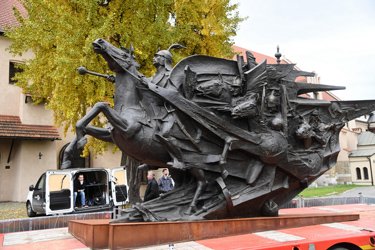
The monument depicts Sobieski as the head of a column of hussars as he routed the Ottoman army at the Siege of Vienna in 1683, a battle that put a check on the Ottomans’ further advances into Europe.
The First News illustrates the spurned monument sitting on a trailer in Cracow.
[T]hirteen attempts have been made to erect a monument in Vienna in honour of the Polish king who relieved the siege of the city. This latest attempt looked set to be successful.
The foundation stone for the monument in Vienna was laid six years ago on the 330th anniversary of the battle. The unveiling of the monument was planned for 12 September 2018 on the 335th anniversary of the relief of Vienna.
However, last July, the new mayor of Vienna, Michael Ludwig, announced that he was withdrawing from the project.
Piotr Zapart, initiator of the project and chairman of the monument’s organising committee said in an interview with radio station RMF FM, “We had all the agreements in place; the cooperation with Vienna, as well as with Kraków was great; there was a signed agreement between the Mayor of the Kraków, Jacek Majchrowski, and the Mayor of Vienna, Michael Häupel.
“On 11 July, President Jacek Majchrowski and I were invited to meet the new mayor Michael Ludwig. And there we were told that a new committee had said that the monument did not meet the artistic standards, was archaic and therefore Vienna withdrew its consent.â€
In its letter to the organising committee, the authorities in Vienna, fearing that the monument may be perceived as anti-Turkish, stated that it was not an appropriate time to erect military monuments.
In the place where the monument was to be erected, everything is ready. The pedestal is already there and the area around it has been cobblestoned. On both sides of the pedestal there was to be an inscription in Polish and German ‘King of Poland Jan III Sobieski’ with the date of the battle.
The monument’s placement on a platform trailer normally used to haul broken-down cars symbolises that it is still on the road to its final destination in the Austrian capital.
It will stand in Kraków for a maximum of two weeks according to local authorities in the city. Later, it will move on to Nowy Sącz, Brzeg and Nysa, places that are connected with the life of the king, and possibly to Warsaw, where it would stand in front of the Royal Castle.
Billy the Kid and three Regulator friends playing cards. From left, Richard Brewer, Billy the Kid (with tall hat), Fred Waite, Henry Brown.
Sofe Design Auctions, November 22, 2019, 11:00 AM CST
Richardson, TX, Lot 241: Sensational Authenticated 1870s BILLY THE KID Tintype Image with Great Provenance. Opening Bid: $50,000. Estimated price: $500,000 — $1,000,000.
A HISTORICALLY IMPORTANT, INCREDIBLY RARE ONE-OF-A-KIND 1877-78 BON-TON TINTYPE PHOTO IMAGE OF THE OLD WEST’S MOST FAMOUS AND MYSTERIOUS OUTLAW, WILLIAM BONNEY, AKA BILLY THE KID. THE IMAGE ALSO CONTAINING THREE IMPORTANT BTK FRIENDS AND FELLOW NEW MEXICO LINCOLN COUNTY WAR REGULATOR VIGILANTES: RICHARD BREWER, FRED WAITE, AND HENRY BROWN. (BILLY THE KID WILL HERETOFORE BE REFERRED TO AS BTK). THIS AMAZING PHOTO IMAGE IS ONLY THE SECOND POSITIVELY DOCUMENTED, ANALYZED PHOTOGRAPHIC IMAGE OF BTK. AS WELL AS THE ONLY KNOWN GROUP IMAGE KNOWN TO INCLUDE BTK. POSSESSING METICULOUS AND IRREFUTABLE TEXAS/NEW MEXICO ANDERSON FAMILY PROVENANCE DATING BACK THREE GENERATIONS. AS WELL AS 101 YEARS OF CONTINUOUS ANDERSON FAMILY POSSESSION AND SAFEKEEPING. THIS NEVER BEFORE SEEN NOR PUBLICLY OFFERED (LIKELY ONE OF A FOUR-PLATE) PHOTOGRAPHIC MASTERPIECE IS ONLY THE SECOND POSITIVELY DOCUMENTED AND FORENSICALLY ESTABLISHED BTK IMAGE. AS PREVIOUSLY MENTIONED, THE SUBJECT PHOTOGRAPH BEING THE ONLY AS YET UNEARTHED GROUP IMAGE OF BTK, POSITIVELY ESTABLISHED THROUGH BOTH SCIENTIFIC AND FORENSIC STUDY. AND EVEN MORE IMPORTANTLY, CRUCIAL AND CONTINUOUS ANDERSON FAMILY CHAIN OF PROVENANCE DATING BACK FROM THE PRESENT DAY, BACK TO 1918, WHEN TOMAS ANDERSON SR. RECEIVED THE SUBJECT PHOTO DIRECTLY, AND WITH POSITIVE AFFIRMATION OF IDENTIFICATION OF IT POSITIVELY CONTAINING BTK. COMING DIRECTLY FROM, AND GIVEN TO MY GRANDFATHER BY THE WIDOW OF DAVID LAWRENCE ANDERSON, (MY GRANDFATHER’S 2ND COUSIN) ALIAS BILLY WILSON, (WHO RODE WITH AND BEFRIENDED BTK DURING THE LINCOLN COUNTY WAR, AND WHO WAS THOUGHT TO HAVE BEEN GIVEN THE SUBJECT PHOTOGRAPH TO HOLD AS SAFEKEEPING PRIOR TO BTK’S 1881 MURDER). …
HE IMAGE DEPICTS THE FOUR MEN PLAYING A FRIENDLY GAME OF CARDS AND DRINKING, IN WHAT WAS UNDOUBTEDLY A “STAGED†PHOTO SITTING BY AN ANONYMOUS TRAVELING PHOTOGRAPHER. MOST LIKELY THE SUBJECT PHOTO WAS PART OF A FOUR-TIN PLATE, WHICH WOULD HAVE COST AROUND, AND SOLD FOR, 25 CENTS, AND DISTRIBUTED INDIVIDUALLY TO EACH OF THE FOUR MEN. ALL PERTINENT DOCUMENTATION PAPERWORK INCLUDED WITH SALE (SHOWN IN AUCTION PHOTOS): PERSONALLY WRITTEN AND ATTESTED-TO ANDERSON FAMILY PROVENANCE CONTINUOUSLY DATING BACK TO 1918 IS PROVIDED TO THE WINNING BIDDER. AS WELL, THE APPROXIMATE AGE AND SPECIFIC TYPE OF ORIGINAL BON-TON TINTYPE BEING POSITIVELY IDENTIFIED BY THE ESTEEMED GEORGE EASTMAN MUSEUM’S HEAD CURATOR. (THE APPROXIMATION OF DATE STAMPING THE PHOTO FROM MID-1877 TO EARLY 1878, COMES FROM THE FACT THAT THE FOUR SUBJECTS IN THE PHOTO ALL WORKED AT THE JOHN TUNSTALL NEW MEXICO RANCH TOGETHER STARTING IN MID-1877, AND RICHARD BREWER, THE SUBJECT ON THE FAR LEFT IN THE PHOTOGRAPH WAS MURDERED IN APRIL,1878). IN ADDITION, A TOP WESTERN PHOTO FORENSIC SCIENTIST WHO RESEARCHED AND WORKED ON SCIENTIFIC FACIAL RECOGNITION AND OTHER PERTINENT RESEARCH FOR SEVERAL MONTHS POSITIVELY IDENTIFIED BTK AND FRED WAITE AS TWO OF THE MEMBERS OF THE SUBJECT PHOTO. (THE OTHER TWO SUBJECTS: BREWER AND BROWN ARE TURNED PROFILE, THUS PRECLUDING FORENSICALLY IDENTIFYING THEM. HOWEVER, AS SEEN IN THE SUPERIMPOSED PHOTO OF PREVIOUSLY DOCUMENTED IMAGES OF THE FOUR MEN, THEN PLACED ON TOP OF THE SUBJECT PHOTO, THE EXTREMELY CLOSE SIMILARITIES OF THE FOUR MEN, INCLUDING BREWER AND BROWN ARE QUITE EVIDENT. IN ADDITION, NOTED ENGLISH APPRAISAL FIRM BARNEBY’S HAS APPRAISED AND COMMENTED VERY POSITIVELY ABOUT THE SUBJECT PHOTOGRAPH, ASSIGNING AN APPROXIMATE PRE-AUCTION ESTIMATE OF 100,000+. BESIDES ALL THE ACCOMPANYING DOCUMENTATION INCLUDED IN THE SALE, IS THE ORIGINAL 1872 LEATHER PHOTO ALBUM WITH BILLY WILSON’S CARVED INITIALS IN WHICH THE SUBJECT PHOTO WAS ORIGINALLY ACQUIRED BY TOMAS ANDERSON SR. IN 1918. …
Billy The Kid (born Henry McCarty 1859-1881, also known as William H. Bonney) was an American Old West outlaw and gunfighter who killed eight men before he was shot and killed at age 21. He took part in New Mexico’s Lincoln County War, during which he allegedly committed three murders.After murdering a blacksmith during an altercation in August 1877, Bonney became a wanted man in Arizona Territory and returned to New Mexico, where he joined a group of cattle rustlers. He became a well-known figure in the region when he joined the Regulators and took part in the Lincoln County War. In April 1878, the Regulators killed three men, including Lincoln County Sheriff William J. Brady and one of his deputies. Bonney and two other Regulators were later charged with killing all three men. Bonney’s notoriety grew in December 1880 when the Las Vegas Gazette in Las Vegas, New Mexico, and The Sun in New York City carried stories about his crimes. Sheriff Pat Garrett captured Bonney later that month. In April 1881, Bonney was tried and convicted of the murder of Brady, and was sentenced to hang in May of that year. He escaped from jail on April 28, 1881, killing two sheriff’s deputies in the process and evading capture for more than two months. Garrett shot and killed Bonney aged 21 in Fort Sumner on July 14, 1881. During the following decades, legends that Bonney had survived that night grew, and a number of men claimed to be him.
Richard M. “Dick” Brewer (February 19, 1850 – April 4, 1878), was an American cowboy and Lincoln County, New Mexico, lawman. He was the founding leader of the Regulators, a deputized posse that fought in the Lincoln County War. Brewer was born on February 19, 1850 in St. Albans, Vermont. At the age of four, he and his family moved to Boaz, Wisconsin. Brewer moved on to Missouri before arriving in Lincoln County, New Mexico. Brewer tried farming as a profession, and he bought a farm in Lincoln County with this in mind. In the spring of 1871, Brewer began working for Lawrence Murphy, but soon left that job. By 1876, he was working as a cattle foreman for cattleman John Tunstall, owner of one of the largest farms in the area. On February 18, 1878, Tunstall was murdered. After Tunstall’s murder, a posse was deputized to serve arrest warrants on his killers, with Brewer chosen to lead the posse. The Regulators originated from that posse, and included Billy the Kid and Jose Chavez y Chavez. Dick Brewer established a bond of friendship with Billy the Kid, Chavez and the rest of Billy the Kid’s gang, and he was often accompanied by gang members. Being one of the founders of the Regulators, Brewer sometimes assumed a leadership role when around Billy, Chavez and the rest of their company, and was the first leader of the Regulators during the early stages of the Lincoln County War. The pair remained friends until Brewer’s death, and evidently he followed Brewer’s lead. Brewer was the most mature of the group, by all accounts, and the rest of the Regulators accepted him in that role.
Frederick Tecumseh Waite, occasionally spelled Fred Wayte (born September 23, 1853 – September 24, 1895), was a Chickasaw cowboy who joined Billy the Kid’s gang. His father was a farmer and operated a trading store and stage stop southeast of Pauls Valley in the Chickasaw Nation. Waite left Indian Territory to work as a cowboy in the New Mexico Territory. While working for John Tunstall as a ranch hand, he met Bill Bonney and several other men who worked for Tunstall. After Tunstall was killed in the Lincoln County War, Bonney, Waite and the others called themselves the Regulators while they pursued Tunstall’s killers. After that, they became known as the “Billy the Kid gang.” In 1880, Waite left the gang, returning to live in the Chickasaw Nation. Waite married, became a rancher and started a family. He lived a law-abiding life thereafter and became involved in Choctaw and Chickasaw politics. Elected to the legislature as a representative both as a representative and as a senator, he was even elected Speaker of the House for three sessions. Then he was appointed Attorney General of the Chickasaw Nation. He died of rheumatism at the age of 42.
Henry Newton Brown (1857 – April 30, 1884) was an American Old West gunman who played the roles of both lawman and outlaw during his life. In 1877, Brown landed in the New Mexico Territory, and became embroiled in the Lincoln County War. Brown joined Billy the Kid and cowboys as “The Regulators”, working John Tunstall’s Rio Feliz Ranch. On April 1, 1878, Brown, Billy the Kid, Jim French, Frank McNab, John Middleton and Fred Waite ambushed and murdered Lincoln County Sheriff William Brady, who was indirectly responsible for the death of Tunstall. Three days later, at the Gunfight at Blazer’s Mill, Brown and the Regulators engaged in a gunfight with Buckshot Roberts, another man they believed involved in Tunstall’s murder. Roberts received a serious gunshot wound from Charlie Bowdre which later proved to be fatal, but not before he managed to kill the Regulators’ nominal leader, Richard M. Brewer. Retreating into proprietor Blazer’s office, Roberts continued a prolonged firefight with Brown and the Regulators. He died the next day.
It will be interesting to see if the market accepts its authetication and it sells.
You got lucky and stumbled upon a fabulously valuable treasure of gold, then you learned that you were unlucky enough to live in a time and place so hedged round everywhere with rules and regulations that you could never even try to recover that treasure. All you can do is tell your sad, sad story to the SF Chronicle
One night five years ago, fisherman Giuseppe Pennisi was lying in bed with his laptop propped up on his barrel chest, reviewing video footage captured from his 76-foot boat, the Pioneer. The boat is a bottom trawler. It scoops up fish with a net that bounces across the seafloor at depths of more than 4,000 feet. A tinkerer, Pennisi likes to keep GoPro cameras attached to the net, allowing him to study the footage and improve his technique. That night, around 2 a.m., he noticed his camera slide past something unusual.
Along the murky seafloor, fish and rocks come in rounded shapes and soft colors, muted grays and greens. His eyes were attuned to this drab underwater landscape, which is why he had been puzzled by brief flashes of light on the video screen, shiny surfaces glimmering by. Then he saw it: a rectangular object, sharp-edged and pale, almost white, with a tinge of yellow.
It was September 2014, and Pennisi, who goes by Joe, was 50 years old, with four decades of fishing behind him. He had sailed on commercial boats since he was 7; his father and grandfather had towed their nets in the same waters for more than a century. He had never seen anything like the object in the video. Still, Joe sensed immediately what it might be. His net often got caught on the rotting underwater husks of old ships wrecked just beyond the Golden Gate, and he knew that some of those ships — Spanish galleons, Gold Rush-era steamers — had carried treasure.
He rewound the video, peered forward and froze the frame with the yellow rectangular object. It looked for all the world like a gold bar, an ingot. For a few minutes, he stared at it while his wife, Grazia, slept beside him.
Israeli Phalanx Close-in air defense system (by Raytheon) engaging incoming missiles.
This is part of Israel’s “Iron Dome” defense system. There appear to be at least two high speed guns out of view of the camera, maybe more. At least 50cal. or maybe 20mm for the range they are shooting. The white can in the foreground appears to be for close-in fire, in the event the longer range guns do not do the job. All this is radar/computer controlled, no human action except to turn it on. What we are seeing are real shoot-downs, rockets launched probably from Lebanon aimed at Tel Aviv or other populated targets. This is cutting-edge American technology.
Last night, I was glancing through the web-sites I follow a bit less frequently than daily and brought up Quillette. The second or third article I opened drew my appalled attention, and kept me thinking about it uneasily all night, in much the manner one is haunted afterwards by the sight of a blood-and-compound-fractures-everywhere motorcycle crash.
The name of the author, “Dierdre” McCloskey, rang a faint bell. When I looked him/her up, that proved to be no surprise, this McCloskey person was actually the rather well-known author of a much positively reviewed book on “The Bourgeois Virtues.”
Professor McCloskey, not surprisingly, of course, for a graduate of Harvard and best-selling author, writes very well in a characteristically restrained, yet Olympian, manner, treating the bizarre topic under discussion, the author’s decision at age 53 to “change gender,” with good humor and detached mild irony.
The fine quality of the writing, however, and the author’s smug, self-congratulatory tone, struck me as outrageously incongruous considering all the issues being so artfully glanced over and avoided.
It’s been a long time now since, at age 53, I became a woman. Actually, I’m an old woman more than twenty years on, who walks sometimes with a nice fold-up cane, and has had two hip-joint replacements, and lives in a loft in downtown Chicago with 8,000 books, delighting in her dogs, her birth family, her friends scattered from Chile to China, her Episcopal church across the street, her eating club near the Art Institute, and above all her teaching and writing as a professor. Or, as the Italians so charmingly say, as una professoressa. …
But of course one can’t “really†change gender, can one? The “really†comes up when an angry conservative man or an angry essentialist feminist writes in a blog or an editorial or a comment page. The angry folk are correct, biologically speaking. That’s why their anger sounds to them like common sense. Every cell in my body shouts XY, XY, XY! I do wish they would shut up. Wretched little chromosomes. In some magical future I suppose we’ll be able to change XYs into XXs. But not now.
And more importantly a gender changer age 53, as I was in 1995, can’t have had the history of a born girl and woman. She cannot have had the good and the bad experiences of girlhood and motherhood and the rest. No science can change her life history. …
I had a normal boy’s life, and the advantage in a macho field like economics of being a man for half of my academic career. The question of what you are is qualitative, not quantitative. What sort? What life? What team? In late 1995, I chose to switch teams. …
It’s a Romantic fallacy to think that people have simple and eternal essences. They change. In a free society, shouldn’t they be allowed to? Tell me.
My wife soon remarried, and lives with her new husband and still enjoys the square dancing she and I loved in the last five years of our happy if sometimes tempestuous thirty years of marriage. Bless ‘em. She’s not spoken to me. In that autumn of first realization in 1995 I left to my wife—stupidly, husband-style—the task of telling my children, my grown son and my college-freshman daughter. Women do emotional work, Donald must have thought, if he thought at all, which I don’t recall he did. I should have gone myself in Donald drag to my children. Not that gender change is a theorem, to be “explained†with the snap shut of a proof. It’s a story, and in October 1995 it was in the middle of Act 1. But my confused and self-absorbed neglect was an awful mistake.
My daughter still lives in the Midwest; she is married and has a child. I’ve told in Crossing about how, a year later, when she was still in college, I saw her that one time, very early in my transition, a weeping father in a dress begging for a hug. My friend Patty had advised against the meeting, wisely. Later I occasionally wrote to her, fruitlessly, and a long time afterwards helped her financially. Her lone letter in reply said “Thanks for the money. I still don’t want you in my life. …
My son lives not too far from me. He too won’t speak. None of my marriage-family, out to cousins, is permitted to speak to any of my birth family, out to cousins. Is my son enforcing the embargo with threats? I don’t know. His wife’s father, a professor of law whom I persuaded once to meet me at O’Hare airport, won’t help, because he’s afraid of losing his daughter. To what? Not to love or to tolerance of human change. Hmm.
Next morning I opened my own door to get the newspaper. The package, unopened, lay on the welcome mat, a message scribbled on it, “We don’t want to have anything to do with you.†My breath stopped. I couldn’t cry. Hope left as shockingly quickly as it had arrived. I thought: So that’s why his wife so awkwardly wouldn’t let her children collect Hallowe’en candy from my door last October. Not even to indulge the sentimental middle-aged lady down the hall. So-called lady. Thus freedom. Maybe my son had claimed to them that I had been an evil father or something. I don’t know. By a decade later they had become at least ordinarily courteous in encounters on the elevator, and I invited them once by note to eat at my club. A note in return:
“No, we are your son’s friends.†And so?
I have not seen my son’s children, now in college or high school, or my daughter’s child, just now in school. The forbidding of children and grandchildren was at first like being stabbed in the chest, the knife twisted in the wound. Early on, I would send Christmas gifts to the grandchildren. But I gave up after a while. Strange, isn’t it, that I care about these offspring I’ve never seen? But there it is. Blood is thicker than water, I suppose.
What worries me most—with the decades, the stab wound hurts less—is the loss to my children and then their children. I would have been a good father, an aunt, whatever you want to say, and anyway a grandparent, nearby and visiting out of state. Youngsters benefit from having more people in their lives, more models of how to live and to love. …
How does a new gender feel after all these years?
Great.
Most decisions leave at least a small regret, a 4:00 a.m. wakefulness. Did you marry the right person? (In my case, yes.) Did you choose the right profession? (In my case, yes.) Should Donald have stayed at his beloved University of Chicago, which in 1980 he left from irritation at the reluctance in the Economics Department, though not in History, to promote him right away to full professor? (A hard one, that; but on the whole, yes.) But becoming Deirdre has evoked not the slightest passing instant of regret. Not once. Nada. …
During the late 1990s shortly after my transition I had called up a male dean at Harvard and asked him if Harvard could change my degree to the women’s college, Radcliffe. “Oh, I don’t think we can do that.†“But the U. S. State Department,†I whined, “had no trouble changing my passport from male to female.†Pause. Then with a smile in his voice, “Yes. But Harvard is older than the U.S. Department of State.†Goodness. Some things never change.
Am I an “angry person?”
Yes and no. Reading Professor McCloskey’s essay did not make me angry, it made me very, very sad. What does make me angry is the patently obvious recognition that Professor McCloskey is, at some level, a very defective and mentally-deranged specimen of humanity afflicted with impulses and desires most of us would consider unbecoming, disgraceful, and bizarre, and the knowledge that a deliberately calculated and conceived political movement using appeals to sentimentality and ressentiment as leverage has successfully persuaded the contemporary elite community of fashion to accept an outrageous Falsehood as Truth and mental illness and sexual perversity as a legitimate societal constituency and a worthy cause.
OK, let us grant that Professor McCloskey really did experience an involuntary, unsolicited in any way, hankering to dress in female clothes and live life as a woman.
We all experience, going through life, involuntary and unsolicited impulses toward thoughts, fantasies, and actions which, acted upon, would really be destructive, disgraceful, illegal, and simply wrong. Who has never experienced homicidal thoughts? Who has not been tempted by an opportunity for theft? Who has never received a sexual proposition for an encounter that was out of bounds?
The political constituency for sexual perversity successfully bamboozled our dim and cowardly elite by the simple tactic of pointing to the involuntary and spontaneous character of homosexual desire and its universal temporal and geographical minority manifestation as evidence the sanction of Nature.
“Ich kann nicht Anders!” (I cannot do otherwise!), Peter Lorre, the child murderer in Fritz Lang’s 1931 “M” protests to the Berlin Underworld gangster jury deciding on his fate. 1931 Berlin gangsters had a lot more sense than the International millennial-era elite. They unsympathetically condemned the murderer Hans Beckert for his crimes.
Consensual homosexuality and female impersonating are, of course, not exactly the same thing as murder. They are basically self-regarding activities that could be omitted from the book of criminal statutes in a libertarian state. But that does not mean they are not disgraceful and wrong. Or even that they do no harm.
Pretending to be something one is not is contemptible and wrong. I expect everyone has one or more unfulfilled personal dreams or fantasies. Lots of people would love to have become rich and famous. Large numbers of people yearn to be movie stars or astronauts. Pretty much everyone has one or more unfulfilled personal ambitions. But living one’s life pretending to be something one is not, ruining one’s marriage, destroying one’s family, breaking one’s vows in order to pretend that the impossible is true? Maybe people like Professor McCloskey should be “allowed†to do all those things, but they certainly should not be encouraged and applauded. Nor should the rest of us participate in their charades. And doctors should certainly should not be allowed to violate the Hippocratic Oath by chemically or surgically mutilating the human body in pursuit of fantasy.
Professor McCloskey writes well, but I fail to understand how anyone can take seriously the academic and scholarly conclusions of someone who thinks it is possible to base his own identity and life on an obvious Lie and an essentially futile fantasy.