For a picture of Christmas Eve, in the olden time, we can desire none better than that furnished by Sir Walter Scott in Marmion:
On Christmas Eve the bells were rung;
On Christmas Eve the mass was sung;
That only night, in all the year,
Saw the stoled priest the chalice rear.
The damsel donned her kirtle sheen;
The hall was dressed with holly green;
Forth to the wood did merry-men go,
To gather in the mistletoe.
Then opened wide the baron’s hall
To vassal, tenant, serf, and all;
Power laid his rod of rule aside,
And Ceremony doffed his pride.
The heir, with roses in his shoes,
That night might village partner choose.
The lord, underogating, share
The vulgar game of “post and pair.”
All hailed, with uncontrolled delight,
And general voice, the happy night,
That to the cottage, as the crown,
Brought tidings of salvation down!
The fire, with well-dried logs supplied,
Went roaring up the chimney wide;
The huge hall-table’s oaken face,
Scrubbed till it shone, the day to grace,
Bore then upon its massive board
No mark to part the squire and lord.
Then was brought in the lusty brawn,
By old blue-coated serving-man;
Then the grim boar’s-head frowned on high,
Crested with bays and rosemary.
Well can the green-garbed ranger tell,
How, when, and where the monster fell
What dogs before his death he tore,
And all the baiting of the boar.
The wassail round in good brown bowls,
Garnished with ribbons, blithely trowls.
There the huge sirloin reeked: hard by
Plum-porridge stood, and Christmas-eye;
Nor failed old Scotland to produce,
At such high-tide, her savoury goose.
Then came the merry masquers in,
And carols roared with blithesome din
If unmelodious was the song,
It was a hearty note, and strong.
Who lists may in their mumming see
Traces of ancient mystery;
White shirts supplied the masquerade,
And smutted cheeks the visors made;
But, oh! what masquers, richly dight,
Can boast of bosoms half so light!
England was merry England, when
Old Christmas brought his sports again.
‘Twas Christmas broached the mightiest ale;
‘Twas Christmas told the merriest tale
A Christmas gambol oft could cheer
The poor man’s heart through half the year.
The Wall Street Journal has an excellent tradition, going back to 1949, of publishing the following editorial in the issue nearest preceding Christmas:
(excerpt)
In Hoc Anno Domini
December 24, 2020
When Saul of Tarsus set out on his journey to Damascus the whole of the known world lay in bondage. There was one state, and it was Rome. There was one master for it all, and he was Tiberius Caesar
Everywhere there was civil order, for the arm of the Roman law was long. Everywhere there was stability, in government and in society, for the centurions saw that it was so.
But everywhere there was something else, too. There was oppression — for those who were not the friends of Tiberius Caesar. There was the tax gatherer to take the grain from the fields and the flax from the spindle to feed the legions or to fill the hungry treasury from which divine Caesar gave largess to the people. There was the impressor to find recruits for the circuses. There were executioners to quiet those whom the Emperor proscribed. What was a man for but to serve Caesar?
There was the persecution of men who dared think differently, who heard strange voices or read strange manuscripts. There was enslavement of men whose tribes came not from Rome, disdain for those who did not have the familiar visage. And most of all, there was everywhere a contempt for human life. What, to the strong, was one man more or less in a crowded world?
Then, of a sudden, there was a light in the world, and a man from Galilee saying, Render unto Caesar the things which are Caesar’s and unto God the things that are God’s….
And so Paul, the apostle of the Son of Man, spoke to his brethren, the Galatians, the words he would have us remember afterward in each of the years of his Lord:
Stand fast therefore in the liberty wherewith Christ has made us free and be not entangled again with the yoke of bondage.
This editorial was written in 1949 by the late Vermont C. Royster and has been published annually ever since.
Robert Arvey finds the establishment’s standard of proof this year impossible to meet.
One of my idle hobbies is writing science fiction stories. The first one will be published after I die, at which point I will become rich and famous.
None of them, however, is as strange as the bizarre world in which we now find ourselves. It is as if criminals had broken into your house, while you were home, in broad daylight, and begun loading up your valuable belongings in a rented truck parked in your driveway. You immediately pick up the phone and dial 911.
“911. What is your emergency?”
“I’m being robbed.”
“Really?”
“Yes!”
“Do you have any evidence of that?”
“Yes! I’m looking right at the robbers.”
“Okay. But do you have any video?”
“As a matter of fact, my security cameras are running right now.”
“Good. Put your phone next to the video and let me see.”
“Okay. Here’s the video, and here is live feed of the robbers, directly from my phone.”
“I see. But there are other possible explanations for what is going on.”
“What other possible explanation could there be? You can actually see them robbing my house.”
“Has any court ruled that they are doing that?”
“Court? What the hell are you talking about? You can see them with your own eyes.”
“Let me talk to them.”
“Talk to them? Are you crazy?”
Just then, one of the robbers hears what you said and takes the phone from your hand. “Hello,” he says. Then, “No, we’re not robbing this guy’s house. He’s just a sore loser.” He gives you back the phone.
“This is 911 again. He denies that he is robbing your house.”
“But you can plainly see him.”
“Sir, there are laws against robbing houses. And you have no evidence of widespread house-robbing.”
The police finally show up, and you say, “These guys are robbing my house.”
Newgrange is a prehistoric monument in County Meath, Ireland, located 8 kilometres (5.0 mi) west of Drogheda on the north side of the River Boyne. It is an exceptionally grand passage tomb built during the Neolithic period, around 3200 BC, making it older than Stonehenge and the Egyptian pyramids.
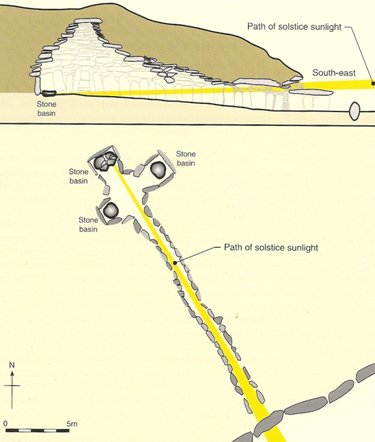
The site consists of a large circular mound with an inner stone passageway and chambers. Human bones and possible grave goods or votive offerings were found in these chambers. The mound has a retaining wall at the front, made mostly of white quartz cobblestones, and it is ringed by engraved kerbstones. Many of the larger stones of Newgrange are covered in megalithic art. The mound is also ringed by a stone circle. Some of the material that makes up the monument came from as far away as the Mournes and Wicklow Mountains. There is no agreement about what the site was used for, but it is believed that it had religious significance. Its entrance is aligned with the rising sun on the winter solstice, when sunlight shines through a ‘roofbox’ located above the passage entrance and floods the inner chamber.
The original complex of Newgrange was built between c. 3200 and 3100 BC. According to carbon-14 dates, it is approximately five hundred years older than the current form of Stonehenge and the Great Pyramid of Giza in Egypt, as well as predating the Mycenaean culture of ancient Greece.
NR’s Kyle Smith puts her doctorate into proper perspective.
Mrs. Biden wanted the credential for its own sake. As for its quality, well. She got it from the University of Delaware, whose ties to her husband, its most illustrious alumnus if you don’t count Joe Flacco, run so deep that it has a school of public policy named after him. That the University of Delaware would have rejected her 2006 dissertation as sloppy, poorly written, non-academic, and barely fit for a middle-school Social Studies classroom (all of which it is) when her husband had been representing its state in the U.S. Senate for more than three decades was about as likely as Tom Hagen telling Vito Corleone that his wife is a fat sow on payday. The only risk to the University of Delaware was that it might strain its collective wrist in its rush to rubber-stamp her doctoral paper. Mrs. Biden could have turned in a quarter-a**ed excuse for a magazine article written at the level of Simple English Wikipedia and been heartily congratulated by the university for her towering mastery. Which is exactly what happened.
Jill Biden’s dissertation is not an addition to the sum total of human knowledge. It is not a demonstration of expertise in its specific topic or its broad field. It is a gasping, wheezing, frail little Disney forest creature that begs you to notice the effort it makes to be the thing it is imitating while failing so pathetically that any witnesses to its ineptitude must feel compelled, out of manners alone, to drag it to the nearest podium and give it a participation trophy.
I didn’t actually read very far. I gave up after encountering:
“Three quarters of the class will be Caucasian; one quarter of the class will be African American; and the remaining seats will be filled with students of Asian descent or non-resident aliens.”