Archive for January, 2021
03 Jan 2021

Colossal has photos of the recently discovered Amazonian petroglyphs: Tens of thousands of paintings of animals and humans, made up to 12,600 years ago, found on an eight-mile rock surface along the Guayabero River in the Colombian Amazon.
The paintings include drawings of large mammals, birds, fish, lizards, handprints, and masked figures of dancing humans. The ancient paintings also record interactions between humans and extinct species of giant Ice Age mammals like mastodons.
03 Jan 2021
Alison Krauss with Yo-Yo Ma.
03 Jan 2021


A shockingly well-preserved woolly rhinoceros has emerged from the thawing muck of the Russian permafrost, reports Valeria Sukhova for the Siberian Times.
Valerii Plotnikov, a mammoth researcher at the Russian Academy of Sciences, tells RT’s Jonny Tickle that this may be the best-preserved example of the extinct Ice Age mammal ever found.
“There are soft tissues in the back of the carcass, possibly genitals and part of the intestine,” he tells RT. “This makes it possible to study the excreta, which will allow us to reconstruct the paleoenvironment of that period.”
Plotnikov tells local Russian outlet Yakutia 24 that the woolly rhino specimen includes all four limbs, its horn and even some of its woolly coat, according to report from Reuters. The scientist also says wear marks on the horn suggest the creature may have used its bony protrusion to gather food, perhaps scraping away snow to reach tender greenery underneath.
Wear marks on the horn suggest the creature may have used its bony protrusion to gather food, perhaps scraping away snow to reach tender greenery underneath.
Plotnikov tells the Siberian Times that the animal looks to have died young at three or four years of age and likely drowned. “The gender of the animal is still unknown,” he adds.
The prehistoric beast was found in the Yakutia region in August and is thought to have roamed the Arctic plains between 20,000 and 50,000 years ago, Plotnikov tells the Siberian Times. The Associated Press reports that radiocarbon dating tests should deliver a more precise estimate of its age once the ancient carcass reaches a lab.
02 Jan 2021
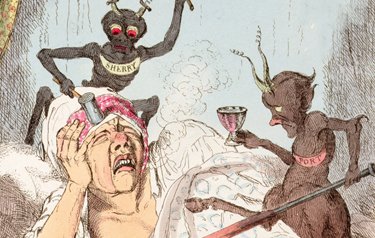
Emma Hughes, in the inestimably excellent Country Life, looks at the literary cure for the common hangover.
First, she quotes Kingsley Amis’s description of the unhappy problem:
‘Dixon was alive again,’ it begins, with biblical solemnity. ‘Consciousness was upon him before he could get out of the way; not for him the slow, gracious wandering from the halls of sleep, but a summary, forcible ejection. He lay sprawled, too wicked to move, spewed up like a broken spider-crab on the tarry shingle of the morning.’
Of the proposed cures, myself, I’d prefer Papa Hemingway’s formula:
If Jeeves’s remedy is the liquid equivalent of a rap on the knuckles, Ernest Hemingway’s is a karate chop to the kidneys. True to form, he christened it Death in the Afternoon. ‘Pour one jigger of absinthe into a Champagne glass. Add iced Champagne until it attains the proper opalescent milkiness,’ he instructs—and then, even more ominously: ‘Drink three to five of these slowly.’
Death in the Afternoon
This one might sound tempting in the wake of Christmas parties, when you’re feeling festively emboldened and actually have the component parts to hand. However, all but the steeliest are likely to take one look at the noxious brew and heave it straight down the sink. Still, the very act of mixing a Death in the Afternoon is guaranteed to perk you up a bit—if only because it reminds you that things could be an awful lot worse.
RTWT
01 Jan 2021

(click on image for larger version)
01 Jan 2021

Eishosai Choki (fl. 1780s-1800s), Sunrise at New Year
A bijin (beautiful woman), presumably a courtesan, has risen early to greet the rising sun of the New Year at the waterfront at Fukagawa in Edo. The woman is adjusting the top of her kimono to protect against the chill of the early morning. In the lower-left is a blossoming fukujuso plant, emblematic of the New Year.
/div>

Feeds
|