15 Nov 2021

Atlas Obscure:
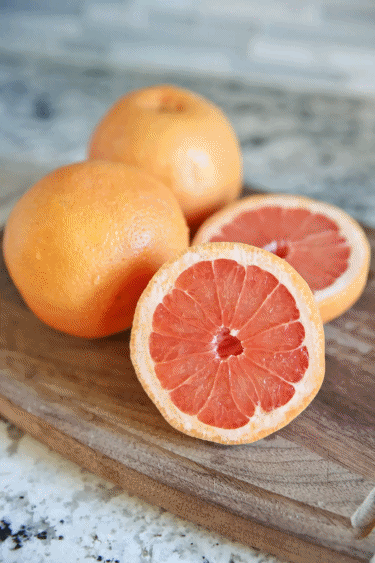
Right from the moment of its discovery, the grapefruit has been a true oddball. Its journey started in a place where it didn’t belong, and ended up in a lab in a place where it doesn’t grow. Hell, even the name doesn’t make any sense.
THE CITRUS FAMILY OF FRUITS is native to the warmer and more humid parts of Asia. The current theory is that somewhere around five or six million years ago, one parent of all citrus varieties splintered into separate species, probably due to some change in climate. Three citrus fruits spread widely: the citron, the pomelo, and the mandarin. Several others scattered around Asia and the South Pacific, including the caviar-like Australian finger lime, but those three citrus species are by far the most important to our story.
With the exception of those weirdos like the finger lime, all other citrus fruits are derived from natural and, before long, artificial crossbreeding, and then crossbreeding the crossbreeds, and so on, of those three fruits. Mix certain pomelos and certain mandarins and you get a sour orange. Cross that sour orange with a citron and you get a lemon. It’s a little bit like blending and reblending primary colors. Grapefruit is a mix between the pomelo—a base fruit—and a sweet orange, which itself is a hybrid of pomelo and mandarin.
Because those base fruits are all native to Asia, the vast majority of hybrid citrus fruits are also from Asia. Grapefruit, however, is not. In fact, the grapefruit was first found a world away, in Barbados, probably in the mid-1600s. The early days of the grapefruit are plagued by mystery. Citrus trees had been planted casually by Europeans all over the West Indies, with hybrids springing up all over the place, and very little documentation of who planted what, and which mixed with which. Citrus, see, naturally hybridizes when two varieties are planted near each other. Careful growers, even back in the 1600s, used tactics like spacing and grafting (in which part of one tree is attached to the rootstock of another) to avoid hybridizing. In the West Indies, at the time, nobody bothered. They just planted stuff. Read the rest of this entry »
13 Nov 2021

The numbers:
4,664 undergraduate students
4,962 faculty
5,042 administrators
——————————————
“I think we don’t yet have a Vice President for the rights of the left-handed, but I haven’t checked this month.” — Professor Leslie Brisman.
——————————————
Oldest College Daily:
Over the last two decades, the number of managerial and professional staff that Yale employs has risen three times faster than the undergraduate student body, according to University financial reports. The group’s 44.7 percent expansion since 2003 has had detrimental effects on faculty, students and tuition, according to eight faculty members.
In 2003, when 5,307 undergraduate students studied on campus, the University employed 3,500 administrators and managers. In 2019, before the COVID-19 pandemic’s effects on student enrollment, only 600 more students were living and studying at Yale, yet the number of administrators had risen by more than 1,500 — a nearly 45 percent hike. In 2018, The Chronicle of Higher Education found that Yale had the highest manager-to-student ratio of any Ivy League university, and the fifth highest in the nation among four-year private colleges.
According to eight members of the Yale faculty, this administration size imposes unnecessary costs, interferes with students’ lives and faculty’s teaching, spreads the burden of leadership and adds excessive regulation. By contrast, administrators noted much of this increase can be attributed to growing numbers of medical staff, and that the University has proportionally increased its faculty size.
“I had remarked to President Salovey on his inauguration that I thought the best thing he could do for Yale would be to abolish one deanship or vice presidency every year of what I hoped would be a long tenure in that position,” professor of English Leslie Brisman wrote in an email to the News. “Instead, it has seemed to me that he has created one upper level administrative position a month.”
RTWT
12 Nov 2021
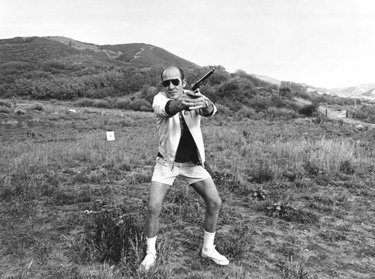
Kevin Mims, in Quillette, reviews High White Notes: The Rise and Fall of Gonzo Journalism by David S. Wills with a very amusing account of just how huge an asshole Hunter Thompson really was.
Every few pages of Wills’s book brings another example of Thompson screwing people over. Thompson always had difficulty with self-discipline, but his inability to produce any work was exacerbated by his cocaine abuse. This was certainly bad for his career. But it was also bad for the careers of those in his orbit. Steadman joined Thompson in Zaire where Rolling Stone had sent them to cover the Ali-Foreman fight. Steadman was eager to see the fight, but Thompson told him, “I didn’t come all this way to watch a couple of niggers beat the shit out of each other.” On the morning of the fight, Steadman frantically tried to find Thompson, who had their press passes, but Thompson had sold them and used the money to buy cocaine and marijuana. When Steadman finally found him, he was stoned and was throwing large quantities of marijuana into the hotel pool. …
When the US military began pulling out of Vietnam, Wenner asked Thompson to cover it for Rolling Stone. Thompson agreed but began to lose his nerve as his departure date drew near. Wenner asked New York Times war correspondent Gloria Emerson to try to bolster Thompson’s confidence. The phone calls between them were recorded (Thompson—like Nixon—recorded many of his phone calls and conversations), and Emerson can be heard telling him how to cover the story, passing him the details of her own contacts and translators, and offering to provide him with all the facts about Vietnam that he lacked.
Thompson finally arrived in Vietnam in April of 1975 (more than a decade after the mainstream journalists he hated began covering the story on a daily basis). He took a lot of opium, mingled with prostitutes, and generally behaved like a clown in order to entertain the other journalists, many of whom were fans of his work. But, as Wills remarks, his behavior “wasn’t as funny in real life.” The other journalists quickly realized that his antics might get him—and them—killed. At least 60 Western journalists were killed covering the war and, as Wills points out, “few of them were running around high on drugs.” Tape recordings make it clear that he was hopelessly out of his element. The other journalists can be heard laughing at his ignorance of the facts on the ground. They teased him about the fact that he hadn’t managed to write a word about the Ali-Foreman fight when Norman Mailer had managed to write a groundbreaking piece for Playboy.
Later, by himself, Thompson can be heard spitting out the words, “Fuck them!” on the recorder. At one point, stoned out of his mind and believing he was chasing “four giant fucker pterodactyls,” Thompson wandered dangerously close to the front line. Several journalists had to put themselves in harm’s way to bundle him into a jeep and drive him back to relative safety. … Read the rest of this entry »
11 Nov 2021

–An annual post–
WWI came to an end by an armistice arranged to occur at the eleventh hour of the eleventh day of the eleventh month of 1918. The date and time, selected at a point in history when mens’ memories ran much longer, represented a compliment to St. Martin, patron saint of soldiers, and thus a tribute to the fighting men of both sides. The feast day of St. Martin, the Martinmas, had been for centuries a major landmark in the European calendar, a date on which leases expired, rents came due; and represented, in Northern Europe, a seasonal turning point after which cold weather and snow might be normally expected.
It fell about the Martinmas-time, when the snow lay on the borders…
—Old Song.

From Robert Chambers, The Book of Days, 1869:
St. Martin, the son of a Roman military tribune, was born at Sabaria, in Hungary, about 316. From his earliest infancy, he was remarkable for mildness of disposition; yet he was obliged to become a soldier, a profession most uncongenial to his natural character. After several years’ service, he retired into solitude, from whence he was withdrawn, by being elected bishop of Tours, in the year 374.
The zeal and piety he displayed in this office were most exemplary. He converted the whole of his diocese to Christianity, overthrowing the ancient pagan temples, and erecting churches in their stead. From the great success of his pious endeavours, Martin has been styled the Apostle of the Gauls; and, being the first confessor to whom the Latin Church offered public prayers, he is distinguished as the father of that church. In remembrance of his original profession, he is also frequently denominated the Soldier Saint.
The principal legend, connected with St. Martin, forms the subject of our illustration, which represents the saint, when a soldier, dividing his cloak with a poor naked beggar, whom he found perishing with cold at the gate of Amiens. This cloak, being most miraculously preserved, long formed one of the holiest and most valued relics of France; when war was declared, it was carried before the French monarchs, as a sacred banner, and never failed to assure a certain victory. The oratory in which this cloak or cape—in French, chape—was preserved, acquired, in consequence, the name of chapelle, the person intrusted with its care being termed chapelain: and thus, according to Collin de Plancy, our English words chapel and chaplain are derived. The canons of St. Martin of Tours and St. Gratian had a lawsuit, for sixty years, about a sleeve of this cloak, each claiming it as their property. The Count Larochefoucalt, at last, put an end to the proceedings, by sacrilegiously committing the contested relic to the flames.
Another legend of St. Martin is connected with one of those literary curiosities termed a palindrome. Martin, having occasion to visit Rome, set out to perform the journey thither on foot. Satan, meeting him on the way, taunted the holy man for not using a conveyance more suitable to a bishop. In an instant the saint changed the Old Serpent into a mule, and jumping on its back, trotted comfortably along. Whenever the transformed demon slackened pace, Martin, by making the sign of the cross, urged it to full speed. At last, Satan utterly defeated, exclaimed:
Signa, te Signa: temere me tangis et angis:
Roma tibi subito motibus ibit amor.’
In English—
‘Cross, cross thyself: thou plaguest and vexest me without necessity;
for, owing to my exertions, thou wilt soon reach Rome, the object of thy wishes.’
The singularity of this distich, consists in its being palindromical—that is, the same, whether read backwards or forwards. Angis, the last word of the first line, when read backwards, forming signet, and the other words admitting of being reversed, in a similar manner.
The festival of St. Martin, happening at that season when the new wines of the year are drawn from the lees and tasted, when cattle are killed for winter food, and fat geese are in their prime, is held as a feast-day over most parts of Christendom. On the ancient clog almanacs, the day is marked by the figure of a goose; our bird of Michaelmas being, on the continent, sacrificed at Martinmas. In Scotland and the north of England, a fat ox is called a mart, clearly from Martinmas, the usual time when beeves are killed for winter use. In ‘Tusser’s Husbandry, we read:
When Easter comes, who knows not then,
That veal and bacon is the man?
And Martilmass beef doth bear good tack,
When country folic do dainties lack.’
Barnaby Googe’s translation of Neogeorgus, shews us how Martinmas was kept in Germany, towards the latter part of the fifteenth century
‘To belly chear, yet once again,
Doth Martin more incline,
Whom all the people worshippeth
With roasted geese and wine.
Both all the day long, and the night,
Now each man open makes
His vessels all, and of the must,
Oft times, the last he takes,
Which holy Martin afterwards
Alloweth to be wine,
Therefore they him, unto the skies,
Extol with praise divine.’
A genial saint, like Martin, might naturally be expected to become popular in England; and there are no less than seven churches in London and Westminster, alone, dedicated to him. There is certainly more than a resemblance between the Vinalia of the Romans, and the Martinalia of the medieval period. Indeed, an old ecclesiastical calendar, quoted by Brand, expressly states under 11th November: ‘The Vinalia, a feast of the ancients, removed to this day. Bacchus in the figure of Martin.’ And thus, probably, it happened, that the beggars were taken from St. Martin, and placed under the protection of St. Giles; while the former became the patron saint of publicans, tavern-keepers, and other ‘dispensers of good eating and drinking. In the hall of the Vintners’ Company of London, paintings and statues of St. Martin and Bacchus reign amicably together side by side.
On the inauguration, as lord mayor, of Sir Samuel Dashwood, an honoured vintner, in 1702, the company had a grand processional pageant, the most conspicuous figure in which was their patron saint, Martin, arrayed, cap-Ã -pie, in a magnificent suit of polished armour; wearing a costly scarlet cloak, and mounted on a richly plumed and caparisoned white charger: two esquires, in rich liveries, walking at each side. Twenty satyrs danced before him, beating tambours, and preceded by ten halberdiers, with rural music. Ten Roman lictors, wearing silver helmets, and carrying axes and fasces, gave an air of classical dignity to the procession, and, with the satyrs, sustained the bacchanalian idea of the affair.
A multitude of beggars, ‘howling most lamentably,’ followed the warlike saint, till the procession stopped in St. Paul’s Churchyard. Then Martin, or his representative at least, drawing his sword, cut his rich scarlet cloak in many pieces, which he distributed among the beggars. This ceremony being duly and gravely performed, the lamentable howlings ceased, and the procession resumed its course to Guildhall, where Queen Anne graciously condescended to dine with the new lord mayor.
10 Nov 2021
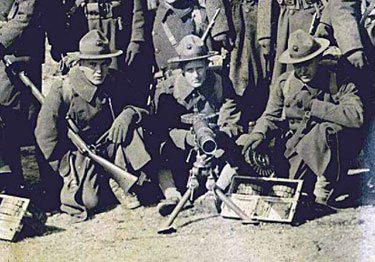
Founded November 10, 1775.
——————————
Maj. Gen. John A. Lejeune’s Birthday Message
RPS ORDERS
No. 47 (Series 1921)
HEADQUARTERS U.S. MARINE CORPS
Washington, November 1, 1921
759. The following will be read to the command on the 10th of November, 1921, and hereafter on the 10th of November of every year. Should the order not be received by the 10th of November, 1921, it will be read upon receipt.
(1) On November 10, 1775, a Corps of Marines was created by a resolution of Continental Congress. Since that date many thousand men have borne the name “Marine”. In memory of them it is fitting that we who are Marines should commemorate the birthday of our corps by calling to mind the glories of its long and illustrious history.
(2) The record of our corps is one which will bear comparison with that of the most famous military organizations in the world’s history. During 90 of the 146 years of its existence the Marine Corps has been in action against the Nation’s foes. From the Battle of Trenton to the Argonne, Marines have won foremost honors in war, and is the long eras of tranquility at home, generation after generation of Marines have grown gray in war in both hemispheres and in every corner of the seven seas, that our country and its citizens might enjoy peace and security.
(3) In every battle and skirmish since the birth of our corps, Marines have acquitted themselves with the greatest distinction, winning new honors on each occasion until the term “Marine” has come to signify all that is highest in military efficiency and soldierly virtue.
(4) This high name of distinction and soldierly repute we who are Marines today have received from those who preceded us in the corps. With it we have also received from them the eternal spirit which has animated our corps from generation to generation and has been the distinguishing mark of the Marines in every age. So long as that spirit continues to flourish Marines will be found equal to every emergency in the future as they have been in the past, and the men of our Nation will regard us as worthy successors to the long line of illustrious men who have served as “Soldiers of the Sea” since the founding of the Corps.
JOHN A. LEJEUNE,
Major General Commandant
————————————-
The Magic of “a Few Good Men”
————————————-
The Old Corps
Tun Tavern, Philadelphia, Pennsylvania, November 10th 1775
Captains Nicholas and Mullens, having been tasked by the 2nd Continental Congress to form 2 battalions of Marines, set up the Corps’ first recruiting station in the tavern.
The first likely prospect was, in typical recruiters fashion, promised a “life of high adventure in service to Country and Corps”. And, as an extra bonus: If he enlisted now he would receive a free tankard of ale….
The recruit gladly accepted the challenge and, receiving the free tankard of ale, was told to wait at the corner table for orders.
The first Marine sat quietly at the table sipping the ale when he was joined by another young man, who had two tankards of ale.
The first Marine looked at the lad and asked where he had gotten the two tankards of ale?
The lad replied that he had just joined this new outfit called the Continental Marines, and as an enlistment bonus was given two tankards of ale.
The first Marine took a long hard look at the second Marine and said, ” It wasn’t like that in the old Corps.”
An annual post.
09 Nov 2021
Yorkshire Post:
Calverley Old Hall, between Leeds and Bradford, is currently subject to a major repair and renovation programme funded by the Landmark Trust, who have owned the building and run part of it as a holiday let since 1981.
The oldest parts of the hall date back to the 14th century but most of it is Tudor. It was the seat of the Calverley family for centuries until the 1750s, when they sold the estate and moved to Esholt Hall. Calverley Old Hall was then subdivided into cottages.
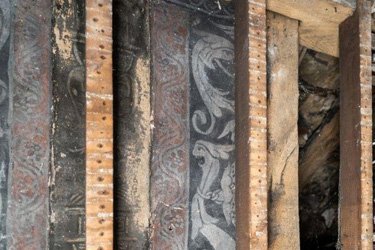
Ahead of the current restoration work, historians and conservation specialists were able to examine the fabric of the building and made an incredible discovery behind a 1930s fireplace. …
Dr Anna Keay, who worked at the site, said: “An exposed area of timber seemed to have something on it; reddish, greenish, and blackish stains on the oak. We thought they could just be the streaks and smudges of mould and dirt and decay. It looked to be wishful thinking that this was anything of note. But just on the off chance, ever cautious, we decided to ask the conservators at Lincoln Conservation to have a look. …
Two days were allocated… to remove the later plaster altogether and see how much remained beneath. I stopped in on the morning of day two, expecting them to have only just begun. When I walked up the stairs into the room I was simply overcome. The plaster had gone and there on all three walls before me was a revelation. Floor to ceiling, wall to wall, a complete, highly decorated Tudor chamber, stripped with black and red and white and ochre. Mythical creatures and twining vines, classical columns and roaring griffins.
“Wall paintings were prized in grand Tudor houses, and from time to time patches of them are revealed. But never in my own 27 years of working in historic buildings have I ever witnessed a discovery like this. Hidden panelling, yes, little snatches of decorative painting, once or twice. But an entire painted chamber absolutely lost to memory, a time machine to the age of the Reformation and the Virgin Queen, never. …
“Suddenly, we are transported from a dusty, dilapidated building into the rich and cultured world of the Elizabethan Calverleys, a well-educated family keen to display their learning and wealth by demonstrating their appreciation of Renaissance culture. The Calverley paintings are very carefully planned, in a vertical design that uses the timber studwork as a framework. Teethed birds laugh in profile; the torsos of little men in triangular hats sit on vases or balustrades. When the fantastical figures and architectural elements are incorporated into dense vertical stacks as at Calverley Old hall, they’re known as ‘candelabra.’
“The whole chamber was probably originally covered in the scheme, a rich, dark, private space that must have been all the more impressive by candlelight.”
RTWT
Wikipedia entry:
The hall was witness to dreadful violence in April 1605, when Walter Calverley murdered two of his sons, William and Walter, after drinking heavily. He was tried in York for murder, but refused to plead and was therefore pressed to death. Because of his refusal, his property could not be seized by the state, and passed to his surviving baby son. The murder inspired the Jacobean play A Yorkshire Tragedy, the authorship of which was attributed to William Shakespeare in the first printed edition (1608) but which is now thought to have been written by Thomas Middleton.
09 Nov 2021

HT: Vanderleun.
And there’s no penalty for being wrong. You still get to keep the prizes and awards and your faculty position at some elite university.
Paul Erlich, in 1968, famously warned:
“The battle to feed all of humanity is over. In the 1970s hundreds of millions of people will starve to death in spite of any crash programs embarked upon now. At this late date nothing can prevent a substantial increase in the world death rate.”
Erlich is Bing Professor of Population Studies Emeritus at Stanford University, president of the Center for Conservation Biology at Stanford, and a fellow of the American Association for the Advancement of Science, the United States National Academy of Sciences, the American Academy of Arts and Sciences, and the American Philosophical Society.
You can spout utter and complete horsecrap, but still wind up successful and covered with honors as long as it’s fashionable horsecrap.
07 Nov 2021

“Gotta problem? Send Rip.”
Tracy Moore assures fellow Coastal Elite liberal Vanity Fair readers that they, too, can watch Yellowstone’s new season (starting tonight).
The show’s flagrant Conservative values and attitudes, you see, are only on the surface and they’re simply there to pull the wool over the eyes of the bitter clinging yokels. In reality, the popular program is speaking the orthodox leftist gospel: denouncing cisgendered masculine violence and ruthless individualism, condemning the white colonialists’ crimes against the noble red man, and agreeing with Proudhon that Property is Theft.
Yellowstone has been called “prestige TV for conservatives,” which explains a lot. “People perceive all my stuff as red state, and it’s the most ridiculous thing,” Sheridan told the New York Times in 2019. “If you truly look at this show…these are pretty wildly progressive notions. The people who are calling it a red-state show have probably never watched it.”
That may be. Or maybe it’s that Yellowstone buries its progressive notions in soapy scenes, over-the-top violence, and grandstanding soliloquies. But either way, Yellowstone is up to something curious. It’s an entertaining and sometimes graphically violent drama, but one that hooks viewers with entertaining brawls, complex family threads, and a willingness to (mostly) punch up. The show may not enjoy the prestige it wants, but it’s a clever conceit that pulls a nifty trick on its core audience.
At a glance, Yellowstone does look like a white male conservative power fantasy—and a white conservative female fantasy of the protection that comes with that. Son Jamie Dutton (Wes Bentley) is a weak-willed college boy who brought his Harvard law degree home to protect his family’s empire. Son Kayce (Luke Grimes), a Navy vet, married Native American woman Monica (Kelsey Asbille), and had a son, Tate (Brecken Merrill), all of whom remain on the reservation, far from the ranch’s perks. Over three seasons, we’ve watched the Duttons negotiate with Broken Rock leaders, whose new chairman, Thomas Rainwater (Gil Birmingham), intends to use his own Harvard MBA to settle an age-old score. We’ve seen a stream of villainous billionaire developers eager to refashion this natural wonder into ski resorts and second homes. We’ve seen alliances change faster than a horse bucks a cowboy at the rodeo.
There’s also a steady stream of sick burns about California and the white libruls enticed to Big Sky Country, whether it’s mocking pour-over coffee in nearby Bozeman, or scheming developer Dan Jenkins (Danny Huston) delivering this scathing line: “This isn’t California, gentleman. It’s Montana. We can do anything we want here.”
City folk are endless fodder, depicted as weak, soft-handed interlopers. Most every granola tourist is from the Golden State, and they often meet gruesome ends thanks to their arrogance about the landscape’s beauty, which hides danger at every turn.
There are only two kinds of men here: Real ones and pussies, a word slung so often in the show—mostly by women, all spun from golden hyperfeminine grit—that I lost count. It’s easy to imagine old-school conservatives—the kind who already had a boner for Reagan but save their biggest boner for Teddy Roosevelt—eating this up.
As entertaining as it sounds, there’s more going on beneath Yellowstone’s surface. One fascinating through line is the insurmountable struggles of the Native Americans on the rez, who endure poverty, addiction, violence, and suicide, with the elders determined to change that by casino, lawsuit, or land grab. Another involves the hardscrabble existence of the cowboys (and occasional cowgirls) in the bunkhouse: the orphans, drifters and ex-cons Yellowstone Ranch hires, who keep the ranch going with their backbreaking labor and the muscling. In a place that makes its own rules, street justice must be served swiftly with brawn on both sides.
But the Duttons’ wrongheaded white ways are also undercut at every turn, with hypocritical callouts aplenty. “No man should own this much land,” scolds a trespassing Chinese tourist when confronted by Dutton with a shotgun. “This is America,” Dutton grumbles. “We don’t share land.”
Yet the show never shies from underlining how Dutton is a dinosaur under threat of extinction. Under all that tough cowboy sumbitch stuff, Yellowstone slow-doles a harsh critique of every form of white supremacy even as it humanizes its central family. Monica may be married to a Dutton, but she teaches oblivious, mostly white freshman at the nearby state school the truth about American history and the genocide that nearly killed her people. On the ranch, a barrel racer tells her cowboy boyfriend that the Yellowstone brand on his chest—the Duttons like to brand their cattle and their men—doesn’t prove he belongs there, but that he’s only as good as property.
It’s obvious that the show believes our history’s ideology and laws are deeply encoded with racism; it also thinks things won’t always stay this way. Watching the series, its conservative viewers are forced to face their biggest fears, whether they realize it or not.
I originally misidentified the author as a Canadian television critic. Actually, the correct Tracy Moore is this one.
RTWT
My biggest fear is that Rip won’t get his hands on those responsible for the attacks on the Duttons in the first episode of Season 4.
06 Nov 2021
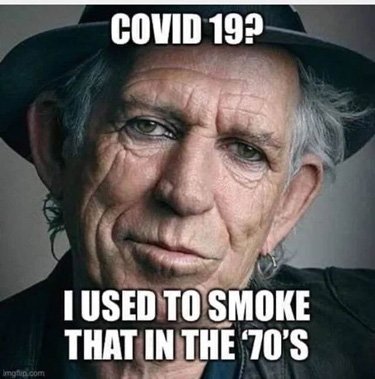
The Washington Examiner reveals the latest and greatest conspiracy theory.
Though the dead Kennedys didn’t make an appearance in Dallas on Tuesday, that didn’t deter a faction of QAnon supporters expecting the return of the political dynasty, who now have a new target for their affection, Rolling Stones guitarist Keith Richards.
When the Kennedys failed to appear during the Tuesday gathering, some started to posit that the reveal might still happen at a Rolling Stones concert coincidentally happening in the city that evening. When this also didn’t happen, QAnon accounts on Telegram and Twitter started to speculate that Richards was actually the 35th president, and if 1993 movie Wayne’s World 2 taught the world anything, it’s that “Keith Richards cannot be killed by conventional weapons.”
RTWT
Links
More or Less Sound Blogs
A Mind Aroused
Aaron’s cc
ABFreedom
Ace of Spades HQ
Albion’s Seedlings
Alphecca
American Conservative, The (Buchananite Paleocons)
American Nihilist Underground Society
Amused Cynic
An Antique Dealer’s Blog
Andrew Cusack
Ankle Biting pundits
Anti-Idiotarian Rottweiler
Art of the Blog
Assistant Village Idiot
Assistant Village Idiot
Augean Stables
Austin Bay Blog
Becker-Posner Blog
Begging to Differ
Bidinotto Bog, The
Big Lizards.net
Black and Right
BlameBush!
Blue Crab Boulevard
Brainster
Brussels Journal, The
Brutally Honest
Captain’s Journal, The
Carnage And culture
Cato at Liberty
Cato Unbound
Cave of the Curmudgeon
Chaos in Motion
Chequer-Board of Nights and Days, A
Chicago Boyz
Claremont Institute
Clarity & Resolve
Clayton Cramer’s Blog
Cobb–Curious,Skeptical,Analytical
Cold Fury
Colonel Robert Neville Always Dresses For Dinner
Conblogeration
Confederate Yankee
Conspiracy to Keep You Poor and Stupid
Corner – National Review Online
CounterIntelligence Center
Coyote Blog
Crosspatch Chronicle
Cubachi
CultureGrrl
Daily Pundit
Daisy Cutter
Dalrock
Damnum Absque Injuria
Dangerous Times
David Bellavia
David Frum
David Thompson
Dean’s World
Death By 1000 Papercuts
Democracy Reform
Dennis the Peasant
Diminished Expectations
Dinocrat.com
Don Surber
Doug Ross
Dust in the Light
Eject! Eject! Eject!
Enchiridion Militis
Error Theory
ex-Liberal in Hollywood
Faster, Please (Michael Ledeen)
FKIN
Flit(tm)
Flopping Aces
Forward Movement (Jules Crittenden)
Fraters Libertas
Front Porch Republic
Future Uncertain, The
Gates of Vienna
Gateway Pundit
Gays Defending Marriage
Greg R. Lawson's Blog
Grouchy Old Cripple
Hog on Ice
Horsefeathers
Hugh Hewitt
Ideas
IMAO
In Mala Fide
In the Bullpen
INDC Journal
Interested-Participant
Irish Pennants
Isegoria
Jack Lewis
Jawa Report, The
JayReding.Com
Jeremayakovka
Jeremy Lott
Jon Swift
Just One Minute
Ken McCracken
Kim du Toit
Kobayashi Maru
Law of the Bad Premise
Left Exposed
Likelihood of Success
Lileks
Lone Pony
Make Haste Slowly (Trad)
Man Without Qualities
Mark Levin
Mike Stopa
Modern Art Notes
Mr. Blonde’s Garage
Musings of the Geek with a .45
Nation of Riflemen, A
New Majority (David Frum) -Neocon Sellout Blog
Nickie Goombah
No End But Victory
No Left Turns
Obsidian Order
Oh, That Liberal Media!
One Cosmos
One Hand Clapping
Only Republican in San Francisco, The
Other Things Amanzi
Outside the Beltway
Palmetto Pundit
Patterico’s Pontifications
Pileus
Point Five
PoliPundit.com
Political Horizons
Political Teen, The
PostLiberal Blog, The
ProfessorBainbridge.Com
Prospero; the Home of the Generative Thought Experiment
Protein Wisdom
QandO
Radio Blogger
Rage Against the Kakistocracy
Rantingprofs
Reason Online – Hit and Run
RedState.org
Republican Dan
Revolutionary War Veteran’s Association Weblog
Revolver Guy
Riding Sun
Right Reason
Right Wings News
Rightwing Nuthouse
Roger L. Simon
Room 12A
Samizdata.net
SayUncle
Scylla & Charybdis
Secular Right
Shot in the Dark
Shrinkwrapped
Solid Surfer, The
Soxblog
stikNstein
Stop Obama
Stop the ACLU
Strange Women Lying in Ponds
Sultan Knish
Sweetness & Light
Taki’s Top Drawer
Tech Central Station
The Buck Stops Here
Three Rounds Brisk
TigerHawk
Tim Chapman Blog
TKS
Tom Delay
Tongue Tied
Transterrestrial Musings
Unqualified Offerinds
Unqualified Reservations (Mencius Moldbug)
Vanishing American
VariFrank
Victor Davis Hanson
View from the Right
ViewPointJournal.Com
Vince aut Morire
Vodka Pundit
War and Piece
Watcher of Weasels
Weapons of Mass Destruction
Western Confucian
What Would Charles Martel Do?
Will Wilkinson
Winds of Change
Wizbang
Xavier Thoughts (Pawn Shop Guns!)
YARGB – Flares into Darkness
Blogs From the Philippines
Pinoy Stupid
Blogs From Israel
Zionist Conspiracy
Blogs From Russia
Mat Rodina
Blogs From Japan
Gaijin Mama
Blogs From Germany
Observing Hermann
/div>
Feeds
|




