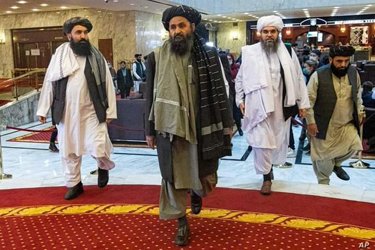
I accidentally stumbled upon a very interesting blog post on the causes of the Taliban’s success in Afghanistan on the blog of Sarah Chayes.
Sara Chayes (Andover and Harvard) is a former senior associate of the Carnegie Endowment for International Peace, an NPR reporter, and an advisor to the Pentagon. Despite all that, she seems to be highly intelligent and to have a deep first-hand understanding of Afghanistan.
For those of you who don’t know me, here is my background — the perspective from which I write tonight.
I covered the fall of the Taliban for NPR, making my way into their former capital, Kandahar, in December 2001, a few days after the collapse of their regime. Descending the last great hill into the desert city, I saw a dusty ghost town. Pickup trucks with rocket-launchers strapped to the struts patrolled the streets. People pulled on my militia friends’ sleeves, telling them where to find a Taliban weapons cache, or a last hold-out. But most remained indoors.
It was Ramadan. A few days later, at the holiday ending the month-long fast, the pent-up joy erupted. Kites took to the air. Horsemen on gorgeous, caparisoned chargers tore across a dusty common in sprint after sprint, with a festive audience cheering them on. This was Kandahar, the Taliban heartland. There was no panicked rush for the airport.
I reported for a month or so, then passed off to Steve Inskeep, now Morning Edition host. Within another couple of months, I was back, not as a reporter this time, but to try actually to do something. I stayed for a decade. I ran two non-profits in Kandahar, living in an ordinary house and speaking Pashtu, and eventually went to work for two commanders of the international troops, and then the chairman of the Joint Chiefs of Staff. (You can read about that time, and its lessons, in my first two books, The Punishment of Virtue and Thieves of State.)
From that standpoint — speaking as an American, as an adoptive Kandahari, and as a former senior U.S. government official — here are the key factors I see in today’s climax of a two-decade long fiasco:
Afghan government corruption, and the U.S. role enabling and reinforcing it. The last speaker of the Afghan parliament, Rahman Rahmani, I recently learned, is a multimillionaire, thanks to monopoly contracts to provide fuel and security to U.S. forces at their main base, Bagram. Is this the type of government people are likely to risk their lives to defend?
Two decades ago, young people in Kandahar were telling me how the proxy militias American forces had armed and provided with U.S. fatigues were shaking them down at checkpoints. By 2007, delegations of elders would visit me — the only American whose door was open and who spoke Pashtu so there would be no intermediaries to distort or report their words. Over candied almonds and glasses of green tea, they would get to some version of this: “The Taliban hit us on this cheek, and the government hits us on that cheek.” The old man serving as the group’s spokesman would physically smack himself in the face.
I and too many other people to count spent years of our lives trying to convince U.S. decision-makers that Afghans could not be expected to take risks on behalf of a government that was as hostile to their interests as the Taliban were. Note: it took me a while, and plenty of my own mistakes, to come to that realization. But I did. Read the rest of this entry »
Cockburn thinks he has found the key explanation: Western elites let Afghans see what Western elite culture is like. Naturally, and inevitably, they took down their AK-47s from the wall and fought tooth and nail to prevent being assimilated into that!
[A]longside the billions for bombs went hundreds of millions for gender studies in Afghanistan. According to U.S. government reports, $787 million was spent on gender programs in Afghanistan, but that substantially understates the actual total, since gender goals were folded into practically every undertaking America made in the country.
A recent report from the Special Inspector General for Afghanistan Reconstruction (SIGAR) broke down the difficulties of the project. For starters, in both Dari and Pastho there are no words for “gender.” That makes sense, since the distinction between “sex” and “gender” was only invented by a sexually-abusive child psychiatrist in the 1960s, but evidently Americans were caught off-guard. Things didn’t improve from there. Under the US’s guidance, Afghanistan’s 2004 constitution set a 27 per cent quota for women in the lower house — higher than the actual figure in America! A strategy that sometimes required having women represent provinces they had never actually been to. Remarkably, this experiment in “democracy” created a government few were willing to fight for, let alone die for.
The initiatives piled up one after another. Do-gooders established a “National Masculinity Alliance”, so a few hundred Afghan men could talk about their “gender roles” and “examine male attitudes that are harmful to women.”
Police facilities included childcare facilities for working mothers, as though Afghanistan’s medieval culture had the same needs as 1980s Minneapolis. The army set a goal of 10 percent female participation, which might make sense in a Marvel movie, but didn’t to devout Muslims. Even as America built an Afghan army ended up collapsing in days, and a police force whose members frequently became highwaymen, it always made sure to execute its gender goals.
But all this wasn’t just a stupid waste of money. It routinely actively undermined the “nation building” that America was supposed to be doing. According to an USAID observer, the gender ideology included in American aid routinely caused rebellions out in the provinces, directly causing the instability America was supposedly fighting. To get Afghanistan’s parliament to endorse the women’s rights measures it wanted, America resorted to bribing them. Soon, bribery became the norm for getting anything done in the parliament.
But instead of rattling off anecdotes, perhaps a single video clip will do the job. Dadaism and conceptual art are of dubious value even in the West, but at some point some person who is not in prison for fraud decided that Afghan women would be uplifted by teaching them about Marcel Duchamp. (See above)
Malcolm Kyeyune* sees a Prerevolutionary 1789/1917 moment in the disorderly American retreat from Afghanistan.
Their spectacular failure on every conceivable level now brings us to the true heart of the matter. Western society today is openly ruled by a managerial class. Where kings once claimed a divine right to rule, and the bolsheviks of old claimed a right to rule as messiahs of a future kingdom on this earth (bearing a conspicuously strong resemblance to a very old tradition of messianic christianity with the serial numbers filed off, by the way) the technocrats of today base their claims to lordship not necessarily on the idea of the democratic will of the people, but on the historical inevitability of technocracy as such. Just as there once was a properly ”socialist” way to understand great literature, there is today a properly technical, scientific, or ”critical” (in the academic sense of the term) way of understanding war, nation building, cinema, primitive marriage rituals, or whatever else. Our managerial leaders deserve to rule us, because managerialism as a world ethos is the only means of effecting functional rule in the context of a modern, international, post-national, information driven, knowledge economy, rules-based… well, you probably already know all the familiar buzzwords beloved by this class of people. Kings ruled in the epoch of monarchies, because only kings could rule, or at least so they all claimed. Technocrats rule our post-Soviet era for very much the same reason; they are, according to the legitimating narrative of our age, the only ones that can rule. Much like you can’t put a monkey in charge of a battleship, you can’t possibly hope to rule a modern country without being part of the educated managerial class. And just like the kings of old, our technocrats at one point claimed (and even enjoyed) a form of quasi-magical power in the eyes of their peasantry; a view once commonly shared that they could use the very thing that made them rightful rulers – science, logic, rationality, data – to lay on hands, cure ills, and improve society.
Put plainly: managers, through the power of managerialism, were once believed to be able to mobilize science and reason and progress to accomplish what everyone else could not, and so only they could secure a just and functional society for their subjects, just as only the rightful kings of yore could count on Providence and God to do the same thing. At their core, both of these claims are truly metaphysical, because all claims to legitimate rulership are metaphysical. It is when that metaphysical power of persuasion is lost that kings or socialists become ”bourgeois”, in Schmitt’s terms. They have to desperately turn toward providing proof, because the genuine belief is gone. But once a spouse starts demanding that the other spouse constantly prove that he or she hasn’t been cheating, the marriage is already over, and the divorce is merely a matter of time, if you’ll pardon the metaphor.
I suspect we are currently witnessing the catastrophic end of this metaphysical power of legitimacy that has shielded the managerial ruling class for decades. Anyone even briefly familiar with the historical record knows just how much of a Pandora’s box such a loss of legitimacy represents. The signs have obviously been multiplying over many years, but it is only now that the picture is becoming clear to everyone. When Michael Gove said ”I think the people in this country have had enough of experts” in a debate about the merits of Brexit, he probably traced the contours of something much bigger than anyone really knew at the time. Back then, the acute phase of the delegitimization of the managerial class was only just beginning. Now, with Afghanistan, it is impossible to miss.
It is not just that the elite class is incompetent – even kings could be incompetent without undermining belief in monarchy as a system – it is that they are so grossly, spectacularly incompetent that they walk around among us as living rebuttals of meritocracy itself. It is that their application of managerial logic to whatever field they get their grubby mitts on – from homelessness in California to industrial policy to running a war – makes that thing ten times more expensive and a hundred times more dysfunctional. To make the situation worse, the current elites seem almost serene in their willful destruction of the very fields they rely on for legitimacy. When the ”experts” go out of their way to write public letters about how covid supposedly only infects people who hold demonstrations in support of ”structural white supremacy”, while saying that Black Lives Matter demonstrations pose no risk of spreading the virus further, this amounts to the farmer gleefully salting his own fields to make sure nothing can grow there in the future. How can anyone expect the putative peasants of our social order to ”trust the science”, when the elites themselves are going out of their way, against all reason and the tenets of basic self-preservation, to make such a belief completely impossible even for those who really, genuinely, still want to believe?
The managerial class increasingly appears as a sort of funhouse mirror inversion of the doomed russian nobility of the late tsarist era; they no longer know how to run a country and only seem to parasitize on the body politic while giving almost nothing of value in return. In tsarist Russia, the nobility proved increasingly incapable of winning Russia’s wars or running its ministries, making their legitimating narratives proclaiming them to possess some natural-born right and capacity for rulership increasingly impossible to believe in. In modern America, it is the meritocrats who now openly lack any merit or ability to rule, quickly undermining the ability of the average person to believe in the very foundational claims behind the managerial order. And by what right does the collective of non-divine kings rule? To borrow from Schmitt: by the same right as the collective of stupid and ignorant technocrats. In other words, by virtue of simply not having been replaced yet. Nothing more.
I find it very likely that most future historians will put the date of the real beginning of the collapse of the current political and geopolitical order right here, right now, at the US withdrawal from Afghanistan. Just as with any other big historical process, however, many others will point out that the seeds of the collapse were sown much farther back, and that a case can be made for several other dates, or perhaps no specific date at all. This is how we modern people look at the fall of the french ancien regime, after all. Still, it is quite obvious that the epoch of the liberal technocrat is now over. The bell has well and truly tolled for mankind’s belief in their ability to do anything else than enrich themselves and ruin things for everyone else.
*I had not heard of him before. Malcolm Kyeyune is evidently a mixed race Afro-Swedish self-avowed Marxist, who nonetheless serves on the steering committee of the Swedish conservative think tank Oikos. He seems to be an interesting and very smart guy, and strikes me on first acquaintance as a decidedly superior version of the Slovenian Marxist contrarian and clown Slavoj Žižek.
Markers placed next to shell casings where a child was shot near the of corner West Haddon Avenue and North Honore Street in East Ukrainian Village, Chicago, Wednesday, August 18, 2021.
Jack Cashill has a good word for the ever so widely despised-and-written-off ordinary non-elite white male.
For the last week or so, I have been living in the middle of a construction zone. In defiance of the climate scientists, Lake Erie and its fellow Great Lakes decided to grow instead of shrink.
While the scientists re-checked their data, the entrepreneurs got to work building sea walls. Through my lakefront windows, I have been watching one entrepreneur and his crew build me a wall. This is no small job. It’s a six-figure project that involves several major pieces of equipment. My favorite is the truck-mounted boom pump that receives the concrete from a mobile concrete mixer and distributes it through its mantis-like arms precisely to where it needs to go.
Running this operation are a half-dozen or so white guys. None of them were born with an ounce of conventional privilege. Some have not graduated from high school. All of them work ferociously as the situation demands. I get tired just watching them, but the elites do not seem to know they exist.
“Census data shows the number of White people in the U.S. fell for the first time since 1790,” shouts the much too happy headline in the Washington Post, but the Post gloats prematurely. No one wants to talk about this phenomenon, but working-class white men dominate just about every difficult and dangerous industry in America. …
It so happened that in the spring of 2020, just as the lockdowns were going into place, construction started on a 500-unit apartment complex across the street from my office. As the androgynous denizens of Westport skulked aimlessly along the street in their ubiquitous masks, a crew of youngish white men descended on the worksite.
From day one, these guys showed up unmasked. Some took smoke breaks. They joked, they laughed, they worked. They continued working even as the neighborhood lemmings marched through the streets, breaking windows, not quite sure what they were marching about. A year later, the lemmings could be seen lining up outside their favorite coffee shops, still masked, waiting for their next marching orders.
The guys across the street, meanwhile, had a building to show for their work. On Independence Day, while the soy boys sulked, the working guys celebrated as though they owned the country. They don’t own it, but they built it, pretty much damn near all of it. It is time we pay them their due.
For those that don’t realize how bad Taliban control is, this is the body of an afghan caught in a C-17 landing gear door that attempted to climb on to escape Afghanistan. pic.twitter.com/4IoPIxcxR6
Lady Butler, Remnants of an Army, 1879, Tate Gallery. Assistant Surgeon William Brydon, the sole survivor of a British Army of 16,000 men, arrives at the gates of Jallabad in 1842.
Thomas Joscelyn sums up why we failed with dead on precision.
There is plenty of blame to go around.
Blame President Bill Clinton. His administration didn’t take Al Qaeda seriously. Clinton and his advisers passed up multiple opportunities to target Osama bin Laden. The Al Qaeda threat manifested on Clinton’s watch, leading to 9/11 and, ultimately, the war in Afghanistan.
Blame President George W. Bush and Donald Rumsfeld. In 2001, they had the opportunity to deliver a death blow to Al Qaeda and the Taliban. But instead of committing the forces necessary to hunt down bin Laden, Ayman al-Zawahiri and others, they hesitated. The U.S. relied on local warlords and other actors, some of whom were duplicitous. Bin Laden and Zawahiri finagled their way out of the remote Tora Bora Mountains. Al Qaeda regrouped in the years that followed.
Blame Barack Obama. Obama decided it was in our “vital national interest” to help the Afghans build the “capacity” to defend their country on their own. In December 2009, he committed forces — at their peak, more than 100,000 of them — to accomplish the task. More Americans were killed in Afghanistan during Obama’s war than in any other period of this debacle. But Obama wasn’t fighting to win. His surge in forces came with an expiration date of just 18 months and then he chased a fanciful peace deal with the Taliban. To his credit, Obama ordered the raid that killed bin Laden. But Al Qaeda lived, despite Obama’s attempts to declare the group dead.
Blame Donald Trump. His instinct was to bring the soldiers home. Instead, he agreed to a small increase in America’s footprint, claiming that the U.S. was fighting for “victory.” He didn’t mean it.
Blame Trump’s Secretary of State, Mike Pompeo, who portrayed the Taliban as America’s counterterrorism partner, saying the group had agreed to “work alongside of us to destroy” Al Qaeda. Trump repeated Pompeo’s claim, saying the Taliban “will be killing terrorists for us.” This is nonsense. The Taliban’s men are terrorists and there’s no evidence they’ve broken with Al Qaeda.
Blame the generals. It is true that they were asked to fight a war that was undermined by America’s erratic political leadership. But no general ever stood up to say: No. We cannot prosecute an unwinnable war.
Since 2018, the U.S. military has been invested in the State Department’s delusional peace process with the Taliban, repeatedly claiming that there was no “military solution” to the conflict. But this was always a lie.
As the Taliban takes control of Kabul, Americans can see for themselves that the jihadists had a “military solution” in mind all along. The Taliban and Al Qaeda were never ambivalent about their jihad. They were fighting to win.
AlJazeera has a video showing crowds of desperate Afghans filling runways at Kabul airport, desperately trying to get out of the country and escape death at the hands of the Taliban. Some panicking Afghans can be seen even attempting to cling to the outside of a US Air Force C17A transport jet.