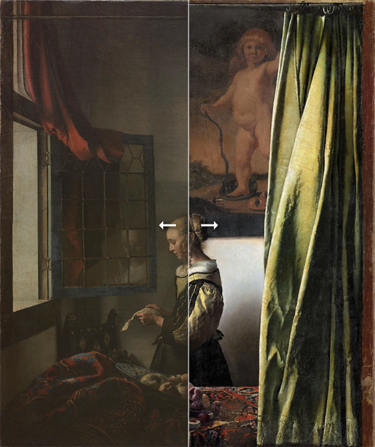
The female figure in Johannes Vermeer’s “Girl Reading a Letter at an Open Window” (1657-59), art historians have long known, is not exactly alone in the room. As early as 1979, x-rays revealed a painting of a full-length cupid hanging on the wall behind her, partly shielded by a silky green trompe l’oeil curtain pulled to the side. This picture-within-a-picture, a hallmark of the artist’s opulent renderings of Dutch interiors, was further confirmed using infrared photography.
But until recently, experts assured us Vermeer had painted over the chubby amorini himself. In 2019, laboratory tests led to a shocking discovery: the cupid imagery was covered up by someone other than the artist, likely decades after its completion. Conservators at the Gemäldegalerie Alte Meister (Old Masters Picture Gallery) in Dresden, where the painting has resided for over 250 years, decided to return the work to its original state, removing the layers of varnish and overpaint concealing the original composition.
Doubtless, the conservators’ decision to restore the painting to the artist’s original intent is an inevitable academic and institutional choice. Still, I find the heavy-handed symbolism of the result tedious and the composition cluttered when compared to the previous version. Sad.
Bonham’s
The Early West
The Collection of Jim and Theresa Earle
27 Aug 2021, 12:00 PDT
Los Angeles
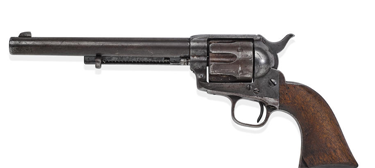
Lot 12: JOHNNY RINGO’S COLT SINGLE ACTION ARMY REVOLVER FOUND HELD IN HIS HAND WHEN HE WAS FOUND DEAD AT TURKEY CREEK.
Serial no. 222 for 1874, .45 caliber, 7 1/4 inch barrel with single line address. Doughnut ejector. US mark on left side of frame (partially defaced), Inspectors marks on barrel. Serial number partially visible on frame and triggerguard. Number on cylinder defaced. Condition: Good. Generally no finish with traces of blue on ejector housing balance a brown patina. Toe of left grip missing. Worn grips with no visible inspectors marks. Cylinder possibly replaced. Barrel shortened through wear. A very early martially marked single action.
Provenance: Johnny Ringo, found in his hand in Morse Canyon (mentioned by serial number, containing five cartridges, in inquest document, “Statement for the information of the Coroner and Sheriff of Cochise County, A.T.,” 1882); by descent to Mrs. Prigmore; to Allen Erwin (bill of sale, signed by Erwin and by Mrs. Prigmore’s son Donald Wilson, on her behalf); by descent to Francis Huffstadter (signed Power of Attorney, May 2, 1979; sold European and American Firearms, Sotheby Parke Bernet, Los Angeles, 1980, to Jim and Theresa Earle.
Literature: Burrows, Jack, John Ringo: The Gunfighter Who Never Was, Tucson, 1980, p 101; Wilson, R.L., The Peacemakers, New York, 1992.
People ask me all the time whether or not I believe that Joe Biden is the President of the United States. I find this question strange and insulting, of course, because it’s simply crazy to think that Joe Biden is not the President of the United States. To entertain that kind of stuff is ludicrous — dangerous really. Pure conspiracy theory nonsense for the rubes. Who do they think wakes up inside the White House bedroom every morning and gets lost in the hallways before the nurse corrals him to the breakfast table?
“Actually,” I tell them, “Joe Biden is the most popular President that we have ever seen in America.” This just stops them right in their tracks. Not that these folks are serious about arithmetic or Socratic dialogue, mind you, but I just knock them over with numbers. Data. Math. Usually, I start with Maricopa County in Arizona because we have so much information leaking from the audit there. Did you know that Joe Biden is so popular that he broke all the electronic voting machines and the authorities still can’t find the router passwords? That’s true. That number of Biden voters has simply never been counted before and it probably just melted the router passwords right off the computers. Nobody can find them.
That’s not all: Twitter just deleted the accounts of the Maricopa Arizona audit team because they probably weren’t sure if the audit team could count that high. That was the right call. Biden’s win was so astronomical and embarrassing for the Trump campaign that, simply out of compassion and politeness, the Maricopa Board of Supervisors refused to comply with state subpoenas to tell Trump the exact number by which Biden kicked his ass. I think that’s wonderful. It really shows how far Biden is willing to go to unite the country. Heck, the guy got 74,000 ballots (EV33s) that Maricopa County didn’t even know they sent out (EV32s) during the election! You know what that means: people were so enthusiastic about Joe they wanted people to know regardless of the legality of their feelings. I mean 3,981 people even registered and voted for Biden after the deadline to register to vote had passed! You can’t put a price tag (or a jail sentence) on that kind of love.
Trump’s people simply can’t handle the truth because Biden’s win is so much bigger than most minds can comprehend. At least 11,326 people who were not even on the voter rolls in Maricopa on November 7th just came out of the woodwork to go for Joe on December 4th. Now I know what you’re thinking: isn’t that after Election Day? Isn’t that sorta impossible? That’s just how big this landslide really was – all the technicalities like dates simply melted away in the final tally. And we’re just talking about the Biden voters who showed up in person. There were another 74,240 mail-in ballots that got counted for Joe and nobody even knows who sent in those ballots. I don’t want to hear any of your bullshit about suspicious ballots coming out of nowhere in the middle of the night to be counted either: the same thing happened in lots of other counties across America so you know it’s true.
The Stones’s final public appearance with Watts was a filmed segment for the first we’re-all-in-this-together COVID broadcast in April 2020. Charlie played along on a spirited version of ‘You Can’t Always Get What You Want’, drumsticks in hand, using a trio of musical storage cases and a nearby couch for percussion. It was an effortless, funny and musically deft performance, and absolutely right for the occasion. Only the drummer in the world’s greatest rock band, it seemed, might not wish to keep a set of drums at home. Somehow that summed up the man.
————-
Tyler McCarthy, at Fox News:
The quiet, elegantly dressed Watts was often ranked with Keith Moon, Ginger Baker and a handful of others as a premier rock drummer, respected worldwide for his muscular, swinging style as the band rose from its scruffy beginnings to international superstardom. He joined the Stones early in 1963 and remained over the next 60 years, ranked just behind Mick Jagger and Keith Richards as the group’s longest lasting and most essential member.
Watts stayed on, and largely held himself apart, through the drug abuse, creative clashes and ego wars that helped kill founding member Brian Jones, drove bassist Bill Wyman and Jones’ replacement Mick Taylor to quit, and otherwise made being in the Stones the most exhausting of jobs. …
He had his eccentricities – Watts liked to collect cars even though he didn’t drive and would simply sit in them in his garage. But he was a steadying influence on stage and off as the Stones defied all expectations by rocking well into their 70s, decades longer than their old rivals the Beatles.
Watts didn’t care for flashy solos or attention of any kind, but with Wyman and Richards forged some of rock’s deepest grooves on “Honky Tonk Women,” “Brown Sugar” and other songs. The drummer adapted well to everything from the disco of “Miss You” to the jazzy “Can’t You Hear Me Knocking” and the dreamy ballad “Moonlight Mile.”
Jagger and Richards at times seemed to agree on little else besides their admiration of Watts, both as a man and a musician. Richards called Watts “the key” and often joked that their affinity was so strong that on stage he’d sometimes try to rattle Watts by suddenly changing the beat – only to have Watts change it right back.
Jagger and Richards could only envy his indifference to stardom and relative contentment in his private life, when he was as happy tending to the horses on his estate in rural Devon, England, as he ever was on stage at a sold-out stadium. …
Charles Robert Watts, son of a lorry driver and a housewife, was born in Neasden, London, on June 2, 1941. From childhood, he was passionate about music – jazz in particular. He fell in love with the drums after hearing Chico Hamilton and taught himself to play by listening to records by Johnny Dodds, Charlie Parker, Duke Ellington and other jazz giants.
He worked for a London advertising firm after he attended Harrow Art College and played drums in his spare time. London was home to a blues and jazz revival in the early 1960s, with Jagger, Richards and Eric Clapton among the future superstars getting their start. Watts’ career took off after he played with Alexis Korner’s Blues Incorporated, for whom Jagger also performed, and was encouraged by Korner to join the Stones.
Watts wasn’t a rock music fan at first and remembered being guided by Richards and Brian Jones as he absorbed blues and rock records, notably the music of bluesman Jimmy Reed. He said the band could trace its roots to a brief period when he had lost his job and shared an apartment with Jagger and Richards because he could live there rent-free.
“Keith Richards taught me rock and roll,” Watts said. “We’d have nothing to do all day and we’d play these records over and over again. I learned to love Muddy Waters. Keith turned me on to how good Elvis Presley was, and I’d always hated Elvis up ’til then.”
Watts was the final man to join the Stones; the band had searched for months to find a permanent drummer and feared Watts was too accomplished for them. Richards would recall the band wanting him so badly to join that members cut down on expenses so they could afford to pay Watts a proper salary. Watts said he believed at first the band would be lucky to last a year.
“Every band I’d ever been in had lasted a week,” he said. “I always thought the Stones would last a week, then a fortnight, and then suddenly, it’s 30 years.”
Rosa Lyster, writing in Gawker, proves herself to be a major fan of John Le Carré’s Cold War spy novels and she argues, from the female perspective, that the Karla trilogy novels are also Romance novels (!).
Existing discussion of the Smileys’ marriage tends to focus on George, with only glancing, baffled mention of Ann. George Smiley is “arguably the most memorable character in modern fiction,” the brilliant intelligence officer at the head of the Circus, and Ann is his beautiful, aristocratic, Unfaithful Wife. George is discussed in terms of his underlying melancholy, his penetrating intelligence, his pursuit of Karla (the KGB agent whose chase is the central plotline of Tinker Tailor, Soldier, Spy, The Honourable Schoolboy, and Smiley’s People), his snuffly voice that cannot easily be heard above the bray of the more confidently upper-class members of the Circus, what some reviewers refer to as his “physique,” which is both unexceptional and strikingly disappointing (this man is somehow both physically anonymous and walking around forcibly reminding people of an egg), his lack of illusion as to human weakness, and the forbearance with which he endures the unfaithfulness of his Unfaithful Wife, who is called Ann.
Ann is discussed mainly in terms of how she is his faithless wife, Ann, permanently off to one side but still exerting a slightly occult hold over a man who she appears to have married for no reason other than to humiliate him for five books. She has to exist so that we understand from the offing that a) George is driven to pursue Karla because of a complex sense of betrayal rooted in the fact that his faithless wife, Ann, is single-mindedly focused on fucking him over, and b) his ongoing attachment to his faithless wife, Ann, means that his colleagues sometimes take him less seriously than his intelligence warrants, and they do so at their own peril etc. In this view, faithless wife Ann is an insanely sexy bit of background dysfunction, and the marriage is primarily a site of catastrophe and shame for poor, trapped, inexplicably loyal George.
Some parts of this are accurate — Ann is so, so unfaithful, and George’s colleagues are so, so rude to him about it. Over and over, we see them making jaunty remarks about how once again the old girl has had sex with the maître d’ of a once-glamorous restaurant in full view of a number of junior staff members, or how she has personally ushered in a new and frightening phase of the Cold War by embarking on an affair with Bill Haydon, who is both a Soviet mole and for some reason her cousin. These men are always slapping George on the back and going on about how he will never divorce “the lovely Ann,” even as she is using George’s account at the tailors to buy suits for a Cypriot dockhand, and then after George lopes sadly away in his ill-fitting garments, they are saying “poor fellow” in a pleased voice. Nevertheless, to see George as a cuckold and Ann as a bitch is a reductive view of the arrangement, which I would argue is much stranger and more interesting than the standard interpretation would have it.
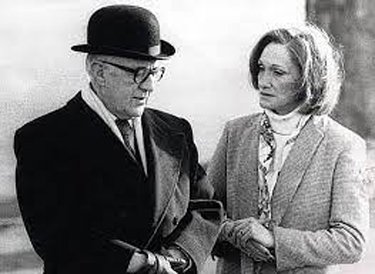
From the beginning of the Karla trilogy, at least, it is clear that George’s attachment to his wife is his definitive feature. Here is how he is introduced at the beginning of Tinker, Tailor, Soldier, Spy: “Small, podgy, and at best middle-aged, he was by appearance one of London’s meek who do not inherit the earth. His legs were short, his gait anything but agile, his dress costly, ill-fitting, and extremely wet.” A sad-seeming man, initially, whose undoubtedly sad sex life is mercifully none of your concern. Now, the sound of glass shattering at the entrance of Ann: “For reasons of vanity he wore no hat, believing rightly that hats made him ridiculous. ‘Like an egg-cosy,’ his beautiful wife had remarked not long before the last occasion on which she left him, and her criticism, as so often, had endured.”
Ann. What a swerve! Instead of a sad man in big wet clothes, we now have a sad man in big wet clothes embroiled in a complicated set-up with a beautiful woman. Why does she keep returning to him even as she is so critical of his fashion sense? Why does he keep putting up with this shit? A sad man, still, but also a dark horse, all moody and sensual (sorry), and this portrait only becomes moodier and more sensual (sorry again) as the trilogy progresses and the answer to these questions becomes clear. ..
These are spy novels, but there is a strong case to be made for them being romance novels as well, or at least ones that present a mortifyingly recognizable picture of what it’s like to not be able to live without someone, and to see the world and yourself through their eyes first. There are a lot of books that will confirm your sense that being in love is one of the most embarrassing things that can ever happen to a human being, but I can’t think of that many that go on to persuasively demonstrate that this state of abjection is to be sought out not only because it is exhilarating and consuming and makes you feel like a demon, but because it makes you smarter and better at your job, whether that job is being a spymaster negotiating the end of empires or a woman who has in her time lost her cool over someone to the extent of writing poems about it. This is one of the most comforting things I can think of.
(as usual, just click on image for larger version.)
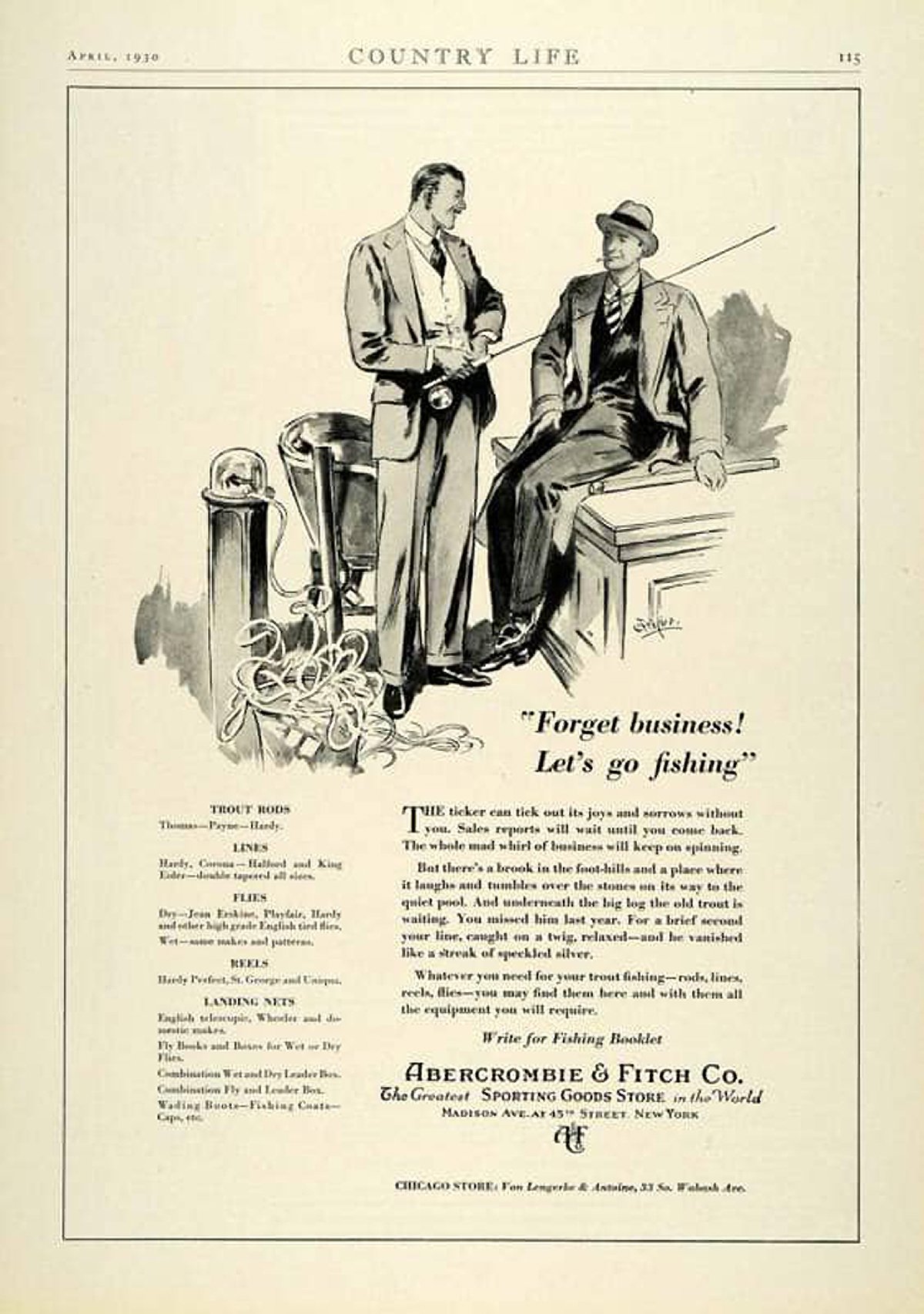
Back when Abercrombie & Fitch was the NYC outfiter for affluent sportsmen, it carried high end guns and fishing tackle and outdoor equipment. Its Madison Avenue store had a shooting range and a casting pool on the roof. Griffin & Howe custom rifles, London best shotguns, and Payne fly rods were waiting there for sale. Alas! the real Abercrombie & Fitch died in the mid-1970s.
The name changed hands repeatedly and was revived in the late 1990s as a completely different kind of entity. The new revival markets sissy fashions to metrosexuals. It’s rather as if after Papa Hemingway shot himself, his name was sold repeatedly, and revived decades later as “Ernestine Hemingway,” an authoress of Gay Romance Novels.
The mysterious deaths of a British Google engineer and his family on a hiking trail were not a case of homicide, police say.
The bodies of Jonathan Gerrish, 45, his wife Ellen Chung and their daughter Muji – along with their dog Oski – were found by search teams on Tuesday in an area of the Sierra National Forest known as Devil’s Gulch. …
The Marisopa County Sheriff’s Office is now ruling out homicide in the hiking trail deaths, Fox News reports. Spokeswoman Kristie Mitchell said: ‘Initially, yes, when we come across a family with no apparent cause of death, there’s no smoking gun, there’s no suicide note, there’s nothing like that, we have to consider all options.
‘Now that we’re five days in, no, we’re no longer considering homicide as a cause of death.’
Mr Gerrish, originally from Lancashire, had been a software developer for Snapchat and previously worked for Google. …
The couple were last heard from early on Sunday when they uploaded a photo of a backpack. Searchers began looking for the family on Monday after they were reported missing by friends when they did not report to work.
County Sheriff Jeremy Briese said: ‘I’ve been here for 20 years, and I’ve never seen a death-related case like this.
‘There’s no obvious indicators of how it occurred.’
Briese said there was no obvious cause of death and that he had not dealt with a case like this in his 20 years in the area.
‘You have two healthy adults, you have a healthy child and what appears to be a healthy canine all within a general same area,’ the sheriff explained.
‘So right now, we’re treating the coroner investigation as a homicide until we can establish the cause.’