
04 Jul 2021
“Who Ain’t a Slave?”
"Moby Dick", Herman Melville, Slavery

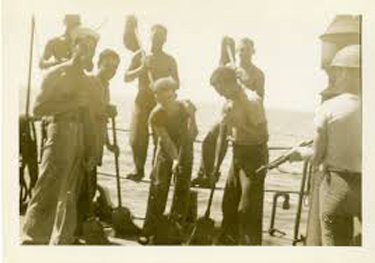
When that leftie friend starts yammering about Slavery, show him what Ishmael said:
“What of it, if some old hunks of a sea-captain orders me to get a broom and sweep down the decks? What does that indignity amount to, weighed, I mean, in the scales of the New Testament? Do you think the archangel Gabriel thinks anything the less of me, because I promptly and respectfully obey that old hunks in that particular instance? Who ain’t a slave? Tell me that. Well, then, however the old sea-captains may order me about—however they may thump and punch me about, I have the satisfaction of knowing that it is all right; that everybody else is one way or other served in much the same way— either in a physical or metaphysical point of view, that is; and so the universal thump is passed round, and all hands should rub each other’s shoulder-blades, and be content.”
— Moby Dick, Chapter 1, page 16.
03 Jul 2021
Pickett’s Charge
Civil War, Gettysburg, History

Today is the 158th Anniversary of the Third Day of the decisive Battle of Gettysburg.
——————————————————–

Crossing the Emmitsburg Road
——————————————————–

“Give them cold steel.” — Brigadier General Lewis Armistead (February 18, 1817–July 3, 1863)
——————————————————–
Dr. Joseph Hold of the 11th Mississippi, Davis’s brigade, anticipated that the afternoon would be busy and set up his dressing station early in a shelter behind Seminary Ridge. . .When the cannonade opened and the Federals’ guns replied, stretcher bearers, crouching low, began bringing in the wounded. Among the first was an athletic young man with reddish golden hair, “a princely fellow,” the doctor called him, with a calm manner and a delightful smile, one of that gay, turbulent company that had left with the University Greys of Oxford to form Company A of the 11th Mississippi.
The physician examined the left arm, cut off at the elbow, and offered encouragement.
“Why, doctor, that isn’t where I am hurt.” The boy pulled back a blanket and showed where a shell had ripped deep across his abdomen, carrying away much that was vital. “I am in great agony,” he said, still smiling. “Let me die easy, dear doctor.”
But before the lad had drunk the cup containing the concentrated solution of opium, the doctor held up his right arm so he could write: “My dear mother. . .Remember that I am true to my country and my regret at dying is that she is not free. . .you must not regret that my body cannot be obtained. It is a mere matter of form anyhow. . .Send my dying release to Miss Mary. . .” He signed, JERE S. GAGE, Co. A, 11 Miss. By that time, the letter was covered with blood.
Then he raised his cup to a group of soldiers. “I do not invite you to drink with me,” he remarked wryly, then with fervor, “but I drink a toast to you, the Southern Confederacy, and to victory.”
* * *
Then Pickett stood in front of his division and gave the final word: “Charge the enemy and remember old Virginia!” His voice was clear and strong as he spoke the order: “Forward! Guide center! March!” . . .
“I don’t want to make this charge,” Longstreet declared emphatically. “I don’t believe it can succeed. I would stop Pickett now, but that General Lee has ordered it and expects it.”
Further remarks showed he wanted some excuse for calling off the whole attack.
But Longstreet and Alexander had lost control. As they talked, the turf trembled about them and the long line of grey infantry broke from the woods. First came Garnett’s Virginians, the general in front, his old blue overcoat buttoned tightly around his neck. Abreast was Kemper’s trim line marching majestically into the open fields, the fifes piping “Dixie,” the ranks in nearly perfect alignment. Far to the left could be heard the drum rolls of the Carolina regiments — Pettigrew and Trimble were in motion. The hour of the generals had passed. The infantrymen from the Richmond offices and Pearisburg farmlands, the “Greys” from the halls of “Old Miss” and the “flower of the Cape Fear section,” had taken the Confederate cause into their hands.
* * *
The assaulting column consisted of 41 regiments and one battalion. . .Nineteen of the regiments were from Virginia, 15 from North Carolina, 3 each from Tennessee and Mississippi, and one regiment and one battalion from Alabama.
* * *
Garnett, with a big voice issuing from his frail body, rode ahead of his line regulating the pace, admonishing his men not to move too rapidly. From the skirmish line, Captain Shotwell obtained one of the rare views of the Confederate advance: the “glittering forest of bright bayonets,” the column coming down the slope “in superb alignment,” the “murmur and jingle” and “rustle of thousands of feet amid the stubble” which stirred up a cloud of dust “like the dash of spray at the prow of a vessel.”
In front of Pickett flew the blue banner of the Old Dominion with the motto, “Sic Semper Tyrannis,” and the Stars and Bars of the Confederacy (the red battle flag with its blue cross not yet being in general use). The regimental flags flapped. A soft warm wind was blowing from the land they loved.
Glenn Tucker, “High Tide at Gettysburg.”
03 Jul 2021
Lee’s Gamble
Civil War, Gettysburg, History, William Faulkner

For every Southern boy fourteen years old, not once but whenever he wants it, there is the instant when it’s still not yet two o’clock on that July afternoon in 1863, the brigades are in position behind the rail fence, the guns are laid and ready in the woods and the furled flags are already loosened to break out and Pickett himself with his long oiled ringlets and his hat in one hand probably and his sword in the other looking up the hill waiting for Longstreet to give the word and it’s all in the balance, it hasn’t happened yet, it hasn’t even begun yet, it not only hasn’t begun yet but there is still time for it not to begin against that position and those circumstance which made more men than Garnett and Kemper and Armistead and Wilcox look grave yet it’s going to begin, we all know that, we have come too far with too much at stake and that moment doesn’t need even a fourteen-year-old boy to think This time. Maybe this time with all this much to lose than all this much to gain: Pennsylvania, Maryland, the world, the golden dome of Washington itself to crown with desperate and unbelievable victory the desperate gamble, the cast made two years ago.
—William Faulkner, Intruder in the Dust, 1948.
03 Jul 2021
“Big Black Eyes Flashing Deep into the Night, Fueled by Nicotine, Caffeine, and Amphetamines”
Ayn Rand, Book Reviews

Art Deco Ayn denouncing the dirty communists in front of HUAC, 1947.
I found yesterday this affectionate, but clear-eyed, and quite well-written tribute to dear old Ayn written for New York magazine back in 2009 by Sam Anderson as a review of Anne Heller’s Ayn Rand and the World She Made.
Whenever Ayn Rand met someone new—an acolyte who’d traveled cross-country to study at her feet, an editor hoping to publish her next novel—she would open the conversation with a line that seems destined to go down as one of history’s all-time classic icebreakers: “Tell me your premises.” Once you’d managed to mumble something halfhearted about loving your family, say, or the Golden Rule, Rand would set about systematically exposing all of your logical contradictions, then steer you toward her own inviolable set of premises: that man is a heroic being, achievement is the aim of life, existence exists, A is A, and so forth—the whole Objectivist catechism. And once you conceded any part of that basic platform, the game was pretty much over. She’d start piecing together her rationalist Tinkertoys until the mighty Randian edifice towered over you: a rigidly logical Art Deco skyscraper, 30 or 40 feet tall, with little plastic industrialists peeking out the windows—a shining monument to the glories of individualism, the virtues of selfishness, and the deep morality of laissez-faire capitalism. Grant Ayn Rand a premise and you’d leave with a lifestyle.
Stated premises, however, rarely get us all the way down to the bottom of a philosophy. Even when we think we’ve reached bedrock, there’s almost always a secret subbasement blasted out somewhere underneath. William James once argued that every philosophic system sets out to conceal, first of all, the philosopher’s own temperament: that pre-rational bundle of preferences that urges him to hop on whatever logic-train seems to be already heading in his general direction. This creates, as James put it, “a certain insincerity in our philosophic discussions: the potentest of all our premises is never mentioned … What the system pretends to be is a picture of the great universe of God. What it is—and oh so flagrantly!—is the revelation of how intensely odd the personal flavor of some fellow creature is.”
No one would have been angrier about this claim, and no one confirms its truth more profoundly, than Ayn Rand. Few fellow creatures have had a more intensely odd personal flavor; her temperament could have neutered an ox at 40 paces. She was proud, grouchy, vindictive, insulting, dismissive, and rash. (One former associate called her “the Evel Knievel of leaping to conclusions.”) But she was also idealistic, yearning, candid, worshipful, precise, and improbably charming. She funneled all of these contradictory elements into Objectivism, the home-brewed philosophy that won her thousands of Cold War–era followers and that seems to be making some noise once again in our era of bailouts and tea parties…
It’s easy to chuckle at Rand, smugly, from the safe distance of intervening decades or an opposed ideology, but in person—her big black eyes flashing deep into the night, fueled by nicotine, caffeine, and amphetamines—she was apparently an irresistible force, a machine of pure reason, a free-market Spock who converted doubters left, right, and center. Eyewitnesses say that she never lost an argument. One of her young students (soon to be her young lover) staggered out of his first all-night talk session referring to her, admiringly, as “Mrs. Logic.” And logic, in Rand’s hands, seemed to enjoy superpowers it didn’t possess with anyone else. She claimed, for instance, that she could rationally explain every emotion she’d ever had. “Tell me what a man finds sexually attractive,” she once wrote, “and I will tell you his entire philosophy of life.” One convert insisted that “she knows me better after five hours than my analyst does after five years.” The only option was to yield or stay away.

01 Jul 2021
I’d Fly a Drone into an Erupting Volcano. Wouldn’t You?
Drone Photography, Fagradalsfjall, Iceland, Volcano
(Full Screen on.)
HT: Vanderleun.
30 Jun 2021
The Astonishing Eccentricity of Japan
Bizarre, Japan

Philip Patrick, in the London Spectator, marvels at just how differently the Japanese finds ways of doing things.
The late A.A. Gill, in his notorious ‘Mad in Japan’ essay, concluded that the only way you could make sense of Tokyo was to think of it as a vast open-air lunatic asylum, with inmates instead of residents. Gill would have loved Arisa.
I don’t think I’ve ever encountered anything more stereotypically Japanese than Arisa. She’s a multilingual robot concierge at Nishi-Shinjuku station in central Tokyo, one of the thousands of new automatons installed in the city ahead of the Olympics next month. She has a rather creepy Doctor Who look to her — she could be Davros’s girlfriend — and she’s there to assist tourists. I considered testing Arisa by asking how to get to the famous Budokan concert hall, in the hope that she’d answer ‘Practise!’; but I’m not sure she’s programmed for humour.
The eccentricity of Japan is all-enveloping and inescapable: the frighteningly shrill screamed chorus of ‘Welcome’ whenever you enter a shop; the bizarre Japanese–English on packaging and billboards, hastily ‘translated’, presumably by non-native speakers, and apparently never checked. (‘The Day Nice Hotel’ and ‘Soup for Sluts’ are my personal favourites.) Then there are the council rose-bush pruners who wear crash helmets to do their work; the incomprehensible address system that makes a new location impossible to find (even with a robot assistant); the dangerous food, the highly prized but poisonous fugu pufferfish which kills a handful of people each year but is still sold as a delicacy. I could go on.
But Gill’s problem may have been that he didn’t stick around long enough (he hated the food). …
As Dikko Henderson, James Bond’s man in Japan, says as he fixes 007 a drink:‘I’ve been in Tokyo 20 years and I’m only beginning to find my way around.’ I imagine he wasn’t merely referring to directions.
So eventually you come to understand that the crash helmets of the rose pruners are not for safety, but part of a formal uniform. And you realise that Japanese-English is decorative and designed to get your attention, rather than be meaningful (you’ll never forget ‘Soup for Sluts’). And you suspect that addresses may be purposefully confusing to deter casual visitors and reward the truly committed with a sense of accomplishment. And you sense that perhaps the irritatingly inflexible and time-consuming etiquette and the vagueness of so much written information keeps us on permanent edge, always slightly anxious and uncertain, thus warding off complacency, laziness, decadence. And eating the pufferfish adds a certain Russian roulette excitement to a meal.
But it’s another mistake to imagine that the locals understand their own peculiarities or have consciously engineered them. The Japanese are self-absorbed but not necessarily fully self-aware. Nihonjinron — the study of Japanese things by the Japanese — is a life’s work and an end in itself, undertaken by the majority in some form or another but never truly completed.
‘You are an eternal student. You never master anything — you just become progressively less bad,’ said an acquaintance about her 30-year flower-arranging career. Process is more important than product.
As Donald Richie, the great writer on Japanese aesthetics, said: ‘A Japanese person understands Japaneseness in the same way a fish understands water. They are surrounded by it, but have no idea what it is.’ Strange customs evolve over long stretches of time and survive because they serve some often obscure purpose and contribute in a small way to the greater good. There’s method in the quirkiness.
29 Jun 2021
Poor, Poor, Pitiful Arianne!
Arianne Shavisi, Britain Sinking into the Sea, Critical Racial Theory, Rank Ingratitude
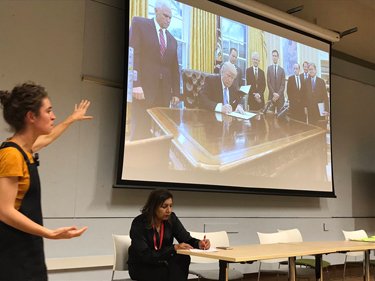
Dr. Arianne Shavisi, on the left (in more ways than one).
In Britain, there has recently arisen a patriotic, Feel-Good movement calling itself: “One Britain, One Nation.” It was founded in 2013 by one Kash Singh, a Punjabi who immigrated to Britain with his parents at the age of six and who grew up to become an Inspector with the West Yorkshire Police.
One Britain, One Nation (OBON, for short) has called for “schools across the UK to celebrate One Britain One Nation Day on 25 June, when children can learn about [British] shared values of tolerance, kindness, pride and respect”, and in particular for children to sing a patriotic song written by school children at St John’s CE Primary School, Bradford titled “We are Britain and we have one dream / To unite all people in one great team.” (Gag me with a spoon!)
All this goody-goody, goo-goo-ism has attracted the support of Boris Johnson, Joanna Lumley, Brandon Lewis, Lord Tebbit, Lord Steel of Aikwood, and various religious leaders, including bishops and imams.
What can one say? It’s not my kind of thing, but it is obviously true that human beings differ in all sorts of tribal ways in every society and need to tolerate one another’s differences and get along, and recent immigrants ought to be grateful to be where they are and should be endeavoring to assimmilate, not complaining.
I came across an editorial this morning in the hoity-toity London Review of Books by one Dr. Arianne Shavisi, who is a Senior Lecturer in Medical Ethics & Humanities (Clinical and Experimental Medicine) at Brighton and Sussex Medical School, a specialist in feminist bioethics, gender studies, global health ethics, social determinants of health, and the philosophy of mind, and a Free Speech opponent.
Dr. Shavisi has degrees like a thermometer from Oxford and Cambridge, and in addition to her university position sits on editorial boards, publishes in prestigious venues, and even advises the British Government on Abortion and Women’s Health. Pretty darn good for a first generation British subject fresh off the banana boat.
You would think this young woman would be grateful to Britain and the British people for letting her parents in, doubtless as refugees from the crazed mullahs’ fanatical regime. Dr. Arianne gets to swan around Decolonize STEM Symposia in overalls and a t-shirt, instead of burying herself in a voluminous black Chador. She can walk down the street or even drink wine without worrying about getting arrested by the Morality Police. She can abuse and attack the country lives in and she is not thrown into a dungeon.
But, no, she is not grateful. In fact, she confusedly considers her Aryan/Arianne self to be a person of color and some sort of victim of Racism, simply because she is a person of foreign, and therefore minority, origin and not a member of the native majority. How terribly, terribly racist and unfair!
She is also a fountain of Marxist CRT nonsense.
From the London Review of Books editorial opposing OBON:
White children experience white privilege regardless of their household income. That doesn’t mean their lives are a piece of cake, it just means that race isn’t part of their burden. Whiteness inoculates them against certain forms of social marginalisation, but it provides little protection against poverty and its variegated effects. (By contrast, wealth fortified with whiteness is practically a superpower.) The problem is therefore not that poor white children are being taught that they’re privileged along the axis of race, it’s that they and others are not being told they’re oppressed along the axis of class. Rather than subtracting conversations about white privilege from our classrooms, we need to ensure that children also learn that the system is designed to keep them poor.
That nefarious system obviously failed to stop her Persian immigrant self.
And:
You can’t demand that children be proud any more than you can ask them not to be ashamed. Poverty and racism pose material barriers, but they also fill people with a shame that is antithetical to their thriving. As Hannah Gadsby put it in her 2018 show Nanette: ‘When you soak a child in shame, they cannot develop the neurological pathways that carry thought.’ Learning is much harder when you’re hungry or humiliated. The government has no place asking children of colour to be proud of a country that fails to recognise racism, and it has no place asking poor children to sing for a country that sells their hunger to private companies which send them half a carrot.
Describing her 2018 talk “Refining the Case Against Free Speech“:
In this talk I counter the claim that free speech is under threat in universities, and instead submit that new opportunities have arisen to make knowledge exchange more inclusive. I argue that there is good reason to demand “political correctness” in the discussion of certain issues, and that far from standing in the way of free exchange, political correctness aims to make that exchange more widely accessible. Political correctness, if judiciously implemented, is a form of censorship whose purpose is to embolden and amplify the voices of the most marginalised and silenced communities within our society, and to bring their experiences and standpoints into collective discourses. I suggest that academics should endorse restrictions on permissible academic speech, with the aim of producing educational spaces within which epistemic outcomes are optimised for all social groups. One concrete strategy is to seriously engage the potent, but currently much-maligned, regulatory functions of “safe spaces” and “no platforming,” which I define and defend against common objections.
29 Jun 2021
How Useless Is this Supreme Court?
"Really Excellent Sheep", Certiori, Supreme Court, Supreme Court Appointments

Republicans win the presidency again and again, and Republican presidents battle Senate democrats to get supposedly responsible and conservative nominees confirmed to seats on the nation’s highest court. And it does no good.
Some of those nominees, like Sandra Day O’Connor, David Souter, or Anthony Kennedy, turn out to be liberal Q-boats. Others, like John Roberts and apparently Brett Kavanaugh and Neil Gorsuch and Amy Coney Barrett, just seem to lack what it takes to hand down decisions the Left seriously doesn’t like.
It is remarkable that a supposedly 6-3 conservative majority court faced with what look like cut-and-dried issues of serious significance, obviously thought about what the establishment media and their liberal friends in Georgetown would have to say, and punted, allowing the Left to win by default.
Case 1: Transgender pride 1, Commonwealth of Virginia girls 0.
The Supreme Court is passing on a key case involving a transgender student, and the ACLU is celebrating the news as an “incredible victory.”
The Supreme Court on Monday declined to hear the case of Gavin Grimm, the transgender student who challenged a Virginia school board’s policy that restrooms are “limited to the corresponding biological genders,” NBC News reports. Lower courts sided with Grimm that this violated Title IX, the civil rights law against sex discrimination, and since the Supreme Court isn’t taking up the case, Grimm’s win stays in place.
Josh Block, an attorney for the American Civil Liberties Union, told NBC that this was “an incredible victory for Gavin and for transgender students around the country,” while Grimm said, “I am glad that my years-long fight to have my school see me for who I am is over. Being forced to use the nurse’s room, a private bathroom, and the girl’s room was humiliating for me, and having to go to out-of-the-way bathrooms severely interfered with my education.”
——————-
Case 2: “Let the People’s Republic of Taxachusetts Reach Across State Lines to Pick New Hampshire Pockets!”
New Hampshire residents working remotely for companies in Massachusetts during the Covid-19 pandemic will still have to pay income tax as if they were commuting to work, after the Supreme Court turned away a challenge to Massachusetts’ rule.
The high court on Monday rejected New Hampshire’s complaint without comment. The justices have exclusive jurisdiction to hear disputes between states if they so choose and such complaints are filed directly with the court.
The dispute centers on a temporary emergency regulation adopted by Massachusetts last year that places a tax on “nonresident income received for services performed” outside of the state.
“For example, the entire salary of a New Hampshire resident who commuted to work full time in Boston in February but has not set foot in the commonwealth for more than eight months continues to be subject to the Massachusetts state income tax as if he were still working every day in Boston,” the complaint states. (Emphasis in original.)
New Hampshire sought a refund of those taxes for its roughly 80,000 residents working remotely for Massachusetts companies. It claims the rule infringes on its “sovereign right to control its own tax and economic policies.” New Hampshire is one of nine states that does not impose an income tax.
I guess the moral is that GOP presidents need to stop nominating justices from the ranks of the “really excellent sheep” top graduates of our most prestigious Ivy League law schools. Republican presidents should start looking for outsider, wild man justices who are serious about defending the Constitution and the culture and who have cojones.
27 Jun 2021
Wall of Boxes — Another Japanese Gameshow
Bizarre, Japan, Japanese Gameshows
Japan has the most over-the-top gameshows.
27 Jun 2021
Signalman Jack: the Baboon Who Was a Railwayman
Baboon, History, Railroads
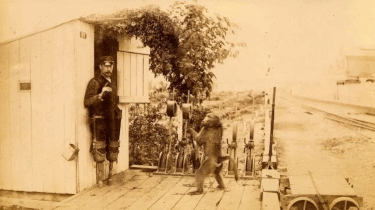
One day in the 1880s, a peg-legged railway signalman named James Edwin Wide was visiting a buzzing South African market when he witnessed something surreal: A chacma baboon driving an oxcart. Impressed by the primate’s skills, Wide bought him, named him Jack, and made him his pet and personal assistant.
Wide needed the help. Years earlier, he had lost both his legs in a work accident, which made his half-mile commute to the train station extremely difficult for him. So the first thing he trained the primate to do was push him to and from work in a small trolley. Soon, Jack was also helping with household chores, sweeping floors and taking out the trash.
But the signal box is where Jack truly shined. As trains approached the rail switches at the Uitenhage train station, they’d toot their whistle a specific number of times to alert the signalman which tracks to change. By watching his owner, Jack picked up the pattern and started tugging on the levers himself.
Soon, Wide was able to kick back and relax as his furry helper did all of the work switching the rails. According to The Railway Signal, Wide “trained the baboon to such perfection that he was able to sit in his cabin stuffing birds, etc., while the animal, which was chained up outside, pulled all the levers and points.”
As the story goes, one day a posh train passenger staring out the window saw that a baboon, and not a human, was manning the gears and complained to railway authorities. Rather than fire Wide, the railway managers decided to resolve the complaint by testing the baboon’s abilities. They came away astounded.
“Jack knows the signal whistle as well as I do, also every one of the levers,” wrote railway superintendent George B. Howe, who visited the baboon sometime around 1890. “It was very touching to see his fondness for his master. As I drew near they were both sitting on the trolley. The baboon’s arms round his master’s neck, the other stroking Wide’s face.”
Jack was reportedly given an official employment number, and was paid 20 cents a day and half a bottle of beer weekly. Jack passed away in 1890, after developing tuberculosis. He worked the rails for nine years without ever making a mistake—evidence that perfectionism may be more than just a human condition.



