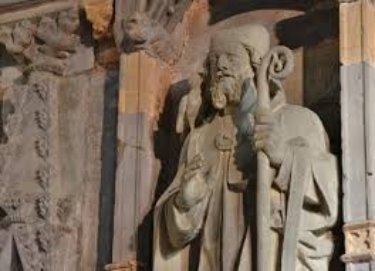
March 1st
Feast Day: St. David, archbishop of Caerleon, patron of Wales.
ST. DAVID
David, popularly termed the titular saint of Wales, is said to have been the son of a prince of Cardiganshire of the ancient regal line of Cunedda Wledig; some, also, state that he was the son of Xanthus, son of Ceredig, lord of Ceredigion, and Non, daughter of Gynyr of Caergawh, Pembrokeshire. St. David has been invested by his legendary biographers with extravagant decoration. According to their accounts, he had not merely the power of working miracles from the moment of his birth, but the same preternatural faculty is ascribed to him while he was yet unborn!
An angel is said to have been his constant attendant on his first appearance on earth, to minister to his wants, and contribute to his edification and relaxation; the Bath waters became warm and salubrious through his agency; he healed complaints and re-animated the dead; whenever he preached, a snow-white dove sat upon his shoulder! Among other things,�as pulpits were not in fashion in those times,�the earth on which he preached was raised from its level, and became a hill; from whence his voice was heard to the best advantage. Among these popular legends, the pretended life of St. David, in Welsh, in the Cotton MSS. (D. xxii.), is the most remarkable for its spurious embellishments. His pedigree is here deduced from the Virgin Mary, of whom it makes him the lineal eighteenth descendant! But leaving the region of Fiction, there is no doubt that the valuable services of St. David to the British church entitle him to a very distinguished position in its early annals. He is numbered in the Triads with Teilo and Catwg as one of the ‘three canonized saints of Britain.’ Giraldus terms him ‘a mirror and pattern to all, instructing both by word and example, excellent in his preaching, but still more so in his works. He was a doctrine to all, a guide to the religious, a life to the poor, a support to orphans, a protection to widows, a father to the fatherless, a rule to monks, and a model to teachers; becoming all to all, that so he might gain all to God.’
To this, his moral character, St. David added a high character for theological learning; and two productions, a Boole of Homilies, and a Treatise against the Pelagians, have been ascribed to him.
St. David received his early education at Menevia, (derived from Main-aw, ‘a narrow water,’ firth or strait), named afterwards Ty Ddewi, ‘David’s Rouse,’ answering to the present St. David’s, which was a seminary of learning and nursery of saints. At this place, some years after, he founded a convent in the Vale of Rhos. The discipline which St. David enjoined in this monastic retreat is represented as of the most rigorous nature. After the Synod at Brevy, in 519, Dubricins, or Dyvrig, Archbishop of Caerleon, and consequently Primate of Wales, resigned his see to St. David, who removed the archiepiscopal residence to Menevia, the present St. David’s, where he died about the year 544, after having attained a very advanced age. The saint was buried in the cathedral, and a monument raised to his memory. It is of simple construction, the ornaments consisting of one row of four quatrefoil openings upon a plain tomb. Read the rest of this entry »