Explaining Democrats’ (and the Media’s) Passion for AOC
Alexandria Ocasio-Cortez, Democrats, Hollywood Stereotypes, Mainstream Media, Politics


Robert Tracinski identifies AOC as a Hollywood archetype.
She’s the Democratic Party’s Manic Pixie Dream Girl.
Once you see it, you can’t unsee it. AOC is an MPDG, and if we had political satirists worthy of the name, NBC would already have brought in Zooey Deschanel to play her on Saturday Night Live.
The Manic Pixie Dream Girl is a stock character first classified by Nathan Rabin in a 2007 review of Elizabethtown, a film he described as “The Bataan Death March of Whimsy.†“The Manic Pixie Dream Girl,†he wrote, “exists solely in the fevered imaginations of sensitive writer-directors to teach broodingly soulful young men to embrace life and its infinite mysteries and adventures.â€
In my youth, this sort of character was usually played by Julia Roberts, often opposite Richard Gere. More recently, the trope has been associated with the kind of chirpingly quirky free spirit, chock full of precious hipster mannerisms, often played by Zooey Deschanel (and widely parodied). You get the idea: strumming a ukulele, dancing in the rain, riding an old-fashioned bicycle in a sundress. The Manic Pixie Dream Girl is the vibrant, attractive young woman who, by the sheer force of her joie de vivre and childlike enthusiasm, rescues the brooding male lead from his cynicism or malaise.
The Democratic party certainly needs this sort of thing right now as it struggles to break free from the funk of defeat and the grey, hopeless compromises of Clintonism. So of course they were eager to idolize a slender, attractive young champion, with her flowing dark hair, improbably big eyes, and wide, toothy smile—many of the qualities, come to think of it, that qualified Julia Roberts for this role on the big screen.
—————————
Lisa Schiffren, on the other hand, offers a simpler explanation.
The real reason that neither cameras nor citizens can look away is, of course: sex. The woman exudes a wild kind of sex appeal. She is hugely mediagenic. Her thin, lanky body, with the attention grabbing, er… rack; the expressive face; the crazy eyes and large, invariably red lipsticked mouth—any casting director could have predicted her ability to grab attention.
To use the Hollywood term of art, young Alexandria is, “fuckable.†That is a rare quality among political women, possibly never previously seen in any elected female Congresswoman or Senator. (Though Harry Reid thought that Sen. Kirsten Gillibrand (D, N.Y.) had it early on, when he called her “the hottest Senator.â€) Remember how the extremely hot Sarah Palin disrupted the political landscape, and we learned the acronym MILF? This attribute explains why there are so many politically conservative men telling the world that they would “do†her, while complaining about her “stupidity,†and irritating voice. Men are obsessed, despite the fact (or because of it?) that she is a clear candidate for the top right corner of the Hot-Crazy matrix.
Meryl Streep first publicized this Hollywood casting criterion in a now scrubbed NPR interview. Asked how it was that she had been given all of the serious female roles in her generation, Streep responded, and I paraphrase, “In Hollywood they decided early on that I wasn’t ‘fuckable.’ So I got to be interesting instead.†Amy Schumer and Julia Louis-Dreyfus elaborated on the concept in a sketch known to all millenials.
Lest you think I am insulting the looks of all women previously elected to Congress, please note that the opposite of “fuckable†is not unattractive. It is “serious.†Serious in the manner of women who wish to be taken seriously in the serious endeavor of making the nation’s laws and policies. Serious so that citizens trust them, as we must. It’s not an accident that the women who have held the most power—Margaret Thatcher, Patricia May, Indira Gandhi, Golda Meir…. everyone except Benazir Bhutto and Evita, were post-menopausal. Even Hillary Clinton, no sexpot, had to be “a certain age,†to be plausible as president. No one trusts a woman—or man—who radiates sexuality as a primary calling card, and excites it in others. This is true in real life, though not on TV, where the implausibly attractive imitate the serious.
For the record, this attribute of AOC’s is the major reason anyone—anyone—takes her “ideas†seriously. There’s no there, there. To be sure, the Socialism she spouts is a threat. But all those old people running for the Democratic nomination apparently believe that she is the ticket to eternal life, or at least to the millennial vote, because of her vibe, not her thinking.
Fascinating as it has been to watch, this AOC dumpster fire of sexuality in Congress is terrible precedent—for our political culture, and for women in politics. Charisma—the ability to charm—is tough enough for the admirably substantive to beat.
“W.E.B. Griffin” — November 10, 1929 – February 12, 2019
Historical Fiction, Military History, Obituaries, U.S. Army, USMC, W.E.B. Griffin

William E. Butterworth III, the best-selling author, has died. He was 89, and had fought a years-long battle with cancer.
While his body of work includes more than 250 books published under more than a dozen pseudonyms, he is best known as W.E.B. Griffin, the #1 best-selling author of nearly 60 epic novels in seven series, all of which have made The New York Times, The Wall Street Journal, Publishers Weekly, and other best-seller lists. More than fifty million of the books are in print in more than ten languages, including Hebrew, Chinese, Japanese, and Hungarian.
Mr. Butterworth’s first novel, Comfort Me with Love, was published in 1959. The delivery-and-acceptance check from the publisher paid the hospital bill for the birth of his first son, who two decades ago began editing the Griffin best-sellers and then became co-author of them.
Mr. Butterworth grew up in the suburbs of New York City and Philadelphia. He enlisted in the United States Army in 1946. After basic training, he received counterintelligence training at Fort Holabird, Maryland. He was assigned to the Army of Occupation in Germany, and ultimately to the staff of then-Major General I.D. White, commander of the U.S. Constabulary.
In 1951, Mr. Butterworth was recalled to active duty for the Korean War, interrupting his education at Phillips University, Marburg an der Lahn, Germany. In Korea he earned the Combat Infantry Badge as a combat correspondent and later served as acting X Corps (Group) information officer under Lieutenant General White.
On his release from active duty in 1953, Mr. Butterworth was appointed Chief of the Publications Division of the U.S. Army Signal Aviation Test & Support Activity at Fort Rucker, Alabama.
Mr. Butterworth is a member of the Special Operations Association, the Veterans of Foreign Wars, the American Legion, the Army Aviation Association, the Armor Association, and the Office of Strategic Services (OSS) Society.
He was the 1991 recipient of the Brigadier General Robert L. Dening Memorial Distinguished Service Award of the U.S. Marine Corps Combat Correspondents Association, and the August 1999 recipient of the Veterans of Foreign Wars News Media Award, presented at the 100th National Convention in Kansas City.
He has been vested into the Order of St. George of the U.S. Armor Association, and the Order of St. Andrew of the U.S. Army Aviation Association, and been awarded Honorary Doctoral degrees by Norwich University, the nation’s first and oldest private military college, and by Troy State University (Ala.). He was the graduation dinner speaker for the class of 1988 at the U.S. Military Academy at West Point.
He has been awarded honorary membership in the Special Forces Association, the Marine Corps Combat Correspondents Association, the Marine Raiders Association, and the U.S. Army Otter & Caribou Association. In January 2003, he was made a life member of the Police Chiefs Association of Southeastern Pennsylvania, Southern New Jersey, and the State of Delaware.
He was the co-founder of the William E. Colby Seminar on Intelligence, Military, and Diplomatic Affairs.
The W.E.B. Griffin novels, known for their historical accuracy, have been praised by The Philadelphia Inquirer for their “fierce, stop-for-nothing scenes.â€
“Nothing honors me more than a serviceman, veteran, or cop telling me he enjoys reading my books,†he said.
———————–
W.E.B. Griffin quotations.
———————–
I really liked his “Brotherhood of War” series, which was so thoroughly grounded in real history that you could describe it as a Roman à clef.
Socialism: Back From the Death Like the Killer at the End of a Horror Movie
Matthew Continetti, Nationalism, Secularism, Socialism

Matthew Continetti associates the rebirth of Socialism and Nationalism with the death of Christianity.
If the death of the socialist idea was the most important political event of the last century, then the rebirth of this ideal must rank high in significance in the current one. Just as nationalism has reasserted itself on the political right, socialism has grown in force on the left. In the twenty-first century the two ideologies are estranged and antagonistic twins, paired in Occupy Wall Street and the Tea Party, Jeremy Corbyn and Brexit, Bernie Sanders and Donald Trump. The Democratic victory in 2018 has elevated socialism to a height it has not reached in the United States in more than a century. Only in recent weeks, however, have defenders of democratic capitalism become aware of how great the socialist challenge really is. Only now are we beginning to formulate a response.
Take your pick of the headlines. Alexandria Ocasio-Cortez is the most talked-about Democrat in the country. Her fellow member of the Democratic Socialists of America, Rashida Tlaib, opened the 116th Congress by saying, “Impeach the mother—.” Their comrade Ilhan Omar apparently wants to offend every Jewish American by the end of her term. The Green New Deal, Medicare For All, eliminating employer-based health insurance, marginal tax rates of upwards of 70 to 90 percent, requiring corporations above a certain size to obtain a federal charter, the expropriation of wealth, heavy inheritance taxes, free college, universal basic income, abolish I.C.E., the anti-Semitism that has long been socialism’s fellow traveler—what was once radical and marginal is now embraced and celebrated by a large and vocal part of the Democratic Party.
Why? The answer goes a long way toward explaining the resurgence of nationalism as well. In “Socialism: An Obituary for an Idea,” the essay quoted above, Kristol exhumed the ideology’s intellectual remains. He explained that the ideal of utopian socialism offered “elements that were wanting in capitalist society—elements indispensable for the preservation, not to say perfection, of our humanity.” Socialism supplied the values, aspirations, goals, mechanisms of meaning that democratic capitalism could not.
As Michael Novak observed in his 1982 masterpiece The Spirit of Democratic Capitalism, what we call capitalism is really three systems in one. There is the economic system of entrepreneurship and free exchange. There is a moral-cultural system governing norms and behavior. And there is the political system of democratic pluralism and individual freedom. Socialism returns at times when the democratic capitalist trinity is out of whack, at places where the moral-cultural and political systems fail to provide answers that legitimize the economic system. Socialism is the attempt to derive from the political sphere the direction and purpose to human life that is the traditional province of morality and culture.
The separation of the moral and cultural from the political and economic was the crack in the foundation of democratic capitalism. “A society founded solely on ‘individual rights,'” Kristol wrote, “was a society that ultimately deprived men of those virtues which could only exist in a political community which is something other than a ‘society.’ Among these virtues are a sense of distributive justice, a fund of shared moral values, and a common vision of the good life sufficiently attractive and powerful to transcend the knowledge that each individual’s life ends only in death.”
Thus, if people do not see the fruits of the economic system as just, and if the moral-cultural system fails to satisfy people’s deepest longings, they will look increasingly to the political system to lessen the gale of creative destruction or to silence it altogether. The viability of democratic capitalism, then, depends on its moral and cultural character. “As there is a degree of depravity in mankind which requires a certain degree of circumspection and trust,” James Madison wrote in Federalist no. 55, “so there are other qualities in human nature which justify a certain portion of esteem and confidence. Republican government presupposes the existence of these qualities in a higher degree than any other form.”
It was Kristol’s view that the founders of democratic capitalism simply assumed that such qualities would be always present. “Capitalist society itself—as projected, say, in the writings of John Locke and Adam Smith—was negligent of such virtues,” he wrote.
It did not reject them and in no way scorned them, but simply assumed that the individual would be able to cope with this matter as he did with his other ‘private’ affairs. This assumption, in turn, was possible only because the founders of capitalism took it for granted that the moral and spiritual heritage of Judaism and Christianity was unassailable, and that the new individualism of bourgeois society would not ‘liberate’ the individual from this tradition. It might free him from a particular theology, or a particular church; but he would ‘naturally’ rediscover for himself, within himself, those values previously associated with that theology or church.
Things did not work out as planned. The bourgeois values of honesty, fidelity, diligence, reticence, delayed gratification, and self-control that once reigned supreme have been contested for many decades by an ethic of self-expression, self-indulgence, instant gratification, and demanding the impossible. Our politics is a competition for control over what Michael Novak called the “empty shrine” at the center of pluralist democracy. The champions of Christianity and militant secularism, free speech and political correctness, meritocracy and diversity, the entrepreneurial instinct and an inflamed egalitarianism, and historical memory and limitless iconoclasm struggle for a dominance that is never fully attained.
Both the right and the left are uncomfortable with the democratic capitalist trinity. Both would rather have the empty shrine be replaced with something else. That is why you see laments for the loss of political community, as well as critiques of inequality, on both Fox News and MSNBC.


Travis Kauffmann Explains How He Killed a Mountain Lion With His Bare Hands
Colorado, Human Predation, Mountain Lion, The Right Stuff, Travis Kauffmann
There May Be Something In All This
Cthulhu, Democrats, H.P. Lovecraft, Michael Walsh, The Left

Michael Walsh, author of the recent history of Leftist Modernism, The Devil’s Pleasure Palace, ?facetiously? contends that today’s leftists have a great deal in common with the squelching, piscine-featured inhabitants of H.P. Lovecraft’s ancient, crumbling New England towns secretly carrying on the nefarious activities of the Starry Wisdom Cult.
It seems to be the only way to account for the frequently self-contadictory unspeakable madness characteristic of the most prominent Progressive democrats.
Ph’nglui mglw’nafh Cthulhu R’lyeh wgah’nagl fhtagn!
St. Valentine’s Day, formerly the Lupercalia
Hagiography, History, Lupercalia, St. Valentine, Traditions, Valentine Day
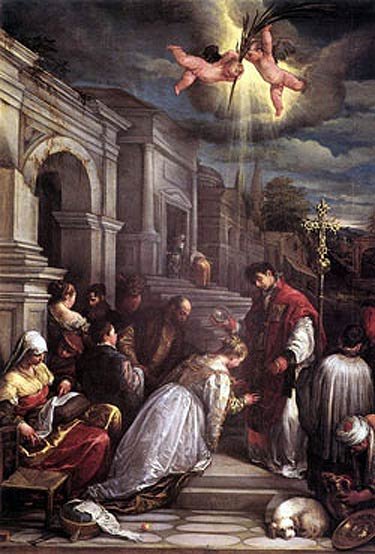
Jacopo Bassano, St Valentine Baptizing St Lucilla, 1575, oil on canvas, Museo Civico, Bassano del Grappa
The popular customs associated with Saint Valentine’s Day undoubtedly had their origin in a conventional belief generally received in England and France during the Middle Ages, that on 14 February, i.e., half way through the second month of the year, the birds began to pair. Thus in Chaucer’s Parliament of Foules we read:
-
For this was sent on Seynt Valentyne’s day
Whan every foul cometh ther to choose his mate.
For this reason the day was looked upon as specially consecrated to lovers and as a proper occasion for writing love letters and sending lovers’ tokens. Both the French and English literatures of the fourteenth and fifteenth centuries contain allusions to the practice. Perhaps the earliest to be found is in the 34th and 35th Ballades of the bilingual poet, John Gower, written in French; but Lydgate and Clauvowe supply other examples. Those who chose each other under these circumstances seem to have been called by each other their Valentines.
In the Paston Letters, Dame Elizabeth Brews writes thus about a match she hopes to make for her daughter (we modernize the spelling), addressing the favoured suitor:
-
And, cousin mine, upon Monday is Saint Valentine’s Day and every bird chooses himself a mate, and if it like you to come on Thursday night, and make provision that you may abide till then, I trust to God that ye shall speak to my husband and I shall pray that we may bring the matter to a conclusion.
——————————————–
From Robert Chambers, The Book of Days, 1869: Feast Day: St. Valentine, priest and martyr, circ. 270.
ST. VALENTINE’S DAY
Valentine’s Day is now almost everywhere a much degenerated festival, the only observance of any note consisting merely of the sending of jocular anonymous letters to parties whom one wishes to quiz, and this confined very much to the humbler classes. The approach of the day is now heralded by the appearance in the print-sellers’ shop windows of vast numbers of missives calculated for use on this occasion, each generally consisting of a single sheet of post paper, on the first page of which is seen some ridiculous coloured caricature of the male or female figure, with a few burlesque verses below. More rarely, the print is of a sentimental kind, such as a view of Hymen’s altar, with a pair undergoing initiation into wedded happiness before it, while Cupid flutters above, and hearts transfixed with his darts decorate the corners. Maid-servants and young fellows interchange such epistles with each other on the 14th of February, no doubt conceiving that the joke is amazingly good: and, generally, the newspapers do not fail to record that the London postmen delivered so many hundred thousand more letters on that day than they do in general. Such is nearly the whole extent of the observances now peculiar to St. Valentine’s Day.
At no remote period it was very different. Ridiculous letters were unknown: and, if letters of any kind were sent, they contained only a courteous profession of attachment from some young man to some young maiden, honeyed with a few compliments to her various perfections, and expressive of a hope that his love might meet with return. But the true proper ceremony of St. Valentine’s Day was the drawing of a kind of lottery, followed by ceremonies not much unlike what is generally called the game of forfeits. Misson, a learned traveller, of the early part of the last century, gives apparently a correct account of the principal ceremonial of the day.
-
‘On the eve of St. Valentine’s Day,’ he says, ‘the young folks in England and Scotland, by a very ancient custom, celebrate a little festival. An equal number of maids and bachelors get together: each writes their true or some feigned name upon separate billets, which they roll up, and draw by way of lots, the maids taking the men’s billets, and the men the maids’: so that each of the young men lights upon a girl that he calls his valentine, and each of the girls upon a young man whom she calls hers. By this means each has two valentines: but the man sticks faster to the valentine that has fallen to him than to the valentine to whom he is fallen. Fortune having thus divided the company into so many couples, the valentines give balls and treats to their mistresses, wear their billets several days upon their bosoms or sleeves, and this little sport often ends in love.’
St. Valentine’s Day is alluded to by Shakespeare and by Chaucer, and also by the poet Lydgate (who died in 1440).
The origin of these peculiar observances of St. Valentine’s Day is a subject of some obscurity. The saint himself, who was a priest of Rome, martyred in the third century, seems to have had nothing to do with the matter, beyond the accident of his day being used for the purpose. Mr. Douce, in his Illustrations of Shakespeare, says:
-
“It was the practice in ancient Rome, during a great part of the month of February, to celebrate the Lupercalia, which were feasts in honour of Pan and Juno. whence the latter deity was named Februata, Februalis, and Februlla. On this occasion, amidst a variety of ceremonies, the names of young women were put into a box, from which they were drawn by the men as chance directed. The pastors of the early Christian church, who, by every possible means, endeavoured to eradicate the vestiges of pagan superstitions, and chiefly by some commutations of their forms, substituted, in the present instance, the names of particular saints instead of those of the women: and as the festival of the Lupercalia had commenced about the middle of February, they appear to have chosen St. Valentine’s Day for celebrating the new feast, because it occurred nearly at the same time.”
—————————————————-
February 14th, prior to 1969, was the feast day of two, or possibly three, saints and martyrs named Valentine, all reputedly of the Third Century.
The first Valentine, legend holds, was a physician and priest in Rome, arrested for giving aid to martyrs in prison, who while there converted his jailer by restoring sight to the jailer’s daughter. He was executed by being beaten with clubs, and afterwards beheaded, February 14, 270. He is traditionally the patron of affianced couples, bee keepers, lovers, travellers, young people, and greeting card manufacturers, and his special assistance may be sought in conection with epilepsy, fainting, and plague.
A second St. Valentine, reportedly bishop of Interamna (modern Terni) was also allegedly martyred under Claudius II, and also allegedly buried along the Flaminian Way.
A third St. Valentine is said to have also been martyred in Roman times, along with companions, in Africa.
Due to an insufficiency of historical evidence in the eyes of Vatican II modernizers, the Roman Catholic Church dropped the February 14th feast of St. Valentine from its calendar in 1969.
Millennial Snowflakes at Yale Apparently Need a Professional “Cool Aunt/Uncle” Whom They Can Run to Whenever They Feel “Unsafe” or “Uncomfortable” on Campus
Diversity, Free Speech, Halloween Costumes, Millennials, Ressentiment, Snowflake Think, The Christakises and the Shrieking Student, Yale

Snowflakes at Wellesley reacting to 2016 Election returns.
My blood boiled this morning when I read this reply to a question on Quora:
TheFire.Org asked, rhetorically:
Is the reaction of Yale University students against professor Erika Christakis email the signal of the start of the steep and rapid decline of Yale and its motto of truth?
——————————————————-
Cathy Xue, Silliman ’19 replied:
During the 2015–2016 school year, I was a freshman in Silliman College, where Erika Christakis was Associate Master (the position of “Master†has since been re-titled as “Head of College†or “HoCâ€). *Mrs. Christakis’ decision to express her opinions on free speech and Halloween costumes in an email the students of Silliman College, **/where she occupied a position of authority/**, was inappropriate. *I do not doubt that if she instead published her statement in a more general forum, for example as an op-ed in the /Yale Daily News/, that the reaction would not be as intense.
Basically, *Erika Christakis failed her duty as Associate Master by sending that email*, and this upset a number of students in Silliman College and in the broader Yale community. At Yale, the role of (Associate) Master/HoC is one of social and community leadership and support — kind of like the cool aunt/uncle for the 400 or so students under their watch. Erika Christakis was supposed to be someone that Silliman students could feel comfortable approaching if they felt unsafe or uncomfortable on campus. Instead, she indicated to her charges that she valued the principle of free speech and intellectual discussion over the very real personal hurt that insensitive language or other expression (like Halloween costumes, for example) might cause.
Also, the negative reaction didn’t occur in a vacuum — other events had already fueled discussion and unrest about racism on campus.
And unconditional emotional support is more important to them than Free Speech.
I’d say: Yale made a huge mistake whenever it started admitting these kinds of spoiled, entitled, sensitive blooming plants.
The Master (Bugger that “Head of College” nonsense!) of a Yale Residential College, I have news for you, Snowflakes, was never intended to be the “Cool Aunt/Uncle” meant to be used as a crying towel at all.
College Masters, in my day, were older male faculty members of distinction whose role was approximately that of the British Viceroy of some minor Imperial Colony. He received a suitably impressive residence and an expense budget. His role was to preside as Master of Ceremonies over regular significant events, to represent the college officially, and to exist remotely, floating above the daily life of the college, as a benign tutelary deity, capable of dipping into that special budget under his control to bestow special favors, a celebratory dining-hall feast, a high-end table soccer game for the Common Room, special funding for the print shop or the wood shop.
The actual administrative work of the college, the disciplinary role, the shit work generally was all handled by the Dean, an humble graduate student type, only a bit older than the undergraduates, who was burnishing up his resume with an eye to future university administrative grandeur at some rinky dink institution far away from Yale.
The College Master could be relied upon to smile benevolently in your direction and to acknowledge you with a “Hullo!” or “Good Morning!” when passing by, but no one, in the pre-millennial Yale, would have dreamt of running crying to the College Master that his feelings had been hurt, Boo hoo!
Nobody, in the old days, old enough and smart enough to get into Yale could possibly have been imagined to consider himself “unsafe” or “uncomfortable” as the result of some other student or students wearing Halloween costumes.
In the old Yale, the natural response to some inadvertent insult, would have been to shrug it off. The natural response to a deliberate insult would have been to retort with a wittier and more devastating response.
Penrose Tiles
Mathematics, Penrose Tiles, Roger Penrose
———————
In 1974, Roger Penrose, a British mathematician, created a revolutionary set of tiles that could be used to cover an infinite plane in a pattern that never repeats. In 1982, Daniel Shechtman, an Israeli crystallographer, discovered a metallic alloy whose atoms were organized unlike anything ever observed in materials science. Penrose garnered public renown on a scale rarely seen in mathematics. Shechtman won the Nobel Prize. Both scientists defied human intuition and changed our basic understanding of nature’s design, revealing how infinite variation could emerge within a highly ordered environment.
At the heart of their breakthroughs is “forbidden symmetry,†so-called because it flies in the face of a deeply ingrained association between symmetry and repetition. Symmetry is based on axes of reflection—whatever appears on one side of a line is duplicated on the other. In math, that relationship is reflected in tiling patterns. Symmetrical shapes such as rectangles and triangles can cover a plane with neither gap nor overlap, and in an ever-repeating pattern. Repeated patterns are called “periodic†and are said to have “translational symmetry.†If you move a pattern from place to place, it looks the same.
Penrose, a bold, ambitious scientist, was interested less in identical patterns and repetition, and more in infinite variation. To be precise, he was interested in “aperiodic†tiling, or sets of tiles that can cover an infinite plane with neither gap nor overlap, without the tiling pattern ever repeating itself. That was a challenge because he couldn’t use tiles with two, three, four, or six axes of symmetry—rectangles, triangles, squares, and hexagons—because on an infinite plane they would result in periodic or repeated patterns. That meant he had to rely on shapes believed to leave gaps in the tiling of a plane—those with forbidden symmetries.
Penrose turned to five-axis symmetry, the pentagon, to create his plane of non-repeating patterns, in part, he has said, because pentagons “are just nice to look at.†What was remarkable about Penrose tiles was that even though he derived his tiles from the lines and angles of pentagons, his shapes left no awkward gaps. They snugged together perfectly, twisting and turning across the plane, always coming close to repetition, but never quite getting there.
Penrose tiling captured public attention for two major reasons. First, he found a way to generate infinitely changing patterns using just two types of tiles. Second, and even more spectacular, his tiles were simple, symmetrical shapes that on their own betrayed no sign of their unusual properties.
Penrose made several versions of his aperiodic tile sets. One of his most famous is known as the “kite†and the “dart.†The kite looks like the kids’ toy of the same name, and the dart looks like a simplified outline of a stealth bomber. Both divide cleanly along axes of symmetry and each has two simple, symmetrical arcs on their surface. Penrose established one placing rule: for a “legal†tile placement these arcs must match up, creating contiguous curves. Without this rule, kites and darts can be placed together in repeating patterns. With this rule, repetition never comes. The kite and the dart tile forever, dancing around their five axes, creating starbursts and decagons, winding curves, butterflies and flowers. Shapes recur but new variations keep creeping in.
Edmund Harriss, an assistant clinical professor in mathematical studies at the University of Arkansas, who wrote his Ph.D. thesis on Penrose tiles, offers a comparison. “Imagine you’re on a world that is just made up of squares,†Harriss says. “You start walking, and when you get to the edge of the square, and the next square is exactly the same, you know what you’re going to see if you walk forever.†Penrose tiling has the exact opposite nature. “No matter how much information you have, how much you’ve seen of the tiling, you’ll never be able to predict what happens next. It will be something that you’ve never seen before.â€



