The Great Pyramid of Cholula, also known as Tlachihualtepetl (Nahuatl for “artificial mountain”), is a huge complex located in Cholula, Puebla, Mexico. It is the largest archaeological site of a pyramid (temple) in the New World, as well as the largest pyramid known to exist in the world today. The pyramid stands 55 metres (180 ft) above the surrounding plain, and in its final form it measured 400 by 400 metres (1,300 by 1,300 ft).mThe pyramid is a temple that traditionally has been viewed as having been dedicated to the god Quetzalcoatl. The architectural style of the building was linked closely to that of Teotihuacan in the Valley of Mexico, although influence from the Gulf Coast also is evident, especially from El TajÃn.
18 Jul 2017
World’s Largest Pyramid Is Not in Egypt
Great Pyramid of Cholula, Mexico

18 Jul 2017
Shooting the .451 Whitworth Civil War Sniper Rifle
Civil War, Guns, John Sedgwick, Whitworth Rifle
“They couldn’t hit an elephant at this range.” U.S. General John Sedgwick’s famous last words.


16 Jul 2017
Collusion in 2016 Election Worse Than Suspected
2016 Election, CNN, Satire, WhateverGate

A new, exclusive CNN investigative report revealed Thursday that millions of American voters may have potentially colluded with the Trump campaign to elect Donald Trump as President of the United States.
While Russia has been accused of interfering in the election, the breaking report indicates that the collusion may have extended to a significant portion of the U.S. population—“as many as 60 million citizens, and possibly even more.â€
“The conspiracy goes much deeper than anyone expected,†Jake Tapper said on his news segment The Politics Lead.
16 Jul 2017
“Do Not Cite Research By White Men”
Academia, Carrie Mott, Feminism, Identity Politics, University of Kentucky

Two feminist geographers are encouraging their colleagues to be more mindful about citing the research of white males because doing so contributes to “the reproduction of white heteromasculinity of geographical thought and scholarship.â€
Writing in “Gender, Place & Culture: A Journal of Feminist Geography,†Carrie Mott and Daniel Cockayne argue that considering an author’s gender, race or sexuality prior to citation can be an effective “feminist and anti-racist technology of resistance that demonstrates engagement with those authors and voices we want to carry forward.â€
The authors point out that whether an academic’s research is cited by his peers has significant implications for promotion, tenure and influence. Therefore, to cite only white men “does a disservice to researchers and writers who are othered by white heteromasculinism.â€
The authors define “white heteromasculinism†as “an intersectional system of oppression describing on-going processes that bolster the status of those who are white, male, able-bodied, economically privileged, heterosexual, and cisgendered.â€
Academics should practice “conscientious engagement†when citing research, the feminists assert, “as a way to self-consciously draw attention to those whose work is being reproduced.â€
16 Jul 2017
The Yale Record Found Dave Brooks Scared-of-Sandwiches Friend
David Brooks, Satire, The Elite
The Yale Record interviews David Brooks only poorly educated friend, living in a trailer in a fly-over Red State with a Trump campaign sign on his lawn:
I am David Brooks’ friend with only a high school degree. My skills are unpolished but my shirt is lamé. My good deeds are numerous but my teeth are not. Once I found five dollars on the street but I didn’t know how to use it. You win some, you lose some!
David Brooks is my wise friend. I am always grateful for him taking me to lunch as I cannot walk the streets without becoming disoriented by all the tall buildings around me. They look so similar, and yet they are not the same. Who lives in them, and what do they live for? Do they stare out their windows, looking through identical windows to the lives they wish they lived? What is “5th Avenue� Without the help of my friend David Brooks, I would stand in the middle of the street paralyzed by these thoughts all day.
When we go to lunch, David Brooks helps me navigate the confusing cultural signifiers I encounter in my daily life. I feel humiliated and excluded because I do not understand them. When we went to the gourmet sandwich shop, I was confused. I was also embarrassed that everyone was so much taller than me on their stilts they got in college. My friend David Brooks sensed my fear and shame. He taught me about the tall bread cylinder and how it is for eating in pieces. Still, I felt out of place. To me, a “Padrino†is a term of endearment for my dad. To me, olive oil is something I use to lubricate my car. You can imagine why I am thankful for my friend David Brooks!
What is “Pomodoro� What is the “liberal elite� Why, when David Brooks takes me out to lunch, does he make me line up all my noodles end to end? These are only some of the questions I have when I dine with my friend David Brooks. Once I told him I did not want to line up all my noodles end to end. He said it was understandable that I was frightened and he did not hold it against me as I have no college diploma but I still had to line them up. He kept shouting, “Line ‘em up! Line those noodles up!†When I cried, he apologized and gave me an Airhead from the breast pocket where he keeps them. I immediately felt at home.
15 Jul 2017
Reading University Excavating Long Barrow
Archaeology, Britain

A “House of the Dead” dating back more than 5,000 years could contain the remains of the ancestors of people who built Stonehenge, archaeologists believe.
A Neolithic long barrow burial mound at Cat’s Brain, in Pewsey Vale, Wiltshire, is being excavated by the University of Reading in the first full investigation of such a monument in the county for half a century.
The long barrow, lies in the middle of a farmer’s field halfway between the two major stone circles of Avebury and Stonehenge, and its existence has been known for decades after a geological survey found the evidence of deep trenches.
The inner building, however, was thought to have been ploughed flat, and it was not until a drone was sent up recently that anyone knew part of it still survives.
The barrrow would have originally consisted of of two ditches flanking a central burial chamber which was probably covered with a mound made of the earth dug from the ditches.
Experts said it was surprising to find lasting evidence of the building and believe it may contain human remains buried there in around 3,600 BC.
It is hoped the Reading University Archaeology Field School investigation will provide crucial evidence from the early Neolithic period, which saw Britain’s first agricultural communities and monument builders.
15 Jul 2017
Everything You Were Told Was True Might Be Wrong
Easter Island, Environmentalism, Science

Take Easter Island. For a long time now, we’ve been told the resident culture’s decline constitutes a cautionary tale about environmental destruction via human excess.
A new study paints a completely different picture. New Atlas:
When Europeans first landed on Easter Island in the 18th century, they found a barren landscape. The story goes that to raise the huge stone heads, called moai, the Rapa Nui people felled most of the island’s trees to use as rollers, burning the rest for fuel and warmth. The negative effects of a treeless island cascaded down, destroying their previous prosperity and leaving the tribes fighting over resources.
“The traditional story is that over time the people of Rapa Nui used up their resources and started to run out of food,” says Carl Lipo, co-author of the study. “One of the resources that they supposedly used up was trees that were growing on the island. Those trees provided canoes and, as a result of the lack of canoes, they could no longer fish. So they started to rely more and more on land food. As they relied on land food, productivity went down because of soil erosion, which led to crop failures … painting the picture of this sort of catastrophe. That’s the traditional narrative.”
To get a better understanding of what the people of Easter Island were eating and how, a team from Binghamton University analyzed human, animal and plant remains dating as far back as 1400 CE. Analyzing the carbon and nitrogen isotopes of the collagen in bones can reveal the diet of ancient people, and these were compared with isotope analyses of the ancient and modern plant and marine samples to get an idea of where their food was coming from.
The results showed that about half of the proteins the Rapa Nui people were consuming came from marine sources, which means they were fishing more consistently for a longer period than they were given credit for. At the same time, the food they were cultivating on land was more productive than previously thought, with the environmental analyses showing an understanding of how to improve poor soil fertility.
“We found that there’s a fairly significant marine diet, over time, throughout history and that people were eating marine resources, and it wasn’t as though they only had food from terrestrial resources,” says Lipo. “We also learned that what they did get from terrestrial resources came from very modified soils, that they were enriching the soils in order to grow the crops. That supports the argument we’ve made in our previous work, that these people came up with an ingenious strategy in enriching the soils by adding bedrock to the surface and inside the soil to create, essentially, fertilizer to support their populations, and that forest loss really isn’t a catastrophe as previously described.”
Although the story of the Rapa Nui’s self-destruction serves as a good fable to teach environmental awareness and responsibility, the Binghamton team concludes that it’s not that simple. The history of Easter Island is more nuanced, and the ancient people shouldn’t be written off as reckless and careless.
14 Jul 2017
Theodore Dalrymple Visits Glastonbury
Bleak House, Environmentalism, Glastonbury Festival, Hypocrisy, Theodore Dalrymple
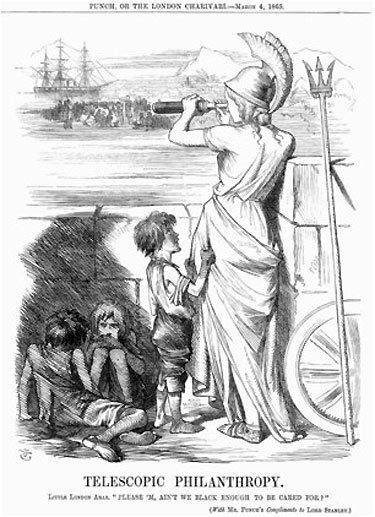
John Tenniel, Mrs. Jellyby
In Taki’s Magazine, and finds a character from Dickens writ large.
In my salad days as vulgarity correspondent—that is to say, a reporter on the disgusting ways in which young British people so often chose to behave—I was sent one year to the Glastonbury Festival. This is a large gathering of the British lumpenintelligentsia come to celebrate its own appalling taste in music, in a place vaguely associated with druidism, the healing chakras of the earth, Hopi ear candles, and that kind of thing: ideal, in other words, for people who claim to be spiritual but not religious. …
This year, unhappily, the weather at the Glastonbury Festival was fine, so that the lumpenintelligentsia was able to disport itself exactly as it wished. The crowd—I hesitate only slightly to call it the mob—was addressed by the man who might be Britain’s next prime minister, Jeremy Corbyn, whom it greeted like a rock star, which should have been enough to give any decent or sensible man pause. Among the worst of Mr. Corbyn’s vices, however, is his sincerity.
He enthused the massed ranks of youthful idealists by telling them that another world was possible: As indeed it was, for when they departed Glastonbury, they left behind them so much litter in this corner of rural England that it made a rubbish dump in Mexico City seem like Switzerland. I don’t think I have ever seen so much detritus left behind by a crowd of people anywhere in the world.
What was most intriguing to me was the fact that the crowd must have been contentedly wallowing in this rubbish for days on end, for it could hardly have accumulated in the last hour or two of the festival. Horrified no doubt by CO2 emissions and rising temperatures, they failed to notice what was about their very feet, and certainly did nothing about it. Indeed, they slept contentedly among it, too exhausted by their idealism and labors of licentiousness for them to apply their minds to anything as lowly as the litter that they dropped, as cows defecate in fields. It was for others to pick up their rubbish after them: That is what social justice required.
After a little reflection on this subject, I came to the conclusion that the most powerful intellectual influences on contemporary British youth are (appropriately enough) two women, one of them fictional and the other historical.
The first is Mrs. Jellyby, the telescopic philanthropist in Dickens’ Bleak House. Mrs. Jellyby, you will remember if you have read the book, desires to settle English families in Africa for their own good and for the good of the natives:
“You find me, my dears,†said Mrs. Jellyby, snuffing the two great office candles in tin candlesticks which made the room taste strongly of hot tallow (the fire had gone out, and there was nothing in the grate but ashes, a bundle of wood, and a poker), “you find me, my dears, as usual, very busy; but that you will excuse. The African project at present employs my whole time. It involves me in correspondence with public bodies, and with private individuals anxious for the welfare of their species all over the country. I am happy to say it is advancing. We hope by this time next year to have from a hundred and fifty to two hundred healthy families cultivating coffee and educating the natives of Borrioboola-Gha, on the left bank of the Niger.â€
Meanwhile, her own children around her fall down the stairs, get their heads stuck between railings, and go hungry, all in conditions of the utmost dirt and disorder.
13 Jul 2017
Running With the Bulls
Bullfighting, Ella G. Alexander, Pamplona, San Fermin
:fill(transparent,1)/about/118788349-56a41b0f5f9b58b7d0d57d50.jpg)
Ella Alexander ran with the bulls at the Festival of San Fermin at Pamplona just so she could say that she had done it.
I chose my campsite based solely on price, even opting out of the girls-only tent to save ten euros, fully aware that choosing ‘mixed gender’ accommodations usually meant a sleepover with a loud and almost naked basketball team or bachelor party. Any woman who’s gone backpacking is familiar with the girls-only room rape prevention tax. The cost adds up, so I decided to take my chances with the guys this time. The travel company promised a tent, a sleeping bag, and a bus ride to and from the running, plus unlimited beer and sangria for a small additional fee that, unlike the rape prevention tax, I did pay.
The morning I ran with the bulls, I woke up with the sunrise. I stepped around the sleeping men in the tent to brush my teeth and change into my white and red outfit in a three-stall port-a-potty. Deodorant was a Band-Aid on a bullet wound — when I finally found a shower two days later in San Sebastian, what I’d mistaken for a tan turned out to be an insistent film of dirt — but still I slathered it on. I’d run out of clean underwear so I turned the previous day’s pair inside out and sprayed floral perfume on my neck, my wrists, and the backs of my knees. There was nothing more to be done.
The campsite was eerie in the early morning, littered with crushed beer cans and trampled red sashes, silent except for the wind hitting the tents. I walked down to the parking lot. The bus driver leaned against his bus, smoking a cigarette. “You’re twenty minutes early.â€
“Really? Damn.†I already knew this, but had nowhere better to stand than by the bus. I drew crescents in the dirt with my Dr. Martens and wove my earbuds into a braid then unwove them on repeat.
“Nervous?†the driver asked, laughing.
“A bit.â€
“Boyfriend drag you into this?â€
“No, I’m just stupid.â€
13 Jul 2017
These Could Be Taggart Transcontinental Posters
Art Deco, New York Central, Posters

——————

A bit before my time, travel on the New York Central Railroad was clearly more romantic.



