13 Jul 2017


Bruce Bawer, at PJ Media, has the story.
What is Swedish culture? A lot of people who still believe in such things would put Astrid Lindgren (1907-2002) at or near the top of that list. During her lifetime, Lindgren was beyond question the most beloved figure in all of Sweden. Her books, about Pippi Longstocking and other characters, were translated into countless languages.
I didn’t grow up on them, but millions of children did, not only in Sweden but around the world. After I moved to Norway, I caught up with the wonderful television series Emil i Lönneberga, based on her novels about a rambunctious farmboy, and came to appreciate Lindgren’s distinctive humor and charm, her skill at handling both the harshly realistic and the extravagantly fanciful, her ability to touch one’s heart without being treacly and sentimental, and her striking combination of delight in subversiveness and respect for moral responsibility.
Lindgren’s influence in her native country was immense. When she revealed in a 1976 article that her income tax rate as a self-employed writer was 102 percent, it brought down the Social Democratic government that had been in power for forty-four years and resulted in an overhaul of the tax system. In 1979, spurred largely by a speech by Lindgren, Sweden became the first nation to make it illegal to strike children.
Despite her role in bringing down the government in 1976, Lindgren was, like pretty much everyone else in Sweden’s intellectual and cultural elite, a committed Social Democrat. And when her books were first coming out, they caused a degree of concern among cultural conservatives.
As the Washington Times noted in its obituary, “Pippi Longstocking was an instant hit among children†but “parents often were shocked by the unruly Pippi, who rebelled against society and happily mocked institutions such as the police and charity ladies.†One admirer, author Laura Pedersen, told the Times that Lindgren’s books had a “wonderful subversion. … She talked about breaking the rules … we often see rules that are wrong, and they should be broken.†But not everyone approved.
In 2017, however, it’s not conservatives who are criticizing Lindgren. The other day came the news that the library in Botkyrka municipality, on the outskirts of Stockholm, had burned older editions of one of the Pippi books, Pippi in the South Seas (1948), because local officials have decided that they “contain racism.â€
After this action came to light, the municipality issued a press release acknowledging that the books had indeed been destroyed because they contained “obsolete expressions that can be perceived as racist†– but that they had been replaced on the library shelves by a 2015 edition of the book from which those expressions have been carefully scrubbed.
Since Lindgren died in 2002, of course, she was not around to grant anybody the right to fiddle with her prose. Her publishers had simply taken it upon themselves to do to her work what a lot of people would love to do to, say, The Adventures of Huckleberry Finn. Like Mark Twain, Lindgren was the very opposite of a racist. But her use of language in Pippi in the South Seas, like that in Huck Finn, violates the Left’s current ideological tests.
RTWT
12 Jul 2017
High Culture, according to David Brooks
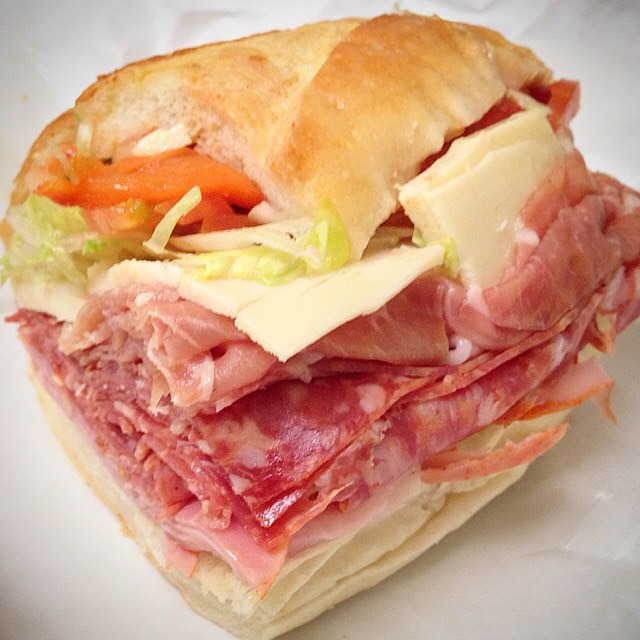
“Recently I took a friend with only a high school degree to lunch. Insensitively, I led her into a gourmet sandwich shop. Suddenly I saw her face freeze up as she was confronted with sandwiches named ‘Padrino’ and ‘Pomodor’ and ingredients like soppressata, capicollo and a striata baguette. I quickly asked her if she wanted to go somewhere else and she anxiously nodded yes and we ate Mexican.â€
— David Brooks, “How We Are Ruining America,†New York Times, 7/11/17
McSweeney’s has published the Course Catalog for David Brooks’ Elite Sandwich College:
Classic Italian Meats 205
Prerequisite: Basic Deli Meats 101
In this class we will go beyond the American deli meats like ham, turkey, and chicken breast and learn more in-depth about the classic Italian cured meats: Pancetta, Prosciutto, Capicola, and more. Students will learn about origin, curing techniques, and appropriate stacking method. Two lectures and two studio hours each week.
Fancy Condiments and Toppings 305
Prerequisite: Mayonnaise and Mustard Only 101
Students will learn the basics of topping a sandwich beyond just meat and vegetables. Techniques include the seasoned olive oil drizzle and distribution of aioli. If time in semester permits, students will dabble in use of cornichons and castelvetranos. Three lectures and one lab weekly.
Wrapping 101
A perfect sandwich wrap takes skills. This likely wasn’t covered in your basic high school sandwich courses. Wrapping techniques discussed include old style deli-fold, long breads, and double layer. Lab only.
Talking to Your Friends About Italian Delis 426
In this soft-skills class, students will learn how to help friends who have never visited a deli choose items on the menu. Students will learn how to gently correct friends when they pronounce “mozzarella†with the “a†sound at the end, when the right time is to explain that tomatoes were actually not native to Europe so marinara sauce is actually not traditionally Italian, and the right way to introduce that pizza is actually very different in Italy. Three lectures weekly. Includes unannounced quizzes/sandwich runs.
12 Jul 2017

CNN:
Museum workers in New Jersey broke through a Prohibition-era wall and a locked wooden cage to discover over 50 bottles and 42 demijohns of rare Madeira wine dating back as early as 1769.
Liberty Hall Museum at Kean University in Union, New Jersey, says the discovery yields the oldest known collection of Madeira in the United States.
“We had no idea the old bottles were there,” said John Kean, first cousin to New Jersey’s former governor and president of the museum. “We knew there would be wine, but had no idea as to the date. That was a major surprise.”
Historians and museum workers have been renovating Liberty Hall Museum, originally just called Liberty Hall, which was home to New Jersey’s first elected governor and signer of the Constitution, William Livingston.
The house was built in 1772, just prior to the American Revolution, and originally had 14 rooms. The estate changed ownership in 1811 to the Kean family and eventually became the 50-room mansion that stands today.
Its wine cellar was chosen to undergo examination and repair, but it was hidden behind a plywood and plaster wall built during the Prohibition.
“First we needed to get the wall down. We took the room apart and performed a complete analysis — paint analysis, mortar analysis, brick analysis to see what needed to be repaired and done to the room,” Bill Schroh, director of museum operations told CNN. “Lo and behold, we found this incredible collection of Madeira.”
The six-month renovation also led to discoveries of more wine in the attic, where demijohns of wine were found buried beneath piles of straw. Demijohns, or large glass vats, commonly held spirits in transit and for storage.
Bottles of Madeira created for the personal use of Robert Lenox, a millionaire and major wine importer from New York City, were among the bottles discovered in the renovation. Lenox died in 1839, according to the New York Historical Society.
“Nothing like this exists,” said president and founder of Rare Wine Co. Mannie Berk, referring to Lenox’s sealed, stamped bottles. “They could be worth up to $20,000.” Liberty Hall Museum would not say how much the total collection of wine could be worth.
RTWT
HT: Jim Harberson.
If you found a cache of 18th century Bordeaux, you could forget about drinking it, it would undoubtedly be cooked or simply aged into vinegar. Madeira, though, is different. Madeira is the wine variety capable of surviving both heat and age. An 18th century Madeira has a pretty good chance of not only being drinkable, but excellent. We have a bottle of 1796 and a couple of 1863s still in our home collection. Karen finished the last of the 1815 years ago, alas!
12 Jul 2017

Stanley Fish takes a cynical, reductionist, and self-interested professorial view of the place of Free Speech with the context of the University.
(The article is behind a paywall at Chronicle of Higher Education, but it was captured and reposted here.)
[In] what might seem to be a paradox, the public university is “absolutely committed to protecting free speech” only when the speech produced is nonacademic. When it is academic speech that is being produced the interest of the employer is paramount and speech is permitted only when it serves that interest.
But isn’t that interest centered on speech because, as the Minnesota faculty put it in their draft recommendations, the university’s “larger normative commitment [is] to the free exchange of ideas”? No, it isn’t. The university’s normative commitment is to freedom of inquiry, which is quite a different thing. The phrase “free exchange of ideas” suggests something like a Hyde Park corner or a town-hall meeting where people take turns offering their opinions on pressing social matters. The right to speak is held by all; no requirements (of rank, intelligence, professional standing, etc.) limit the number of those who have access to the microphone. (Limits of course may attach to time, manner, and place.)
The course of free inquiry in universities is not like that at all. Before one can speak, in a classroom or in the research seminar or in a journal publication, one will have been subjected to any number of vetting procedures
— votes, auditions, presentations — designed largely to determine those who will not be allowed to speak. Whether it is a department, a college, a dean, a provost, a learned-journal editor, it is the business of the university to silence voices, not to license them indifferently. To put it another way, the free exchange of ideas between persons who want in on the conversation is a democratic ideal; but the university is not a democracy; it is (or is supposed to be) a meritocracy, one in which those who get to put their ideas forward are far outnumbered by those who don’t. The process is more Darwinian than democratic.
This leads me to a conclusion implicit in the previous paragraphs: Freedom of speech is not an academic value. Accuracy of speech is an academic value; completeness of speech is an academic value; relevance of speech is an academic value. Each of these values is directly related to the goal of academic inquiry: getting a matter of fact right. The operative commonplace is “following the evidence wherever it leads.” You can’t do that if your sources are suspect or nonexistent; you can’t do that if you only consider evidence favorable to your biases; you can’t do that if your evidence is far afield and hasn’t been persuasively connected to the instant matter of fact.
Nor can you follow the evidence wherever it leads if you are guided by a desire that it reach a conclusion friendly to your political views. If free speech is not an academic value because it is not the value guiding inquiry, free political speech is positively antithetical to inquiry: It skews inquiry in advance; you get where you wanted to get from the get-go. It is political speech if, when the material under consideration raises political/ethical questions, you believe it is your task to answer them, to take them seriously rather than academically. Any number of topics taken up in a classroom will contain moral and political issues, issues like discrimination, inequality, institutional racism. Those issues should be studied, analyzed, and historicized, but they shouldn’t be debated with a view to fashioning and prosecuting a remedial agenda. The academic interrogation of an issue leads to an understanding of its complexity; it does not (or should not) lead to joining a party or marching down Main Street.
That is what I mean by saying that the issue shouldn’t be taken seriously; taking it seriously would require following its paths and byways to the point where one embarks upon a course of action; taking it academically requires that one stop short of action and remain in the realm of deliberation so long as the academic context is in session; action, if it comes, comes later or after class.
So neither free speech — speech uttered by anyone who has something to say — nor political speech — speech intended to nudge students in one direction or the other — is a legitimate part of the academic scene. But both are part of the extracurricular scene: the rallies, workshops, panel discussions, and lectures about which we hear so
much today. In those contexts partisan views are front and center, and they are aired by anyone and everyone in the room or the quad or the auditorium. And these views are being taken seriously. Speakers are not merely reflecting on the alternatives; they are strongly urging the alternatives, sometimes in apocalyptic terms: Unless we divest
from fossil-fuel stocks, the environment will be destroyed; unless we speak out against Israel, a new Nazi-ism will triumph; unless we stand up against microaggressions, racism will run rampant. Passions run high, the stakes
are felt to be enormous, the fate of the republic hangs in the balance.
It’s all so exciting, so exhilarating, so serious. But it is not a seriousness to which the university is a party. My contention that moral/political seriousness has no place in the university holds even in those areas in which moral/political seriousness is being performed to a fare-thee-well; for while that conversation (often very heated) is occurring within university precincts, the university is not actively presiding over it; rather, the university is, or should be, managing it, much as the proprietors of a sports stadium manage the crowds they invite in or as the proprietors of a Broadway theater manage the audiences they labor to attract. It’s show business! The university lets this stuff go on, but it doesn’t have a dog in the hunt; it neither affirms nor repudiates any
of the positions that vie for attention in the circus it allows on its grounds; it doesn’t take those positions seriously, and it shouldn’t, for if it did so (by divesting from fossil fuels or policing microaggressions or declaring the entire campus a free-speech zone) it would no longer be in the education business; it would be in the partisan-politics business.
Not all universities understand the difference between curricular and extracurricular activities and the different responsibilities attendant on each. They are confused in both directions: They think that the partisan passion of the extracurricular sideshow has a place in the classroom, and they think that something genuinely academic is
going on when speakers invited precisely because they are controversial become the occasion for controversy. They don’t see that it is the administration’s job, first, to ensure that the classroom is a safe space for intellectual deliberation (that’s the only safe space I’m interested in), and, second — a very distant second — to maintain
control of the energies that have been let loose once the decision to have a lecture or mount a panel discussion or allow a rally has been made.
I put it that way so as to emphasize the fact that nothing requires the making of that decision; nothing requires that there be extracurricular activities at all. A university would still be one if all it contained were classrooms, a library, and facilities for research. A university would not be one if all it contained was a quad with some tables on it, a student union with a food court, an auditorium and a bowling alley, a gymnasium with a swimming pool and some climbing walls. You could take away all those things, and along with them the student newspaper, the fraternities, the sororities, the concerts, the athletic events, the dances and everything else
administered by the office of student affairs (which you could get rid of too), and the core of the university would be intact.
So if you’re a college or a university, you don’t have to saddle yourself with any of those extras. But once you’ve decided to add them on, it’s your job to see that they work, which means, mostly, ensuring that events go smoothly and no one gets hurt. If that’s the assignment, many colleges and universities deserve a failing grade.
RTWT
HT: Matthias E. Storme.
Mr. Fish is obviously right in a strictly definitional sense: yes, take everything else away and leave one lecture room, some books, and a scribbling professor to give lectures, and you still have the core of the university.
But universities in reality never consist simply of such a core. There are also, besides the learned professor in his professional role, the same professor as human being, and along with him there are college administrators, employees, and, yea! even students. Those core activities are always surrounded by a community and by the social, the fraternal, and the recreational penumbrae of human life.
Universities, particularly elite universities, never exist in a vacuum, but rather maintain an active intercourse and constantly communicative relationship with the general society which supports them and whose interests they purport to serve. The university’s core may be research, scholarship, and teaching, but the university is always much more than its core. Every day of the week, its community lives and functions; its clubs and societies hold meetings, lectures, and debates; athletic teams hold practices and competitions; its cultural life manifests itself in the form of exhibitions, concerts, and film showings; and political leaders, intellectuals, and public figures and celebrities visit to use the university as a platform for self-promotion and communication.
The customary traffic in, and exchange of, enhanced prestige between the university and the public figure visiting speaker may be, as Stanley Fish contends, not really central, not part of the university’s core function, but it is, on the other hand, a routine feature of today’s university life, and one of no insignificant value.
The regular presence on campus of nation-wide famous people is a well-recognized and highly visible evidence of a particular university’s comparative status and of its relevance to, and influence upon, the great outer world.
Reasoning that the theoretically adventitious character of a standard feature of university life makes everything about it trivial and reduces the responsibility of university authorities from upholding liberal political ideals and values to merely keeping the peace is really just a clever and tongue-in-cheek exercise in sophistry.
11 Jul 2017

As Freshmen first we came to Yale,
Fol de rol de rol rol rol!
Examinations made us pale.
Fol de rol de rol rol rol!
Chorus:
Eli Eli Eli Yale,
Fol de rol de rol rol rol!
Eli Eli Eli Yale,
Fol de rol de rol rol rol!
A lot of Yale alumni look forward to the bimonthly arrival of the Alumni Magazine with roughly the same enthusiasm with which we look forward to our next dental procedure.
There is always the triumphant announcement of Peter Salovey’s invertebrate administration’s latest surrender to leftist insanity; accompanied by all the usual gloating over this, that, and the other cases of recent worldly success by this Yale graduate or that one; the advertising columns offering vacation rentals in Tuscany or Provence for thousands a week; and the Class Notes (at my age typically telling you who died).
The Yale Administration is cowardly and conformist, and has no enemies to the Left, but there is still usually in evidence the Yale tradition of competence, particularly in formal areas involving language. Yale’s English Department was always traditionally the best in the country.
So, it is even more depressing than usual to learn that the Administration is caving to feminist crackpots and eliminating the word “Freshman.” It was not very long ago that every educated person recognized that “man” was in the English language a generic plural for all of mankind, male and female, with no particular offense intended to females, children, hermaphrodites, or the family dog.
It was not very long ago that some belligerent female trying to make an issue out of this particular feature of ordinary language would simply have been dismissed universally as a nuisance and a crank.
All this has changed recently with respect to the very center of the American Establishment. Today, no preposterous complaint, no demand for grotesque change, no utter and complete absurdity emanating from the ranks of society’s demoniacs will not be rapidly complied with.
I was marveling over all this, and asking myself how and why this came about, and the best answer I am able to come up with is to echo Bill Deresiewicz’s 2008 Essay, which argues that what our most elite schools have evolved into is engines of production of “really excellent sheep.”
The radicals are the wolves and Peter Salovey, the rest of the Administration, and the Yale Corporation are all the very best little girls and boys, all with their medals for deportment clinking away, all of them too nice and too tame, domesticated, and civilized to stand up to an adversary prepared to use Alinskyite tactics.
Yale men of yore, the kind of Yalies who won their place on the Fence as Freshmen by physically ejecting the Sophomore Class, the kind of Yalies who used to go out to Dragon led by the Class Bully, wielding his badge of office bully club, to fight with sailors, are extinct. The American elite of today is made up of Deresiewicz’s “really excellent sheep,” i.e. utterly conformist tools, competent at the job but always with a keen eye fixed completely on the main chance, the kind of people ready to eat any toad required to get ahead.
All you can say is: A country gets the kind of elite that it deserves and God help the country that deserves this elite.
The alumni mag:
Strictly speaking, the term “freshman†became obsolete at Yale in 1969, when women were first admitted as undergraduates. But language moves a little more slowly than reality, so the Yale College Dean’s Office only recently resolved to use the gender-neutral “first-year†in official materials. “This has been talked about for years,†says Dean of Student Affairs Camille Lizarribar. “We’ve been asked about it by students and parents, and it’s become more and more clear that what you call things does matter.†The new terminology will start appearing in Yale publications this fall, but Lizarribar expects that in conversation the two terms will coexist for a while. (“Nobody’s going to say, ‘Oh my god, you used the wrong word!’â€) Freshman counselors will be known this fall as first-year counselors, but Lizarribar says the informal portmanteau “fro-co†isn’t going anywhere. As for other time-honored phrases of undergrad tradition, we have a feeling it will be case by case.
11 Jul 2017

P.J. O’Rourke:
I was having dinner… in London… when eventually he got, as the Europeans always do, to the part about “Your country’s never been invaded.†And so I said, “Let me tell you who those bad guys are. They’re us. WE BE BAD. We’re the baddest-assed sons of bitches that ever jogged in Reeboks. We’re three-quarters grizzly bear and two-thirds car wreck and descended from a stock market crash on our mother’s side. You take your Germany, France, and Spain, roll them all together and it wouldn’t give us room to park our cars. We’re the big boys, Jack, the original, giant, economy-sized, new and improved butt kickers of all time. When we snort coke in Houston, people lose their hats in Cap d’Antibes. And we’ve got an American Express card credit limit higher than your piss-ant metric numbers go. You say our country’s never been invaded? You’re right, little buddy. Because I’d like to see the needle-dicked foreigners who’d have the guts to try. We drink napalm to get our hearts started in the morning. A rape and a mugging is our way of saying ‘Cheerio.’ Hell can’t hold our sock-hops.
We walk taller, talk louder, spit further, fuck longer and buy more things than you know the names of. I’d rather be a junkie in a New York City jail than king, queen, and jack of all Europeans. We eat little countries like this for breakfast and shit them out before lunch.â€
From Sarah Hoyt.
10 Jul 2017

Military historians have long debated whether Lee’s decision to attack the Union center on the third day of the Battle of Gettysburg with Pickett’s Division ever had any chance of succeeding.
Up at Norwich University in Vermont, Michael J. Armstrong (with Steve Sondergen) was the most recent to have a try at settling the dispute.
We used computer software to build a mathematical model of the charge. The model estimated the casualties and survivors on each side, given their starting strengths.
We used data from the actual conflict to calibrate the model’s equations. This ensured they initially recreated the historical results. We then adjusted the equations to represent changes in the charge, to see how those affected the outcome. This allowed us to experiment mathematically with several different alternatives.
The first factor we examined was the Confederate retreat. About half the charging infantry had become casualties before the rest pulled back. Should they have kept fighting instead? If they had, our model calculated that they all would have become casualties too. By contrast, the defending Union soldiers would have suffered only slightly higher losses. The charge simply didn’t include enough Confederate soldiers to win. They were wise to retreat when they did.
We next evaluated how many soldiers the Confederate charge would have needed to succeed. Lee put nine infantry brigades, more than 10,000 men, in the charge. He kept five more brigades back in reserve. If he had put most of those reserves into the charge, our model estimated it would have captured the Union position. But then Lee would have had insufficient fresh troops left to take advantage of that success.
Ammunition ran out
We also looked at the Confederate artillery barrage. Contrary to plans, their cannons ran short of ammunition due to a mix-up with their supply wagons. If their generals had better coordinated those supplies, the cannons could have fired twice as much. Our model calculated that this improved barrage would have been like adding one more infantry brigade to the charge. That is, the supply mix-up hurt the Confederate attack, but was not decisive by itself.
Finally, we considered the Union Army. After the battle, critics complained that Meade had focused too much on preparing his defences. This made it harder to launch a counter-attack later. However, our model estimated that if he had put even one less infantry brigade in his defensive line, the Confederate charge probably would have succeeded. This suggests Meade was correct to emphasize his defense.
Pickett’s Charge was not the only controversial part of Gettysburg. Two days earlier, Confederate Gen. Richard Ewell decided against attacking Union soldiers on Culp’s Hill. He instead waited for his infantry and artillery reinforcements. By the time they arrived, however, it was too late to attack the hill.
Was Ewell’s Gettysburg decision actually wise?
Ewell was on the receiving end of a lot of criticism for missing that opportunity. Capturing the hill would have given the Confederates a much stronger position on the battlefield. However, a failed attack could have crippled Ewell’s units. Either result could have altered the rest of the battle.
A study at the U.S. Military Academy used a more complex computer simulation to estimate the outcome if Ewell had attacked. The simulation indicated that an assault using only his existing infantry would have failed with heavy casualties. By contrast, an assault that also included his later-arriving artillery would have succeeded. Thus, Ewell made a wise decision for his situation.
—————————
I’m afraid I do not buy the analysis on Ewell’s decision one bit. The Union 1st and XIth Corps were retiring in disorder late in afternoon having been beaten in a hard fight west of Gettysburg. Ewell’s Corps was arriving from the North, on the right flank of the collapsing Union line. What do you suppose would have happened to the Union Army if Stonewall Jackson had survived the Battle of Chancellorsville, six weeks earlier, and been commanding that corps instead of Ewell? Those computer simulations up at Norwich are clearly not accurately calculating for momentum and morale.
—————————
For every Southern boy fourteen years old, not once but whenever he wants it, there is the instant when it’s still not yet two o’clock on that July afternoon in 1863, the brigades are in position behind the rail fence, the guns are laid and ready in the woods and the furled flags are already loosened to break out and Pickett himself with his long oiled ringlets and his hat in one hand probably and his sword in the other looking up the hill waiting for Longstreet to give the word and it’s all in the balance, it hasn’t happened yet, it hasn’t even begun yet, it not only hasn’t begun yet but there is still time for it not to begin against that position and those circumstance which made more men than Garnett and Kemper and Armistead and Wilcox look grave yet it’s going to begin, we all know that, we have come too far with too much at stake and that moment doesn’t need even a fourteen-year-old boy to think This time. Maybe this time with all this much to lose than all this much to gain: Pennsylvania, Maryland, the world, the golden dome of Washington itself to crown with desperate and unbelievable victory the desperate gamble, the cast made two years ago.
—William Faulkner, Intruder in the Dust, 1948.
09 Jul 2017

You won’t be reading about it in the Times or the Post, but Michael Mann has blown his attempt to silence critics with lawsuits for defamation by refusing to release his data to the Canadian Court.
Newscasts.org:
Michael Mann, who chose to file what many consider to be a cynical SLAPP (Strategic Lawsuit Against Public Participation) libel suit in the British Columbia Supreme Court, Vancouver six long years ago, has astonished legal experts by refusing to comply with the court direction to hand over all his disputed graph’s data. Mann’s iconic hockey stick has been relied upon by the UN’s IPCC and western governments as crucial evidence for the science of ‘man-made global warming.’
As first reported in Principia Scientific International (February 1, 2017), the defendant in the case, Canadian climatologist Dr. Tim Ball, had won “concessions†against Mann, but at the time the details were kept confidential, pending Mann’s response.
The negative and unresponsive actions of Dr Mann and his lawyer, Roger McConchie, are expected to infuriate the judge and be the signal for the collapse of Mann’s multi-million dollar libel suit against Dr Ball. It will be music to the ears of so-called ‘climate deniers’ like President Donald Trump and his EPA Chief, Scott Pruitt.
As Dr Ball explains:
“Michael Mann moved for an adjournment of the trial scheduled for February 20, 2017. We had little choice because Canadian courts always grant adjournments before a trial in their belief that an out of court settlement is preferable. We agreed to an adjournment with conditions. The major one was that he [Mann] produce all documents including computer codes by February 20th, 2017. He failed to meet the deadline.â€
Mann’s now proven contempt of court means Ball is entitled to have the court serve upon Mann the fullest punishment. Contempt sanctions could reasonably include the judge ruling that Dr. Ball’s statement that Mann “belongs in the state pen, not Penn. State’ is a precise and true statement of fact. This is because under Canada’s unique ‘Truth Defense’, Mann is now proven to have wilfully hidden his data, so the court may rule he hid it because it is fake. As such, the court must then dismiss Mann’s entire libel suit with costs awarded to Ball and his team.
The spectacular rise and fall of climate alarmism’s former golden boy is a courtroom battle with even more ramifications than the infamous Scopes Monkey Trial of 1925. To much fanfare at the time, Mann had sued Ball for daring to publish the damning comment that Mann “belongs in the state pen, not Penn. State.â€
RTWT
———————–
More at American Thinker.
09 Jul 2017

Richard Fernandez finds cause for ultimate optimism.
David Gerlenter writing in the Wall Street Journal says something self-evidently true. The Left seems to have won every single culture battle fought.
Although the right reads the left, the left rarely reads the right. Why should it, when the left owns American culture? Nearly every university, newspaper, TV network, Hollywood studio, publisher, education school and museum in the nation. The left wrapped up the culture war two generations ago. Throughout my own adult lifetime, the right has never made one significant move against the liberal culture machine.
The late Andrew Breitbart noticed the same thing. Observing that “politics is downstream from culture,” he argued the Left has made us the villains of our own stories.
Our lives — indeed, our very species — has storytelling wound into our DNA. … Popular culture is delivered to us in the form of story via books, TV, film, music, video games, and new media. …
Thus we come to politics … the vast majority of those with the power of content creation are Liberals. … Liberals control story. …What is some of that messaging? Think about movies and TV. Corporations are evil — using unwitting poor Africans for pharmaceutical testing (Constant Gardener) or dumping toxic chemicals into nature (Erin Brockovich, A Civil Action) or responsible for the end of mankind (Rise of the Planet of the Apes). American soldiers are bloodthirsty lawbreaking maniacs (Any military film). The CIA conducts illegal, secret operations that have nothing to do with protecting America. Radical Muslim terrorists are never villains. Trial lawyers are crusading do-gooders. David Letterman and Saturday Night Live ridicule the Right 95% of the time. Jon Stewart pretends to be centrist, but in fact jumps all over the Right far more often than the Left.
Liberal political candidates are the embodiments of those Liberal tenets. The goal is to associate them in voter minds via the vehicle of popular culture.
Even before Breitbart’s warning there was Orwell, who understood that the Left’s ultimate ability was to uproot the past and plant their chosen seed for the future. His famous dictum “he who controls the past controls the future. He who controls the present controls the past” is an unsurpassed indictment of groupthink totalitarianism. There seemed no doubt they would succeed. Within its bubble, the Left’s control of culture is so absolute they can watch 1984 without realizing it’s about them.
Yet the real mystery — one which even Orwell himself did not anticipate — is why,
Look around you. Every single country that adopted socialism as an economic system went bankrupt. The Soviet Union collapsed. Now the Western Gramscian project is self-immolating in the fires of its own absurdity. The current political crisis is the collective shudder of mortality passing through “every university, newspaper, TV network, Hollywood studio, publisher, education school and museum in the nation.” The left may have “wrapped up the culture war two generations ago,” but it is rotting inside the wrapping.
RTWT
08 Jul 2017

Telegraph:
New research has shown that a copper axe carried by a Neolithic hunter known as Ötzi the Iceman came from southern Tuscany.
The find has surprised experts because hundreds of miles separate Tuscany from the Alpine pass where the mummified body of Ötzi was discovered 25 years ago.
It is known that copper was mined in the Alps so it is a mystery why the Iceman’s blade should have come from so far away.
Nor do scientists know whether the copper was acquired as a raw ingot, which then had to be fashioned into an axe, or as a ready-made blade.
The hunter-gatherer, nicknamed Ötzi after the Otztal mountains where he was found, died 5,300 years ago on what is now the border between Italy and Austria.
He perished after being shot in the back with an arrow by an unknown assailant, in one of the world’s oldest murder mysteries.
His body was frozen forever in the snow and ice of the mountains.
“Our results unambiguously indicate that the source of the metal is the ore-rich area of southern Tuscany, despite ample evidence that Alpine copper ore sources were known and exploited at the time,” scientists said in a report published in the research journal Plos One.
The fact that copper was being traded between central Italy and the remote Alps was “surprisingâ€, said the experts, who are from Padua University and the South Tyrol Museum of Archaeology, where the mummified body of the Iceman is on permanent display.
RTWT
Links
More or Less Sound Blogs
A Mind Aroused
Aaron’s cc
ABFreedom
Ace of Spades HQ
Albion’s Seedlings
Alphecca
American Conservative, The (Buchananite Paleocons)
American Nihilist Underground Society
Amused Cynic
An Antique Dealer’s Blog
Andrew Cusack
Ankle Biting pundits
Anti-Idiotarian Rottweiler
Art of the Blog
Assistant Village Idiot
Assistant Village Idiot
Augean Stables
Austin Bay Blog
Becker-Posner Blog
Begging to Differ
Bidinotto Bog, The
Big Lizards.net
Black and Right
BlameBush!
Blue Crab Boulevard
Brainster
Brussels Journal, The
Brutally Honest
Captain’s Journal, The
Carnage And culture
Cato at Liberty
Cato Unbound
Cave of the Curmudgeon
Chaos in Motion
Chequer-Board of Nights and Days, A
Chicago Boyz
Claremont Institute
Clarity & Resolve
Clayton Cramer’s Blog
Cobb–Curious,Skeptical,Analytical
Cold Fury
Colonel Robert Neville Always Dresses For Dinner
Conblogeration
Confederate Yankee
Conspiracy to Keep You Poor and Stupid
Corner – National Review Online
CounterIntelligence Center
Coyote Blog
Crosspatch Chronicle
Cubachi
CultureGrrl
Daily Pundit
Daisy Cutter
Dalrock
Damnum Absque Injuria
Dangerous Times
David Bellavia
David Frum
David Thompson
Dean’s World
Death By 1000 Papercuts
Democracy Reform
Dennis the Peasant
Diminished Expectations
Dinocrat.com
Don Surber
Doug Ross
Dust in the Light
Eject! Eject! Eject!
Enchiridion Militis
Error Theory
ex-Liberal in Hollywood
Faster, Please (Michael Ledeen)
FKIN
Flit(tm)
Flopping Aces
Forward Movement (Jules Crittenden)
Fraters Libertas
Front Porch Republic
Future Uncertain, The
Gates of Vienna
Gateway Pundit
Gays Defending Marriage
Greg R. Lawson's Blog
Grouchy Old Cripple
Hog on Ice
Horsefeathers
Hugh Hewitt
Ideas
IMAO
In Mala Fide
In the Bullpen
INDC Journal
Interested-Participant
Irish Pennants
Isegoria
Jack Lewis
Jawa Report, The
JayReding.Com
Jeremayakovka
Jeremy Lott
Jon Swift
Just One Minute
Ken McCracken
Kim du Toit
Kobayashi Maru
Law of the Bad Premise
Left Exposed
Likelihood of Success
Lileks
Lone Pony
Make Haste Slowly (Trad)
Man Without Qualities
Mark Levin
Mike Stopa
Modern Art Notes
Mr. Blonde’s Garage
Musings of the Geek with a .45
Nation of Riflemen, A
New Majority (David Frum) -Neocon Sellout Blog
Nickie Goombah
No End But Victory
No Left Turns
Obsidian Order
Oh, That Liberal Media!
One Cosmos
One Hand Clapping
Only Republican in San Francisco, The
Other Things Amanzi
Outside the Beltway
Palmetto Pundit
Patterico’s Pontifications
Pileus
Point Five
PoliPundit.com
Political Horizons
Political Teen, The
PostLiberal Blog, The
ProfessorBainbridge.Com
Prospero; the Home of the Generative Thought Experiment
Protein Wisdom
QandO
Radio Blogger
Rage Against the Kakistocracy
Rantingprofs
Reason Online – Hit and Run
RedState.org
Republican Dan
Revolutionary War Veteran’s Association Weblog
Revolver Guy
Riding Sun
Right Reason
Right Wings News
Rightwing Nuthouse
Roger L. Simon
Room 12A
Samizdata.net
SayUncle
Scylla & Charybdis
Secular Right
Shot in the Dark
Shrinkwrapped
Solid Surfer, The
Soxblog
stikNstein
Stop Obama
Stop the ACLU
Strange Women Lying in Ponds
Sultan Knish
Sweetness & Light
Taki’s Top Drawer
Tech Central Station
The Buck Stops Here
Three Rounds Brisk
TigerHawk
Tim Chapman Blog
TKS
Tom Delay
Tongue Tied
Transterrestrial Musings
Unqualified Offerinds
Unqualified Reservations (Mencius Moldbug)
Vanishing American
VariFrank
Victor Davis Hanson
View from the Right
ViewPointJournal.Com
Vince aut Morire
Vodka Pundit
War and Piece
Watcher of Weasels
Weapons of Mass Destruction
Western Confucian
What Would Charles Martel Do?
Will Wilkinson
Winds of Change
Wizbang
Xavier Thoughts (Pawn Shop Guns!)
YARGB – Flares into Darkness
Blogs From the Philippines
Pinoy Stupid
Blogs From Israel
Zionist Conspiracy
Blogs From Russia
Mat Rodina
Blogs From Japan
Gaijin Mama
Blogs From Germany
Observing Hermann
/div>

Feeds
|