What an embodiment of the mod beauty we adored in the 1960s! Go to the link — it’s to the NYT — to see the photographs of her that made us so envious — in the arms of Keith Richards in 1969 and drawing lipliner on Mick Jagger (in the movie “Performance”) in 1970.
That movie “remains as hallucinogenically strange and disturbing as ever and Pallenberg will be for ever remembered as Pherber: sexually omnivorous, dangerous, sweetly amoral. The movie… captures the psychosis of the end of the 60s, where art, crime and sex open up the gates of social mobility but identity becomes fragmented.”
Pallenberg spoke of drugs freezing her, so she did not grow emotionally. Faithfull has spoken of not being able to have sex without being semi-anaesthetised with drugs. Their stories remind us of what sexual liberation could mean for women in the 60s. These great beauties paid a huge price for being the “girlfriends” of rock stars. Both these clever, multilingual, arty women educated their boyfriends (Jagger and Richards) about culture and art and style. Pallenberg got the boys to wear her clothes. Everyone, Faithfull once told me, was in love with Keith, even Mick of course !
“I like a high-spirited woman. And with Anita, you knew you were taking on a Valkyrie — she who decides who dies in battle.” — wrote Keith Richards.
Thomas Lifson marvels at the conspiracy of silence on the part of Republicans which has allowed the MSM to fabricate and keep running for months coverage of a completely imaginary story involving supposititious collusion with Russia for which no evidence whatsoever has been identified.
The stunning truth is that the American political and media establishment allowed a phony story – that they knew was phony — to dominate our political discourse for months. When James Comey testified before the Senate Intelligence Committee last week, he revealed that he had informed many important Congressional leaders that there was no investigation of President Trump and the Russians underway, even as MSNBC, CNN, The New York Times, and the Washington Post daily carried stories alluding to an imaginary investigation.
None of these informed leaders spoke out! They allowed a make-believe tale intended to harm the legitimacy and therefore political power of President Trump to dominate mindshare in the nation’s collective political conversation. …
The American people were played as patsies, their attention diverted to a fantasy that had — and still has — no evidence whatsoever of its existence. That fantasy was propounded for political reasons, and used to subvert the outcome of a democratic election.
And except for Senator Grassley, the entire roster of congressional establishment held its tongues.
Millennials (born between 1980 and 2000) are on the brink. There is no company, organization or politician that does not dedicate its efforts to reach, convince or mobilize these children of the technological revolution. All are aimed at conquering them. However, there is no evidence that they were born and raised with the values ​​of civility and responsibility. Until now, except for their technological preferences, they do not identify with any political or social aspirations. Their lack of connection with the past and their indifference, in a certain sense, to the real world are the traits that best define them. In that sense, it is likely that the missing link of this generalized global crisis resides in the fact that they are a generation that has all rights, but no obligation.
I would love to know a single millennial idea that was not an Instagram filter or an application for the mobile phone. A single idea that transcends and originates in its name. Because, when one observes the relationship of many with the world around them, they seem more like software of the last generation than human beings who came to the world thanks to their mothers.
Those millennials that live submerged in virtual reality do not have a program, do not have projects and only have one objective: to live with the simple fact of existing. It seems that all they care about is the number of likes, comments and followers on their social networks just because they are there and because they want to live from being born.
The problem is that if a large part of this generation that is taking over has no responsibilities, no obligations and no definite project, perhaps that explains the arrival of leaders like Donald Trump or the huge electoral abstention in Mexico. Hopefully the high participation of those under 35 in the recent British elections will mean a change in the trend of this deep social indifference.
In the end the questions are many. Is it worthwhile to construct a discourse for those who do not have the function of listening in their DNA? Is it worth taking a step further in anthropology and finding the missing link between the millennial and the human being? Is it worth knowing the latest technological contribution and living wanting to influence it in a world that has historically been governed by ideas, evolution and changes?
If millennials want nothing and they are the future, then the future is in the middle of nowhere. That is why others, those of us who do not belong to that generation, who are not willing to be responsible for the failure that represents the significant part of these young people who want nothing in the real world, we must have the courage to ask them, if they want to belong to the human condition, begin by using their ideas and their technological tools, learn to speak up and close the circuit of autism. But also, let them know that the rest of the world is not obliged to maintain them simply because they lived and were part of the transition with which this century of knowledge arrived.
Ben Hersh, at Backchannel, discusses the ability of different fonts to make cultural and political statements.
The US is not so different from the rest of the world when it comes to tribalism and conflicted identity. This has crystalized in last few months, and we’ve seen typography play a substantial role.
Hillary Clinton ran for president with a slick logo befitting a Fortune 100 company. It had detractors, but I think we’ll remember it fondly as a symbol of what could have been — clarity, professionalism, and restraint.
Donald Trump countered with a garish baseball cap that looked like it had been designed in a Google Doc by the man himself. This proved to be an effective way of selling Trump’s unique brand.
I’m not interested in whether Clinton or Trump had good logos. I’m interested in the different values they reveal. Clinton’s typography embodies the spirit of modernism and enlightenment values. It was designed to appeal to smart, progressive people who like visual puns. They appreciate the serendipity of an arrow that completes a lettermark while also symbolizing progress. In other words, coastal elites who like “design.â€
Trump’s typography speaks with a more primal, and seemingly earnest voice. “Make America Great Again†symbolizes “Make America Great Again.†It tells everyone what team you’re on, and what you believe in. Period. It speaks to a distrust of “clean†corporate aesthetics and snobs who think they’re better than Times New Roman on a baseball cap. Its mere existence is a political statement.
The two typographies are mutually intelligible at first glance, but a lot gets lost in translation. We live in a divided country, split on typographic lines as cleanly as the Serbs and the Croats.
Victor Davis Hanson explains why the establishment media’s furious efforts at ginning up public interest in the Trump Administration’s alleged offenses are not working.
The Left was mostly untroubled for eight years about the often unconstitutional abuses of Barack Obama — given that they saw their shared noble aims as justifying almost any means necessary to achieve them.
There was the not uncommon Rice-Gruber-Rhodes-Holder sort of deception (on Benghazi, on the conduct of Bowe Bergdahl, on the Affordable Care Act, the Iran deal, on Fast and Furious, etc.) — a required tactic because so much of the Obama agenda was antithetical to the wishes and preferences of the American electorate and thus had to be disguised and camouflaged to become enacted.
There was the pen-and-phone mockery of established federal law (the suspension of the ACA employer mandate, the Chrysler creditor reversal, the non-enforcement of federal immigration law, the institutionalization of sanctuary-city nullification). There was the constant mythmaking (from faux red lines, deadlines, and step-over lines to the fatuity of the Cairo Speech and Iran-deal harangues).
There were the abuses of presidential power (the surveillance of journalists, the selective release of the bin Laden trove to pet journalists, the likely surveilling, unmasking, and leaking through reversed targeting of political enemies).
No one worried much when Obama promised on a hot mic to Medvedev that he would be more flexible with the Russians after his reelection, as if they were to conform to a desired sort of behavior in service to Obama that would earn them dividends from him later on — the kind of unapologetic partisan “collusion†that would have earned Trump a Comey-induced indictment. No one cared that Obama pulled all peacekeepers out of Iraq and thereby ruined what the surge had saved.
Nor did anyone fret much about the serial scandals at the GSA, the VA, the IRS, and the Secret Service, or his disastrous reset policy with Russia and the implosion of the Middle East or the strange spectacles of Obama’s interview with GloZell or polarizing Oval Office guests, such as the rapper whose album cover portrayed celebrations over a dead white judge.
True, none of these were impeachable or even major offenses. But all of them recalibrated the bar of presidential behavior.
So along came the next Republican president, empowered by Obama’s exemptions to do almost anything he wished, albeit without the thin exculpatory veneer of Ivy League pretension, multicultural indemnity, and studied smoothness.
In biblical “there is a season†fashion, for every sermon about not building your business, making too much money, or profiting at the wrong time, there was a Trump retort to profit as never before.
For every too-frequent gala golf outing of a metrosexual Obama decked out in spiffy attire, there is a plumper Trump swinging away, oblivious to the angry pack of reporters that Obama once so carefully courted.
For every rapper with an ankle bracelet that went off in the White House, there is now a White House photo-op with Ted Nugent.
For every executive-order suspension of federal immigration enforcement, there is an executive-order corrective. For every lecture on the crusades, sermons on Western genocidal history, apology tour, or Islamic mythmaking, there is an American Greatness pride in everything.
The progressive ironies continued.
If the media were to be believed when they insisted that Obama was a “god,†or that he was the smartest man ever to achieve the presidency, or that the first lady was Jackie Kennedy incarnate, or that Obama was capable of sending electrical shocks down a reporter’s leg or was sure to be a brilliant president on the basis of his pants crease or because he talked in the manner of Washington elites, then surely it could not be believed when Trump was smeared as a veritable dunce, crook, buffoon, and naïf worthy of impeachment or that his wife (fluent in several languages) was an airhead former escort girl.
By their former unhinged adoration and obsequiousness, progressives and the media undermined all future credibility in their unhinged venom and loathing of Donald Trump. Now they live with the reality that by elevating Obama into a deity, they unleashed their own worst nightmare and have reduced themselves to irrelevance. In the end, no one believes the current venom of a CNN or a New York Times precisely because no one could have believed their prior slavish adulation.
The picture is a small version, dated 1889, of one that Riviere exhibited at the Royal Academy in 1888 (Art Gallery of New South Wales, Sydney). Another small version, also dated 1889, was sold at Sotheby’s Belgravia on 16 November 1976, lot 80 (illustrated in catalogue). The existence of these reduced replicas is no surprise since the original version was immensely popular and praised in almost every review of the RA exhibition. The success of the image was predictable, combining as it does two concepts that held an enormous appeal for the Victorians, canine devotion and medieval chivalry. Riviere had chosen the subject as the inheritor of the mantle of Sir Edwin Landseer, specialising in animal subjects with a strong element of anthropomorphism. In fact Landseer had already treated it in a different context in his famous painting The Old Shepherd’s Chief Mourner, exhibited at the RA in 1837 (Sheepshanks Collection, Victoria and Albert Museum). In both pictures the body of a departed master is mourned by a faithful dog almost visibly shedding tears of grief. As Robert Rosenblum puts it, ‘If only, the message reads, human beings, in this or any other age, could be counted on for such selfless and prayerful devotion!’. But a dramatic change has also occurred. The lonely and indigent crofter who lies in the coffin in Landseer’s picture is replaced by a fallen medieval hero in full armour, while the crofter’s working collie becomes a noble and all too soulful bloodhound. The result is not only to push the image a long way up the social scale but to substitute for the true pathos of the Landseer (analysed at length and warmly commended by Ruskin in Modern Painters ) a dose of heady but rather obvious romance. In fact, come to think of it, it is surprising that Landseer himself did not paint Riviere’s subject; he was quite capable of doing so, and it was perfectly tailored to his talents. We might say he missed a trick, leaving a gap which the younger artist had no hesitation in filling. The recumbent knight lies so stiffly on his catafalque that he resembles the carved effigy of a knight on a medieval tomb. It is almost as if the dog on which such figures often rest their feet has jumped down to become ‘the fallen hero’s chief mourner’
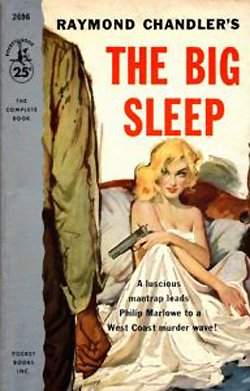
Literary Hub republishes the original New York Times reviews of three Ray Chandler mystery novels.
Isaac Anderson, The New York Times, February 12, 1939:
Most of the characters in this story are tough, many of them are nasty and some of them are both. Philip Marlowe, the private detective who is both the narrator and the chief character, is hard: he has to be hard to cope with the slimy racketeers who are preying on the Sternwood family. Nor do the Sternwoods themselves, particularly the two daughters, respond to gentle treatment. Spoiled is much too mild a term to describe these two young women. Marlowe is working for $25 a day and expenses and he earns every cent of it. Indeed, because of his loyalty to his employer, he passes up golden opportunities to make much more. Before the story is done Marlowe just misses being an eyewitness to two murders and by an even narrower margin misses being a victim. The language used in this book is often vile, at times so filthy that the publishers have been compelled to resort to the dash, a device seldom employed in these unsqueamish days. As a study in depravity, the story is excellent, with Marlowe standing out as almost the only fundamentally decent person in it.â€
John Tierney interviews renowned law professor Philip Hamburger, in the Wall Street Journal, on the appalling growth of the Administrative State.
What’s the greatest threat to liberty in America? Liberals rail at Donald Trump’s executive orders on immigration and his hostility toward the press, while conservatives vow to reverse Barack Obama’s regulatory assault on religion, education and business. Philip Hamburger says both sides are thinking too small.
Like the blind men in the fable who try to describe an elephant by feeling different parts of its body, they’re not perceiving the whole problem: the enormous rogue beast known as the administrative state.
Sometimes called the regulatory state or the deep state, it is a government within the government, run by the president and the dozens of federal agencies that assume powers once claimed only by kings. In place of royal decrees, they issue rules and send out “guidance†letters like the one from an Education Department official in 2011 that stripped college students of due process when accused of sexual misconduct.
Unelected bureaucrats not only write their own laws, they also interpret these laws and enforce them in their own courts with their own judges. All this is in blatant violation of the Constitution, says Mr. Hamburger, 60, a constitutional scholar and winner of the Manhattan Institute’s Hayek Prize last year for his scholarly 2014 book, “Is Administrative Law Unlawful?†(Spoiler alert: Yes.)
“Essentially, much of the Bill of Rights has been gutted,†he says, sitting in his office at Columbia Law School. “The government can choose to proceed against you in a trial in court with constitutional processes, or it can use an administrative proceeding where you don’t have the right to be heard by a real judge or a jury and you don’t have the full due process of law. Our fundamental procedural freedoms, which once were guarantees, have become mere options.†​
In volume and complexity, the edicts from federal agencies exceed the laws passed by Congress by orders of magnitude. “The administrative state has become the government’s predominant mode of contact with citizens,†Mr. Hamburger says. “Ultimately this is not about the politics of left or right. Unlawful government power should worry everybody.â€
Former Top Gear host Richard Hammond has escaped serious injury after a crash in Switzerland.
Mr Hammond was attending a car race when his vehicle, a Rimac electric supercar believed to be worth £2 million, left the road and mounted a grassy verge.
“It was the biggest crash I’ve ever seen and the most frightening ,” Jeremy Clarkson tweeted on Saturday afternoon. “But incredibly, and thankfully, Richard seems to be mostly OK.”
The Grand Tour tweeted: “Richard Hammond was involved in a serious crash after completing the Hemburg Hill Climb in Switzerland in a Rimac Concept One, an electric super car built in Croatia, during filming for The Grand Tour Season 2 on Amazon Prime, but very fortunately suffered no serious injury.
Joel Kotkin admires the contradictions inherent in California’s Socialism.
The oligarchs of the Bay Area have a problem: They must square their progressive worldview with their enormous wealth. They certainly are not socialists in the traditional sense. They see their riches not as a result of class advantages, but rather as reflective of their meritocratic superiority. As former TechCrunch reporter Gregory Ferenstein has observed, they embrace massive inequality as both a given and a logical outcome of the new economy.
The nerd estate is definitely not stupid, and like rulers everywhere, they worry about a revolt of the masses, and even the unionization of their companies. Their gambit is to expand the welfare state to keep the hoi polloi in line. Many, including Mark Zuckerberg, now favor an income stipend that could prevent mass homelessness and malnutrition.
Unlike its failed predecessor, this new, greener socialism seeks not to weaken, but rather to preserve, the emerging class structure. Brown and his acolytes have slowed upward mobility by environment restrictions that have cramped home production of all kinds, particularly the building of moderate-cost single-family homes on the periphery. All of this, at a time when millennials nationwide, contrary to the assertion of Brown’s “smart growth†allies, are beginning to buy cars, homes and move to the suburbs.
In contrast, many in Sacramento appear to have disdain for expanding the “California dream†of property ownership. The state’s planners are creating policies that will ultimately lead to the effective socialization of the regulated housing market, as more people are unable to afford housing without subsidies. Increasingly, these efforts are being imposed with little or no public input by increasingly opaque regional agencies.
To these burdens, there are now growing calls for a single-payer health care system — which, in principle, is not a terrible idea, but it will include the undocumented, essentially inviting the poor to bring their sick relatives here. The state Senate passed the bill without identifying a funding source to pay the estimated $400 billion annual cost, leading even former Los Angeles Mayor Antonio Villaraigosa to describe it as “snake oil.†It may be more like hemlock for California’s middle-income earners, who, even with the cost of private health care removed, would have to fork over an estimated $50 billion to $100 billion a year in new taxes to pay for it.
In the end, we are witnessing the continuation of an evolving class war, pitting the oligarchs and their political allies against the state’s diminished middle and working classes. It might work politically, as the California electorate itself becomes more dependent on government largesse, but it’s hard to see how the state makes ends meet in the longer run without confiscating the billions now held by the ruling tech oligarchs.