East Indian locally-made machete, cartridge brass & elephant ivory handle. Sheath marked: “Across the Equator — Batavia to Java 1925.” My own collection.
If a picture is worth a thousand words, a knife is worth a million. …
The collecting started in 2006 on a backpacking trip to Madagascar. I had never collected knives or bought any knives before then. Hell, even the kitchen knives in my apt were a set that an old roommate had left behind when moving out. I was, however, motivated in returning from this trip with a souvenir, or more accurately, an artifact to remind me of my trip, one that was unique. I wasn’t interested in purchasing anymore tchotckes or keepsakes that had been manufactured specifically for tourists. So on a whim, I bought my first knife from a farmer on the outskirts of Fianarantsoa. It was a small hand knife that looked homemade. Both the handle and blade were formed from a worn and pitted metal and crudely fused together. It was dirty and sharp as a spoon. Perfect.
I continued adding to my collection over the next several years and soon my wall was decorated with machetes from Cambodia, Vietnam, Ecuador and Panama. They were all purchased used, having had a history with the previous owner. …
For me, every knife tells a story. It’s a story about the locals, their culture and my travels, all bound up in metal. Large knives and machetes are versatile and extremely durable tools. They are a must for many.
To date I have collected 88 machetes and large knives from 16 countries for the project.
Latin American locally-made machete, hardwood and bone grip with cast brass rooster head pommel, first half 20th century. My own collection.
Patented and produced in 1837 by Henry Harrington, this bizarre volley features 37 barrels which fired a .22 caliber bullet. Each barrel would have had to be loaded by hand with loose powder and bullets. All of the barrels discharged simultaneously.
I bet 37 .22 bullets coming his way would, at the very least, make the highwayman stop and think.
Mr. Harrington lived in Southbridge, Massachusetts, and apparently had a penchant for volley guns. He patented a percussion volley gun pistol, made in a variety of barrel lengths and configurations, in 1837. He also produced volley gun rifles in larger calibers. His productions are rare and expensive.
Steve Bodio reports that the famous Rigby gunmaking company has resumed London operations and is in possession of the original company records.
He writes:
I have owned one once, a “.275”. So did Walter Dalrymple Maitland Bell, who shot many elephants with that “tiny”, actually moderate, caliber. And Jim Corbett (man -eating tigers), and Eleanor O’Connor [Mrs. Jack O’Connor] (mostly edible horned things).
I used to own one, too. Mine was one of the earliest made, produced on an Oberndorf Mauser Model of 1898 action and sold October 27th of 1898 to Major Blunt, complete with case, cleaning equipment, and ammunition.
Dr. Yonatan Sahle, leader of a team who found stone tools older than expected, stands in front of an outcrop where artifacts were found.
Motherboard Vice:
Ancient stone-tipped javelins found in Ethiopia have scientists raising eyebrows thanks to an odd dating conundrum. The javelins were recently carbon-dated to around 280,000 years ago. Pretty old, right? There’s only one problem:​ The earliest fossils of modern Homo sapiens are from around 195,000 years ago. With an 80,000 year gap, you have to ask: Who made them?
The discovery could mean one of two things: that our species is much older than archaeologists once thought, or, more likely, that another species before us was intelligent enough to make and use these kind of projectile weapons
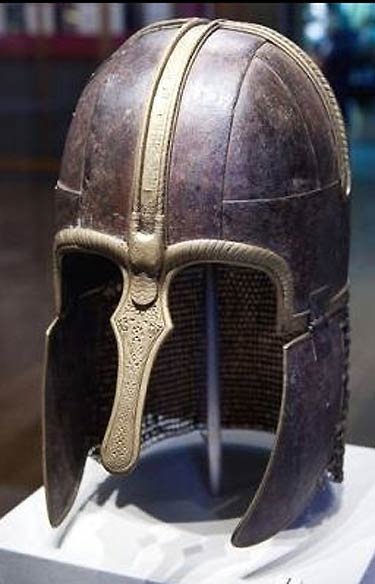
The Coppergate helmet (York helmet) was found in May 1982 at a site where many Viking Age artifacts had been discovered previously during the archeological excavations. The Anglo-Saxon helmet was right beneath the surface, protected by a brick chimney above. It was created about AD 750-775 but deposited considerably later: the brass decoration was already worn. There is also evidence of using the helmet in battle. Then someone buried it in a wood-lined pit along with a few other objects. It is unclear why such a fine possession was hidden, but it attracted universal attention after it was struck by the claw of a mechanical digger 28 years ago.
After careful excavation and reconstruction the quality craftsmanship of the Coppergate helmet became evident. It was made of iron, with two cheek-plates and a well-preserved mail curtain. Its characteristic feature is a long nose-guard. Both the guard and the edge of eyebrows are richly decorated with brass ornamentation (tests revealed that it contains about 85 percent copper). The framework of the helmet consists of four main elements: a band of iron encircling the head; the brow band to which another band is riveted, running from front to back over the crown; two shorter bands run over the ears. The four spaces between these bands are filled with triangular plates.
The brass strips running from ear to ear and from front to back bear a Latin inscription that reads: IN NOMINE : DNI : NOSTRI : IHV : SCS : SPS : DI : ET : OMNIBVS : DECEMVS : AMEN : OSHERE : XPI. The last segment of the inscription represents the first three letters in XPICTOC, Christ in Greek. Oshere is an Anglo-Saxon personal name. The initial part of the inscription seems clear: In the name of our Lord Jesus Christ, the Holy Spirit and God [the Father]. What follows received various interpretations: …And with all we pray. Amen or: …And to all we say Amen or else: …Let us offer up Oshere to all saints. Amen.
The Coppergate helmet is currently on display at the Castle Museum in York.
Gazeta Krakowska has the story of the recent discovery of a medieval sword in southeastern Poland by a high school student.
(roughly translated by me)
During a Sunday walk with his dad and his Bernese dog along the banks of the Dunajec River, 17-year-old Piotr Warzała made a surprising discovery. He found in the river a very well preserved sword from the Middle Ages. The river was unusually shallow , and in a place where water once flowed, there was now a small beach. They went down to it during their walk.
Immediately, he caught sight of a round objerct projecting about 10 centimeters above the ground covered with mud. It proved to be the pommel of the handle of a sword 1.2 meters [3.9 feet] in length. The boy took the unusual discovery home and wrapped it in a sheet to bring to the city of Tarnow, to the local office of the National Service for the Protection of Monuments.
Peter’s rational and praiseworthy action made it possible to document and map the location where the sword was found as new archaelogical site, said Andrzej Cetera , Head of the Office for the Protection of Monuments.
The teenager’s behavior was exemplary and a proposal is being prepared requesting that the Ministry of Culture and National Heritage reward the boy with a diploma of commendation, and also with a financial reward, not exceeding 5% of the average salary, he said.
It is not only his opinion that finding this sword is worth a reward. There are in the collections of the department of archeology and museums about ten medieval swords, but this one is unique because of its unusually well-preserved handle and hilt, says Andrzej Szpunar from the District Museum.
On Friday, the sword was exhibited in Tarnow to researchers from Warsaw specializing in the period of the Hussite Wars, who were very impressed with our latest acquisition, reported Agnieszka Kukułka of the department of archeology .
After detailed documentation is completed, the sword will ​​probably next week be taken to Glogau, where it will undergo conservation by specialists, which may take up to six months. It is possible that it will seen again in the Tarnów museum in all its glory later this year.
It is impossible to tell how the sword came to be lost in Biskupice Radłowskie or to whom it belonged. Perhaps, it was the property of one of the knights who fought at the Battle of Grunwald.
“I am glad that in this small way I could contribute to the preservation of such traces of the past. Just knowing this is a great reward for me.” said Piotr WarzaÅ‚a, day student of the first class at the Szczepanik school in Tarnow.
Maine Antique Digest runs a monthly Letter from London column which describes some of the more interesting items appearing in recent sales.
At Sotheby’s “Art of Imperial India” sale, London, October 9th last, was sold a captured and re-hilted British sword decorated with the bubri symbol of Tipu Sahib, “the Tiger of Mysore,” one of the most formidable enemies of British rule in India, slain finally defending his own fortress at the Siege of Seringapatam in 1799.
Tipu is quoted as saying: “Better to die like a soldier than live a miserable life dependent on the infidels… I would rather live two days as a tiger, than two hundred years as a sheep.”
Interestingly, this sword was not taken at Seringapatnam, as it comes from the estate of Sir Charles Malet, Bart., who had left India a year before the siege. It was probably a trophy of the Third Anglo-Mysore War.
The sword sold for $157,695 (98,500 GBP). Lot 249.
The standard’s symbol of a maiden comes a 1388 poem by Bouden or Baudouin van der Loore, De maghet of Ghend (The Maiden of Ghent), a poem of 240-odd verses, which allegorically describes a war between the city of Ghent and Lodewijk van Maele, Count of Flanders fought between 1379 and 1385.
In a dream, the poet sees a beautiful arbor, located in the middle of a wilderness where two rivers come together: an allusion to the city of Ghent. In the arbor is seated a graceful lady, resplendent in black fur and wearing on her right arm fine gems spelling out the letters: G, H, E, N and D. The maiden is accompanied by a silver lion with golden crown and necklace — the defender of the city. In a clear voice, the maiden sings a heavenly song. But the maiden is soon threatened by a gang of soldiers who covet her purity and her freedom. Across the river appears the leader of the army who turns out to be none other than the father of the beleaguered virgin, i.e., the Count of Flanders. On his banner, he bears a black lion rampant on gold. The poet now warns the lady that they are surprised and surrounded by many enemies. She replies that she has ​​much good company which can come to the rescue if necessary. And when the poet looks around he sees emerging out of the mists from the North East, Christ, St. Jacob, St. Bavo, St. Macharius, and from the East came Saint George and Saint John, and from all directions, all the saints to whom were dedicated in Ghent churches from their exact geographical directions. With the protection of this heavenly host, the maiden has nothing to fear. Still, she hopes for a peaceful end to the conflict with her ​​father. The poet, now awakened, closes with a short prayer to God and the Virgin and all the saints to save the maiden and reconcile her with her ​​father.
Wired profiles “Armourer to the Stars” Tony Swatton.
Tony Swatton is the most famous blacksmith in Los Angeles. But he’s not forging horseshoes. Rather, Swatton has banged out a place in Tinseltown as the go-to guy when a big-budget movie or hit TV show needs custom metalwork. The swords in Pirates of the Caribbean? Those creepy-cool murder weapons from CSI and Criminal Minds? The Infinity Gauntlet from Thor? All were Swatton creations. …
His skill, not to mention his eye for detail, have made him the go-to guy for anyone who needs the most realistic, and awesome, weapons. He’s got a knack for coming through with just the right thing.
“When you look at actual historical weapons, they often don’t live up to your expectations,†says Shawn Strider, the organizer of the Labyrinth of Jareth masquerade in Los Angeles, who has used Swatton’s swords and armor in several of his events. “But when you look at Tony’s work, it’s exactly what you wanted it to be like.â€
Demand for Swatton’s creations is huge, and the odds are you’re familiar with his work. The hook from Hook, the blade from Blade, creepy weapons from the Hellboy movies, Batarangs from Batman Returns and even custom crucifixes from Sons of Anarchy all came from the forge at The Sword and the Stone. All the vikings in Capital One’s “What’s in your wallet?†commercials carried Swatton’s gear, and Rihanna, Katy Perry and Britney Spears have worn his armor in videos. It’s an odd occasion when Swatton’s fingerprints aren’t on something seen in a big-budget flick.
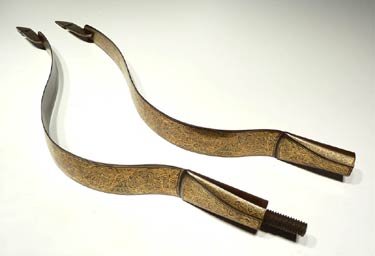
A 19th century Indo-Persian Steel Bow sold last year at Christie’s for £30,000 ($48,840).
Apparently, steel bows began replacing composite bows in Central Asia in the 16th century. Steel bows were superior with respect to having no need to be unstrung when not in use.
This take-down example is a remarkable piece of craftsmanship, made entirely of Damascus steel and completely inlaid on the front with 24 karat gold koftgari decoration.
Gendai-to made in 1929 by Ikkansai Kasama Shigetsugu, formerly owned by General Tomoyuki Yamashita, Conqueror of Singapore, “The Tiger of Malaya.”
Yesterday, one of the correspondents on a Japanese sword email list shared this current commercial offering.
The sword was once carried by General Tomoyuki Yamashita, one of the most successful Japanese commanders of WWII, who captured Malaya and Singapore and who received the largest surrender of British forces on history. General Yamashita was hanged in 1946 for war crimes committed under his command for which many thought he bore no real personal responsibility.
The sword was made in 1929 by Ikkansai Kasama Shigetsugu, arguably the most important and influential swordsmith of the Showa period.
Kurihara Hikosaburo (Akihide) [charged with reviving the craft of swordmaking by the Japanese Prime Minister] invited one of the most famous smiths of the period, Ikkansai Kasama Shigetsugu, to become the chief instructor of Nipponto Tanren Denshu Jo (Japanese Sword Forging Institute) on the grounds of his estate in Akasaka, Tokyo. Shigetsugubecame perhaps the most influential smith to teach there in its entire history, and had the greatest impact on students and teachers alike.
Shigetsugu, born Kasama Yoshikazu on April 1, 1886 in Shizuoka, started his apprenticeship under his uncle Miyaguchi Shigetoshi in 1899. In 1903 he entered the Tokiwamatsu Token Kenkyujo, on the estate of Toyama Mitsuru, to study under Morioka Masayosh. Later he went on to study metallurgy whilst collaborating with Dr. Tawara Kuniichi in formal research on the composition of
Japanese swords. Tazawa built a special laboratory in Tokyo University for the project. The results were published in a book called Nihonto no Kagakuteki Kenkyu (Scientific Research of the Japanese Sword), which remains to this day a definitive scientific work on the subject.
Shigetsugu worked mainly in the Bizen and Soshu traditions of swordmaking, which influenced many of the Denshujo’s students’ later work.
The sword has an origami (authentication paper) from the NBTHK (Nihon Bijutsu Token Hozon Kai), the premier Japanese sword preservation and study society, testifying to its correct attribution and awarding it a rank of HOZON – “Worthy of Preservation.”
Origami ranks are commonly awarded in a step-by-step process, and it seems likely to me that this sword could very possibly receive higher rankings if re-submitted.
The asking price is 2,800,000 JPY, roughly equal to $28,000.