Ennio Morricone, who passed away on the 6th of July at the age of 91, is best known for the unusually-instrumented title music to “The Good the Bad and the Ugly” (1966).
His “March Of The Beggars” from “Duck You Sucker” (1971) is similarly amusing.
Far Out Magazine publishes Woody Allen’s list of ten favorite films:
The 400 Blows – François Truffaut, 1959 8½ – Federico Fellini, 1963 Amarcord – Federico Fellini, 1972 The Bicycle Thieves – Vittorio de Sica, 1948 Citizen Kane – Orson Welles, 1941 The Discreet Charm of the Bourgeoisie – Luis Buñuel, 1972 Grand Illusion – Jean Renoir, 1937 Paths of Glory – Stanley Kubrick, 1957 Rashomon – Akira Kurosawa, 1950 The Seventh Seal – Ingmar Bergman, 1957
An overly conventional list, “Seven Samurai” is obviously more worthy than “Rashomon.” “Citizen Kane” sucks. “Paths of Glory” is a tendentious, downer leftie propaganda piece. And “Bicycle Thief” should be singular.
—————————————
Last year, the same publication gave us Quentin Tarrantino’s list of twelve favorites:
1. Apocalypse Now – Francis Ford Coppola, 1979.
2. The Bad News Bears – Michael Ritchie, 1976.
3. Carrie – Brian de Palma, 1976.
4. Dazed and Confused – Richard Linklater, 1993.
5. The Good, the Bad, and the Ugly – Sergio Leone, 1966.
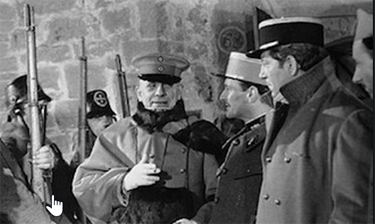
6. The Great Escape – John Sturges, 1963.
7. His Girl Friday – Howard Hawks, 1939.
8. Jaws – Steven Spielberg, 1975.
9. Pretty Maids All in a Row – Roger Vadim, 1971.
10. Rolling Thunder – John Flynn, 1977.
11. Sorcerer – William Friedkin, 1977.
12. Taxi Driver – Martin Scorsese, 1976.
“The Bad News Bears”?! “Carrie”!?? Tarrantino’s list is much more populist, but he’s not wrong in rating “The Good, the Bad, and the Ugly,” “Great Escape,” and “Jaws” as great films. Kudos to Quentin for picking William Friedkin’s “Sorcerer,” a neglected, typically unappreciated, but fantastic remake of Henri-Georges Clouzot’s “Le Salaire de la Peur” (1953), that is, on the whole, even better than the original.
—————————————
I’m a major cinemaphile myself. I ran a film society at college. So, inevitably, I’ve got to do my own top ten twelve list.
Intolerance – D.W. Griffith, 1916. Earth – Alexander Dovzhenko, 1930. Grand Illusion – Jean Renoir, 1937. Children of Paradise – Marcel Carne, 1945. Smiles of a Summer Night – Ingmar Bergman, 1955. The Seventh Seal – Ingmar Bergman, 1957 Sword of Doom – Kihachi Okamoto, 1957. La Dolce Vita – Federico Fellini, 1960. Jules and Jim – François Truffaut, 1962. 8 1/2 – Federico Fellini, 1963. Shadows of Forgotten Ancestors – Sergei Parajanov, 1965. Hitler, ein Film aus Deutschland – Hans-Jurgen Syberberg, 1977.
[T]o go back again to the need for fresh images: In “A Guide for the Perplexed,†you say that our children will be upset with us for not having thrown hand grenades into television stations. I took that to be a criticism of the poverty of television’s visual imagination. Are Hollywood movies much better?
Hollywood, of course, is undergoing a massive shift. There are new forms of passing your films onto audiences and new expectations and new behavior and patterns of audiences. Everything is in great turmoil, and the dust hasn’t settled yet. But we should not underestimate how we can reach, with our films, to a village in Kenya. It’s phenomenal and strange. You’re sitting in front of a man who is unique. I’m unique in world history. My generation. Not just me. I grew up with pre-industrialized agriculture, with hay being turned around with forks and then hoisted up onto horse-drawn carts. Then I have seen gigantic harvesters, and they have three computer screens inside, and it goes by GPS. And I have seen — may I go wild?
Yes, please.
I have witnessed, as a child, the town crier with a bell coming up the street and shouting: “Announcement! Announcement! If you want to have subsidies for your new septic tank, opening hours will be then and then.†I am coming from a pre-industrialized town crier to today’s world. There’s no one like my generation.
Are you unique in any other ways?
There are no other men like me. I’m quoting from a film of Les Blank.
There is a small category of films which failed in theatrical release, but which, when played and replayed on television, found their audience and proved themselves to be authentic heart-warming and important films striking a chord with a very wide audience and proving watchable again and again and again.
Kathy Shaidle pays tribute in a review to yet another wonderful case of the same phenomenon, Galaxy Quest (1999).
In a just world, O.J. Simpson would currently be serving the 24th year of a double life sentence; Ronald Reagan would have been president during America’s bicentennial instead of Gerald Ford — and Galaxy Quest would’ve earned half-a-billion bucks at the box office when it came out in 1999.
But inept and indifferent studio marketing (plus competition from another “sci-fi” comedy, Ghostbusters) relegated Galaxy Quest to semi-cult status. Which is ironically appropriate, given its plot:
At a science fiction convention, fans await an appearance by the cast of Galaxy Quest, a hokey interstellar TV adventure series unceremoniously cancelled in the early 1980s. The show’s fatally typecast has-been “stars” (played by Tim Allen, Alan Rickman, Sigourney Weaver, Tony Shalhoub and Daryl Mitchell) are reduced to reluctantly signing autographs at tacky gatherings like this one, when they’re not cutting ribbons (in full costume) at supermarket openings.
That is, until genuine aliens — who, in cargo cult fashion, have based their civilization on Galaxy Quest re-runs transmitted through space — touch down and beg “the crew of the NSEA-Protector” to help them defeat the villain bent on destroying their planet. The adorable Thermians innocently believe the program’s “crew” are fearless, intrepid space warriors and technological geniuses, not just washed-up actors in laughable uniforms. Their language has no word for “pretend”…
Lazily calling this movie “a Star Trek spoof” unfairly slots it alongside broad, coarse parodies like Blazing Saddles or the soulless Mars Attacks! In truth, Galaxy Quest is a tender, big hearted valentine — more My Favorite Year than Airplane.
That the film’s jokes and, more incredibly, its special effects, hold up so well twenty years later is a testament to the loving care with which Galaxy Quest was crafted. Obeying the first (yet often ignored) commandment of movie comedy, all the actors “play it straight.”
Genre veteran Sigourney Weaver of Alien fame never winks “Get it?”; neither does Alan Rickman, a classically-trained Shakespearean actor stuck wearing a rubber prosthetic forehead, portraying… a classically-trained Shakespearean actor stuck wearing a rubber prosthetic forehead:
While I’d have preferred the director’s original choice for the leading role — Kevin Kline — Tim Allen acquits himself surprisingly well as the pompous, Shatner-esque Jason Nesmith, a.k.a., Commander Taggart.
Cast as Thermian leader Mathesar, Yale Drama alumnus Enrico Colantoni conceived of his species’ quirky gait, rictus grin and off-key speech patterns during his winning audition, then led hour-long “alien school” on set each morning to ensure uniformity and, therefore, believability; of all the Thermians, Missi Pyle’s Laliari is so indelibly delightful that John Updike gave her a shout-out in his novella Rabbit Remembered.
Speaking of famous writers, David Mamet has called Galaxy Quest “a perfect film,” ranking it with The Godfather (and another of my other favorites, Dodsworth.)
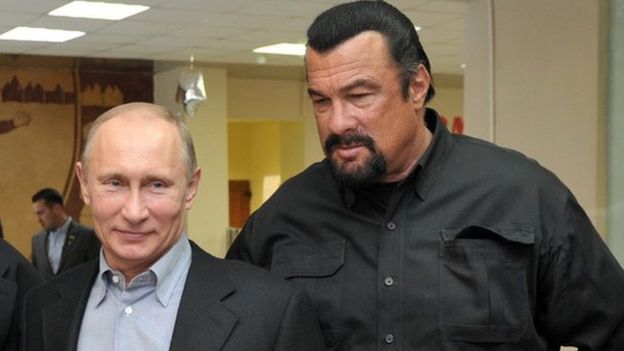
Kenneth Lowe marvels that, old, fat, and ill-behaved as he is, Stephen Seagal is still able to keep making lots and lots of really terrible movies.
“What you have to understand is that Steven Seagal isn’t about being a good action hero. He’s always about being a complete fucking asshole. That’s, like, his duty. … Steven Seagal is our hero/villain, where he’s apparently the protagonist, but he just does the cruelest, most fucked-up shit that he possibly can.†—El-P, member of Run The Jewels and avowed Seagal fan
…
Since his falling out with Warner Brothers, Seagal has become an unbelievable workhorse, albeit one who shows up to maybe a few days of filming and looks terrible. With the exception of the couple of years he was doing his reality show and another TV series, he’s put out two if not at least three pictures per year since 2003, almost all of them direct-to-video. I haven’t seen one scene in any of them where he can convincingly throw a punch.
He will never stop making them, because they will never stop making money, because his own salary is probably the largest expenditure of anything involved in the production. It certainly isn’t lighting or locations.
I wanted this to be a handy explanation of why Seagal is still around and why he continues to make pictures, but in tracking his career, I realize I’ve failed. There is no explanation, not in any way that makes sense in a sane and ordered society that rewards merit and punishes incompetence, sloth and cruelty toward others. …
That’s the final paradox of Seagal. He cranked out more movies last year than Jude Law at his height, yet he’s the laziest actor imaginable. He puts people in real bodily danger by his very presence, yet he walks free and enjoys celebrity. He can’t throw a punch in fewer than three cuts yet he’s immune to shame, Man’s oldest weapon.
Josh Karp, in Vanity Fair, recounts the story of another never-finished Orson Welles masterpiece film, The Other Side of the Wind. Imagine a film about a troubled director in which Orson Welles collaborated with both John Huston and Peter Bogdanovich. What could possibly go wrong?
In early 1970, director Orson Welles returned to Hollywood after more than a decade in Europe, and later that year he began work on his innovative comeback movie—The Other Side of the Wind.
The movie was the story of a legendary director named Jake Hannaford, who returns to Hollywood from years of semi-exile in Europe with plans to complete work on his own innovative comeback movie—also entitled The Other Side of the Wind.
Welles said it wasn’t autobiographical.
The story line of The Other Side of the Wind was supposed to take place during a single day. At one point, Welles intended to shoot it in eight weeks. Instead, it took six years, and the film remains unfinished nearly four decades later.
Based on a script Welles revised nightly, the film was financed principally by the Shah of Iran’s brother-in-law and offered possibly one last shot at topping Citizen Kane. The making of The Other Side of the Wind began as a tale of art imitating life, but ultimately morphed into life imitating art, on a set where it sometimes became difficult to tell the difference between the movie and real life.
During production many people asked Welles what his movie was all about. To his star, John Huston, he once replied, “It’s a film about a bastard director…. It’s about us, John. It’s a film about us.â€