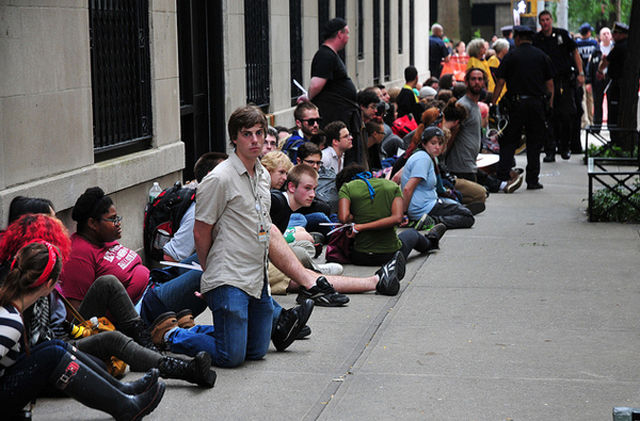
Dan Greenfield describes the symbiotic relationship of three key manifestations of modernity.
Universalizing college has not universalized education; it has not made us a better educated country, only a dumber one. Universal education has led to dumbed-down education and meaningless degrees. The only way we could keep moving more and more students up the ladder was by making the ladder as short as possible. Promotion, populist education and educators who barely knew more than the students have taken care of the rest.
A college degree was once a mark of distinction, now it’s a checkmark even for jobs that don’t have any innate reason for requiring it, and fortunes have been spent by government and students just to “stay in place” with the jobs of yesterdays high school graduates going to tomorrow’s college grads.
The primary purpose of a degree in many fields is to provide demonstrable proof to prospective employers that you aren’t an idiot. A high school degree once served that purpose. Now not even a college degree does. But with a surplus of job-seekers, it’s a useful way to winnow down the stack of applications to people who can analyze the heteronormative subtext of a detergent commercial and have few options for employment because of their massive student loan debt.
Treating college as the new high school hasn’t benefited students who waste four years of their lives and pick up staggering debts which make it harder for them to buy homes and start families, but it has benefited the liberal arts infrastructure, which, despite the liberal spin, is just as good at handing out useless degrees with no career path as any for-profit college. And it has benefited the Democratic Party, which rightly sees college campuses as recruitment grounds and liberal-voter-training seminars. …
Manhattan, home to Barnard, its sibling Columbia, NYU, Pace, and dozens of others, has one leading line of work, the restaurant business. The restaurant business doesn’t require a degree, just the willingness of pretty white people with student debt to wait tables at below minimum wage, and of some of the city’s three million illegal aliens to work illegally in the back. The city used to make things, now it makes sandwiches for Chinese tourists going to see a Disney musical on Broadway. Students dissatisfied with the low wages are, according to the erratically reliable New York Post, working at strip clubs. Fidel Castro boasted, that in Cuba, even the prostitutes have university degrees. Adopting the socialist degrees for everyone approach means we can now say the same thing.
A recent letter from an upscale 1980s alumna to the Smith College newspaper, The Sophian, questioned Smith’s current admissions policies and provoked howls of outrage in response.
To the Editor,
I am the president of the Smith Club of Westchester County. I enjoy reading the Sophian online because it helps me stay abreast of developments at the school.
I read your article about [President] Carol [Christ]’s resignation and it had some interesting statistics. It mentioned the percentage increase in the population of women of color and foreign students. The gist of the article was that one of Carol’s objectives coming into the position was to increase diversity and the article gave statistics that showed that she did.
As someone who has followed admissions for many years, I can tell you how the school is viewed by students in Westchester and Fairfield Counties. First, these counties are some of the wealthiest in the country. The children have parents who are highly educated and accomplished and have high household incomes. The children are programmed from day one to get into Ivy League schools.
To this demographic, Smith is a safety school. Also, very few of these students want to go to a single sex school. With the exception of Wellesley, it is not hard to get into the Seven Sisters any more. The reason why Wellesley is more selective is because it is smaller than Smith and in a better geographic location – Boston beats Northampton.
The people who are attending Smith these days are A) lesbians or B) international students who get financial aid or C) low-income women of color who are the first generation in their family to go to college and will go to any school that gives them enough money. Carol emphasizes that this is one of her goals, and so that’s why the school needs more money for scholarships or D) white heterosexual girls who can’t get into Ivy League schools.
Smith no longer looks at SATs because if it did, it would have to report them to U.S. News & World Report. Low-income black and Hispanic students generally have lower SATs than whites or Asians of any income bracket. This is an acknowledged fact because they don’t have access to expensive prep classes or private tutors.
To accomplish [President Christ’s] mission of diversity, the school is underweighting SAT scores. This phenomenon has been widely discussed in the New York Times Education section. If you reduce your standards for grades and scores, you drop in the rankings, although you have accomplished a noble social objective. Smith has one of the highest diversity rates in the country.
I can tell you that the days of white, wealthy, upper-class students from prep schools in cashmere coats and pearls who marry Amherst men are over. This is unfortunate because it is this demographic that puts their name on buildings, donates great art and subsidizes scholarships.
-Anne Spurzem ’84
The responses published in The Sophian are good for a laugh.
——————————————-
Drew Zandonella-Stannard, class of 2006, took personal charge of leading the angry mob brandishing pitchforks and torches to Ms. Spurzem’s email inbox.
Anne Spurzem: You Have Been Warned
Here at Vintage Smith, I try to keep an even temper. However, I’m not past putting anyone on notice. This week, that person is Anne Spurzem, the President of the Smith Club of Westchester County, who wrote a letter to The Sophian that can only be described as hateful, confused, bigoted and just plain mean. To read it, go here.
In these pages, I showcase the pieces of Smith College’s past that make us proud to hail from such a unique community. Sometimes it’s about Hilda Yen, the famed aviatrix who dedicated her career to teaching flight in China. Sometimes it’s about how one photo can encapsulate the bond felt by so many alums. Sometimes it’s about finding the perfect pair of saddle shoes circa 1949.
I was hoping some of you wonderful readers could pass along a message to Ms. Spurzem, telling her why you’ve been proud to call Smith home at one time or another.
I write all of this as a white, heterosexual alum who occasionally wears pearls, who accepted much-needed financial aid, who plans on giving to her school annually, and who hails from one big Lesbian family.
Please let Anne Spurzem know how much we love Smith College. Her email address is: [redacted –the college authorities intervened] and I think she needs to hear from you.
——————————————-
Jezebel (being just a trifle dim) had actual difficulty understanding what Ms. Spurzem could possibly be going on about.
I’ve written Spurzem to ask her to clarify what she actually wants from Smith — does she think the college should admit fewer low-income and minority students, or does she have some other recommendation? Maybe there’s an interesting debate to be had here about how universities can keep their endowments healthy enough to offer scholarships while still serving low-income populations — but Spurzem’s letter hasn’t exactly gotten that debate off to a good start.
——————————————-
How amusingly self-entitled members of recognized victim groups are today. They understand that it is none other than themselves, in all their accusatory glory, that represent the ultimate goal and endpoint of civilization and human achievement. Their unique worthiness makes it possible for them to elevate and ornament any sphere honored with their mere presence with Diversity.
When some Devonian fish first crawled upon dry land; when the first human beings pursued the Wooly Mammoths amid the retreating glaciers; when the Spartans held the pass at Thermopylae; when the Pilgrim fathers crossed the ocean, cleared the forest and settled the New England Wilderness; when Washington crossed the Delaware and defeated the redcoats; when the wealthy spinster Sophia Smith decided to use her inherited fortune to found a women’s college (instead of an institute for the deaf), lesbians and persons of color were always the intended beneficiaries. Everyone knows that.
——————————————-
As to poor confused Jezebel: I suppose I need to explain that elite colleges function as a system of prestige exchange. They traditionally admitted representatives of wealthy, powerful, and influential families, leavening their student bodies with a percentage of outsiders distinguished by exceptional demonstrated academic talent.
One would go to such a school in order to bask in the reflected glory of a grand tradition of famous alumni and distinguished scholars and to be accredited oneself as a member in good standing of the national elite. Elite schools were founded to educate the children of the richest families, of the heads of major corporations, and of prominent officials and political leaders. These kinds of schools would graciously admit persons of obscure origin and humble background (like myself), and would even in essence pay them to go there, when such persons could offer potential future prestige in return.
The transformation of Smith College’s admissions criteria from a focus on academic talent evidenced by high scores on standardized tests to a focus on politically correct victimhood, as Ms. Spurzem notes, fatally compromises the prestige exchange, accepting the counterfeit currency of membership in privileged victim groups instead of the real gold of actual existing status and demonstrated superior talent.
Any elite college or university that follows Smith’s example will find that it has dramatically cheapened its brand and devalued its own currency of prestige. It will inevitably move downmarket, having less of exactly what matters most to offer potential applicants. Less qualified students with lower SAT scores translates directly to less prestige associated with the school’s degrees and fewer applications from the most competitive first rank students.
The Economist explains why universities admit enormously more students to doctorate programs than will ever find jobs in their fields.
[U]niversities have discovered that PhD students are cheap, highly motivated and disposable labour. With more PhD students they can do more research, and in some countries more teaching, with less money. A graduate assistant at Yale might earn $20,000 a year for nine months of teaching. The average pay of full professors in America was $109,000 in 2009—higher than the average for judges and magistrates.
Indeed, the production of PhDs has far outstripped demand for university lecturers. In a recent book, Andrew Hacker and Claudia Dreifus, an academic and a journalist, report that America produced more than 100,000 doctoral degrees between 2005 and 2009. In the same period there were just 16,000 new professorships. Using PhD students to do much of the undergraduate teaching cuts the number of full-time jobs. Even in Canada, where the output of PhD graduates has grown relatively modestly, universities conferred 4,800 doctorate degrees in 2007 but hired just 2,616 new full-time professors. Only a few fast-developing countries, such as Brazil and China, now seem short of PhDs.
In research the story is similar. PhD students and contract staff known as “postdocsâ€, described by one student as “the ugly underbelly of academiaâ€, do much of the research these days. There is a glut of postdocs too. Dr Freeman concluded from pre-2000 data that if American faculty jobs in the life sciences were increasing at 5% a year, just 20% of students would land one. In Canada 80% of postdocs earn $38,600 or less per year before tax—the average salary of a construction worker. The rise of the postdoc has created another obstacle on the way to an academic post. In some areas five years as a postdoc is now a prerequisite for landing a secure full-time job.
These armies of low-paid PhD researchers and postdocs boost universities’, and therefore countries’, research capacity. Yet that is not always a good thing. Brilliant, well-trained minds can go to waste when fashions change. The post-Sputnik era drove the rapid growth in PhD physicists that came to an abrupt halt as the Vietnam war drained the science budget. Brian Schwartz, a professor of physics at the City University of New York, says that in the 1970s as many as 5,000 physicists had to find jobs in other areas.
My old Philosophy professor, John Niemeyer Findlay, as a young man became infatuated with Buddhism, and wanted to take his doctorate in Sanskrit and go on to work on Buddhist sutras. His advisor at Balliol (Findlay was a Rhodes Scholar from South Africa) listened patiently, as Findlay described his career ambitions, looked at him coldly, and observed: “Mr. Findlay, there is but one single chair in Sanskrit in Great Britain, and I occupy it.” Findlay changed his subject to Philosophy.
At places like Yale, it is all but impossible to move from the junior faculty to the senior faculty. Full professors hired by Yale are all big names. You would have a better chance simply sitting at home and devoting your energy to writing the Great Big Book. If you pull it off, major universities will beat a path to your door. If you are not going to be able to write the Great Big Book, you will, at best, wind up teaching a rudimentary version of your subject at some dreadfully obscure facility in a remote fly-over location.
When Patrick Stewart (formerly Captain Jean-Luc Picard of the Federation Starship Enterprise) is a university’s chancellor, recruiting videos seem to become a bit more imaginative.
Older and more respectable (i.e. employed) lefties weren’t occupying Wall Street. Instead, they were smiling happily and fantasizing about the Revolution, or at least another great big wave of punitive regulation and taxation, as the young, the dumb, and the Bohemian took to the streets in Lower Manhattan to protest against Wall Street and the bankers.
Somebody gave those protesters the wrong address.
If they want to wave signs and shout slogans at the people really responsible for our economic problems, they ought to be protesting in front of the offices of their own educators, the same people who overcharged them and left them quite commonly without either wisdom or marketable skills, but buried in student loans.
Those protestors are typically college graduates, and there they are on the streets, bearing allegiance to political sentiments and theories alien to their own country’s fundamental values and traditions. They are overloaded with fashionable poses and slogans, but are perfectly innocent of serious political philosophy. They don’t like their own country’s political and economic system, institutions, and history, but they might think very differently if they had ever actually been informed accurately what any of those things are.
If those protestors knew enough of history and economics to associate the material prosperity and technological progress that they are accustomed to with the free economic system that produced them, if they even had been given enough of an adult understanding of the world that they could understand that business corporations, like Wall Street banks, are not, and cannot possibly be, charities, they would not be protesting where they are.
Wall Street did not cause the recession. Government caused the recession (by following the same left-wing philosophy that those protestors and the people who educated them embrace) by inadvertently grossly inflating home real estate prices, as the product of efforts to make long-term mortgage financing ever more widely and easily available. Government has worsened, and prolonged the recession, by dramatically meddling in the economy in the area of health care, by adding to the regulatory burden, and by generally increasing uncertainty. All of the damage was done on the basis of precisely the same ideas and philosophy that those demonstrators are trying to advance.
If all those kids, drop outs, poets, and Bohemians had the benefit of a decent education; if they actually understood history, economics, and political philosophy; if they understood how the world actually works and what banks do; none of them would be where they are doing what they are doing.
Joseph Epstein finds in the recently published Cambridge History of the American Novel a perfect demonstration of exactly what has happened to university English departments in recent decades and thinks all this probably has something to do with the percentage of students majoring in English having been roughly cut in half over the same period.
Only 40 or 50 years ago, English departments attracted men and women who wrote books of general intellectual interest and had names known outside the academy—Perry Miller, Aileen Ward, Walter Jackson Bate, Marjorie Hope Nicolson, Joseph Wood Krutch, Lionel Trilling, one could name a dozen or so others—but no longer. Literature, as taught in the current-day university, is strictly an intramural game.
This may come as news to the contributors to “The Cambridge History of the American Novel,” who pride themselves on possessing much wider, much more relevant, interests and a deeper engagement with the world than their predecessors among literary academics. Biographical notes on contributors speak of their concern with “forms of moral personhood in the US novels,” “the poetics of foreign policy,” and “ecocriticism and theories of modernization, postmodernization, and globalization.”
Yet, through the magic of dull and faulty prose, the contributors to “The Cambridge History of the American Novel” have been able to make these presumably worldly subjects seem parochial in the extreme—of concern only to one another, which is certainly one derogatory definition of the academic. These scholars may teach English, but they do not always write it, at least not quite. A novelist, we are told, “tasks himself” with this or that; things tend to get “problematized”; the adjectives “global” and “post”-this-or-that receive a good workout; “alterity” and “intertexuality” pop up their homely heads; the “poetics of ineffability” come into play; and “agency” is used in ways one hadn’t hitherto noticed, so that “readers in groups demonstrate agency.” About the term “non-heteronormativity” let us not speak.
These dopey words and others like them are inserted into stiffly mechanical sentences of dubious meaning. “Attention to the performativity of straight sex characterizes . . . ‘The Great Gatsby’ (1925), where Nick Carraway’s homoerotic obsession with the theatrical Gatsby offers a more authentic passion precisely through flamboyant display.” Betcha didn’t know that Nick Carraway was hot for Jay Gatsby? We sleep tonight; contemporary literary scholarship stands guard.
“The Cambridge History of the American Novel” is perhaps best read as a sign of what has happened to English studies in recent decades. Along with American Studies programs, which are often their subsidiaries, English departments have tended to become intellectual nursing homes where old ideas go to die. If one is still looking for that living relic, the fully subscribed Marxist, one is today less likely to find him in an Economics or History Department than in an English Department, where he will still be taken seriously. He finds a home there because English departments are less concerned with the consideration of literature per se than with what novels, poems, plays and essays—after being properly X-rayed, frisked, padded down, like so many suspicious-looking air travelers—might yield on the subjects of race, class and gender. “How would [this volume] be organized,” one of its contributors asks, “if race, gender, disability, and sexuality were not available?”
Civility and a non-hostile atmosphere are crucial, we have recently been advised by various representatives of the left, for young feminists to be able to participate equally in academic programs at major universities like Yale.
Does that mean that young conservatives are also entitled to civility? A couple of recent incidents of expression of hostility by left-wing faculty members raised the issue of equal civility toward conservatives, according to Jay Schalin of the Pope Center for Higher Education Policy.
[A] campus-wide email recruiting campaign by the University of Iowa College Republicans called “Conservative Coming Out Week” so enraged one professor that she responded with a mass email of her own saying “F— You Republicans.â€
The other incident occurred at Davidson College, a small, prestigious private school outside of Charlotte, North Carolina. This time it was a professor’s abusive letter to the editor of the student newspaper attacking a conservative student columnist. While it did not receive anywhere near the national attention that the Iowa episode did—possibly because no profanity was involved—it perhaps caused more of a stir on its own campus than did the Iowa episode.
The roots of this phenomenon most likely lie in the political imbalance on many campuses, which results in an atmosphere allowing left-wing professors to avoid criticism of even their most extreme views. Dissenting opinions, particularly by students fearful of lowered grades and ostracism, were once uncommon on campuses. But today there is a growing—and increasingly vocal—conservative student presence.
For the two professors involved, it appears that having their sacred political cows gored by swaggeringly aggressive conservatives on the hallowed ground of the Ivory Tower was too much to bear, and they erupted with a torrent of angry words.
The Iowa case readily illustrates these dynamics. Ellen Lewin, a women’s studies and anthropology professor who specializes in gender issues, claimed that the main reason for her fury was the College Republican’s expropriation of the term “coming out.†The Republicans’ wordplay was an obvious attempt to draw a parallel between the tendency of campus conservatives to hide their opinions from professors and fellow students and the tendency of many gays to remain in the “closet,†in both cases for fear of facing discrimination and hostility. …
At Davidson, German professor Scott Denham’s fuse burnt more slowly than did Lewin’s, but he exploded much the same. For four years, senior Bobby DesPain was a political columnist for the student newspaper, The Davidsonian. His opinions were unabashedly conservative and often unpopular on the highly liberal campus. On March 31, his column claiming that President Obama lacked leadership appeared; it was the final straw for Denham, who fired off a letter that began by asking, “Is Bobby DesPain leaving soon? We, your loyal readers, sure hope so. He gives the intellectual climate here a bad reputation.â€
He continued, “This last belch of his tops most of the others I’ve read over the years on the stench-o-meter of silliness. “ He concluded the largely ad hominem assault with “We’d hate for Davidson to attract more of this sort of illogical thinker, regardless of politics.†…
The Davidson administration has declined to make any statement regarding the situation. At Iowa, university president Sally Mason issued a bland general statement about diversity and respect that avoided any specific mention of the incident.
Nor has either professor has received any sort of punishment—at least publicly. Both issued apologies that were notable for their absence of contrition. At Iowa, Lewin’s blamed “fresh outrages committed by Republicans in the government†for her profane missive.
Denham continued to attack even in his apology, blaming his “frustration and anger in public at what I find are poorly argued ideas on your part. Engaging those in detail wasn’t on my agenda, since I don’t think there is much to engage.†…
Davidson philosophy professor Sean McKeever asked in a letter to The Davidsonian whether Denham’s “contempt†for DesPain “can be consistent with our chosen vocation as educators or with the College’s mission to develop humane instincts.â€
Indeed, by reacting to students’ differing opinions with such unprofessional and acrimonious emotional outbursts, one must wonder about the offending professors’ fitness for their jobs and what kind of judgment they will use in campus business such as grading and serving on search, tenure, and promotion committees.
For instance, Denham is the committee chair for the Graduate Fellowships Committee. Since, according to the committee’s website, the committee “seeks to identify early in their Davidson careers students who are likely candidates for graduate fellowships and scholarships,†can he be expected to recruit conservative students for such honors? It would appear to be unlikely.
Given that conservative beliefs on campus seem to be on the ascendance, and given that some of America’s most extreme intellectuals have long found a sanctuary in the Ivory Tower (and have grown comfortable with winning one-sided debates), we can probably expect to see more incidents like those at Iowa and Davidson.
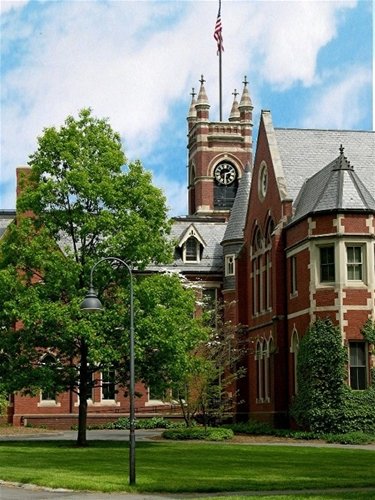
Richard Kahlenberg, in the Chronicle of Higher Education, reviews a book by Toronto sociologist Ann L. Mullen, looking at the differences in student demographics, life style, academic major, and expectations between Yale and Southern Connecticut State University, a nearby former Normal School (i.e., a teacher’s training school) upgraded in recent years to university status.
Mullen examines two four-year colleges located within two miles of one another: Yale University and Southern Connecticut State University. In racial terms, the two institutions are not all that different. Yale is 69 percent white, while Southern is 70 percent white. But as Mullen finds in interviews with 50 Yale students and 50 Southern students, the class divide is significant, and that difference has enormous implications for the attitudes, experiences, and expectations of students.
Mullen’s insightful new book, Degrees of Inequality, notes that Southern students tend to be the sons and daughters of “shopkeepers, secretaries, teachers, and construction workers,†about half of whom never completed college. By contrast, about 80 percent of Yale students sampled had parents with BA’s, two-thirds had some form of graduate education, and more than half came from the top 15 percent by income nationally. These students often “arrived on the back of tremendous childhood advantages.â€
Among the advantages, she writes, were high parental expectations. In interviews, she writes, it was clear that most Yale students “never actually decided to go to college; it was simply the next step in their lives, one not requiring a rationale.†Although less than one percent of four- year college students attend Ivy League institutions, for some Yale students interviewed, “it was a question of which one.†She writes, “It is not simply that they aspired to attend the most elite institutions; rather, they planned on it.
Southern students, by contrast, made a conscious decision to pursue higher education and then mostly chose Southern based on “cost and convenience.†Neither factor was mentioned by a single Yale student. Over 90 percent of Yale students were from out of state, while over 90 percent of Southern students came from in-state. The Southern students never thought of applying to Yale, and the Yale students have never even heard of Southern.
The differences in opportunities and outlooks of Yale and Southern are then amplified once they reach college, Mullen finds. Yale, founded 300 years ago, has a $15-billion endowment “about two thousand times greater†than the endowment of Southern, which became a four-year institution in 1937 and became part of the Connecticut State University system in 1983.
The economic chasm between the schools and their students also drives profound differences in the experiences at each institution. To save money, only about one-third of Southern students live on campus and only 24 percent participate in extracurriculars, as many have to work 20-30 hours a week. By contrast, almost all students at Yale live on campus, and 67 percent participate in extracurriculars, from playing tennis to singing a capella.
Asked what they value most about college, Yale students tended to mention learning from friends and peers and participating in extracurricular activities. Southern students were only half as likely as Yale students to mention peers and friends.
Academic pursuits also differ greatly. Deciding on a college major is usually portrayed as a matter of individual choice, Mullen notes, but economic constraints are strongly felt. “For the Southern students,†she says, “majors represented not bodies of knowledge or academic disciplines, but rather occupational fields.†By contrast, Yale students were “quite cognizant†that their Ivy League degrees made the field of study chosen less important. One student told Mullen, “I’m getting a diploma with four letters Y-A-L-E on it. I should be able to have the sky be my limit.â€
Surprise, surprise! Professor Mullen discovers the third-oldest and one of the most competitive colleges in the country attracts a more affluent and more cosmopolitan student body with larger ambitions and wider career options than those of students attending the local neighborhood’s uncompetitive teacher’s college.
Certainly a lot of Yale students come from more affluent and better educated family backgrounds, but comparing Yale and Southern most meaningfully would have to be done on the basis of academic talent. Southern’s students have average SAT scores in the 480-490 range on the three parts of the current test. Yale quotes different 25%/75% figures, which indicate that only 25% of Yale students got under 700 on any of the three parts of the SAT, and another 25% got 780 to 800. Yale admits around 7.5% of applicants these days. Southern admits 71% of applicants.
Yale students have different majors and different career options from students at Southern Conn, not because Yalies have inherited clout, but because they are, on the average, a great deal more academically competent and competitive.
In my day, Southern and Yale did interact a bit socially, most commonly via contact within the Connecticut Intercollegiate Student Legislature (CISL). Yalies dated girls from Southern, and I knew some people who married them.
If you want to go to naked parties, first you have to be admitted to the appropriate elite college, and even if you don’t want to go to naked parties, you are going to need to get your ticket stamped in our credential-obsessed society in order to get any kind of serious job.
In my day, places like Yale, in the aftermath of Sputnik, were scouring the country in search of anybody with good standardized test scores. All you had to do was ace the 9th grade Stanford-Binet IQ test, then do well on the SATs and alumni representatives of Yale would come and plead with you to accept a full scholarship. Things are a bit more complicated today.
The most darkly humorous aspect of this often hilarious book is its depiction of an admissions process that corrupts everything it touches.
It’s a process that discourages reticence by requiring students to write revealing and disingenuous personal essays; discourages thrift by regarding parental savings as fair game in the financial-aid evaluation; discourages intellectual curiosity by encouraging students to pursue grades rather than knowledge; and discourages honesty by transforming adolescence into a period of cynical calculation.
“At its most intense,” Mr. Ferguson writes, “the admissions process didn’t force kids to be Lisa Simpson; it turned them into Eddie Haskell. . . . It guaranteed that teenagers would pursue life with a single ulterior motive, while pretending they weren’t. It coated their every undertaking in a thin lacquer of insincerity. Befriending people in hopes of a good rec letter; serving the community to advertise your big heart; studying hard just to puff up the GPA and climb the greasy poll of class rank—nothing was done for its own sake.”
This stressful process practically demands cynicism from all parties. To “climb the page” in the closely watched U.S. News & World Report rankings, schools solicit applications so that they can increase the numbers they reject, thereby appearing more selective. Elite institutions claim to be open to all but devote wide swaths of their entering classes to athletes, the offspring of donating alumni, members of minority groups and others with “hooks” that give them an edge.
Matters have been complicated in recent years by the success of girls, who persist in outperforming boys academically in high school and outnumbering them in college. But a university may admit so many girls that a tipping point is reached, making boys even less likely to apply or, as Mr. Ferguson notes, “attracting the wrong kind of boys for the wrong reasons.”
Admissions officers have tried to rectify this problem by making schools more appealing to male applicants, expanding math and science departments, adding sports—and lowering admission standards for males, most of whom are white. Asian boys generally don’t need any such help. “After several generations of vicious racism,” Mr. Ferguson says, “followed by protest marches, civil rights lawsuits, accusations of bigotry, appeals to color-blindness, feminism, and eloquent invocations of the meritocratic ideal, the latest admissions trend in American higher education is affirmative action for white men. Just like the old days.”
Megan McArdle contemplates yesterday’s New York Times academic bias against conservatives article. She does not pretend to have a solution, but thinks it would be nice if liberals actually recognized their own biases.
[L]iberals, who are usually quick to assume that underrepresentation represents some form of discrimination–structural or personal–suddenly become, as Haidt notes, fierce critics of the notion that numerical representation means anything. Moreover, they start generating explanations for the disparity that sound suspiciously like some old reactionary explaining that blacks don’t really want to go into management because they’re much happier without all the responsibility. Conservatives are too stupid to become academics; they aren’t open new ideas; they’re too aggressive and hierarchical; they don’t care about ideas, just money. In other words, it’s not our fault that they’re not worthy.
Besides, liberals suddenly argue, we shouldn’t look for every sub-population to mirror the composition of the population at large; just as Greeks gravitated towards diners in 1980s New York, and the small market business was dominated by Koreans, liberals are attracted to academia, and conservatives to, well, some other profession. …
I don’t actually know many conservatives who want quotas for conservatives, either–I’m sure they’re out there, but even David Horowitz didn’t go that far. Most of the people I talk to think, like James Joyner, that this may be a problem without a solution. It is just my impression, but I think what conservatives want most of all is simply recognition that they are being shut out. It is a double indignity to be discriminated against, and then be told unctuously that your group’s underrepresentation is proof that almost none of you are as good as “us”. Haidt notes that his correspondence with conservative students (anonymously) “reminded him of closeted gay students in the 1980s”:
He quoted — anonymously — from their e-mails describing how they hid their feelings when colleagues made political small talk and jokes predicated on the assumption that everyone was a liberal. “I consider myself very middle-of-the-road politically: a social liberal but fiscal conservative. Nonetheless, I avoid the topic of politics around work,” one student wrote. “Given what I’ve read of the literature, I am certain any research I conducted in political psychology would provide contrary findings and, therefore, go unpublished. Although I think I could make a substantial contribution to the knowledge base, and would be excited to do so, I will not.”
Beyond that, mostly they would like academics to be conscious of the bias, and try to counter it where possible. As the quote above suggests, this isn’t just for the benefit of conservatives, either. Just as excluding blacks and women from academia by tacit agreement allowed for a certain amount of wrong-headed groupthink, so does excluding people with different political views. No, I’m not saying you have to hire a Young Earth Creationist to be a biology professor, but I don’t see why it should matter in a professor of Mathematics or Sociology.
Trying to be more conscious of one’s own bias, and even to attempt to work against it, should not be such a hard task for people as brilliant, open-minded, and committed to equality and social justice as I keep hearing that liberal academics are. So it doesn’t really seem like so much to ask.
The New York Times has an amusing item about the professional bias investigators of the modern academic world finding themselves confronted with powerful evidence of a very large beam in their own collective eye.
Discrimination is always high on the agenda at the Society for Personality and Social Psychology’s conference, where psychologists discuss their research on racial prejudice, homophobia, sexism, stereotype threat and unconscious bias against minorities. But the most talked-about speech at this year’s meeting, which ended Jan. 30, involved a new “outgroup.â€
It was identified by Jonathan Haidt, a social psychologist at the University of Virginia who studies the intuitive foundations of morality and ideology. He polled his audience at the San Antonio Convention Center, starting by asking how many considered themselves politically liberal. A sea of hands appeared, and Dr. Haidt estimated that liberals made up 80 percent of the 1,000 psychologists in the ballroom. When he asked for centrists and libertarians, he spotted fewer than three dozen hands. And then, when he asked for conservatives, he counted a grand total of three.
“This is a statistically impossible lack of diversity,†Dr. Haidt concluded, noting polls showing that 40 percent of Americans are conservative and 20 percent are liberal. In his speech and in an interview, Dr. Haidt argued that social psychologists are a “tribal-moral community†united by “sacred values†that hinder research and damage their credibility — and blind them to the hostile climate they’ve created for non-liberals.
“Anywhere in the world that social psychologists see women or minorities underrepresented by a factor of two or three, our minds jump to discrimination as the explanation,†said Dr. Haidt, who called himself a longtime liberal turned centrist. “But when we find out that conservatives are underrepresented among us by a factor of more than 100, suddenly everyone finds it quite easy to generate alternate explanations.â€
—————————————–
The social sciences are build around left-wing assumptions and perspectives, so it isn’t all that surprising to me that Sociology and Anthro departments are overwhelmingly populated by left-wing democrats, but lack of political diversity in American colleges and universities notoriously extends far beyond the social sciences. English and History departments are scarcely more diverse in their political representation.
Steven Hayward, at Power-Line, describes the well-known phenomenon of conservative fear and isolation on the modern university faculty.
I have a good friend–I won’t name out him here though–who is a tenured faculty member in a premier humanities department at a leading east coast university, and he’s . . . a conservative! How did he slip by the PC police? Simple: he kept his head down in graduate school and as a junior faculty member, practicing self-censorship and publishing boring journal articles that said little or nothing. When he finally got tenure review, he told his closest friend on the faculty, sotto voce, that “Actually I’m a Republican.” His faculty friend, similarly sotto voce, said, “Really? I’m a Republican, too!”
That’s the scandalous state of things in American universities today. Here and there–Hillsdale College, George Mason Law School, Ashland University come to mind–the administration is able to hire first rate conservative scholars at below market rates because they are actively discriminated against at probably 90 percent of American colleges and universities. Other universities will tolerate a token conservative, but having a second conservative in a department is beyond the pale.
A few weeks ago, I posted a link referred to in private email correspondence by a younger person from Yale, now teaching English at a major university. As is the custom, I mentioned his name as my source for the post in a final “hat tip.” A few hours later, I received an email from that university professor, thanking me for the courtesy, but asking me to remove his name from this blog for fear that the association with Never Yet Melted might possibly out his unacceptable personal political views and jeopardize his candidacy for tenure. Conservative faculty members all over America today live in real, and well-founded, fear of being victimized by discrimination on the basis of their political views.
Our lords and masters of the national elite may have been defeated in the election last November, but they are still our rulers.
Just to drive home the point of who is in charge in this country, the liberal establishment took the lame duck congress it controls and delivered its own special Christmas present to a prized constituency. Now those second-class citizens who fail to attend elite institutions, who live outside the coastal cities and suburbs which call the shots, who bitterly cling to God and guns and are stupid enough to serve in the US military for chump change will have to accept as their equals (and often, undoubtedly, their superiors in rank and command) persons who choose to define themselves on the basis of an inclination to engage in certain kinds of unconventional (intrinsically non-reproductive) sexual activities.
Liberals don’t themselves actually serve in the military anymore. Liberals usually do not even support the military operations in which members of the armed forces risk their lives. Liberals frequently make strong efforts to undermine and delegitimitize the causes for which Americans serving in the military are fighting. Liberals routinely provide aid and comfort to the enemy opposing US forces in the field. Liberals undermine domestic support for our military’s efforts, destroy our national morale, and work tirelessly to bring about our Armed Forces’ failure and withdrawal. Liberals devote their energy to voiding and rendering useless all the American military’s efforts and sacrifices. But the liberals get to tell the American military with whom they will have to shower, beside whom they will have to sleep, who will be serving beside them, and on whom they will have to depend in action.
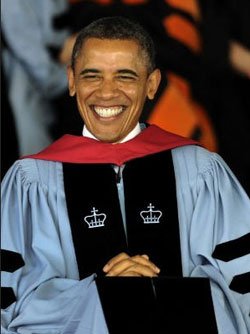
A certain amount of social friction and the occasional incident of abuse of authority to obtain affection is obviously an insignificant price for the American Armed Forces to pay to permit those wiser and better than themselves to deliver social equality to the oppressed and despised. Besides, along with the burden of providing a new field for the social engineering of a better future for all of mankind comes very possibly a rise to new social acceptability for the American military. Columbia’s President Lee Bollinger is quoted today predicting that, along with transgendered roommates and more interesting activities in the showers, military personnel can look forward to a “new era” in the relationship between American universities and “the uniforms that guard them while they sleep.”
Isn’t that just ducky? They may allow recruiters back on Ivy League campuses, just so long as drag queens can join the Marine Corps.



 a perfect demonstration of exactly what has happened to university English departments in recent decades and thinks all this probably has something to do with the percentage of students majoring in English having been roughly cut in half over the same period.
  , notes that Southern students tend to be the sons and daughters of “shopkeepers, secretaries, teachers, and construction workers,†about half of whom never completed college. By contrast, about 80 percent of Yale students sampled had parents with BA’s, two-thirds had some form of graduate education, and more than half came from the top 15 percent by income nationally. These students often “arrived on the back of tremendous childhood advantages.â€
 in the Wall Street Journal, has a lot of negative things to say about the process.