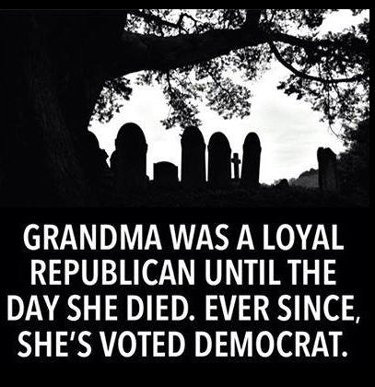
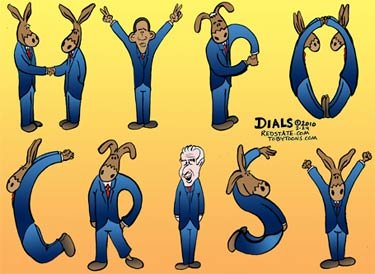
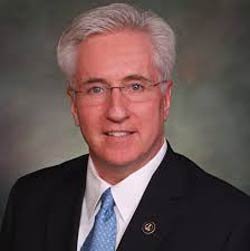
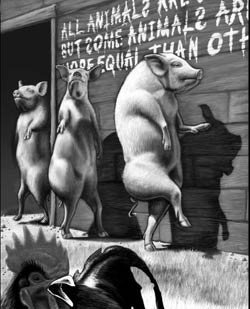
Somebody on Facebook also posted this political ad, ran last time around by Republican Roger Williams, who ran for the Texas 25th District Congressional seat and won.
Andrew Sullivan’s gloating readers are this morning offering some clues.
Reader 1:
I live in the 7th District in Virginia, and I am a Democrat who voted for David Brat in the open primary. There has been a whisper campaign going on among the Democrats in the district for the last few weeks and it resulted in many Democrats coming out to vote for Brat. We felt especially encouraged after the 7th District committee nominated Jack Trammell to be the Democratic candidate for the seat last Sunday. We now feel we at least have a fair chance at winning it. (By the way, Jack Trammell is a professor at the same small college as Brat, Randolph-Macon.)
Reader 2:
Here’s a theory to support your reader who, though a Democrat, voted for Brat: in 2012, roughly 47,000 people voted in the 7th District Republican primary. This time, roughly 65,000. Now let’s assume that of those 18,000 new voters, 16,000 were Democrats voting to axe Cantor, then rework the numbers if they hadn’t voted: Cantor would then have had around 29,000+ votes, and Brat would have had around 20,000+. Which would have worked out to approximately 59% for Cantor, which is where he was at in 2012 and much closer to his internal polling showing him with a lead of 34% among likely REPUBLICAN voters.
I’m thinking time will show that Democrats in his district were fed up with him, and decided to do something about it.
—————————–
Cantor should just run, and win, as an independent in November, rather than giving up. What would a left-wing democrat (sandbagged in a primary by the opposition party) do?
And Virginia should get rid on non-party-registration and open primaries.
——————————-
CORRECTION: Damn! Cantor actually cannot run as an independent. Commenter JKB points out that Virginia not only has open primaries, it has a “sore-loser” law preventing candidates defeated in a primary from entering the race as independents.
According to the Code of Virginia’s section on candidates and elections (24.2-520), candidates filing for a primary must sign a statement agreeing that if they lose, their names cannot be printed on ballots for the general election. Meaning, if a candidate in the Republican primary for the 5th District loses on June 8, he or she cannot run as a third-party candidate in November.
The deadline for filing as an independent, however, is June 8 at 7 p.m. – the same time the primary polls close.
Glenn Reynolds was amused the other day when he found the gun-running scandal involving Democrat State Senator Leeland Yee (who represents San Francisco & San Mateo County and who was, when the scandal broke, running for Secretary of State) was getting coverage from Popular Mechanics, while being studiously ignored by CNN.
Esquire magazine picked up the Popular Mechanics “Leeland Yee-supplied guns” feature, but the MSM is generally ignoring all this, classifying the matter as merely “local news.”
Leeland Yee was honored in 2006 by the Brady Campaign for “gun violence prevention” for his co-athoring a bill requiring semiautomatic handguns (not sold covertly by State Senator Yee) to include ballistics identification microstamping.
Restoring the Lost Constitution just got much easier.
This is an historic moment on our constitutional history. With the change of Senate rules today by a simple majority to [allow a simple majority to] close debate on judicial nominations, a Rubicon has been crossed. Restoring the Lost Constitution has now been made far more feasible, and will make the 2014 & 2016 of enormous importance to our constitutional future.
I’m always amused by the nuclear option debate because it is without a doubt the most spectacular display of Congressional hypocrisy, which is saying a lot. Because whenever the minority party is arguing, it says that this is a very important, indeed a majestic part of our constitution. And as soon as the minority become the majority, like Harry Reid and the Democrats and Obama, all of a sudden it’s terrible instrument of obstruction.
Look, as a matter of the means in which this was done, it was a rather lowdown way. This is a fundamental change of the structure of the rules of the Senate and done on strict party lines, which it should not be. The same way, incidentally, Obamacare, a major reform, on party lines. That should not be. But on the substance of the change, I think the Democrats have stumbled upon the truth as they do every decade or so. If you are not to know who is in power, I think it’s a better idea for the president to have the ability to nominate his nominees, judicial and executive, without having to get a supermajority.
And the other part of it, as a conservative, I am extremely happy that the Democrats are doing this. The prospects are very strong that the Democrats are going to lose the Senate next year and there is an excellent chance of losing the White House. And the Democrats will absolutely rue the day because they not only are going to allow a Republican majority — which will come one day anyway — to get its nominees through, but Chuck Grassley has said that when Republicans come into you power, they’re going to include Supreme Court nominees, and that will be a devastating blow to the liberals on the Court and to the liberals in the country. So I don’t think Democrats will remember this day with any joy in the near future.
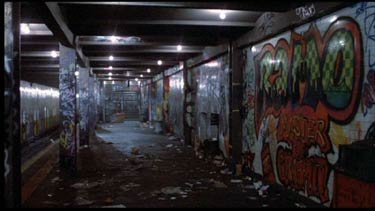
NYC voted to go back to the 1970s, back to grafitti, squeegee men, and muggings. Dan Greenfield has some words of congratulation for NYC voters.
Do you miss the old New York City? Remember when subway trains were covered in graffiti, a news hour began with six shootings and everyone who lived in the city had been mugged at least once?
Remember when Times Square had more strip clubs than theaters and when you could afford an apartment in the village because it was a drug infested mess?
Remember when the city and everyone living in it were on the verge of bankruptcy and the only people who had money lived upstate or in a small cluster of Manhattan?
Remember when everything was grimy and had a layer of filth, when people moved to the city because they wanted to slum, when nothing worked and no one cared and the only difference between New York and Chicago was that it had taller buildings?
If you miss that classic New York, there’s good news because Bill de Blasio is bringing it back.
The muggers are coming back. The squeegee men are coming back. The crazy people randomly stabbing you on the subway, the gangs shooting each other over turf, the race rioters marching through neighborhoods and shouting, “Whose streets, our streets”– they’re all coming back.
Because the polls have spoken. And it’s De Blasio time now.
No more fascist cops hassling “innocent” people. Bill de Blasio won’t put up with any of that. De Blasio will put the cops in their place, inside a Dunkin Donuts and away from people. They’ll still get paid. They’re in a union. They just won’t lift a finger to help you because they’ll have more special monitors and civilian complaint review boards on their necks than they can handle.
And next time one of the innocent victims of Stop and Frisk is pounding your face into the sidewalk with one hand while digging through your pockets with the other, wave to the pair of beat cops sitting in the window of the coffee shop. And they’ll wave back without getting up. Because you voted for this. And you’re getting what you deserve.
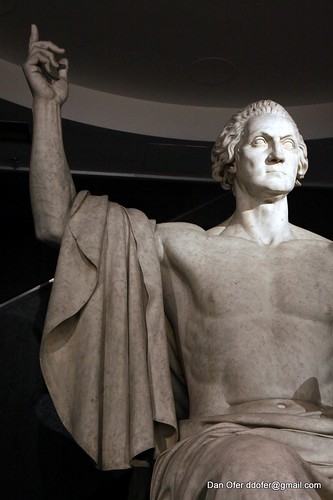
Detail, Horatio Greenough, George Washington Attired in Roman Toga, 1841, National Museum of American History
Stratfor’s George Friedman thinks seriously about what the founders would have thought about the partisan stalemate in Washington.
The founders needed to bridge the gaps between the need to govern, the fear of tyranny and the uncertainty of the future. Their solution was not in law but in personal virtue. The founders were fascinated by Rome and its notion of governance. Their Senate was both a Roman name and venue for the Roman vision of the statesman, particularly Cincinnatus, who left his farm to serve (not rule) and then returned to it when his service was over. The Romans, at least in the eyes of the founders if not always in reality, did not see government as a profession but rather as a burden and obligation. The founders wanted reluctant rulers.
They also wanted virtuous rulers. Specifically they lauded Roman virtue. It is the virtue that most reasonable men would see as praiseworthy: courage, prudence, kindness to the weak, honoring friendship, resolution with enemies. These were not virtues that were greatly respected by intellectuals, since they knew that life was more complicated than this. But the founders knew that the virtues of common sense ought not be analyzed until they lose their vigor and die. They did not want philosopher-kings; they wanted citizens of simple, clear virtues, who served reluctantly and left gladly, pursued their passions but were blocked by the system from imposing their idiosyncratic vision, pursued the ends of the preamble, and were contained in their occasional bitterness by the checks and balances that would frustrate the personal and ideological ambitions of others.
The Founding Father who best reflects these values is, of course, George Washington. Among the founders, it is he whom we should heed as we ponder the paralysis-by-design of the founders’ system and the current conundrum threatening an American debt default. He understood that the public would be reluctant to repay debt and that the federal government would lack the will to tax the public to pay debt on its behalf. He stressed the importance of redeeming and discharging public debt. He discouraged accruing additional debt and warned against overusing debt.
However, Washington understood there would be instances in which debt had to be incurred. He saw public credit as vital and therefore something that ought to be used sparingly — particularly in the event of war — and then aggressively repaid. This is not a technical argument for those who see debt as a way to manage the economy. It is a moral argument built around the virtue of prudence.
After these excellent observations, though, George reaches a dubious conclusion.
I think the founders would have questioned the prudence of our current debt. They would ask if it were necessary to incur, and how and whether it would be paid back. They would also question whether economic growth driven by debt actually strengthens the nation. In any case, I think there is little doubt they would be appalled by our debt levels, not necessarily because of what it might do to the economy, but because of what it does to the national character. However, because they were moderate men they would not demand an immediate solution. Nor would they ask for a solution that undermines national power.
As for federally mandated health care, I think they would be wary of entrusting such an important service to an entity they feared viscerally. But they wouldn’t have been fanatical in their resistance to it. As much as federally mandated health care would frighten them, I believe fanaticism would have frightened them even more.
The question of a default would have been simple. They would have been disgusted by any failure to pay a debt unless it was simply impossible to do so. They would have regarded self-inflicted default — regardless of the imprudence of the debt, or health care reform or any such subject — as something moderate people do not contemplate, let alone do.
So, by this analysis (which I think is drawn unconsciously from the poisoned well of the establishment media), even though Obamacare and an ever-increasing and unsustainable public debt are both classic examples of the kind of fundamentally destructive perils to the Republic which the framers devised the Constitution specifically to avoid, good men must refrain from fully utilizing the House’s power of the purse to restrain the radicals and the corrupt because refusing to write checks to cover the debts they irresponsibly and uncontrollably pile up would mean the good men were being “immoderate.” Uh, huh!
Sorry, but I think it is appropriate to quote Justice Jackson to Mr. Friedman: “The Constitution is not a suicide pact.” And a one-sided political philosophy which demands that the forces of conservatism, liberty, and fiscal prudence must be moderate and cannot fight totally ruthless opponents who shrink from nothing with all their means simply guarantees that the democrats are always going to win.
When we have one of these policy confrontations, I would say, “Republicans, what would the democrats do?” The answer is: everything and anything necessary to win. In political wars, it is desirable to maintain a standard of behavior. It is desirable to set an example of moderation. But to set any kind of example, to have any impact on the future, to be remembered by history, you actually do have to win. Nobody, long years afterwards, says, they lost, but they were so well-mannered and restrained in their manner of being defeated that we are building them this monument.
We have, in this country, an ongoing political struggle between two parties. The Republican Party is commonly comprised of well-meaning, civic-minded and moderate men, successful businessmen, Rotarians who went on into public service. The democrat party, on the other hand, is full of machine politicians, of ruthless bastards with limitless ambition, of demagogues and crooks. Republicans would like to do politics in the genteel way you play a game of croquet. Democrats are professional, organized, and utterly and totally determined to win every time at any cost. We are doing politics as an obligation and a duty. They are doing politics to make a living. If a typical Republican leaves office, he is happy to go home. If a typical major democrat pol were to leave politics, he’d be in the gutter or in jail. The Republican Party is going to keep losing until its leaders realize that they are really fighting for the survival of the Republic and that they have to fight these people with no holds barred.
Former Colorado State Senate President John Morse (D – Colorado Springs)
Colorado democrats took advantage of the emotional atmosphere occurring in the wake of the Newtown, Connecticut shootings to ram through a controversial gun bill requiring background checks for any firearm transfer and limiting the capacity of most magazines to 15 rounds.
The response from residents of the outdoor-loving state was furious. 54 out of 64 Colorado county sheriffs even brought suit to overturn the law, contending that its provisions were too vague and that innocent citizens could inadvertently violate the law by owning magazines readily convertible to larger capacities.
Angry sportsmen and gun owners responded by petitioning for recall elections in the cases of several of the most prominent senatorial supporters of the bill.
Yesterday’s election produced the first successful recalls in Colorado’s history of any elected officials. Colorado Senate President John Morse was ousted and along with him Senator Angela Giron who represented Pueblo.
All this proves once again that gun control in regions outside coastal urban enclaves represents a very effective political third rail for progressive democrats.
Drew in Wisconsin, at Ricochet, has a go at inferring the correct hierarchy of interest groups.
Recent events help illuminate a few things on the left.
The Keystone XL pipeline demonstrates that environmentalists slot in above unions
The Trayvon Martin case shows that it’s blacks over Hispanics.
Reaction to North Carolina’s gay marriage vote last year suggests that Democrats favor gays over blacks.
Women over men is too well-established to even be questioned.
Any examples where gays come in conflict with unions or environmentalists? That would help us figure out who really takes the #1 slot.
I think some of the left’s constituencies just naturally lack opportunities for conflict, but it should be obvious that left’s status hierarchy is founded upon specifically upon ressentiment, the inversion of values by which the loudest whiner and the leper with the most sores gets the top place.
If gays were more reflective, they might start thinking about exactly what their current very high position in the left’s roll call of constituencies says about what lefties really think of them.