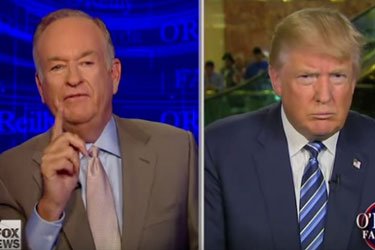
Last night, I happened to catch Bill O’Reilly trying to persuade Donald Trump to change his mind and participate in tonight’s GOP Debate on Fox News.
O’Reilly was his usual annoying self, but I thought Trump was truly intolerable: egomaniacal (“I won all six debates!”), petulant, self-entitled, thin-skinned, vindictive, odiously tyrannical, and childishly spiteful.
I’m rather amazed that there are still lots of American adults out there still inclined to be supporting Trump after such an exhibition of irresponsible behavior.
El Rushbo, for instance, looked on yesterday, and interpreted Trump’s blowing off the Fox Debate as a commendable case of “not playing by the rules” made by the elites, and as a case example of the application of one of his own rules published in his book, The Art of the Deal. That rule being: You have to know when to walk away.
I rarely disagree with Rush, but this is one of those times.
Running for President of the United States is actually different from negotiating a real estate deal. Even if you are a bigshot and a billionaire, in politics, unlike your own private business activities, you cannot expect everything to be specifically arranged for your comfort and advantage. There is a complex process, partly derived from tradition, partly contrived by happenstance, ruled over in the final analysis by nobody in particular, through which American Democracy arrives at its decision and expresses its will. That process is bigger than Donald Trump.
A long time ago, candidates for the presidency were expected to sit in dignity at home, while others sought their nomination, and the country as a whole, in essence, politely invited them to serve. Today, Americans expect presidential candidates to go through a kind of ordeal involving submitting themselves to be tested on their personal history, political record, and grace under pressure by facing hostile questioning by the press and hostile attacks by their opponents. You know this, I know this, and Donald Trump knows this.
For a candidate to carry a grudge over one question for six months, to demand special treatment, to keep threatening a personal boycott of the debate process on the basis of his own self-perceived unique status, and then finally to announce that he will not participate in the final debate occurring directly before delegates actually begin to be chosen is fantastical behavior.
Trump’s refusal to participate is selfish, infantile, petulant, tyrannical, unrealistic, and it certainly should be self-defeating. He may have persuaded himself that he is proving to be oh-so clever, but I think most Republicans are going to agree with me that Donald Trump has definitively discredited himself as a presidential candidate.
Yes, a lot of us agree with Trump that Republican candidates get a kind of hostile treatment from members of the press, including those working for Fox News, that democrats don’t get. Some reform of debate formats and a better selection of journalistic participants is highly desirable. Donald Trump had an opportunity to exercise his alleged leadership skills here. He could have gone to his Republican rivals, and said: “Look, guys, what are we doing holding debates on thoroughly hostile venues like NBC and CNN? Why do Republicans let the likes of partisan lefties like Candy Crowley run the debates? Let’s do all of them on Fox and get Rush Limbaugh and Sean Hannity to do the questioning.” Then, he could have stood back, pointed to an improved process and stronger GOP prospects, and taken the credit. Instead, Trump has delivered a disgraceful exhibition of thin-skinned egomania and rich kid self-entitlement. He obviously has neither the brains nor the character to hold any elected office. If you had a business, despite his megabucks, you would not want a petty tyrant like him as a customer.
Matt Labash has compiled a list of Donald Trump’s most Trumpish moments.
If you’re the sort of person who’s been conditioned to accept reality-show excess as entertainment, which is to say the sort of person who lives in America, then what’s not to love? There’s the supermodel wife and the gold-covered “Trump”-embossed Boeing 757. There’s the garishly decorated three-story Trump Tower penthouse that had a New Statesman writer, after a tour, calling Trump “a man whose front room proved that it really was possible to spend a million dollars in Woolworth’s.” There’s that hair that looks like a mac-‘n’-cheese-colored nutria that was hit by an oil truck. There’s the permanent pucker, which at rest makes Trump look like a puzzled duck working out long-division problems in its head.
And who doesn’t admire his fiscal conservatism? (“The only kind of people I want counting my money are little short guys that wear yarmulkes.”) His impeccable manners? (To Larry King: “Do you mind if I sit back a little? Because your breath is very bad.”) His commitment to diversity? (“I have a great relationship with the blacks.”) Who couldn’t appreciate the executive know-how and tested mettle that come from telling La Toya Jackson “you’re fired” on Celebrity Apprentice?
And as if all that doesn’t qualify Trump to Make America Great Again®, he’s a man who knows his own mind, except when he changes it. (Trump has switched his party registration five times since 1987, once every 5.8 years.) He’s a man who tells it like it is, except when he’s lying. (“Sorry losers and haters, but my IQ is one of the highest and you all know it!”) He’s a man of rich contradictions. (“I’m actually very modest,” he once bragged.)
But to lovingly catalog all of Trump’s gaffes is a pointless exercise. Even calling them “gaffes” is a bit of a misnomer. Gaffes are what stop normal politicians. But a gaffe can’t actually be considered a gaffe if, say, you give a speech in the belly of the evangelical beast, Liberty University, and show your total ignorance of the Bible (an amazing holy book, right up there with The Art of the Deal) by calling Second Corinthians “Two Corinthians,” and yet you still sop up 42 percent of evangelical voters, as Trump did in a recent New York Times/CBS poll. Second-place Ted Cruz (or should I say “two place”) only managed 25 percent. Expecting a gaffe to stop Trump, at this late date, is like expecting a traffic cone to stop a runaway train. …
But with a sizable chunk of the electorate now poised to take the great leap forward with Trump, it may be worth hitting the pause button for some quiet reflection. Who is this man and what do we really know of him?
After combing my vast Trump archive, as well as contacting Trump sources, I present herewith nine of Trump’s Trumpiest moments — a Trump Moments collage, if you will — that distill the very essence of the man.
Rod Dreher notes that National Review may be substantively correct about Trump, but elite conservative writers, a lot like the liberals, are also thoroughly disconnected from the concerns and views of normal working class voters out there in the hinterlands. Trump, in openly and passionately taking on the Establishment, has tapped into a powerful reservoir of political support, and is rejecting the whole elite Establishment intelligentsia, on the Right as well as on the Left.
When I worked at National Review in 2002, I took pride at being part of the team of conservative standard-bearers, and believed that we were articulating what American conservatives felt. This continued after I left NR, but kept up my work as a conservative opinion journalist.
But a funny thing kept happening. When I would go back to south Louisiana to visit my family, I often got into (friendly) arguments with people about conservative principles and policies. I noticed that we were at loggerheads over many things. It frustrated me to no end that reason was useless; “ideologically unmoored cultural passions†weren’t just something, they were the only thing. This was a tribal conservatism, one that had very little to do with ideas, and everything to do with nationalism and a sense of us-versus-them. To be a conservative is to agree with Us; to disagree with us means you must be a liberal.
I remember getting into it with my dad once after I moved home. I was driving him to the VA clinic for a check-up. This was during the Obamacare debate, and he started complaining about welfare spongers who expected the government to pay for their medical care. I pointed out that he was an avid user of Medicare and of veterans’ medical benefits, and that if not for those government programs, he would have died a long time ago.
“That’s different,†he said.
“How?†I asked.
He just got mad, and changed the subject.
This kind of thing happened more than a few times. Moving back to Louisiana to live really did reveal to me the gap between the conservative punditocracy and those for whom they — for whom we — presume to speak. Ideas and reason matter far less to most people than they do to people like us (this is true of the left as well), not because most people are stupid, but because their mode of experiencing life is not nearly as abstract as ours. …
[C]onservative theoreticians (like me) get so caught up in our ideas that we fail to see some important things, even as many of us tell ourselves, as we have for a generation now, that we are the spokesmen for “real†America.
It’s a narrative that is irresistible to intellectuals. The Left, of course, always loves to think of itself on the side of the People, never mind what actual people think. Trouble is, the Right is the same way.
I’d say that we’d better beat Trump in the primaries, because Populist Nationalism is never going to lead to conservative results or good government. What Trump in power and unbridled would turn into is another Juan Peron, another Huey Long, cozying up to the masses with Nativism, Protectionism, and an inevitable package of socialist goodies, with a large helping of crony capitalism and corruption on the side.
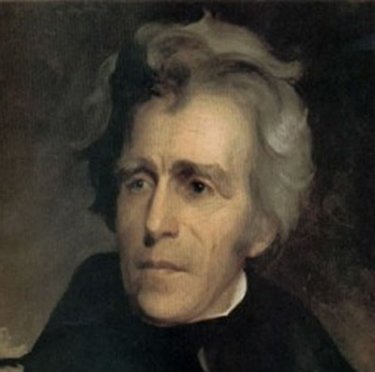
Walter Russell Mead warns that a spectre is haunting the election of 2016, the spectre is that of no less than Andrew By God! Jackson, and the Locofocos are again challenging the rule of the Bank and the Urban Elites.
Not since he fought with Nicholas Biddle over the future of the Bank of the United States has Andrew Jackson been this controversial or this central in American political life. Jacksonian populism, the sense of honor-driven egalitarianism and fiery nationalism that drove American politics for many years, has never been hated and reviled as often as it is today, and many American academics and intellectuals (to say nothing of Hollywood icons) are close to demanding that Jacksonian sentiment be redefined as a hate crime.
For President Barack Obama and his political allies in particular, Jacksonian America is the father of all evils. Jacksonians are who the then Senator had in mind when, in the campaign of 2008, he spoke of the ‘bitter clingers’ holding on to their guns and their Bibles. They are the source of the foreign policy instincts he most deplores, supporting Israel almost reflexively, demanding overwhelming response to terror attacks, agitating for tight immigration controls, resisting diplomacy with Iran and North Korea, supporting Guantanamo, cynical about the UN, skeptical of climate change, and willing to use ‘enhanced interrogation’ against terrorists in arms against the United States. …
The hate and the disdain don’t spring from anything as trivial as pique. Historically, Jacksonian America has been the enemy of many of what President Obama, rightly, sees as some of America’s most important advances. …
Virtually everything about progressive politics today is about liquidating the Jacksonian influence in American life. From immigration policy, touted as ending the era when American whites were the population of the United States, to gun policy and to regulatory policy, President Obama and his coalition aim to crush what Jacksonians love, empower what they fear, and exalt what they hate. …
What we are seeing in American politics today is a Jacksonian surge. …
Donald Trump, for now, is serving as a kind of blank screen on which Jacksonians project their hopes. Proposing himself as a strong leader who ‘gets’ America but is above party, Trump appeals to Jacksonian ideas about leadership. Trump’s Jacksonian appeal has left the Republican Party in deep disarray, demonstrating the gulf between contemporary conservative ideology and Jacksonian nationalism. Indeed, one of the reasons that Trump hasn’t been hurt by attacks that highlight his lack of long term commitment to the boilerplate conservative agenda (either in the social or economic conservative variant) is that Jacksonian voters are less dogmatic and less conservative than some of their would-be political representatives care to acknowledge. …
Whatever happens to the Trump candidacy, it now seems clear that Jacksonian America is rousing itself to fight for its identity, its culture and its primacy in a country that it believes it should own. Its cultural values have been traduced, its economic interests disregarded, and its future as the center of gravity of American political life is under attack. Overseas, it sees traditional rivals like Russia, China, North Korea and Iran making headway against a President that it distrusts; more troubling still, in ISIS and jihadi terror it sees the rapid spread of a movement aiming at the mass murder of Americans. Jacksonian America has lost all confidence in the will or the ability of the political establishment to fight the threats it sees abroad and at home. It wants what it has always wanted: to take its future into its own hands.
The biggest story in American politics today is this: Andrew Jackson is mad as hell, and he’s not going to take it anymore.