Category Archive 'Education'
15 Nov 2015

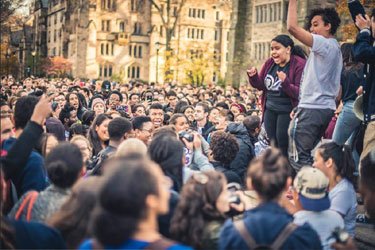
“March of Resilience” at Yale
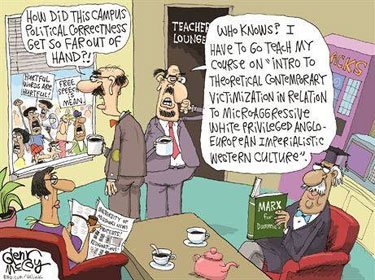
Ross Douthat obviously does not agree with the crybullying of today’s radicalized college students, but he recognizes that it was the same academic establishment they are insulting and revolting against which made the corrupt bargain with the revolutionary left that is responsible for the presence of the toxins within the national educational system which produced the current infatuated mobs howling at their doors. There are the crazed students, heads full of Marxist agitprop, filled with passionate intensity confronting the empty-headed and empty-hearted liberals who never believed there could be such a thing as an enemy to the left.
The protesters at Yale and Missouri and a longer list of schools stand accused of being spoiled, silly, self-dramatizing — and many of them are. But they’re also dealing with a university system that’s genuinely corrupt, and that’s long relied on rote appeals to the activists’ own left-wing pieties to cloak its utter lack of higher purpose.
And within this system, the contemporary college student is actually a strange blend of the pampered and the exploited.
This is true of the college football recruit who’s a god on campus but also an unpaid cog in a lucrative football franchise that has a public college vestigially attached.
It’s true of the liberal arts student who’s saddled with absurd debts to pay for an education that doesn’t even try to pass along any version of Matthew Arnold’s “ best which has been thought and said,†and often just induces mental breakdowns in the pursuit of worldly success.
It’s true of the working class or minority student who’s expected to lend a patina of diversity to a campus organized to deliver good times to rich kids whose parents pay full freight. And then it’s true of the rich girl who discovers the same university that promised her a carefree Rumspringa (justified on high feminist principle, of course) doesn’t want to hear a word about what happened to her at that frat party over the weekend.
The protesters may be obnoxious enemies of free debate, in other words, but they aren’t wrong to smell the rot around them. And they’re vindicated every time they push and an administrator caves: It’s proof that they have a monopoly on moral spine, and that any small-l liberal alternative is simply hollow.
Or as the great Walter Sobchak might have put it: “Say what you want about the tenets of political correctness, Dude, at least it’s an ethos.â€
Which might turn out to be the only epitaph for the modern university anybody needs to write.
17 Jul 2015

The calming, new-idea-free zone will be open around the clock to comfort students who have read or heard opinions that are at odds with their preexisting worldview.
From The Onion:
LYNNFIELD, MA—In an effort to provide sanctuary for Lynnfield College students exposed to perspectives different from their own, a new campus safe space was dedicated Wednesday in honor of Alexis Stigmore, a 2009 graduate who felt kind of weird in class one time.
Addressing students at the dedication ceremony, parents Arnold and Cassie Stigmore noted that while the college had adequate facilities to assist victims of discrimination, abuse, and post-traumatic stress, it had until now offered no comparable safe space for students, like their beloved daughter, who encounter an academic viewpoint that gives them an uncomfortable feeling.
“When our Alexis felt weird after hearing someone discuss an idea that did not conform to her personally held beliefs, she had no place to turn,†said Arnold Stigmore, standing outside the $2 million space that reportedly features soothing music, neutral-colored walls, oversized floor cushions, fun board games, and a variety of snacks. “God forbid any of you, in your years at this institution, are ever confronted with an opinion you do not share. But if you are, you will have a refuge on this campus.â€
“If unfamiliar thoughts are ever provoked in your mind, or in the mind of someone you know, you can come to this place and feel safe again,†he added.
Read the whole thing.
Hat tip to Robert Laird.
24 Mar 2015

WHH (obviously a liberal) describes just how intimidated by liberal student protests today’s professors have become.
[L]iberal students scare the shit out of me. I know how to get conservative students to question their beliefs and confront awful truths, and I know that, should one of these conservative students make a facebook page calling me a communist or else seek to formally protest my liberal lies, the university would have my back. I would not get fired for pissing off a Republican, so long as I did so respectfully, and so long as it happened in the course of legitimate classroom instruction.
The same cannot be said of liberal students. All it takes is one slip—not even an outright challenging of their beliefs, but even momentarily exposing them to any uncomfortable thought or imagery—and that’s it, your classroom is triggering, you are insensitive, kids are bringing mattresses to your office hours and there’s a twitter petition out demanding you chop off your hand in repentance.
Is paranoid? Yes, of course. But paranoia isn’t uncalled for within the current academic job climate. Jobs are really, really, really, really hard to get. And since no reasonable person wants to put their livelihood in danger, we reasonably do not take any risks vis-a-vis momentarily upsetting liberal students. And so we leave upsetting truths unspoken, uncomfortable texts unread.
There are literally dozens of articles and books I thought nothing of teaching, 5-6 years ago, that I wouldn’t even reference in passing today. I just re-read a passage of Late Victorian Holocausts, an account of the British genocide against India, and, wow, today I’d be scared if someone saw a copy of it in my office. There’s graphic pictures right on the cover, harsh rhetoric (“genocideâ€), historical accounts filled with racially insensitive epithets, and a profound, disquieting indictment of capitalism. No way in hell would I assign that today. Not even to grad students.
Here’s how bad it’s gotten, for reals: last summer, I agonized over whether or not to include texts about climate change in my first-year comp course. They would have fit perfectly into the unit, which was about the selective production of ignorance and the manipulation of public discourse. But I decided against including them. They forced readers to come to uncomfortable conclusions. They indicted our consumption-based lifestyles. They called out liars for lying. Lots of uncomfortable stuff. All it would take was one bougie, liberal student to get offended by them, call them triggering, and then boom, that’s it, that’s the end of me.
Read the whole thing.
Do note: Professor WHH (obviously not the sharpest pencil in the box) is so spooked that he/she? is actually afraid that teaching “the evils of British Imperialism” and “climate change” (what two topics could possibly be more PC?) might provoke a hostile leftist response.
04 Feb 2015
Megan McArdle notes that Barack Obama’s Free Community College scheme is really just one more example of the pseudo-intelligentsia’s typical attempt to make the world better by making everybody more like themselves.
I would argue instead that what’s elitist is our current fixation on college. It starts from the supposition that being good at school is some sort of great personal virtue, so that any suggestion that many people aren’t good at school must mean that those people are not equal and valuable members of society. And that supposition is triple-distilled balderdash.
My grandparents had perhaps ten adult books in their house, most of which were either Bibles or biographies of presidents. I don’t think there’s anything to be ashamed of in not regarding reading as great recreation. Bookishness has added greatly to society. So has the ability to run a business well, which my grandfather did for many years, employing dozens, maybe hundreds, of people over his lifetime. So has community service, which both my parents did with great distinction, and being kind and decent and generous. I don’t need to hide the fact that neither of my grandparents much cared for books or school, because I don’t think that made them some sort of lesser class of person. Pretending that everyone has the potential to be like the tiny class of educated people who run policy in this country is not egalitarianism; it is the secret snobbery of a mandarin class who really do think that being good at school made them more worthy and important than everyone else. …
Higher education is becoming the ginseng of the policy world: a sort of all-purpose snake oil for solving any problem you’d care to name, as long as we consume enough of it. Education is a very good thing, but it is not the only good thing. An indiscriminate focus on pushing more people into the system is no cure for society’s ills–and indeed, often functions as a substitute for helping the people who are struggling in the current system.
What if people in the policy elite stopped assuming that the ideal was to make everyone more like them, and started thinking about making society more hospitable to those who aren’t? My grandfather graduated into a world where a man with a high-school diploma could reasonably hope to own his own business, or become someone else’s highly valued employee, a successful pillar of a supportive community. His grandchildren graduated into a world where a college diploma was almost the bare necessity to get any kind of a decent job. Why aren’t we at least asking ourselves if there’s something we can do to create more opportunity for people without diplomas, instead of asking how many more years we can keep everyone in school? Why do all of our proposed solutions essentially ratify the structure that excludes so many people, instead of questioning it?
I have some ideas about what those policies might look like: broad deregulation, especially at the state and local level, to ease things for business creators and make it easier to get various sorts of jobs that are currently protected by licensing requirements; more co-op and apprenticeship programs; wage subsidies for entry-level workers, and perhaps a broad system of government internships that could help people gain experience outside of the classroom. I’m sure that there are many more I haven’t named. But we won’t find them as long as the only politically interesting solution is ever more years in school.
Read the whole thing.
31 Dec 2014

Caltech has all three volumes available right now on the Internet for free. Very cool stuff.
Don’t let’s hear any more liberal whining about the unavailability of educational opportunity in this country.
01 Sep 2014

Are you a Chinese student with shaky English and a weak understanding of US college admission office culture who wants to go to Yale? You need to hire Eunice Park to write that application essay for you.
I’m a black market college admissions essay writer, and over the last three years I’ve written over 350 fraudulent essays for wealthy Chinese exchange students. Although my clients have varied from earnest do-gooders to factory tycoon’s daughters who communicate primarily through emojis, they all have one thing in common: They’re unable to write meaningful sentences.
Sometimes this inability has stemmed from a language barrier, but other times they have struggled to understand what American college admissions committees are looking for in a personal essay. Either way, they have all been willing to pay me way more than my old waitressing job ever paid me.
Although I’m a second-generation Korean American like some of my clients, I never felt pressured to become a doctor or a lawyer. I majored in art history at college, and after graduation, I found myself bouncing from retail jobs to temp work. Every day, I loafed about in bed. Reading my friends’ Facebook statuses about finishing law school and starting their dream jobs, I wondered if I should ever leave my house. I didn’t know what I wanted to do with my life or if I even possessed any skills someone could pay me to use—at least I didn’t know until my friend told me I could reap in a cash bonanza forging wealthy Asian students’ college essays.
Once I started ghostwriting essays, I quickly went from making $8.50 an hour as a waitress to making $2,000 in two weeks. In one admissions cycle, I wrote over a hundred essays and earned enough money to pay my bills for the rest of the year, pay off my car loan, and—as a treat for my hardworking hands—receive $150 Japanese manicures on a biweekly basis.
Each ghostwriting session starts with a daylong interview. I pry into every intimate corner of a client’s life: her family history, financial background, and childhood secrets. Then I try to pinpoint one relatable thread of pain or humanity, which I can make the focal point of an essay attached to a larger universal theme, like empathy or humility. …
The voice of a college admissions essay is very specific, especially when you’re writing from the perspective of a Chinese exchange student. You have to portray a lot of their expected characteristics while simultaneously fighting against some of their more negative stereotypes. You have to be timid yet idealistic, ambitious yet giving, and reserved yet honest. Selling personal stories of yourself written in the voice of strangers who lack empathy and humility will eventually dissolve you. At the end of every writing season, I always swear I will quit, but I’m still broke with no idea about the shape of my future. I can deny it all I want, but I know, come this fall, I will be in front of my computer at 2 AM mining my brain for another piece of myself to sell for $400.
23 Jul 2014
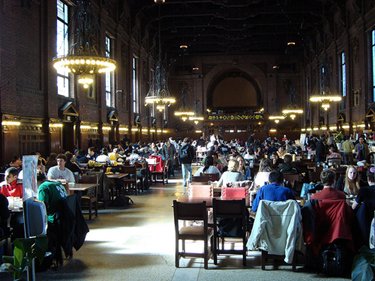
Yale’s University Commons, the freshman dining hall
William Deresiewicz criticizes American elite education from what might almost be a conservative perspective, but in the end he thinks the answer has to be a Utopia in which “you don’t have to go to the Ivy League, or any private college, to get a first-rate education.” Good luck with that, Bill.
If there is one idea, above all, through which the concept of social responsibility is communicated at the most prestigious schools, it is “leadership.†“Harvard is for leaders,†goes the Cambridge cliché. To be a high-achieving student is to constantly be urged to think of yourself as a future leader of society. But what these institutions mean by leadership is nothing more than getting to the top. Making partner at a major law firm or becoming a chief executive, climbing the greasy pole of whatever hierarchy you decide to attach yourself to. I don’t think it occurs to the people in charge of elite colleges that the concept of leadership ought to have a higher meaning, or, really, any meaning.
The irony is that elite students are told that they can be whatever they want, but most of them end up choosing to be one of a few very similar things. As of 2010, about a third of graduates went into financing or consulting at a number of top schools, including Harvard, Princeton, and Cornell. Whole fields have disappeared from view: the clergy, the military, electoral politics, even academia itself, for the most part, including basic science. It’s considered glamorous to drop out of a selective college if you want to become the next Mark Zuckerberg, but ludicrous to stay in to become a social worker. “What Wall Street figured out,†as Ezra Klein has put it, “is that colleges are producing a large number of very smart, completely confused graduates. Kids who have ample mental horsepower, an incredible work ethic and no idea what to do next.†…
Let’s not kid ourselves: The college admissions game is not primarily about the lower and middle classes seeking to rise, or even about the upper-middle class attempting to maintain its position. It is about determining the exact hierarchy of status within the upper-middle class itself. In the affluent suburbs and well-heeled urban enclaves where this game is principally played, it is not about whether you go to an elite school. It’s about which one you go to. It is Penn versus Tufts, not Penn versus Penn State. It doesn’t matter that a bright young person can go to Ohio State, become a doctor, settle in Dayton, and make a very good living. Such an outcome is simply too horrible to contemplate.
Deresiewicz is right and he is also wrong.
Elite culture in America always worshipped money and success. What is different today is that elite culture no longer respects its past or feels any meaningful connection to the rest of the country or the rest of society, except for recognized victims groups, patronage of which is useful for credentialing of the elite.
He’s right that race-based affirmative action is silly, and efforts at egalitarianism ought to be based on family finances and geographic representation. But, he fails to recognize that the education of national elites is not, in the end, about leveling. It is about building a leadership class, and our problem today is that American society has lost touch with its own identity and has replaced everything including conservation and transmssion of culture and paideia itself with left-wing power games based upon ressentiment.
16 May 2014
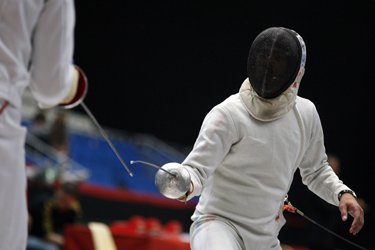
Fox News reports that hoplophobic insanity has reached far out into the Heartland.
Fencing, an Olympic sport sponsored by more than 30 NCAA schools, involves two athletes engaging in what is effectively a sword fight with a foil, saber, or épée. The equipment is blunted and does not have any actual blades or sharp tips. Unfortunately, for the newly-formed club fencing team at North Dakota State University, fencing equipment counts as a weapon, and the club has been barred from practicing on campus.
Naturally, the club members and their coach are not thrilled about this decision:
“The current interpretation of the non-weapon policy in NDSU…understands our fencing equipment as weapons,” says the club’s coach Enrique Alvarez.
19 Jan 2014
A takeoff of Gilbert & Sullivan’s “Modern Major General” by the student choir at Simon Fraser University.
xkcd does the lyrics.
04 Nov 2013

When we get up in the morning recently we’ve been finding the first frosts of the season here on the farm in Central Pennsylvania. I looked out the window this morning and the opening lines of the old poem came into my head.
“James Whitcomb Riley,” I thought, but I wasn’t positive that I was right, and I couldn’t remember any of it after “the struttin’ turkey-cock.”
When I looked it up, I found that I had indeed remembered the name of the poet rightly. It was James Whitcomb Riley (1853–1916).
Imagine a time in America when you could become rich and famous delivering readings all over the country and at major universities of poetry written in rustic American dialect.
—————————————-
“When the Frost is on the Punkin”
WHEN the frost is on the punkin and the fodder’s in the shock,
And you hear the kyouck and gobble of the struttin’ turkey-cock,
And the clackin’ of the guineys, and the cluckin’ of the hens,
And the rooster’s hallylooyer as he tiptoes on the fence;
O, it’s then the time a feller is a-feelin’ at his best,
With the risin’ sun to greet him from a night of peaceful rest,
As he leaves the house, bareheaded, and goes out to feed the stock,
When the frost is on the punkin and the fodder’s in the shock.
They’s something kindo’ harty-like about the atmusfere
When the heat of summer’s over and the coolin’ fall is here—
Of course we miss the flowers, and the blossoms on the trees,
And the mumble of the hummin’-birds and buzzin’ of the bees;
But the air’s so appetizin’; and the landscape through the haze
Of a crisp and sunny morning of the airly autumn days
Is a pictur’ that no painter has the colorin’ to mock—
When the frost is on the punkin and the fodder’s in the shock.
The husky, rusty russel of the tossels of the corn,
And the raspin’ of the tangled leaves as golden as the morn;
The stubble in the furries—kindo’ lonesome-like, but still
A-preachin’ sermuns to us of the barns they growed to fill;
The strawstack in the medder, and the reaper in the shed;
The hosses in theyr stalls below—the clover overhead!—
O, it sets my hart a-clickin’ like the tickin’ of a clock,
When the frost is on the punkin and the fodder’s in the shock.
Then your apples all is gethered, and the ones a feller keeps
Is poured around the cellar-floor in red and yaller heaps;
And your cider-makin’s over, and your wimmern-folks is through
With theyr mince and apple-butter, and theyr souse and sausage too!…
I don’t know how to tell it—but ef such a thing could be
As the angels wantin’ boardin’, and they’d call around on me—
I’d want to ‘commodate ’em—all the whole-indurin’ flock—
When the frost is on the punkin and the fodder’s in the shock.
—————————————-
In my day, 50 years ago, elementary school English instruction included memorizing lots of old chestnut poems like this from standard reader anthologies. From what I understand, the educational powers-that-be have since concluded that memorizing poetry is bad for children and they have moved in a supposedly more creative and spontaneous direction.
It seem a pity. There was a time when the likes of Longfellow, Whittier, and Riley were part of a univerally-shared American culture. What they seem to be sharing today are a collection of accusatory sob stories, all about slavery, discrimination, and just how mean everyone was to today’s privileged victim groups in the wicked American past. “The kyouck and gobble of the struttin’ turkey-cock” has given way to left-wing agitprop.
/div>

Feeds
|