Category Archive 'Education'
17 Jun 2012


Sebastian Thrun on a recent news broadcast
Maybe there is a solution for the problem of out-sized tuition costs from elite universities which leave graduates hundreds of thousands of dollars in debt.
Andy Kessler, in the Wall Street Journal, describes what happened when a Stanford Computer Science professor last year decided to offer an Artificial Intelligence course over the Internet for free.
[Sebastian Thrun was] [f]rustrated that his (and fellow Googler Peter Norvig’s) Stanford artificial intelligence class only reached 200 students, they put up a website offering an online version. They got few takers. Then he mentioned the online course at a conference with 80 attendees and 80 people signed up. On a Friday, he sent an offer to the mailing list of a top AI association. On Saturday morning he had 3,000 sign-ups—by Monday morning, 14,000.
In the midst of this, there was a slight hitch, Mr. Thrun says. “I had forgotten to tell Stanford about it. There was my authority problem. Stanford said ‘If you give the same exams and the same certificate of completion [as Stanford does], then you are really messing with what certificates really are. People are going to go out with the certificates and ask for admission [at the university] and how do we even know who they really are?’ And I said: I. Don’t. Care.”
In the end, there were 160,000 people signed up, from every country in the world, he says, except North Korea. Rather than tape boring lectures, the professors asked students to solve problems and then the next course video would discuss solutions. Mr. Thrun broke the rules again. Twenty-three thousand people finished the course. Of his 200 Stanford students, 30 attended lectures and the other 170 took it online. The top 410 performers on exams were online students. The first Stanford student was No. 411.
Mr. Thrun’s cost was basically $1 per student per class. That’s on the order of 1,000 times less per pupil than for a K-12 or a college education—way more than the rule of thumb in Silicon Valley that you need a 10 times cost advantage to drive change.
So Mr. Thrun set up a company, Udacity, that joins many other companies attacking the problem of how to deliver the optimal online education. “What I see is democratizing education will change everything,” he says.
16 May 2012
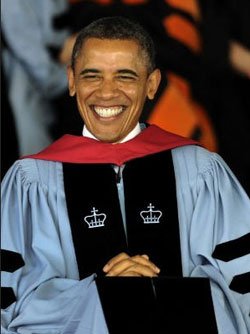
Dan Greenfield describes the symbiotic relationship of three key manifestations of modernity.
Universalizing college has not universalized education; it has not made us a better educated country, only a dumber one. Universal education has led to dumbed-down education and meaningless degrees. The only way we could keep moving more and more students up the ladder was by making the ladder as short as possible. Promotion, populist education and educators who barely knew more than the students have taken care of the rest.
A college degree was once a mark of distinction, now it’s a checkmark even for jobs that don’t have any innate reason for requiring it, and fortunes have been spent by government and students just to “stay in place” with the jobs of yesterdays high school graduates going to tomorrow’s college grads.
The primary purpose of a degree in many fields is to provide demonstrable proof to prospective employers that you aren’t an idiot. A high school degree once served that purpose. Now not even a college degree does. But with a surplus of job-seekers, it’s a useful way to winnow down the stack of applications to people who can analyze the heteronormative subtext of a detergent commercial and have few options for employment because of their massive student loan debt.
Treating college as the new high school hasn’t benefited students who waste four years of their lives and pick up staggering debts which make it harder for them to buy homes and start families, but it has benefited the liberal arts infrastructure, which, despite the liberal spin, is just as good at handing out useless degrees with no career path as any for-profit college. And it has benefited the Democratic Party, which rightly sees college campuses as recruitment grounds and liberal-voter-training seminars. …
Manhattan, home to Barnard, its sibling Columbia, NYU, Pace, and dozens of others, has one leading line of work, the restaurant business. The restaurant business doesn’t require a degree, just the willingness of pretty white people with student debt to wait tables at below minimum wage, and of some of the city’s three million illegal aliens to work illegally in the back. The city used to make things, now it makes sandwiches for Chinese tourists going to see a Disney musical on Broadway. Students dissatisfied with the low wages are, according to the erratically reliable New York Post, working at strip clubs. Fidel Castro boasted, that in Cuba, even the prostitutes have university degrees. Adopting the socialist degrees for everyone approach means we can now say the same thing.
Hat tip to Vanderleun.
05 Feb 2012

Patrick Witt
The original story seemed straight out of Owen Johnson or Burt L. Standish‘s school stories: Yale’s record-breaking quarterback forced to choose between the interview that could win him a Rhodes Scholarship and playing for Yale against Harvard in The Game, turns his back on dreams of Oxford and dons his uniform to take the field for dear old Yale.
The denouement in which Harvard proceeded to crush the Bulldogs 45-7 seemed a sufficiently inglorious return to ordinary reality, but the Kindly Ones were not finished with Patrick Witt and Yale.
The New York Slimes, last week, published a story based on information from anonymous sources (apparently from within the administration of Yale itself), flagrantly violating that institution’s confidentiality policies, alleging that Witt’s Rhodes application had been compromised by an “informal” sexual assault charge made against Witt in September by another student. The article went on to detail a couple of minor brushes with the law on the Yale senior’s record, hinting darkly at a pattern of criminality on the part of the Yale senior.
The New York Times’ decision to destroy a college senior’s personal reputation by elevating an anonymous allegation, unsupported by any evidence and purveyed by a secondary layer of anonymous sources, to national news provoked both astonishment from ESPN and well-deserved indignation from the Wall Street Journal.
What the Times’ smear article really represents is a shocking case of toxic spillover from the radical left-wing head of the Obama Administration’s Department of Education Office for Civil Rights (OCR), Russlyn Ali‘s personal campaign to reinvigorate Title IX Anti-Discrimination enforcement on American campuses.
Her approach amounted to nothing less than arm-twisting university administrations to participate in a federally-required witch hunt against “sexual harassment,†with sexual harassment defined in the broadest possible terms to include “verbal, nonverbal, or physical conduct†in any fashion connected with sex which is “unwelcome†to someone or anyone, and asserting that harassing conduct in general may create “a hostile environment†anytime the conduct is deemed “sufficiently serious†as to interfere with some student’s ability to participate in or benefit from the school’s program.
Russlyn Ali’s notorious “Dear Colleague” letter of 4 April 2011 essentially mandates new grievance procedures, processes, and tribunals, specifically reduces standards of proof, and threatens “appropriate remedies” for noncompliance including both withdrawal of all forms of federal funding and assistance and lawsuits by the Justice Department.
The Obama Administration’s Education Department mandates on-campus inquisitions into a supposititious pattern of nation-wide victimization of female students by sexual harassment and assault. Patrick Witt, a white male member of Yale’s Delta Kappa Epsilon fraternity, ideally fits the favored profile stereotype of male harassers and assaulters. These days, a politically incorrect smart remark or an unwelcome date request can be construed as a punishable offense. Who knows who accused Witt of exactly what or why? We can, I think, tell that the charge did not rise to what we usually think of as a crime since no police complaint was made. He hasn’t been arrested or charged with any crime. The assault the Times reported was clearly one of the notional assaults prosecutable only in the kind of jurisdictions, like our university campuses, successfully annexed by the radical left, where justice consists of whatever Russlyn Ali says it is.
30 Jan 2012

Cheyenne, the author’s daughter.
Lesbian pagan Amy Phillips testifies that a conservative Catholic school saved her daughter, after the public high school experience had left her suicidal.
02 Jan 2012

The Economist explains why universities admit enormously more students to doctorate programs than will ever find jobs in their fields.
[U]niversities have discovered that PhD students are cheap, highly motivated and disposable labour. With more PhD students they can do more research, and in some countries more teaching, with less money. A graduate assistant at Yale might earn $20,000 a year for nine months of teaching. The average pay of full professors in America was $109,000 in 2009—higher than the average for judges and magistrates.
Indeed, the production of PhDs has far outstripped demand for university lecturers. In a recent book, Andrew Hacker and Claudia Dreifus, an academic and a journalist, report that America produced more than 100,000 doctoral degrees between 2005 and 2009. In the same period there were just 16,000 new professorships. Using PhD students to do much of the undergraduate teaching cuts the number of full-time jobs. Even in Canada, where the output of PhD graduates has grown relatively modestly, universities conferred 4,800 doctorate degrees in 2007 but hired just 2,616 new full-time professors. Only a few fast-developing countries, such as Brazil and China, now seem short of PhDs.
In research the story is similar. PhD students and contract staff known as “postdocsâ€, described by one student as “the ugly underbelly of academiaâ€, do much of the research these days. There is a glut of postdocs too. Dr Freeman concluded from pre-2000 data that if American faculty jobs in the life sciences were increasing at 5% a year, just 20% of students would land one. In Canada 80% of postdocs earn $38,600 or less per year before tax—the average salary of a construction worker. The rise of the postdoc has created another obstacle on the way to an academic post. In some areas five years as a postdoc is now a prerequisite for landing a secure full-time job.
These armies of low-paid PhD researchers and postdocs boost universities’, and therefore countries’, research capacity. Yet that is not always a good thing. Brilliant, well-trained minds can go to waste when fashions change. The post-Sputnik era drove the rapid growth in PhD physicists that came to an abrupt halt as the Vietnam war drained the science budget. Brian Schwartz, a professor of physics at the City University of New York, says that in the 1970s as many as 5,000 physicists had to find jobs in other areas.
My old Philosophy professor, John Niemeyer Findlay, as a young man became infatuated with Buddhism, and wanted to take his doctorate in Sanskrit and go on to work on Buddhist sutras. His advisor at Balliol (Findlay was a Rhodes Scholar from South Africa) listened patiently, as Findlay described his career ambitions, looked at him coldly, and observed: “Mr. Findlay, there is but one single chair in Sanskrit in Great Britain, and I occupy it.” Findlay changed his subject to Philosophy.
At places like Yale, it is all but impossible to move from the junior faculty to the senior faculty. Full professors hired by Yale are all big names. You would have a better chance simply sitting at home and devoting your energy to writing the Great Big Book. If you pull it off, major universities will beat a path to your door. If you are not going to be able to write the Great Big Book, you will, at best, wind up teaching a rudimentary version of your subject at some dreadfully obscure facility in a remote fly-over location.
28 Dec 2011

Amy Chua, in the Wall Street Journal on Saturday, explained that her tiger parenting involved no interference with her kids when they are at college. That is very much the opposite of the father-in-law’s parents’ early 1940s approach. They dictated his major at Yale, and even told him what sports he could pursue.
What I really liked in Amy Chua’s piece, though, was this story:
Here’s an example of real tiger parenting for you. When I was 15, my father, a professor of chaos theory at Berkeley, took our whole family with him to Europe for his sabbatical year. For one semester, he threw my sisters and me into a local public school in Munich.
When I mentioned to him that we didn’t speak any German and couldn’t understand the teachers, he told me to check out some language books from the library, and reminded me that mathematics and science employ universal symbols. “This is an opportunity,” he said. “Make the most of it.” It ended up being one of the best years of my life.
No wonder she wound up a professor at Yale Law with that father.
30 Nov 2011

The goofballs running the Air Force Academy spent $80,000 to construct an outdoor circle of boulders around a propane-fueled fire pit to accommodate the spiritual needs of infinitesimally small numbers of cadets self-described as “pagans, Wiccans, druids, witches and followers of Native American faiths.”
What exactly people who like extinct religions and imaginary religions have in common is unclear, but the Air Force classifies all of the former schools of metaphysical opinion as “Earth-based,” whatever that means.
If one were a Grecian pagan worshipping Zeus or a Nordic pagan worshipping Odin, wouldn’t that make one’s religion “Sky-based?”
And why exactly do these nonconformist cadets need boulders and propane? Couldn’t they sit even more comfortably on ordinary teakwood lawn furniture? Is the Academy planning to supply pious pagan undergraduates with chickens, sheep, and the occasional ox to be sacrificed on major holy days? Will worshippers of Baal or Quetzalcoatl be immunized from the common law and permitted to sacrifice unwanted children or enemy combatants to their bloodthirsty divinities? Will the usual Academy prohibitions on sexual fraternization be suspended for Wiccans to conduct Black Masses? It’s not easy to see how the officials in Colorado Springs think they can conveniently draw the line once they’ve committed themselves to honoring diversity of opinion on such a scale.
LA Times story.
07 Nov 2011

Helmuth Karl Bernhard Graf von Moltke (1800-1891)
Ross Douthat, I think, rather laboriously reaches the same conclusion Count von Moltke reached long ago, but Douthat miscategorizes the offenders.
In hereditary aristocracies, debacles tend to flow from stupidity and pigheadedness: think of the Charge of the Light Brigade or the Battle of the Somme. In one-party states, they tend to flow from ideological mania: think of China’s Great Leap Forward, or Stalin’s experiment with Lysenkoist agriculture.
In meritocracies, though, it’s the very intelligence of our leaders that creates the worst disasters. Convinced that their own skills are equal to any task or challenge, meritocrats take risks than lower-wattage elites would never even contemplate, embark on more hubristic projects, and become infatuated with statistical models that hold out the promise of a perfectly rational and frictionless world. (Or as Calvin Trillin put it in these pages, quoting a tweedy WASP waxing nostalgic for the days when Wall Street was dominated by his fellow bluebloods: –Do you think our guys could have invented, say, credit default swaps? Give me a break! They couldn’t have done the math.–)
Field Marshall von Moltke conceptually divided his officers into a four part matrix:
— Smart & Lazy: I make them my Commanders because they make the right thing happen but find the easiest way to accomplish the mission.
— Smart & Energetic: I make them my General Staff Officers because they make intelligent plans that make the right things happen.
— Dumb & Lazy: There are menial tasks that require an officer to perform that they can accomplish and they follow orders without causing much harm
— Dumb & Energetic: These are dangerous and must be eliminated. They cause thing to happen but the wrong things so cause trouble.
In which category, do Ross Douthat’s meritocrats really belong? It seems obvious to me.
Douthat has the precise same problem our contemporary “meritocracy” has: mistaking credentials and narrowly focused technical expertise for intelligence. In reality, the meritocratic system of education rewards energy and proficiency in areas requiring certain kinds of intellectual ability almost entirely divorced from wisdom, integrity, and good judgment. What our system of education characteristically produces are skilled sophists and opportunists, most conspicuously ingenious in conformity. It is a system designed to promote the energetic but stupid.
01 Nov 2011

Kenneth Anderson penetrates through the general confusion about what the Occupy Wall Street protests are all about and explains that what we see is the indignation of the low-end intellectual clerisy left behind by more successful representatives of the same class.
The problem the New Class faces at this point is the psychological and social self-perceptions of a status group that is alienated (as we marxists say) from traditional labor by its semi-privileged upbringing — and by the fact that it is actually, two distinct strands, a privileged one and a semi-privileged one. It is, for the moment, insistent not just on white-collar work as its birthright and unable to conceive of much else. It does not celebrate the dignity of labor; it conceived of itself as existing to regulate labor. So it has purified itself to the point that not just any white-collar work will do. It has to be, as Michelle Obama instructed people in what now has to be seen as another era, virtuous non-profit or government work. Those attitudes are changing, but only slowly; the university pipelines are still full of people who cannot imagine themselves in any other kind of work, unless it means working for Apple or Google. …
The lower tier is in a different situation and always has been. It is characterized by status-income disequilibrium, to borrow from David Brooks; it cultivates the sensibilities of the upper tier New Class, but does not have the ability to globalize its rent extraction. The helping professions, the professions of therapeutic authoritarianism (the social workers as well as the public safety workers), the virtuecrats, the regulatory class, etc., have a problem — they mostly service and manage individuals, the client-consumers of the welfare state. Their rents are not leveraged very much, certainly not globally, and are limited to what amounts to an hourly wage. The method of ramping up wages, however, is through public employee unions and their own special ability to access the public-private divide. But, as everyone understands, that model no longer works, because it has overreached and overleveraged, to the point that even the system’s most sympathetic politicians understand that it cannot pay up.
The upper tier is still doing pretty well. But the lower tier of the New Class — the machine by which universities trained young people to become minor regulators and then delivered them into white collar positions on the basis of credentials in history, political science, literature, ethnic and women’s studies — with or without the benefit of law school — has broken down. The supply is uninterrupted, but the demand has dried up. The agony of the students getting dumped at the far end of the supply chain is in large part the OWS. …
The OWS protestors are a revolt — a shrill, cri-de-coeur wail at the betrayal of class solidarity — of the lower tier New Class against the upper tier New Class. It was, after all, the upper tier New Class, the private-public finance consortium, that created the student loan business and inflated the bubble in which these lower tier would-be professionals borrowed the money. It’s a securitization machine, not so very different from the subprime mortgage machine. The asset bubble pops, but the upper tier New Class, having insulated itself and, as with subprime, having taken its cut upfront and passed the risk along, is still doing pretty well. It’s not populism versus the bankers so much as internecine warfare between two tiers of elites.
This one is a must read.
Anderson is perfectly correct. Just as in places like Egypt and Tunisia, the penchant for empire-building on the part of the Academic industry combined with the general recognition of university education as the path to success and security led the United States to run through a vastly over-inflated system of ersatz higher education a large population with resulting delusions of self importance and entitlement and no means of satisfying them. Naturally, they think the system is unjust. Those other guys, over there, they have money and power, and we, the purer, nobler spirits, who majored in Afro-American Musical Traditions or Gender Inequity Studies are working in Starbucks. It’s so not fair! Rage against the Machine!
Hat tip to Megan McArdle.
25 Oct 2011

Bookworm saw all the Powerbooks and iPads buzzing down at Occupy Wall Street, and reflected that these young people’s problem doesn’t consist of material poverty in the traditional sense. They were badly educated and their problem is intellectual and moral poverty combined with a weak grasp of reality.
[T]here’s the sense of poverty created by utterly ludicrous expectations. We promised these kids that they were all “good enough, smart enough and, gosh darn it!, that everyone would like them.†We promised them that they were all number one, and that they would never need to make any actual effort to achieve that blue ribbon status. We taught them, through MTV and computer games, that a 3 minute attention span is sufficiently long to be awesomely cool and win the game. And, God help us, we taught them that a Womyn’s Studies, or Africana Studies, or GLBT Studies, or Oppressed People’s degree from some big name university would assure them the kind of job that would enable them to pay off $25,000 or $100,000 or even $250,000 in student loans. We, the older generation, created this wealth of stupidity.
These young people also suffer from a vast intellectual and moral poverty. One of the things that shines through when we interview the people taking to the streets is that so many are woefully ignorant, and that they wallow in a sea of relativism that allows for no morality other than that gained by intense navel gazing. They are the antithesis of the original American revolutionaries, whose leaders were men of exceptional erudition and thoughtfulness, and whose followers knew at the very least their Bible and Pilgrim’s Progress. Revolutionaries of old were shaped by philosophy, known science, literature, practical life experience, and a deep sense of morality and justice. Today’s little park piddlers are shaped by an aching sense of unfairness, a terrible fear of human-kind (that would be the AGW shtick), and a morality shaped by Oprah and whichever fabulously rich Hollywood Leftist happens to grab the microphone on any given day.
These self-styled 99%-ers are not poor, not by any known standard, either today or in the history of the world. They are intellectually and emotionally bereft, but otherwise awash in material benefits.
28 Aug 2011

Joseph Epstein finds in the recently published Cambridge History of the American Novel a perfect demonstration of exactly what has happened to university English departments in recent decades and thinks all this probably has something to do with the percentage of students majoring in English having been roughly cut in half over the same period. a perfect demonstration of exactly what has happened to university English departments in recent decades and thinks all this probably has something to do with the percentage of students majoring in English having been roughly cut in half over the same period.
Only 40 or 50 years ago, English departments attracted men and women who wrote books of general intellectual interest and had names known outside the academy—Perry Miller, Aileen Ward, Walter Jackson Bate, Marjorie Hope Nicolson, Joseph Wood Krutch, Lionel Trilling, one could name a dozen or so others—but no longer. Literature, as taught in the current-day university, is strictly an intramural game.
This may come as news to the contributors to “The Cambridge History of the American Novel,” who pride themselves on possessing much wider, much more relevant, interests and a deeper engagement with the world than their predecessors among literary academics. Biographical notes on contributors speak of their concern with “forms of moral personhood in the US novels,” “the poetics of foreign policy,” and “ecocriticism and theories of modernization, postmodernization, and globalization.”
Yet, through the magic of dull and faulty prose, the contributors to “The Cambridge History of the American Novel” have been able to make these presumably worldly subjects seem parochial in the extreme—of concern only to one another, which is certainly one derogatory definition of the academic. These scholars may teach English, but they do not always write it, at least not quite. A novelist, we are told, “tasks himself” with this or that; things tend to get “problematized”; the adjectives “global” and “post”-this-or-that receive a good workout; “alterity” and “intertexuality” pop up their homely heads; the “poetics of ineffability” come into play; and “agency” is used in ways one hadn’t hitherto noticed, so that “readers in groups demonstrate agency.” About the term “non-heteronormativity” let us not speak.
These dopey words and others like them are inserted into stiffly mechanical sentences of dubious meaning. “Attention to the performativity of straight sex characterizes . . . ‘The Great Gatsby’ (1925), where Nick Carraway’s homoerotic obsession with the theatrical Gatsby offers a more authentic passion precisely through flamboyant display.” Betcha didn’t know that Nick Carraway was hot for Jay Gatsby? We sleep tonight; contemporary literary scholarship stands guard.
“The Cambridge History of the American Novel” is perhaps best read as a sign of what has happened to English studies in recent decades. Along with American Studies programs, which are often their subsidiaries, English departments have tended to become intellectual nursing homes where old ideas go to die. If one is still looking for that living relic, the fully subscribed Marxist, one is today less likely to find him in an Economics or History Department than in an English Department, where he will still be taken seriously. He finds a home there because English departments are less concerned with the consideration of literature per se than with what novels, poems, plays and essays—after being properly X-rayed, frisked, padded down, like so many suspicious-looking air travelers—might yield on the subjects of race, class and gender. “How would [this volume] be organized,” one of its contributors asks, “if race, gender, disability, and sexuality were not available?”
02 Jul 2011
Arnold Kling and Nick Schulz, in the latest National Affairs, discuss how government intervention has excluded market mechanisms from regulating the operations of health care and education, the two most rapidly growing and influential sectors of the current American economy.
The commanding heights of our economy today are not heavy manufacturing, energy, and transportation. They are, rather, education and health care. These are our foremost growth sectors — the ones most central to employment and consumption; the ones that, increasingly, drive our economy. And it is in precisely these two sectors that the case for extensive government intervention and planning, if not outright control, is dominant — and becoming ever more so. …
If it were true only that health care and education are increasingly important sectors of our economy, there would be little cause for concern. Indeed, societies ought to desire economies that are strong and flexible enough to hum along as new technologies and other developments cause industries within them to rise and fall. The problem, rather, is that both health care and education are increasingly government-dominated industries. And this domination produces two ill effects that exacerbate the changes these sectors are already undergoing: Government’s influence artificially increases the demand for health care and education (by significantly subsidizing both), and it makes both sectors even less efficient than they would be otherwise (by heavily regulating them and shielding them from market forces). …
[I]n the cases of health care and education — in large part because of the dominance of government in these sectors — the prices of various “features” are often barely related to consumer preferences. With much of health-care and education spending paid for by third parties (and ultimately subsidized by government), consumers generally do not make decisions based on perceived relative value. The medical patient, instead of asking which medical procedure offers the greatest value, asks only whether the recommended procedure will be covered by insurance — a decision made by insurance-company or government bureaucrats, who have little sense of what is most important to the patient. The parents of a student in an elementary school are not responsible for choosing the school’s teaching methods; as “consumers,” they have no say in — and indeed, no way of knowing — whether the costly programs they pay for with their tax dollars are in fact producing good “value” in the form of their child’s education.
The result is that, in the sectors of education and health care, the preferences of policymakers — not of consumers — become the driving economic forces. And as these sectors become the new commanding heights, policymakers — rather than consumers and producers — will come to dominate more and more of our nation’s economic life.
Under these circumstances, the supposed inadequacy of market economics will become a self-fulfilling prophecy. Markets can work in education and health care, but only if governments allow them to. This means that, for the champions of free enterprise, introducing market principles and mechanisms into health care and education must become a top priority in the years ahead.
Read the whole thing.
Hat tip to John C. Meyer.
/div>
Feeds
|



