It’s amazingly easy to exploit the community of bedwetting holier-than-thous, you can even mock their stupidity while getting them to re-affirm all of it by supporting you. Follow the frog, wet ends, he’s more intelligent and better suited to survive than you are.
Hat tip to poor crying-his-eyes-out-over-the Obama-implosion Andrew Sullivan.
Western Outdoor News: COMMISSION PRESIDENT CELEBRATES A SUCCESSFUL HUNT – California Fish and Game commissioner Dan W. Richards travelled deep into the wicked terrain of Idaho’s Flying B Ranch to fulfill a long-held goal. “It was the most physically exhausting hunt of my lifetime. Eight hours of cold weather hiking in very difficult terrain. I told the guides I appreciated the hard work. They were unbelievably professional, first class all the way,†he said. Richards said he took the big cat over iron sights using a Winchester Centennial lever action .45 carbine. Asked about California’s mountain lion moratorium, Richards didn’t hesitate. “I’m glad it’s legal in Idaho.â€
The LA Times reports that the president of the California Fish and Game Commission has been successfully hounded out of office by the usual West Coast crowd of left-wing extremists for the outrage of legally taking a trophy mountain lion on a hunt in Idaho. Residents of California have been regularly stalked, occasionally mauled, and even killed and eaten by mountain lions in unprecedented numbers of incidents since hunting lions in the Golden State was banned by whacko-supported initiative in 1990.
The California Fish and Game Commission was created a century ago (1909) by sportsmen to manage and regulate the state’s wildlife resources. Its operations and programs are funded by license fees and taxes on sporting goods paid exclusively by hunters and fishermen.
But, in California today, the tyranny of the fruits-and-nuts supporters of the democrat party is so far-reaching, their intolerance and bigotry concerning other people’s lifestyles and convictions so great, that the president of the state Fish and Game Commission has been hounded out office by a six-month-long campaign of vilification based on his being guilty of legally hunting!
Daniel W. Richards was replaced as president of the California Fish and Game Commission on Wednesday, seven months after he sparked a storm of controversy by killing a mountain lion during a hunt in Idaho.
Although the kill was legal in Idaho, California has outlawed the hunting of mountain lions for decades. More than 40 state legislators called for Richards to resign in March, saying he showed poor judgment in killing the cougar when the practice is opposed by most Californians.
At the time, Richards defiantly refused to resign from the commission, saying he had done nothing improper. Even though the commission voted to elect Commissioner Jim Kellogg as president Wednesday, Richards plans to remain on the commission until his term expires in January. …
[Michael] Sutton, an executive with the Audubon Society [who was at the same time elected Vice President of the Fish and Game Commission], said later that the killing of the lion and Richards’ comments defending it were factors in his decision to vote to replace Richards.
“It was pretty clear that Commissioner Richards had lost the confidence of the majority of the commission,” Sutton said. “Most of us feel it is inappropriate to use the presidency as a bully pulpit for your views.”
The president of the State Fish & Game Commission is supposed, in California, to be out of line when he uses his office to speak in favor of hunting.
The presidency and control of the commission will be passing out of the hands of the sportsmen who pay for it and into the hands of Environmentalist granola-crunching ideologues eager to implement new policies based on junk science, Animal Rights theories, and hostility to firearms and the field sports.
————————————-
The LA Weekly describes the politics of the situation:
[A]lthough Fish and Game commissioners haven’t explained specifically why they decided to vote Richards down from his throne today, it was clearly a symbolic move to kill the human who killed the beast.
“The president of the commission should be someone who has the confidence of a majority of his peers,” Mike Sutton, vice president, told the Mercury News leading up to the vote.
Richards was playing the feisty right-wing ideologue at the beginning of this battle, but he has since became strangely resigned to his ousting.
He looked on as the commission changed its own internal election policy in May so that they might replace Richards. And today, a Fish and Game Commission spokesman tells us that Richards himself took part in the unanimous vote to elect Commissioner Jim Kellogg as his replacement.
The ex-prez, appointed by Arnold Schwarzenegger (surprise, surprise) in 2008, will remain on the commission until his term ends in six months. But from there, he tells the Mercury News: “I think there is a zero chance that Jerry Brown will appoint me, so it doesn’t matter what I think. He has his hands full with shoplifters and other thugs in the Legislature.”
Pretty morbid, right? Let this be a lesson for all trigger-happy Republicans who dare to dream of swimming against California’s blue tide: We’ll eat your grin for dinner.
In the year 2012, the Lord came unto Noah, Who was now living in the USA and said:
“Once again, the earth has become wicked and over-populated, and I see the end of all flesh before me.”
“Build another Ark and save 2 of every living thing along with a few good humans.”
He gave Noah the blueprints, saying:
“You have 6 months to build the Ark before I will start the unending rain for 40 days and 40 nights.”
Six months later, the Lord looked down and saw Noah weeping in his yard – but no Ark.
“Noah!,” He roared, “I’m about to start the rain! Where is the Ark?”
“Forgive me, Lord,” begged Noah, “but things have changed.”
“I needed a Building Permit.”
“I’ve been arguing with the Coast Guard about the need for a sprinkler system.”
“My neighbors claim that I’ve violated the Zoning Regulations by building the Ark in my back garden and exceeding the height limitations. We had to go to the Planning Committee for a decision.”
“Then the Town Council and the Power Company demanded a shed load of money for the future costs of moving power lines and other overhead obstructions, to clear the passage for the Ark’s move to the sea. I told them that the sea would be coming to us, but they would hear nothing of it.”
“Getting the wood was another problem. There’s a ban on cutting local trees in order to save the Spotted Owl.”
“I tried to convince the environmentalists that I needed the wood to save the owls – but no go!”
“When I started gathering the animals the SPCA took me to court. They insisted that I was confining wild animals against their will. They argued the accommodations were too restrictive, and it was cruel and inhumane to put so many animals in
a confined space.”
“Then the Environmental Protection Agency ruled that I couldn’t build the Ark until they’d conducted an environmental impact study on your proposed flood.”
“I’m still trying to resolve a complaint with the Civil Rights Commission on how many minorities I’m supposed to hire for my building crew.”
“The Immigration and Naturalization Department is checking the Visa status of most of the people who want to work.”
“The trades unions say I can’t use my sons. They insist I have to hire only Union workers with Ark-building experience.”
“To make matters worse, the IRS seized all my assets, claiming I’m trying to leave the country illegally with endangered species.”
“So, forgive me, Lord, but it would take at least 10 years for me to finish this Ark.”
“Suddenly the skies cleared, the sun began to shine, and a rainbow stretched across the sky.”
Noah looked up in wonder and asked, “You mean you’re not going to destroy the world?”
“Darkling I listen; and, for many a time I have been half in love with easeful Death.â€
— John Keats
In Mother Jones, Clive Thompson describes with relish the coercive fantasies of a variety of leftist sophisters, economists, and calculators, who theorize on the ways and means to end the growth and expansion of the human population and economy, and who yearn for stagnation and retrenchment.
What would just a world be like? Thompson quotes Peter Alan Victor, a environmental sophister at the University of Toronto and a former senior economist at the World Bank named Herman Daly.
Americans would need to scale back our energy consumption to 1960s levels (assuming we stick to a predominantly fossil-fueled economy). Victor, for his part, points out that 1983 was the last year that “the world economy was just at the level of the capacity of the planet to support it.” Since then, of course, world population has exploded and global resources have dwindled even further.
Beyond these big-picture parameters, none of the experts has really crunched the numbers to envision what daily life might be like in a no-growth world—though they agree that it’s something people had better start thinking about.
For starters, they say, Western consumption rates would need to shrink disproportionately so that citizens of countries like India and El Salvador could enjoy a lifestyle upgrade. Why? The no-growthers argue that a world with fewer yawning inequities between the rich and poor would be more stable; but quite apart from that, their models require stabilizing world population, and raising the economic lot of the poor is a proven way to do that.
Given the shift in wealth needed to accomplish this, Americans would need to turn back the clock to well before 1983; in fact, we’d be pretty lucky even to find ourselves where we were in 1960—when the median family made $35,994 in today’s dollars (versus $61,932 in 2008).
Hardly the plenitude we’re accustomed to. Still, technological advances mean that your dollar buys a lot more than it did back then. For a couple of bucks, you can score a pocket calculator that does things it once took a million-dollar university machine to accomplish. “We’re better at making things now,” Victor says, so our living standards would be considerably higher than this figure suggests.
In a no-growth economy, as Daly points out, we would still consume new stuff—just at a much slower pace. People might need to develop a renewed appreciation for durable goods that require lots of labor to make but ultimately use fewer resources than their throwaway counterparts. We would also have to evolve away from “positional” consumption—feeling good because you possess something the Joneses don’t.
So maybe hipsters won’t be buying the latest iPhone every 12 monthsÂ. Or perhaps we’ll seek more fulfillment through activities with a lighter footprint—sports, music, hiking. The vexing reality is that the no-growth thinkers simply don’t know how things would shake out. We don’t have any realistic examples to learn from, after all. In the past, the only no-growth societies were agrarian or consisted of hunter-gatherers.
But these great minds are willing and eager to take us right back there. We need only surrender the necessary authority to credentialed experts in Environmental Witch-Doctory like themselves.
[Kaczynski] lists his occupation as “prisoner” and says his awards are “Eight life sentences, issued by the United States District Court for the Eastern District of California, 1998.”
It’s an update the alumni association now regrets.
“While all members of the class who submit entries are included, we regret publishing Kaczynski’s references to his convictions and apologize for any distress that it may have caused others,” the Harvard Alumni Association said in a statement Wednesday evening.
The alumni association said all class members, including Kaczynski, were invited to submit entries for the class report, distributed for reunion activities during commencement week.
The government spent at least $205,075 in 2010 to “translocate†a single bush in San Francisco that stood in the path of a $1.045-billion highway-renovation project that was partially funded by the economic stimulus legislation President Barack Obama signed in 2009.
“In October 2009, an ecologist identified a plant growing in a concrete-bound median strip along Doyle Drive in the Presidio as Arctostaphylos franciscana,†the U.S. Department of Interior reported in the Aug. 10, 2010 edition of the Federal Register. “The plant’s location was directly in the footprint of a roadway improvement project designed to upgrade the seismic and structural integrity of the south access to the Golden Gate Bridge.
“The translocation of the Arctostaphylos franciscana plant to an active native plant management area of the Presidio was accomplished, apparently successfully and according to plan, on January 23, 2010,†the Interior Department reported.
The bush—a Franciscan manzanita—was a specimen of a commercially cultivated species of shrub that can be purchased from nurseries for as little as $15.98 per plant. The particular plant in question, however, was discovered in the midst of the City of San Francisco, in the median strip of a highway, and was deemed to be the last example of the species in the “wild.â€
Prior to the discovery of this “wild†Franciscan manzanita, the plant had been considered extinct for as long as 62 years–extinct, that is, outside of people’s yards and botanical gardens. …
While the MOA did not detail all the costs for moving the bush, it did state that in addition to funding removal and transportation of the Franciscan manzanita, Caltrans agreed to transfer $79,470 to the Presidio Trust “to fund the establishment, nurturing, and monitoring of the Mother Plant in its new location for a period not to exceed ten (10) years following relocation and two (2) years for salvaged rooted layers and cuttings according to the activities outlined in the Conservation Plan.â€
Furthermore, Presidio Parkway Project spokesperson Molly Graham told CNSNews.com that the “hard removalâ€â€”n.b. actually digging up the plant, putting it on a truck, driving it somewhere else and replanting it–cost $100,000.
The MOA also stated that Caltrans agreed to “Transfer $25,605.00 to the Trust to fund the costs of reporting requirements of the initial 10-year period as outlined in the Conservation Plan.â€
The $100,000 to pay for the “hard removal,†the $79,470 to pay for the “establishment, nurturing and monitoring†of the plant for a decade after its “hard removal,†and the $25,605 to cover the “reporting requirements†for the decade after the “hard removal,†equaled a total cost of $205,075 for “translocating†this manzanita bush.
But those were not the only costs incurred by taxpayers on behalf of the bush. According to the MOA, other costs included:
–“Contract for and provide funding not to exceed $7,025.00 for initial genetic or chromosomal testing of the Mother Plant by a qualified expert to be selected at Caltrans’ sole discretion.†(MOA – Fran Man – 2009.pdf)
–“Contract for and fund the input, guidance, and advice of a qualified Manzanita expert on an as-needed basis to support the tending of the Mother Plant for a period not to exceed five (5) years, provided that said expert selection, retention and replacement at any point after hiring rests in the sole discretion of Caltrans.â€
“Provide funding not to exceed $5,000.00 to each of 3 botanical gardens (Strybing, UC, and Tilden) to nurture salvaged rooted layers and to monitor and report findings as outlined in the Conservation Plan.â€
–“Provide funding not to exceed $1,500.00 for the long-term seed storage of 300 seeds collected around the Mother Plant in November 2009 as outlined in the Conservation Plan.â€
The plant is now protected by a fence and its location is kept secret, in part because the Presidio Trust and the National Park Service fear that nature-lovers seeking to see the rare wild Manzanita might trample it to death.
It is a bit complicated. Hooker’s manzanita is a shrub indigenous to the San Franciso Bay Area with several subspecies. One of these subspecies, Franciscan manzanita, was thought to be “extinct in the wild.”
It, nonetheless, survived in cultivation in yards and gardens, and could be purchased from nurseries at modest prices.
Doubtless, the extinction “in the wild” of the subspecies specifically associated with San Francisco has a lot to do with the reduction of the extent of “the wild” in an intensely developed, densely populated urban center.
So, having found an example flourishing in what the authorities choose to define as the wild, those same authorities with the characteristic wisdom and fiscal responsibility concluded that pompous, heroic (and very costly) measures had to be taken to save the contextually-precious plant.
No one in authority noticed that all this was complete madness.
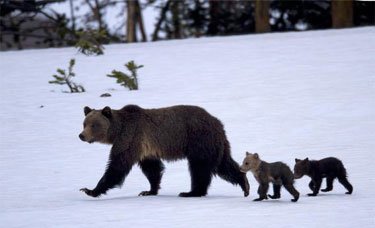
The female grizzly bear, referred to as the Wapiti sow, killed Brian Matayoshi on July 6, 2011 and then killed John Wallace on August 27, 2011, after officials declined to hunt the bear responsible. The Wapiti sow was finally trapped in late September and euthanized October 2nd after four days of forensic analysis and chin stroking.
Jessica Grose, in Slate, describes how the swift and hearty justice dealt out to man-killing grizzlies in simpler and less-grovelly-toward-Nature times has been replaced by a new intensely ethically conscientious regime that will only kill bears which are deemed to have behaved with “unnatural aggression” or which have been found to have eaten people.
In the bad old days, they knew what to do with man-killing bruins.
The first extensively documented death by grizzly within Yellowstone Park’s borders was the fatal mauling of 61-year-old government laborer Frank Welch in 1916. And the park’s first extensively documented judicial execution of a grizzly soon followed. Some historians suspect the bear that killed Welch was abnormally ill-tempered because his toes had been ripped off when he escaped from a trap in 1912. Whatever the bear’s motives, though, Welch’s fellow laborers decided that “Old Two Toes†deserved to die for his crimes. Men from the road camp where Welch had been working placed some edible garbage in front of a barrel filled with dynamite. When the bear began to eat, they blew it to smithereens.
That was how grizzlies were treated if they injured humans in the early days of Yellowstone: They were killed.
Not today. Today, when Ephraim or Ephraimina takes out a tax paying citizen, there is the equivalent of a judicial procedure. There are major exculpatory loopholes. And even totally guilty bears are put down reluctantly, as big, salty tears pour down the faces of the responsible officials.
Every bear is pwecious, you see.
The euthanization of the bear known as “the Wapiti sow†was the culmination of a series of horrifying events that had gripped Yellowstone for months, and alarmed rangers, visitors, and the conservation biologists tasked with keeping grizzly bears safe. In separate incidents in July and August, grizzlies had killed hikers in Yellowstone, prompting a months-long investigation replete with crime scene reconstructions and DNA analysis, and a furious race to capture the prime suspect. The execution of the Wapiti sow opens a window on a special criminal justice system designed to protect endangered bears and the humans who share their land. It also demonstrates the difficulty of judging animals for crimes against us. The government bear biologists who enforce grizzly law and order grapple with the impossibility of the task every day. In the most painful cases, the people who protect these sublime, endangered animals must also put them to death.
Whenever a grizzly bear commits a crime in the continental United States, Chris Servheen gets a call at his office at the University of Montana in Missoula. Servheen has been the Grizzly Bear Recovery Coordinator for the U.S. Fish and Wildlife Service for three decades. …
Before Servheen, Gunther, and their bear management colleagues could decide what to do, they’d need a lot more information. Was a grizzly bear in fact responsible for this second death? If so, which bear did the mauling? And what were the circumstances that led up to attack—was it provoked or had some hiker just been caught unaware? The answers to those questions would determine whether a precious animal would need to die. …
Wildlife biologists like Kerry Gunther help the park’s crime-scene investigators by speculating on a bear’s emotional state. Based on the evidence at hand, he tries to determine whether a given act of bear aggression might have been a natural behavior—the result of being startled while feeding on an elk carcass, for example, or seeing someone approaching her cubs. If a bear appears to have followed a hiker down the trail instead of backing off, or if it attacked campers while they were asleep, that would be more unusual—the result, perhaps of a deranged grizzly mind.
If you blunder into a bear that is thought to have attacked and killed you out of natural aggression (you violated that bear’s space, dude!) or via an impulse of self defense, that’s just too bad for you. The bear goes free, as long as he refrains from dining on your pitiable remains.
The authorities in question reluctantly draw the line at actual predation, simply because they are afraid of the public response to tolerating man-eaters in National Parks.
The zero-tolerance policy for man-eating bears invites an obvious question, though. Once a bear kills someone, whether it’s out of some wild-animal psychopathy or a natural inclination to defend her young, why wouldn’t she eat the corpse? Everyone agrees that it’s natural for grizzlies to eat carrion—they’re scavengers, after all. When I ask Servheen whether grizzlies can get “a taste for human blood”—whether a grizzly that starts eating people-meat will desire it endlessly—he dismisses the idea. “That’s for horror stories in movies,” he says. “Bears don’t get a taste for human blood. There’s no studies that show that.”
No studies show it, in part because every time a bear eats someone, they kill it. Not that it’s something that would ever be studied—biologists would never want to take the risk of keeping a bear that had eaten a person in the greater bear population. “We don’t want to test whether bears really get a taste for people,†Gunther explains. “The public wouldn’t appreciate us using them as subjects.” That’s for horror movies, but it seems like even the bear biologists think there might be some truth to the campfire legends.
Mark Steyn takes at look at America’s situation at the beginning of the New Year, and concludes that the welfare state is self-destructing, but the establishment elites would rather save the planet than balance the national books.
At the end of 2011, America, like much of the rest of the Western world, has dug deeper into a cocoon of denial. Tens of millions of Americans remain unaware that this nation is broke — broker than any nation has ever been. A few days before Christmas, we sailed across the psychological Rubicon and joined the club of nations whose government debt now exceeds their total GDP. It barely raised a murmur — and those who took the trouble to address the issue noted complacently that our 100 percent debt-to-GDP ratio is a mere two-thirds of Greece’s. That’s true, but at a certain point per capita comparisons are less relevant than the sheer hard dollar sums: Greece owes a few rinky-dink billions; America owes more money than anyone has ever owed anybody ever.
Public debt has increased by 67 percent over the last three years, and too many Americans refuse even to see it as a problem. For most of us, “$16.4 trillion†has no real meaning, any more than “$17.9 trillion†or “$28.3 trillion†or “$147.8 bazillion.†It doesn’t even have much meaning for the guys spending the dough: Look into the eyes of Barack Obama or Harry Reid or Barney Frank, and you realize that, even as they’re borrowing all this money, they have no serious intention of paying any of it back. That’s to say, there is no politically plausible scenario under which the 16.4 trillion is reduced to 13.7 trillion, and then 7.9 trillion, and eventually 173 dollars and 48 cents. At the deepest levels within our governing structures, we are committed to living beyond our means on a scale no civilization has ever done.
Our most enlightened citizens think it’s rather vulgar and boorish to obsess about debt. The urbane, educated, Western progressive would rather “save the planet,†a cause which offers the grandiose narcissism that, say, reforming Medicare lacks. So, for example, a pipeline delivering Canadian energy from Alberta to Texas is blocked by the president on no grounds whatsoever except that the very thought of it is an aesthetic affront to the moneyed Sierra Club types who infest his fundraisers. The offending energy, of course, does not simply get mothballed in the Canadian attic: The Dominion’s prime minister has already pointed out that they’ll sell it to the Chinese, whose Politburo lacks our exquisitely refined revulsion at economic dynamism, and indeed seems increasingly amused by it. Pace the ecopalyptics, the planet will be just fine: Would it kill you to try saving your country, or state, or municipality? …
What indeed? In September, the tenth anniversary of a murderous strike at the heart of America’s most glittering city was commemorated at a building site: The Empire State Building was finished in 18 months during a depression, but in the 21st century the global superpower cannot put up two replacement skyscrapers within a decade. The 9/11 memorial museum was supposed to open on the eleventh anniversary, this coming September. On Thursday, Mayor Bloomberg announced that there is “no chance of it being open on time.†No big deal. What’s one more endlessly delayed, inefficient, over-bureaucratized construction project in a sclerotic republic?
Barely had the 9/11 observances ended than America’s gilded if somewhat long-in-the-tooth youth took to the streets of Lower Manhattan to launch “Occupy Wall Street.†The young certainly should be mad about something: After all, it’s their future that got looted to bribe the present. As things stand, they’ll end their days in an impoverished, violent, disease-ridden swamp of dysfunction that would be all but unrecognizable to Americans of the mid–20th century — and, if that’s not reason to take to the streets, what is? Alas, our somnolent youth are also laboring under the misapprehension that advanced Western societies still have somebody to stick it to. The total combined wealth of the Forbes 400 richest Americans is $1.5 trillion. So, if you confiscated the lot, it would barely cover one Obama debt-ceiling increase. Nevertheless, America’s student princes’ main demand was that someone else should pick up the six-figure tab for their leisurely half-decade varsity of Social Justice studies. Lest sticking it to the Man by demanding the Man write them a large check sound insufficiently idealistic, they also wanted a trillion dollars for “ecological restoration.†Hey, why not? What difference is another lousy trill gonna make?
Underneath the patchouli and pneumatic drumming, the starry-eyed young share the same cobwebbed parochial assumptions of permanence as their grandparents: We’re gayer, greener, and groovier, but other than that it’s still 1950 and we’ve got more money than anybody else on the planet, so why get hung up about a few trillion here and a few trillion there? In a mere half century, the richest nation on earth became the brokest nation in history, but the attitudes and assumptions of half the population and 90 percent of the ruling class remain unchanged.
Yale’s Kroon Hall, a recently built, fantabulously expensive ecological Taj Mahal proves that Harvard is not unique. In that building in order to reduce tapwater usage, “Stormwater is collected from the roof and grounds and filtered through native aquatic plants. Wastewater collected from sinks and showers is added to the stormwater and used for all non-potable needs such as toilets and irrigation. Water demand is further reduced by the installation of low-flow plumbing and irrigation fixtures.”
James Delingpole referred recently to the immense difficulty sane people face in trying to resist an unstoppable bandwagon of do-gooders and reformers, brainwashed kids, powerful NGOs, sanctimonious corporations, and politicians all pushing the party-line of Enviromentalist stupidity. At American Thinker, Peter Wilson admires the colossal scale of resources the other side has at its disposal, and notes just how deeply entrenched the green priesthood is at one of our most prestigious universities.
Australian science writer Jo Nova estimates that since 1989 the U.S. government has spent $79 billion on global warming-friendly climate research. Nova notes that the “figure does not include money from other western governments, private industry, [or universities] and is not adjusted for inflation,” and yet even this partial sum is 3,500 times the $23 million spent by Exxon in the same period. Global warming alarmists however continue to accuse skeptics of being duped by disinformation from well-funded carbon polluters, while they seem incapable of recognizing the far greater funding that supports their own efforts.
Case in point: I attended a “Harvard Thinks Green” program last week, which promised “6 all-star environmental faculty, 6 big green ideas.” (According to the flyer, “Green is the new crimson.”) The most polemical of the six speakers was medical doctor Eric Chivian, a founder of the International Physicians for the Prevention of Nuclear War, the nuclear freeze group that won the 1985 Nobel Peace Prize. One of Chivian’s big green ideas: “legal restrictions on oil consumption.” Dr. Chivian lashed out at the evil Koch brothers, enunciating their middle initials as further evidence of their perfidy: “Charles G. Koch and David H. Koch,” who together with “vested interests” like Exxon-Mobil, have spent “tens of millions of dollars” on a “disinformation campaign,” aided by the likes of Rush Limbaugh.
Vested interests? Take a look in the mirror, Dr. Chivian. His speech came from the podium in Saunders Theatre, a sumptuous wood-paneled auditorium in H.H. Richardson’s Memorial Hall, a clubhouse for the 1% at Harvard University. Dr. Chivian earns his generous salary as Founder/Director of the Harvard Medical School’s Center for Health and the Global Environment, which is “designated an official ‘Collaborating Center’ of the United Nations Environment Programme.” The Center’s Corporate Council includes 3M, Baxter (pharmaceuticals & medical devices), Johnson & Johnson, and Siemens. These are some deep pockets and vested interests.
Looking further: The sponsor of the evening was the Harvard Office for Sustainability, which is staffed by fifteen full-time employees, holding graduate degrees in things like Public Administration and the Sociology of Religion/Gender Studies. They hold titles like: Manager, Sustainability Communications; Manager, Sustainability Engagement; Coordinator, Business and Finance Sustainability Engagement Program; or Coordinator, FAS Green Resource Efficiency Program.
A separate department called Green Building Services employs seven full-time employees and manages student volunteer teams at Harvard College, the Business School and the Law School.
Harvard students can apply for the following 10-hour-a-week internships: Sustainability Innovation Challenge Engagement Assistant, OFS Events and Sustainability Engagement Intern, Housing and Real Estate Design Internship, Greenhouse Gas Reduction Program Research Assistant, Green Skillet Team Leader, Green Skillet Assessor, Green Office Liaison and the Green Ribbon Commission Internship.
Over at the Graduate School of Design there’s the Sustainable Design program G(SD)2. And Harvard Business School has a Green Living Program, “a peer-to-peer education program” that…well, you get the idea.
These various activities are supported by the Harvard University Task Force on Greenhouse Gas (GHG) Emissions, commissioned by President Drew Faust, which is committed to reduce the University’s GHGs through 2016. In other words, these people will not be losing their jobs any time soon, no matter what happens at COP-18.
Reading this, I was reflecting that, if Jonathan Edwards and the other “New Light” enthusiasts of the mid-18th century Great Awakening had only taken care to arrange for the construction of exceptionally architecturally distinguished buildings to serve as centers for the study the personal experience of religious revelation and the penning of passionate sermons, and taken care to establish well-paid corps of special managers, communicators, coordinators, deans and interns, all devoted to intensifying man’s consciousness of his sinfulness, unworthiness, and dependence of Divine restraint, why, the emotionalist version of Congregationalism and Sunday hell-fire sermons about sinners in the hands of an angry God might never have gone out of fashion at Harvard and Yale at all.
The thing about both the Soviet Union and Adolf Hitler’s Germany was that the enemy was plain in view. We knew these guys were bad, they had black uniforms, they had swastikas, they had tanks – they were obviously the bad guys, they wanted to destroy us. What makes the modern environmental movement so dangerous is that it masks its intentions behind this cloak of cuddly, touchy feely, polar bear-hugging, Nobel Prize-winning righteousness. …
What could be nicer than trying to save those cuddly little polar bears from melting due to our wanton greed and selfishness? It gels with a sense that I think grew in the affluent ’90s, when people began asking themselves questions like, Shouldn’t there be limits to growth? You know, isn’t there more to life than consumption?
So, you have this alliance of ordinary people, of kids who’ve been brainwashed at school, of the big corporations which wanted to get in on the act by greenwashing their image, of powerful NGOs like Greenpeace and the World Wildlife Fund, of politicians wanting to be seen to take action in matters of public concerned. So what you have is this unstoppable bandwagon, all pushing this agenda based on the flimsiest of junk science.
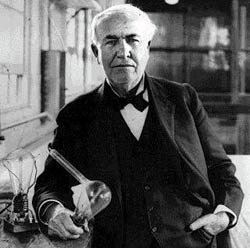
They saved your right to continue to use Thomas Edison’s incandescent light bulbs if you so choose. We won’t all have to sit in our living rooms bathed in the Orwellian florescent glare of the over-priced alternative bulbs favored by devotees of the modern cult of Gaia.
The shutdown-averting budget bill will block federal light bulb efficiency standards, giving a win to House Republicans fighting the so-called ban on incandescent light bulbs.
GOP and Democratic sources tell POLITICO the final omnibus bill includes a rider defunding the Energy Department’s standards for traditional incandescent light bulbs to be 30 percent more energy efficient.
DOE’s light bulb rules — authorized under a 2007 energy law authored signed by President George W. Bush — would start going into effect Jan. 1. The rider will prevent DOE from implementing the rules through Sept. 30.
But Democrats said they could claim a “compromise” by adding language to the omnibus that requires DOE grant recipients greater than $1 million to certify they will upgrade the efficiency of their facilities by replacing any lighting to meet or exceed the 2007 energy law’s standards.
Fueled by conservative talk radio, Republicans made the last-ditch attempt to stop federal regulations from making their way into every Americans’ living room.
“There are just some issues that just grab the public’s attention. This is one of them,” said Rep. Greg Walden (R-Ore.). “It’s going to be dealt with in this legislation once and for all.”
Our self-appointed lords and masters on the left were not pleased.
White House… communications director Dan Pfeiffer [was] saying Wednesday that the House GOP plan would “undercut environmental protections.”
On Twitter, Senate Energy and Natural Resources Committee Chairman Jeff Bingaman (D-N.M.) wrote: “I strongly oppose that language. I hope it’s deleted from any final bill that we pass.â€
“This is just another poke in the eye,” said Rep. Jan Schakowsky (D-Ill.).