That clever Gerard van der Leun, despite being recently much too infatuated with the deep thinkers of the Alt Right trailer parks, sums up perfectly where we find ourselves right now.
The Moving Finger writes; and, having writ,
Moves on: nor all your Piety nor Wit
Shall lure it back to cancel half a Line,
Nor all your Tears wash out a Word of it.
and adds:
gives you the finger.
Then Gerard writes:
I watch the formal nomination with a growing feeling of special dread. I watch it with a kind of sardonic awe as Fox splits its screen in two and on the right I see someone from Ohio proclaiming their surreal votes while on the left some aging supermodel working for WeightWatchers proclaims “Bye-bye bellyfat!†And thus the rising surreality of our current reality washes over me and gives me a sick, sinking feeling. Not about Trump. Not about that at all. Just the feeling that returns and returns, that echoes and echoes, that repeats and repeats the careworn mantra, “Events are in the saddle and ride mankind.â€
Feeling the tectonic plates shift deep under the population….
Something moving deep in the mantle. Small tremors here, vibrations at slant there….
Like that movie with the burrowing monster worms roaming under the homes of men. Not the hellish island sized worms of Doom sifting sand mountains and devouring whole factories, but the smaller ones, the predators, the carnivores, the ones in the American grain, the ones that rise up and at most take down a Chevy with a couple of people in it as sandwich filling.
Over the passing months this saison en enfer fills me, more and more, with a kind of nameless dread regardless of the outcome. The more that I read from people who have it “all figured out†the more I feel that my only shelter is in staying stupid. Staying stupid and admitting that deep down I don’t have one single crisp clue as to what is really going on.
I have had the same feeling that, as it did before back when Gerard and I were young, History has begun to awaken, the foundations of everything have begun to move, change is happening, and soon it will be happening faster and with less civility than anyone could ever have imagined. No one is in charge, except the noisiest, the craziest, and the stupidest.
Jeffrey Tucker explains that the Trump Nationalist agenda is just another version of Socialism, and that the world has seen the rise of precisely this kind of nationalist socialism before.
The rise of Fascism and Nazism was not a reaction against the socialist trends of the preceding period,†wrote Hayek, “but a necessary outcome of those tendencies.†In Hayek’s reading, the dynamic works like this. The socialists build the state machinery, but their plans fail. A crisis arrives. The population seeks answers. Politicians claiming to be anti-socialist step up with new authoritarian plans that purport to reverse the problem. Their populist appeal taps into the lowest political instincts (nativism, racism, religious bigotry, and so on) and promises a new order of things under better, more efficient rule.
Hayek’s thesis is very similar to Mises’: that the greatest threat in the world today comes from a version of socialism — a rightist socialism — cobbled together in the name of fighting authoritarianism abroad and countering leftism at home. The road to serfdom, in Hayek’s view, is paved by a blind pursuit of unified nationhood and central planning in the name of national greatness. Or, to use today’s language, “making America great again.â€
Donald Trump, Bernie Sanders and Hillary Clinton agree on a lot, especially on the need to protect and enlarge state power. None of them accepts any principled limits on what the state may rightfully do to the individual. Even on big issues where one might think they disagree — healthcare, immigration, and control of lands by the federal government — their positions are more alike than different. …
Most of these candidates’ supporters don’t see it that way, of course. They imagine themselves to be rebels fighting power itself, however they want to define it: Wall Street, the party establishment, the paid-off politicians, the bureaucracy, the billionaires, the foreigners, the special interests, and so on.
But notice that neither Trump, Sanders, nor Clinton attacks government authority as such. Instead they aspire to use it and grow it for their purposes. “The conflict between the Fascist or National-Socialist and the older socialist parties must indeed very largely be regarded as the kind of conflict which is bound to arise between rival socialist factions,†Hayek wrote. “There was no difference between them about the question of it being the will of the state which should assign to each person his proper place in society.â€
As the campaign progress over 2015, the close relationship between right and left socialisms became more obvious. On the surface, Bernie Sanders and Donald Trump represent opposite extremes. But in their celebration of the nation state as the people’s salvation — their burning calls to overthrow the existing elites and replace them with a more intense form of top-down rule — they are morally indistinguishable, and equally un-American.
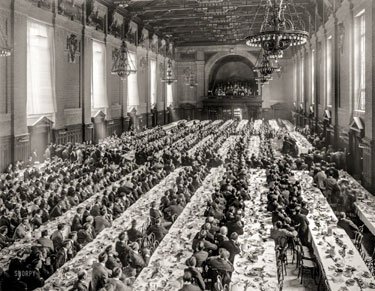
I would guess that this was a Reunion Banquet. In my day, freshman ate their meals here in University Commons. Normally, this dining hall was far less crowded. There were many fewer individual tables, spaced a lot farther apart. Yale doesn’t use the space for student meals anymore, and I believe the whole building is being renovated and changed into some kind of multi-purpose student center. But, then, where will Yale hold these kind of banquets? one wonders.
[Britain’s Edwardian] serenity was misplaced. Astute observers at home warned that Britain was losing its industrial supremacy and was indifferent to its ill educated population. Acute observers abroad declared that the solidarity of British life was an illusion. The American historian Brooks Adams (brother of Henry) forecast the departure of Britain from the historical stage. The steel production of the United States and Germany was overtaking that of Britain; and the Boer war had revealed Britain’s inefficiency as a world power. Conrad heard the tumult beneath the surface of that thin crust men called civilization – the anarchist world of the secret agent or of Henry James’s Hyacinth Robinson. But there was one writer in particular who was aware how thin the crust was and who redefined the gentlemanly ethos, and it was often through his eyes that Our Age was told to admire it. That was Kipling.
Kipling wanted his generation to recall how much the gentleman owed to society. He valued the independence of the individual – as an artist how could he not? But the individual left on his own, isolated and lonely, disintegrated. Particularly in India where men and their wives died young, where to take one’s work seriously could result in madness because government, unlike in England, never achieved results. What prevented such a society from going over the precipice? Kipling answered: religion, law, custom convention, morality – the forces of social control – which imposed upon individuals certain rules which they broke at their peril. Conventions enabled men to retain their self-respect and even to live together under appalling circumstances. Those who break the conventions must be punished. Numbers of Kipling stories contain scenes in which the individualistic, the eccentric, the man who offends against the trivial rules of the club, are tarred and feathered with gleeful brutality. If the offender is not brought to heel, society will suffer. It is not worth spending much effort, Kipling thought, debating whether the customs, morality and religion of the place you live in are right or wrong. His contemporary, the anthropologist James Frazer, was informing the learned public that religion and magic were a kind of primitive science which would vanish as scientific knowledge spread; but for Kipling, as for Max Weber, religion was a social fact.
These forces of social control, as Kipling admitted, were harsh. The harshness could be alleviated by belonging to in-groups. These in-groups protect the individual, give him privacy, identity and self-confidence. They are the family, the school and the craft or profession you follow. These in-groups, too, teach us our place. We all need a course of indoctrination to find our place and, if you have come up in the world, to be taught it. But when the individual has proven himself in his in-group, and so long as he is not in the strict sense of the word of an eccentric, then the more daring his behaviour and the more abundant his action, the greater is the addition of joy in the world. Stalky was the prototype of this socialized individualism. He acted beyond the formal law of school or army regulations and possessed the gift of seeing himself from the outside in relation to society. In Kipling’s world action revitalized man. That was the obverse of suffering it caused. And suffering was inevitable. Political action is often not a choice between good and evil but between lesser and greater evil.
Social realities interested Kipling. The liberal pictures man as choosing goals to pursue and asks whether or not he is free to pursue them. Kipling thought that men and women were forced to accept those goals which their group or clan in society chose for them and only when they had accepted these constraints were they free to exercise their individuality and take it for a trot. He is not unlike Durkheim who saw the individual as a bolt which might snap if the nut of society held it too tightly, or by being too loose allowed it to vibrate. Excessive integration as in the officer caste in the Army could be as dangerous as imperfect integration.
Kipling therefore defined the gentleman differently from Trollope. His gentleman has come down in the world, is harsher, more meagre, with fewer graces and more limitations. The gentleman has now become the manager, the colonial administrator, the engineer and the skilled worker. You feel his gentleman is more beleaguered. He is threatened from above by the politicians, threatened from below by the lower orders who now have the vote, and threatened by the new barbarians in Europe. In the fable of England he wrote for his children Kipling scanned the future with anxious eyes. Would the wall of British civilization fall again before the democratic hordes of little men and the barbarians, the Prussian Winged Hats? Were not the younger rulers like Churchill tainted by the same ambition that made Roman generals overpower the emperor? Were not the financiers manipulating trade and industry to their own ends, were not luxury and wealth corrupting the ruling class and turning their children to flannelled fools at the wicket? What would be England’s fate?
John McWhorter, in the Atlantic, compares the complexity of several languages.
When a language seems especially telegraphic, usually another factor has come into play: Enough adults learned it at a certain stage in its history that, given the difficulty of learning a new language after childhood, it became a kind of stripped-down “schoolroom†version of itself. Because all languages, are, to some extent, busier than they need to be, this streamlining leaves the language thoroughly complex and nuanced, just lighter on the bric-a-brac that so many languages pant under. Even today, Indonesian is a first language to only one in four of its speakers; the language has been used for many centuries as a lingua franca in a vast region, imposed on speakers of several hundred languages. This means that while other languages can be like overgrown lawns, Indonesian’s grammar has been regularly mowed, such that especially the colloquial forms are tidier. Lots of adult learning over long periods of time is also why, for example, the colloquial forms of Arabic like Egyptian and Moroccan are somewhat less elaborated than Modern Standard Arabic—they were imposed on new people as Islam spread after the seventh century.
In contrast, one cannot help suspecting that not too many adults have been tackling the likes of sÇq’ayÇÆ›aaÉ£wÇaÉ£hasÌ. Kabardian has been left to its own devices, and my, has it hoarded a lot of them. This is, as languages go, normal, even if Kabardian is rather extreme. By contrast, only a few languages have been taken up as vehicles of empire and imposed on millions of unsuspecting and underqualified adults. Long-dominant Mandarin, then, is less “busy†than Cantonese and Taiwanese, which have been imposed on fewer people. English came out the way it did because Vikings, who in the first millennium forged something of an empire of their own in northern and western Europe, imposed themselves on the Old English of the people they invaded and, as it were, mowed it. German, meanwhile, stayed “normal.â€
An incident on the river may bear telling. It was after the battle [Fredericksburg], when the pickets had resumed their posts and had become friendly; more given to trading than shooting each other at less than one hundred yards. … A fine Federal band came down to the river bank one afternoon and began playing pretty airs, among them the Northern patriotic chants and war songs. “Now give us some of ours!” shouted our pickets, and at once the music swelled into Dixie, My Maryland, and the Bonnie Blue Flag. Then, after a mighty cheer, a slight pause, the band again began, all listening; this time it was the tender, melting bars of Home, Sweet Home, and on both sides of the river there were joyous shouts, and many wet eyes could be found among those hardy warriors under the flags. “One touch of nature makes the whole world kin.”
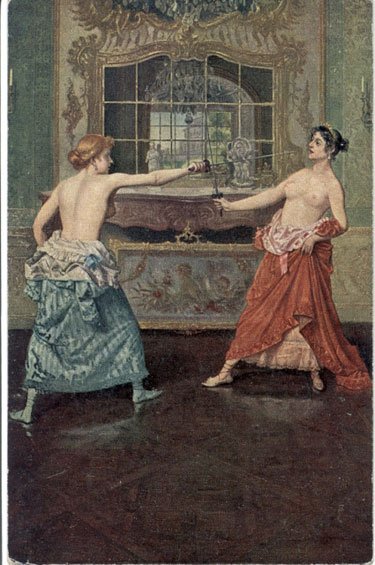
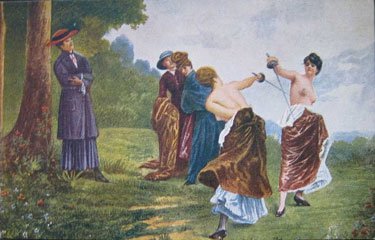
The most intriguing duel fought between women, and the sole one that featured exposed breasts, took place in August 1892 in Vauduz, the capitol of Liechtenstein, between Princess Pauline Metternich and the Countess Kielmannsegg. It has gone down in history as the first “emancipated duel†because all parties involved, including the principals and their seconds were female. Also, the confrontation was organized and presided over by the Baroness Lubinska, who had a degree in medicine (a rarity for a woman in those days) and was prepared to minister to any wounds incurred. Before the proceedings began, the baroness pointed out that many insignificant injuries in duels often became septic due to strips of clothing being driven into the wound by the point of a sword. To counter this danger she prudently suggested that both parties should fight stripped of any garments above the waist. Certainly, Baroness Lubinska was ahead of her time, taking an even more radical take on the (at the time) widely dismissed theories of British surgeon Joseph Lister, who in 1870 revolutionized surgical procedures with the introduction of antiseptic. With the precautions Baroness Lubinska recommended, the topless women duelists were less likely to suffer from an infection; indeed, it was a smart idea to fight semiclad. Given the practicality of the baroness’ suggestion and the “emancipated†nature of the duel, it was agreed that the women would disrobe—after all, there would be no men present to ogle them. For the women, the decision to unbutton the tops of their dresses was not sexual; it was simply a way of preventing a duel of first blood from becoming a duel to the death.
At the dueling ground on the fateful day, all formalities were carried out to the letter including an attempt at and refusal of reconciliation. The ladies engaged and, after a few trifling feints and thrusts, a wild slash from the princess brought about a light flow of blood from the countess’ nose. Seeing the injury she caused, the shocked princess, in a stereotypical feminine gesture, threw both hands up to her cheeks. Just then, the countess lunged and pierced the princess through her right forearm. The sight of the ensuing blood caused the respective seconds to faint. The footmen and coachmen, who had been ordered to stand some distance away with their backs toward the action, heard the cries and ran toward the women to render aid. Baroness Lubinska, however, decided the male servants had more salacious motives and attacked them with her umbrella, shouting, “Avert your eyes, avert your eyes—you lustful wretches!†The baroness was once again ahead of her time in sensing the necessary precautions. It was as if she already knew the gossip and speculation that would result from this premier example of what could have become a clothing–optional sport.
The rumors started just as soon as the Princess Metternich and Countess Kielmannsegg cast aside their weapons. Artists and storytellers speculated about the duel, most of their tales centering specifically on the scanty clothes the women wore. It is humorous that most recounts of this historic event fail to mention two important things: the winner of the duel (Princess Metternich) and the reason why the women came to arms in the first place—they disagreed over the floral arrangements for an upcoming musical exhibition. Bared breasts, apparently, overshadow such trivial details.
The rivalry between “Princess Paulina†and the Countess Kielmannsegg was apparently so well known that it was documented in the Vienna society pages of the British women’s magazine The Lady’s Realm. In one issue, the magazine reported, “The Countess Anastasia, who is Russian by birth, is very ambitious, and has a great talent for arranging entertainments of all kinds, and during the mourning of the Princess Paulina she has come more to the front than ever and has been most indefatigable. She is young enough to be the daughter of her rival in good works, and, like her, is possessed of an untiring energy.â€
In the summer of 1892, Princess Pauline was the Honorary President of the Vienna Musical and Theatrical Exhibition and Countess Kielmannsegg was the President of the Ladies’ Committe of the Exhibition, and the two clashed over some of the arrangements for the Exhibition. (Several sources claim it had something to do with the floral arrangements.) Heated words were exchanged, and the two women agreed to settle their differences with a duel. …
The Metternich-Kielmannsegg duel was … an “emancipated duel,†because all the parties involved were women. The duelists seconds were the Princess Schwarzenberg and Countess Kinsky, and a woman even presided over the duel: Baroness Lubinska, a Polish woman who had a degree in medicine.
So why on Earth were they topless? According to Atlas Obscura and the Women of Action Network, that was Baroness Lubinska’s idea. The duel was not supposed to be a deadly one, but the baroness noted, that if a piece of dirty clothing was pushed into a wound, that would would be more likely to become infected. It would be much safer, she reasoned for the rapiers to touch only bare skin. So she instructed the combatants to strip down to the waist and ordered the male servants off in the distance to look away.
The combatants met in August 1892 Vaduz, the capital of Liechtenstein, and dueled with rapiers to first blood. The Princess Pauline was the victor in the third round, when she was injured slightly on the nose but also drew blood from the countess’s arm. The report in the Pall Mall Gazette says that, once the round ended, the seconds “advised them to embrace, kiss, and make friends.†But the idea of topless duelists captured the imagination of many folks, with images of women, breasts bared and swords crossed, appearing in paintings and erotic photographs of the era.
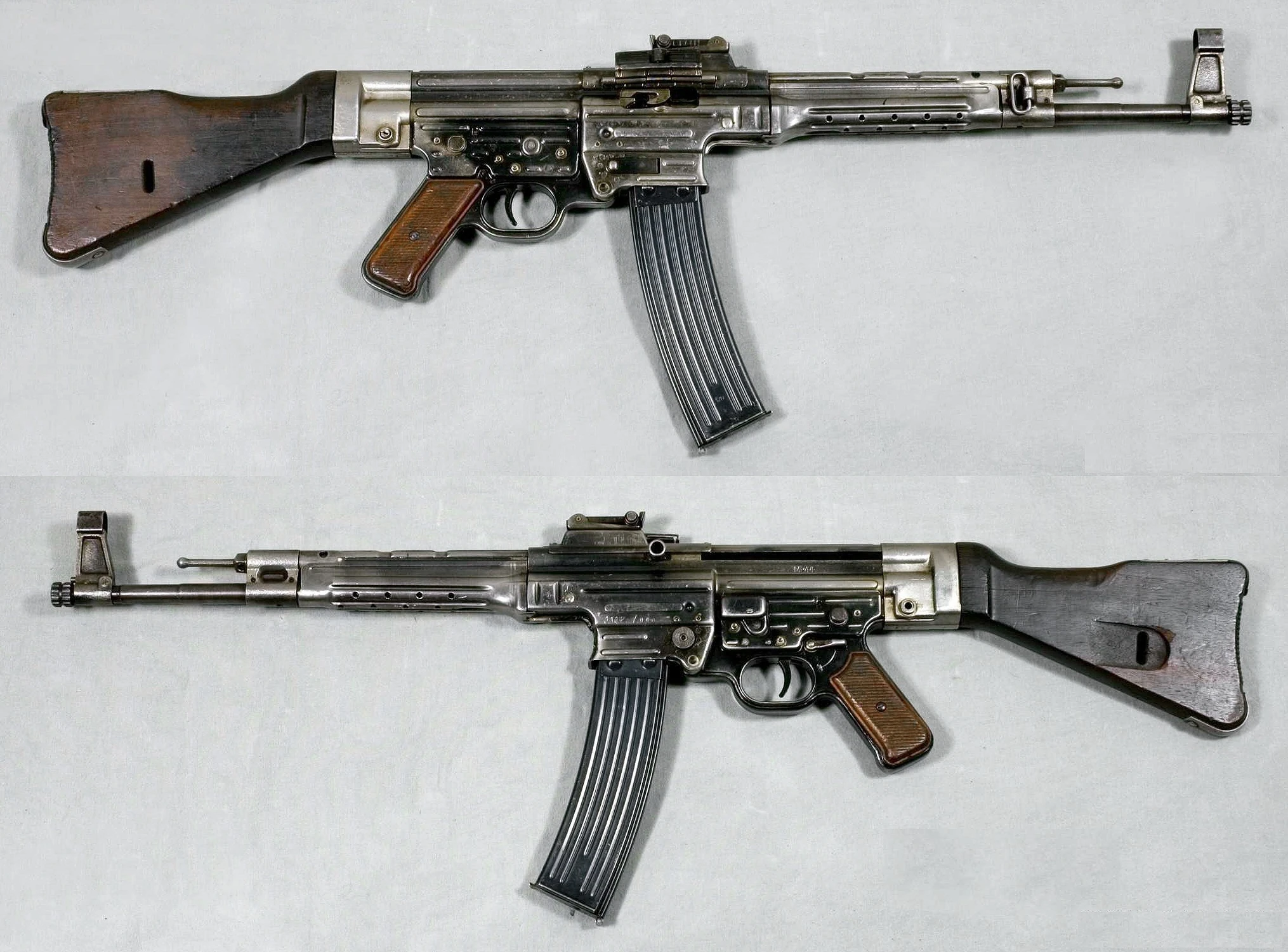
STG-44, aka Sturmgewehr 44, the world’s first assault weapon.
The US backed Free Syrian Army [FSA] allegedly uncovered a stockpile of 5,000 STG-44s in 2012. A video released at the time had WWII militaria collectors everywhere wishing the weapons could be accessed and imported.
———————————–
———————————–
So, how did 5000 of those historic pieces get to Syria? Probably from Africa.
JWH1975 explains that first the Russians captured them.
When WWII ended in 1945, the Soviet army retained and stored every StG-44 it found. By best estimate, in 1948 there were about 102,000 StG-44s in Soviet custody. As the SKS and AK-47 were already entering Soviet use, the captured StG-44s were not issued to Soviet units but rather made available for transfer abroad, with Czechoslovakia being the first and main recipient, followed by East Germany. Hungary also received a small (about 4,000) batch, and Yugoslavia also received some prior to it’s split with the east bloc. These joined StG-44s captured by the Yugoslavs themselves. Finally the Soviets transferred a few to North Vietnam; these in turn were joined by more transferred from Czechoslovakia and East Germany (which themselves had come from the USSR) as those two countries phased the type out.
Lots of them ended up in Africa, dispatched by Russia, and its satellite proxies Czechoslovakia and East Germany, to Soviet-sponsored insurgent groups in Algeria and Somalia, with others also sold to the governments of Egypt and Libya.