Category Archive 'History'
25 Dec 2014
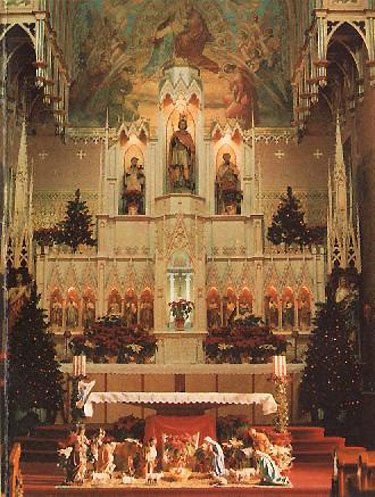
St. George Lithuanian Roman Catholic Church, Shenandoah, PA, decorated for Christmas in 1979. I served mass at Christmas there many decades ago. The Diocese of Allentown had this church, the grandest and most architecturally distinguished in town, torn down in 2010.
25 Dec 2014


From Robert Chambers, The Book of Days, 1869:
Born: Jesus Christ, Saviour of the world; Sir Isaac Newton, natural philosopher, 1642, Woolsthorpe, near Grantham; Johann Jacob Reiske, oriental scholar, 1716, Zorbig, Saxony; William Collins, poet, 1720, Chichester; Richard Person, Greek scholar, 1759, East Ruston, Norfolk.
and my wife, Karen.
Feast Day: St. Eugenia, virgin and martyr, about 257. St. Anastasia, martyr, 304. Another St. Anastasia.
Christmas Day
The festival of Christmas is regarded as the greatest celebration throughout the ecclesiastical year, and so important and joyous a solemnity is it deemed, that a special exception is made in its favour, whereby, in the event of the anniversary falling on a Friday, that day of the week, under all other circumstances a fast, is transformed to a festival.
That the birth of Jesus Christ, the deliverer of the human race, and the mysterious link connecting the transcendent and incomprehensible attributes of Deity with human sympathies and affections, should be considered as the most glorious event that ever happened, and the most worthy of being reverently and joyously commemorated, is a pro-position which must commend itself to the heart and reason of every one of His followers, who aspires to walk in His footsteps, and share in the ineffable benefits which His death has secured to mankind. And so though at one period denounced by the Puritans as superstitious, and to the present day disregarded by Calvinistic Protestants, as unwarranted by Scripture, there are few who will seriously dispute the propriety of observing the anniversary of Christ’s birth by a religious service. …
Towards the close of the second century, we find a notice of the observance of Christmas in the reign of the Emperor Commodus; and about a hundred years afterwards, in the time of Dioclesiaun an atrocious act of cruelty is recorded of the last named emperor, who caused a church in Nicomedia, where the Christians were celebrating the Nativity, to be set on fire, and by barring every means of egress from the building, made all the worshippers perish in the flames. Since the, end of the fourth century at least, the 25th of December has been uniformly observed as the anniversary of the Nativity by all the nations of Christendom.
Thus far for ancient usage, but it will be readily comprehended that insurmountable difficulties yet exist with respect to the real date of the momentous event under notice. Sir Isaac Newton, indeed, remarks in his Commentary on the Prophecies of Daniel, that the feast of the Nativity, and most of the other ecclesiastical anniversaries, were originally fixed at cardinal points of the year, without any reference to the dates of the incidents which they commemorated, dates which, by the lapse of time, had become impossible to be ascertained. Thus the Annunciation of the Virgin Mary was placed on the 25th of March, or about the time of the vernal equinox; the feast of St. Michael on the 29th of September, or near the autumnal equinox; and the birth of Christ and other festivals at the time of the winter-solstice. Many of the apostles’ days –such as St. Paul, St. Matthias, and others– were determined by the days when the sun entered the respective signs of the ecliptic, and the pagan festivals had also a considerable share in the adjustment of the Christian year.
To this last we shall shortly have occasion to advert more particularly, but at present we shall content ourselves by remarking that the views of the great astronomer just indicated, present at least a specious explanation of the original construction of the ecclesiastical calendar. As regards the observance of Easter indeed, and its accessory celebrations, there is good ground for maintaining that they mark tolerably accurately the anniversaries of the Passion and Resurrection of our Lord, seeing that we know that the events themselves took place at the period of the Jewish Passover. But no such precision of date can be adduced as regards Christmas, respecting which the generally received view now is, that it does not correspond with the actual date of the nativity of our Saviour. One objection, in particular, has been made, that the incident recorded in Scripture, of shepherds keeping watch by night on the plains of Bethlehem, could not have taken place in the month of December, a period generally of great inclemency in the region of Judea.
Though Christian nations have thus, from an early period in the history of the church, celebrated Christmas about the period of the winter-solstice or the shortest day, it is well known that many, and, indeed, the greater number of the popular festive observances by which it is characterized, are referable to a much more ancient origin. Amid all the pagan nations of antiquity, there seems to have been a universal tendency to worship the sun as the giver of life and light, and the visible manifestation of the Deity. Various as were the names bestowed by different peoples on this object of their worship, he was still the same divinity. Thus, at Rome, he appears to have been worshipped under one of the characters attributed to Saturn, the father of the gods; among the Scandinavian nations he was known under the epithet of Odin or Woden, the father of Thor, who seems after-wards to have shared with his parent the adoration bestowed on the latter, as the divinity of which the ‘sun was the visible manifestation; whilst with the ancient Persians, the appellation for the god of lights was Mithras, apparently the same as the Irish Mithr, and with the Phoenicians or Carthaginians it was Baal or Bel, an epithet familiar to all students of the Bible.
Concurring thus as regards the object of worship, there was a no less remarkable uniformity in the period of the year at which these different nations celebrated a grand festival in his honour. The time chosen appears to have been universally the season of the New Year, or, rather, the winter-solstice, from which the new year was frequently reckoned. This unanimity in the celebration of the festival in question, is to be ascribed to the general feeling of joy which all of us experience when the gradual shortening of the day reaches its utmost limit on the 21st of December, and the sun, recommencing his upward course, announces that mid-winter is past, and spring and summer are approaching. On similar grounds, and with similar demonstrations, the ancient pagan nations observed a festival at mid-summer, or the summer-solstice, when the sun arrives at the culminating point of his ascent on the 21st of June, or longest day.
By the Romans, this anniversary was celebrated under the title of Saturnalia, or the festival of Saturn, and was marked by the prevalence of a universal license and merry-making. The slaves were permitted to enjoy for a time a thorough freedom in speech and behavior, and it is even said that their masters waited on them as servants. Every one feasted and rejoiced, work and business were for a season entirely suspended, the houses were decked with laurels and evergreens, presents were made by parents and friends, and all sorts of games and amusements were indulged. in by the citizens. In the bleak north, the same rejoicings had place, but in a ruder and more barbarous form. Fires were extensively kindled, both in and out of doors, blocks of wood blazed in honour of Odin and Thor, the sacred mistletoe was gathered by the Druids, and sacrifices, both of men and cattle, were made to the savage divinities. Fires are said, also, to have been kindled at this period of the year by the ancient Persians, between whom and the Druids of Western Europe a relationship is supposed to have existed.
In the early ages of Christianity, its ministers frequently experienced the utmost difficulty in inducing the converts to refrain from indulging in the popular amusements which were so largely participated in by their pagan countrymen. Among others, the revelry and license which characterized the Saturnalia called for special animadversion. But at last, convinced partly of the inefficacy of such denunciations, and partly influenced by the idea that the spread of Christianity might thereby be advanced, the church endeavored to amalgamate, as it were, the old and new religious, and sought, by transferring the heathen ceremonies to the solemnities of the Christian festivals, to make them subservient to the cause of religion and piety. A compromise was thus effected between clergy and laity, though it must be admitted that it proved anything but a harmonious one, as we find a constant, though ineffectual, proscription by the ecclesiastical authorities of the favorite amusements of the people, including among others the sports and revelries at Christmas.
Ingrafted thus on the Romani Saturnalia, the Christmas festivities received in Britain further changes and modifications, by having superadded to them, first, the Druidical rites and superstitions, and then, after the arrival of the Saxons, the various ceremonies practiced by the ancient Germans and Scandinavians. The result has been the strange medley of Christian and pagan rites which contribute to make up the festivities of the modern Christmas. Of these, the burning of the Yule log, and the superstitions connected with the mistletoe have already been described under Christmas Eve, and further accounts are given under separate heads, both under the 24th and 25th of December.
The name given by the ancient Goths and. Saxons to the festival of the winter-solstice was Jul or Yule, the latter term forming, to the present day, the designation in the Scottish dialect of Christmas, and preserved also in the phrase of the ‘Yule log.’ Perhaps the etymology of no term has excited greater discussion among antiquaries. Some maintain it to be derived from the Greek, συλσι, or, ισυλσς, the name of a hymn in honor of Ceres; others say it comes from the Latin jubilum, signifying a time of rejoicing, or from its being a festival in honour of Julius Caesar; whilst some also explain its meaning as synonymous with ol or oel, which in the ancient Gothic language denotes a feast, and also the favorite liquor used on such occasion, whence our word ale. But a much more probable derivation of the term in question is from the Gothic giul or hiul, the origin of the modem word wheel, and bearing the same signification. According to this very probable explanation, the Yule festival received its name from its being the turning-point of the year, or the period at which the fiery orb of day made a revolution in his annual circuit, and entered on his northern journey. A confirmation of this view is afforded by the circumstance that in the old clog almanacs, a wheel is the device employed for marking the season of Yule-tide.
Throughout the middle ages, and down to the period of the Reformation, the festival of Christmas, ingrafted on the pagan rites of Yule, continued throughout Christendom to be universally celebrated with every mark of rejoicing. On the adoption of a new system of faith by most of the northern nations of Europe in the sixteenth century, the Lutheran and Anglican churches retained the celebration of Christmas and other festivals, which Calvinists rejected absolutely, denouncing the observance of all such days, except Sunday, as superstitious and unscriptural. In reference to the superstition anciently prevalent in Scotland against spinning on Christmas or Yule day, and the determination of the Calvinistic clergy to put down all such notions, the following amusing passage is quoted by Dr. Jamieson from Jhone Hamilton’s Facile Tractise:
‘The ministers of Scotland — in contempt of the vther halie dayes obseruit be England — cause their wyfis and seruants spin in oppin sicht of the people upon Yeul day; and their affectionnate auditeurs constraines their tennants to yok thair pleuchs on Yeul day in contempt of Christ’s Natiuitie, whilk our Lord has not left vnpunisit: for thair oxin ran wod [mad], and brak their nekis, and leamit [lamed] sum pleugh men, as is notoriously knawin in sindrie partes of Scotland.’
In consequence of the Presbyterian form of church-government, as constituted by John Knox and his coadjutors on the model of the ecclesiastical polity of Calvin, having taken such firm root in Scotland, the festival of Christmas, with other commemorative celebrations retained from the Romish calendar by the Anglicans and Lutherans, is comparatively unknown in that country, at least in the Lowlands. The tendency to mirth and jollity at the close of the year, which seems almost inherent in human nature, has, in North Britain, been, for the most part, transferred from Christmas and Christmas Eve to New-year’s Day and the preceding evening, known by the appellation of Hogmenay. …
The geniality and joyousness of the Christmas season in England, has long been a national characteristic. The following poem or carol, by George Wither, who belongs to the first-half of the seventeenth century, describes with hilarious animation the mode of keeping Christmas in the poet’s day:
‘So now is come our joyful feast;
Let every man be jolly;
Each room with ivy leaves is drest,
And every post with holly.
Though some churls at our mirth repine,
Round your foreheads garlands twine;
Drown sorrow in a cup of wine,
And let us all be merry.
Now all our neighbours’ chimneys smoke,
And Christmas blocks are burning;
Their ovens they with baked meat choke,
And all their spits are turning.
Without the door let sorrow lye;
And if for cold it hap to die,
We’ll bury’t in a Christmas-pie,
And evermore be merry.
Now every lad is wond’rous trim,
And no man minds his labour;
Our lasses have provided them
A bagpipe and a tabor;
Young men and maids, and girls and boys,
Give life to one another’s joys;
And you anon shall by their noise
Perceive that they are merry.
Rank misers now do sparing shun;
Their hall of music soundeth;
And dogs thence with whole shoulders run,
So all things then aboundeth.
The country-folks, themselves advance,
With crowdy-muttons out of France;
And Jack shall pipe and Jyll shall dance,
And all the town be merry.
Ned Squash hath fetcht his bands from pawn,
And all his best apparel
Brisk Nell hath bought a ruff of lawn
With dropping of the barrel.
And those that hardly all the year
Had bread to eat, or rags to wear,
Will have both clothes and dainty fare,
And all the day be merry.
Now poor men to the justices
With capons make their errants;
And if they hap to fail of these,
They plague them with their warrants:
But now they feed them with good cheer,
And what they want, they take in beer,
For Christmas comes but once a year,
And then they shall be merry.
Good farmers in the country nurse
The poor, that else were undone;
Some landlords spend their money worse,
On lust and pride at London.
There the roysters they do play,
Drab and dice their lands away,
Which may be ours another day,
And therefore let’s be merry.
The client now his suit forbears;
The prisoner’s heart is eased;
The debtor drinks away his cares,
And for the time is pleased.
Though others’ purses be more fat,
Why should we pine or grieve at that?
Hang sorrow! care will kill a cat,
And therefore let’s be merry.
Hark! now the wags abroad do call,
Each other forth to rambling;
non you’ll see them in the hall,
For nuts and apples scrambling.
Hark! how the roofs with laughter sound,
Anon they’ll think the house goes round,
For they the cellar’s depth have found,
And there they will be merry.
The wenches with their wassel-bowls
About the streets are singing;
The boys are come to catch the owls,
The wild mare in it bringing,
our kitchen-boy hath broke his box,
And to the dealing of the ox,
Our honest neighbors come by flocks,
And here they will be merry.
Now kings and queens poor sheepcotes have,
And mate with every body;
The honest now may play the knave,
And wise men play the noddy.
Some youths will now a mumming go,
Some others play at Rowland-ho,
And twenty other game boys mo,
Because they will be merry.
Then, wherefore in these merry daies,
Should we, I pray, be duller?
No, let us sing some roundelayes,
To make our mirth the fuller.
And, while thus inspired we sing,
Let all the streets with echoes ring;
Woods and hills and every thing,
Bear witness we are merry.’
At present, Christmas-day, if somewhat shorn of its ancient glories, and unmarked by that boisterous jollity and exuberance of animal spirits which distinguished it in the time of our ancestors, is, nevertheless, still the holiday in which of all others throughout the year, all classes of English society most generally participate. Partaking of a religious character, the forenoon of the day is usually passed in church, and in the evening the re-united members of the family assemble round the joyous Christmas-board. Separated as many of these are during the rest of the year, they all make an effort to meet together round the Christmas-hearth. The hallowed feelings of domestic love and attachment, the pleasing remembrance of the past, and the joyous anticipation of the future, all cluster round these family-gatherings, and in the sacred associations with which they are intertwined, and the active deeds of kindness and benevolence which they tend to call forth, a realization may almost be found of the angelic message to the shepherds of Bethlehem—’Glory to God in the highest, and on earth peace, good-will toward men.’
16 Dec 2014


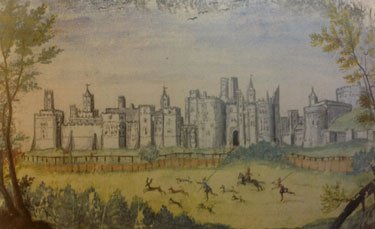
Travellers often have the best eyes for the beauties of the cities they visit, and some of the best views of London in the early seventeenth century have been come down to us in the album amicorum of Michael van Meer, a Flemish soldier who lived in London in the years 1614-1615. In this album we find marvelous images of the Tower, London Bridge and Windsor Castle, views Shakespeare and his contemporaries have seen.
The album is now kept at Edinburgh University Library, La. III. 283. It’s extensively discussed in June Schlueter’s The Album Amicorum & The London of Shakespeare’s Time. London, The British Library 2011.
Hat tip to Ratak Monodosico.
04 Dec 2014

Edmund Blair Leighton, The End of the Song, 1802, private collection.
DNA testing of the bones of Richard III apparently demonstrates that what DNA testers refer to as a “non-paternal event” occurred at some crucial point in the blood-line of the British royal family.
Telegraph:
When the body of Richard III was discovered in a car park in Leicester in 2012 archaeologists knew it was a momentous find.
But little did they realise that it might expose the skeletons in the cupboard of the British aristocracy, and even call into question the bloodline of the Royal family.
In order to prove that the skeleton really was Richard III, scientists needed to take a DNA sample and match it to his descendants.
Genetic testing through his maternal DNA proved conclusively that the body was the King. However, when they checked the male line they discovered something odd. The DNA did not match showing that at some point in history an adulterous affair had broken the paternal chain.
Although it is impossible to say when the affair happened, if it occurred around the time of Edward III (1312- 1377) it could call into question whether kings like Henry VI, Henry VII and Henry VIII had royal blood, and therefore the right to rule.
Without his claim to royalty, Henry VII is unlikely to have been able to raise an army for the Battle of Bosworth Field, in which Richard III was killed, and the history of England could have been very different.
And it has implications for our own Royal Family who also share a direct bloodline to the Tudors.
Hat tip to Karen L. Myers.
27 Nov 2014

As published in the Massachusetts Centinel, Wednesday, October 14, 1789
27 Nov 2014
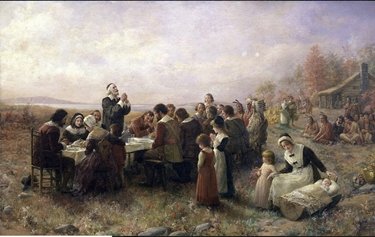
Mike Franc, at Human Events in 2005, identified the real reason for celebration at the first Thanksgiving.
Writing in his diary of the dire economic straits and self-destructive behavior that consumed his fellow Puritans shortly after their arrival, Governor William Bradford painted a picture of destitute settlers selling their clothes and bed coverings for food while others “became servants to the Indians,†cutting wood and fetching water in exchange for “a capful of corn.†The most desperate among them starved, with Bradford recounting how one settler, in gathering shellfish along the shore, “was so weak … he stuck fast in the mud and was found dead in the place.â€
The colony’s leaders identified the source of their problem as a particularly vile form of what Bradford called “communism.†Property in Plymouth Colony, he observed, was communally owned and cultivated. This system (“taking away of property and bringing [it] into a commonwealthâ€) bred “confusion and discontent†and “retarded much employment that would have been to [the settlers’] benefit and comfort.â€
Just how did the Pilgrims solve the problem of famine? In addition to receiving help from the local Indians in farming, they decided allow the private ownership of individual plots of land.
On the brink of extermination, the Colony’s leaders changed course and allotted a parcel of land to each settler, hoping the private ownership of farmland would encourage self-sufficiency and lead to the cultivation of more corn and other foodstuffs.
As Adam Smith would have predicted, this new system worked famously. “This had very good success,†Bradford reported, “for it made all hands very industrious.†In fact, “much more corn was planted than otherwise would have been†and productivity increased. “Women,†for example, “went willingly into the field, and took their little ones with them to set corn.â€
The famine that nearly wiped out the Pilgrims in 1623 gave way to a period of agricultural abundance that enabled the Massachusetts settlers to set down permanent roots in the New World, prosper, and play an indispensable role in the ultimate success of the American experiment.
A profoundly religious man, Bradford saw the hand of God in the Pilgrims’ economic recovery. Their success, he observed, “may well evince the vanity of that conceit…that the taking away of property… would make [men] happy and flourishing; as if they were wiser than God.†Bradford surmised, “God in his wisdom saw another course fitter for them.â€
The real story of Thanksgiving is the triumph of capitalism and individualism over collectivism and socialism, which is the summation of the story of America.
24 Nov 2014
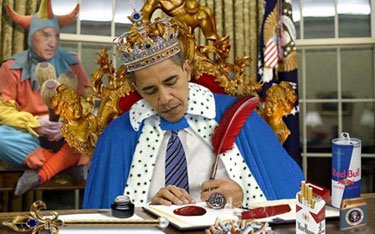
Walter Russell Mead has intelligent things to say about immigration and American history and predicts that Barack Obama’s shameless ploy to capture Hispanics as a permanent democrat constituency is based on flawed and grossly oversimplified thinking. All this, he contends, is going to backfire on democrats and Barack Obama is carving out a place for himself in presidential history below Jimmy Carter’s.
President Obama’s new initiative is unlikely to succeed politically—in part because Democrats are overconfident that rising Hispanic immigration will deliver them a permanent, left-leaning majority.
Frank Fukuyama, no howling partisan, has tagged President Obama’s decision to circumvent Congress on immigration as a “bad call,†and while the President’s limited offer of a three-year temporary work authorization for people in the country illegally was not the worst or the most radical step he could have taken, Frank is right. This was the wrong step at the wrong time. At the very minimum, the President should have given the new Congress ninety days to act before going it alone. Failing to do so isn’t just a slap in the face of his Republican opponents; it is a slap in the face of the voters who no longer trust the President and his party on the big issues of national life.
If the new Congress proved unable or unwilling to act, the President’s step would have had at least an element of political legitimacy to it. As it is, this half-hearted, hobbled amnesty will likely join President Obama’s flawed health care law as a toxic legacy that will haunt the Democratic Party for years to come. Just as the President’s poor reputation was a millstone around the neck of many Democratic candidates in 2014, future Democratic candidates are going to run away from Obama’s memory, and their opponents will work to tag them with the heavy burden of a presidency that most Americans will want to forget. As a political brand, the name “Barack Obama†now risks drifting into Jimmy Carter territory and becoming a label that blights the prospects of the Democratic party and its candidates for years.
Moreover, as with the health care law, the President’s immigration policy doesn’t solve the underlying problems it addresses and makes the task of real reform more difficult.
24 Nov 2014

At Richochet, Sabrdance views the American political future in the light of the Jacksonian Tradition. He even manages to place Abraham Lincoln (perhaps the ultimate anti-Jacksonian) directly in the Jacksonian Tradition (!).
In this week’s G-File, Jonah Goldberg elaborates on his Special Report rant that there is a populist revolt brewing in response to the misbehavior of the government, specifically, the revelations regarding Jonathan Gruber. Jacksonians expect government to be corrupt, but they require that it not be perverse; it may line its pockets, but it may not harm the people to do so. If it does, Meade is sanguine: the Jacksonians will revolt and elect a hero, as they did previously with Jackson himself, both Roosevelts, and Ronald Reagan.
I am less sure. The Jacksonian response to corruption has historically been to withdraw, first to the frontier, then into their churches and towns. Their antagonists follow until their train of insults culminates in harm, at which point the Jacksonians become bloodyminded. Meade skips over it in his discussion of Jacksonian heroes, but Lincoln can also be seen as of that mold, elected to punish the Southern states for insulting their Northern brethren by forcing the Fugitive Slave Act on them, violating both the Missouri Compromise and the Compromise of 1850, as well as the implicit the agreement of the Founding to contain slavery and allow it to die (all brought about by the Louisiana Purchase, itself a dubiously legal executive act).
Jacksonians are honorable people. They will put up with much, and will withdraw into their enclaves rather than get sucked into a vendetta. Executive encroachments, legislative flimflam, judicial arrogance… the Jacksonians won’t respond to any of it. Until they do.
Their predecessors in England launched both the English Civil War and the Glorious Revolution.
I do not want to repeat that experience.
Read the whole thing.
11 Nov 2014

—this post is repeated annually—
WWI came to an end by an armistice arranged to occur at the eleventh hour of the eleventh day of the eleventh month of 1918. The date and time, selected at a point in history when mens’ memories ran much longer, represented a compliment to St. Martin, patron saint of soldiers, and thus a tribute to the fighting men of both sides. The feast day of St. Martin, the Martinmas, had been for centuries a major landmark in the European calendar, a date on which leases expired, rents came due; and represented, in Northern Europe, a seasonal turning point after which cold weather and snow might be normally expected.
It fell about the Martinmas-time, when the snow lay on the borders…
—-Old Song.

From Robert Chambers, The Book of Days, 1869:
St. Martin, the son of a Roman military tribune, was born at Sabaria, in Hungary, about 316. From his earliest infancy, he was remarkable for mildness of disposition; yet he was obliged to become a soldier, a profession most uncongenial to his natural character. After several years’ service, he retired into solitude, from whence he was withdrawn, by being elected bishop of Tours, in the year 374.
The zeal and piety he displayed in this office were most exemplary. He converted the whole of his diocese to Christianity, overthrowing the ancient pagan temples, and erecting churches in their stead. From the great success of his pious endeavours, Martin has been styled the Apostle of the Gauls; and, being the first confessor to whom the Latin Church offered public prayers, he is distinguished as the father of that church. In remembrance of his original profession, he is also frequently denominated the Soldier Saint.
The principal legend, connected with St. Martin, forms the subject of our illustration, which represents the saint, when a soldier, dividing his cloak with a poor naked beggar, whom he found perishing with cold at the gate of Amiens. This cloak, being most miraculously preserved, long formed one of the holiest and most valued relics of France; when war was declared, it was carried before the French monarchs, as a sacred banner, and never failed to assure a certain victory. The oratory in which this cloak or cape—in French, chape—was preserved, acquired, in consequence, the name of chapelle, the person intrusted with its care being termed chapelain: and thus, according to Collin de Plancy, our English words chapel and chaplain are derived.
The canons of St. Martin of Tours and St. Gratian had a lawsuit, for sixty years, about a sleeve of this cloak, each claiming it as their property. The Count Larochefoucalt, at last, put an end to the proceedings, by sacrilegiously committing the contested relic to the flames. …
The festival of St. Martin, happening at that season when the new wines of the year are drawn from the lees and tasted, when cattle are killed for winter food, and fat geese are in their prime, is held as a feast-day over most parts of Christendom. On the ancient clog almanacs, the day is marked by the figure of a goose; our bird of Michaelmas being, on the continent, sacrificed at Martinmas. In Scotland and the north of England, a fat ox is called a mart, clearly from Martinmas, the usual time when beeves are killed for winter use. In ‘Tusser’s Husbandry, we read:
When Easter comes, who knows not then,
That veal and bacon is the man?
And Martilmass beef doth bear good tack,
When country folic do dainties lack.’
Barnaby Googe’s translation of Neogeorgus, shews us how Martinmas was kept in Germany, towards the latter part of the fifteenth century
‘To belly chear, yet once again,
Doth Martin more incline,
Whom all the people worshippeth With roasted geese and wine.
Both all the day long, and the night, Now each man open makes
His vessels all, and of the must, Oft times, the last he takes,
Which holy Martin afterwards Alloweth to be wine,
Therefore they him, unto the skies, Extol with praise divine.’
A genial saint, like Martin, might naturally be expected to become popular in England; and there are no less than seven churches in London and Westminster, alone, dedicated to him. There is certainly more than a resemblance between the Vinalia of the Romans, and the Martinalia of the medieval period.
Indeed, an old ecclesiastical calendar, quoted by Brand, expressly states under 11th November: ‘The Vinalia, a feast of the ancients, removed to this day. Bacchus in the figure of Martin.’ And thus, probably, it happened, that the beggars were taken from St. Martin, and placed under the protection of St. Giles; while the former became the patron saint of publicans, tavern-keepers, and other ‘dispensers of good eating and drinking. In the hall of the Vintners’ Company of London, paintings and statues of St. Martin and Bacchus reign amicably together side by side.
On the inauguration, as lord mayor, of Sir Samuel Dashwood, an honoured vintner, in 1702, the company had a grand processional pageant, the most conspicuous figure in which was their patron saint, Martin, arrayed, cap-Ã -pie, in a magnificent suit of polished armour; wearing a costly scarlet cloak, and mounted on a richly plumed and caparisoned white charger: two esquires, in rich liveries, walking at each side. Twenty satyrs danced before him, beating tambours, and preceded by ten halberdiers, with rural music. Ten Roman lictors, wearing silver helmets, and carrying axes and fasces, gave an air of classical dignity to the procession, and, with the satyrs, sustained the bacchanalian idea of the affair.
A multitude of beggars, ‘howling most lamentably,’ followed the warlike saint, till the procession stopped in St. Paul’s Churchyard. Then Martin, or his representative at least, drawing his sword, cut his rich scarlet cloak in many pieces, which he distributed among the beggars. This ceremony being duly and gravely performed, the lamentable howlings ceased, and the procession resumed its course to Guildhall, where Queen Anne graciously condescended to dine with the new lord mayor.
10 Nov 2014

Marines at Khe Sanh, 1968
Founded November 10, 1775.
——————————
Maj. Gen. John A. Lejeune’s Birthday Message
RPS ORDERS
No. 47 (Series 1921)
HEADQUARTERS U.S. MARINE CORPS
Washington, November 1, 1921
759. The following will be read to the command on the 10th of November, 1921, and hereafter on the 10th of November of every year. Should the order not be received by the 10th of November, 1921, it will be read upon receipt.
(1) On November 10, 1775, a Corps of Marines was created by a resolution of Continental Congress. Since that date many thousand men have borne the name “Marine”. In memory of them it is fitting that we who are Marines should commemorate the birthday of our corps by calling to mind the glories of its long and illustrious history.
(2) The record of our corps is one which will bear comparison with that of the most famous military organizations in the world’s history. During 90 of the 146 years of its existence the Marine Corps has been in action against the Nation’s foes. From the Battle of Trenton to the Argonne, Marines have won foremost honors in war, and is the long eras of tranquility at home, generation after generation of Marines have grown gray in war in both hemispheres and in every corner of the seven seas, that our country and its citizens might enjoy peace and security.
(3) In every battle and skirmish since the birth of our corps, Marines have acquitted themselves with the greatest distinction, winning new honors on each occasion until the term “Marine” has come to signify all that is highest in military efficiency and soldierly virtue.
(4) This high name of distinction and soldierly repute we who are Marines today have received from those who preceded us in the corps. With it we have also received from them the eternal spirit which has animated our corps from generation to generation and has been the distinguishing mark of the Marines in every age. So long as that spirit continues to flourish Marines will be found equal to every emergency in the future as they have been in the past, and the men of our Nation will regard us as worthy successors to the long line of illustrious men who have served as “Soldiers of the Sea” since the founding of the Corps.
JOHN A. LEJEUNE,
Major General Commandant
————————————-
The Magic of “a Few Good Men”
————————————-
The Old Corps
Tun Tavern, Philadelphia, Pennsylvania, November 10th 1775
Captains Nicholas and Mullens, having been tasked by the 2nd Continental Congress to form 2 battalions of Marines, set up the Corps’ first recruiting station in the tavern.
The first likely prospect was, in typical recruiters fashion, promised a “life of high adventure in service to Country and Corps”. And, as an extra bonus: If he enlisted now he would receive a free tankard of ale….
The recruit gladly accepted the challenge and, receiving the free tankard of ale, was told to wait at the corner table for orders.
The first Marine sat quietly at the table sipping the ale when he was joined by another young man, who had two tankards of ale.
The first Marine looked at the lad and asked where he had gotten the two tankards of ale?
The lad replied that he had just joined this new outfit called the Continental Marines, and as an enlistment bonus was given two tankards of ale.
The first Marine took a long hard look at the second Marine and said, ” It wasn’t like that in the old Corps.”
An annual post.
05 Nov 2014

Guy Fawkes arrested in the cellar of Parliament with the explosives.
Remember, remember!
The fifth of November,
Gunpowder, treason, and plot;
There is no reason
Why the Gunpowder treason
Should ever be forgot!’
Early in the morning of November 5, Guy Fawkes crept, torch in hand, into the cellar beneath the House of Lords in the Palace of Westminster. In that cellar, he and his fellow conspirators had previously placed a cache of 1800 pounds ((36 barrels, or 800 kg) of gunpowder. Just as he was about to ignite the barrels, blowing himself and the House of Lords to Kingdom Come, the torch was snatched from his hand by a man named Peter Heywood.
Fawkes was arrested and taken before the privy council where he remained defiant. When asked by one of the Scottish lords what he had intended to do with so much gunpowder, Fawkes answered him, “To blow you Scotch beggars back to your own native mountains!â€
So went the attempted Gunpowder Plot of 1605.
The intention of the plotters was to use the explosion, timed to coincide with the opening of Parliament, to kill King James I and eliminate much of the ruling Protestant aristocracy. They also intended to kidnap the royal children, then raise the standard of revolt in the Midlands with the object of restoring the freedom to practice Catholicism in England.
Dr. Mercury, at Maggie’s Farm, is on the side of Gunpowder Treason, and serves up a nice video excerpt from James McTeigue’s V for Vendetta (2005).

03 Nov 2014

Tomb of Sharaf al-Dawla, Uqaylid ruler of Mosul, 1052
Not everybody is as enamored of multiculturalism as the burghers of Birmingham.
Reports from a variety of sources are confirming that the Islamic State of Syria and the Levant (ISIS) has dynamited the mausoleum of Sharaf al-Dawla, the earliest of six surviving muquarnas-domed tombs.
The destruction of the Sharaf al-Dawla mausoleum is part of a consistent program of elimination of Shiite and Yezidi cultural monuments.
Hyperallergic:
The destruction of the Shia Shrine of Imam al-Daur shows that the Islamic State appears to continues to be intent on and capable of waging genocidal wars on multiple fronts. UNESCO Director-General Irina Bokova stated that “intentional targeting and systematic destruction of cultural heritage in Iraq is reaching unprecedented levels†and insisted that “cultural cleansing underway in Iraq must stop.â€
/div>
Feeds
|




