04 Mar 2014
How They Used to Deal With Islamic Extremists
History, Iran, Photography, Turkmen


Persian soldiers pose with the straw-stuffed heads of Turkmen chiefs delivered to Tehran, c. 1911 source: Wikimedia commons.
Via Fred Lapides.
|
Category Archive 'History'
04 Mar 2014
How They Used to Deal With Islamic ExtremistsHistory, Iran, Photography, Turkmen
Via Fred Lapides. 02 Mar 2014
Russia & the CrimeaCrimea, History, Russia, Ukraine
Greg Satell, at Forbes, I think, accurately identifies Vladimir Putin’s motive in occupying the Crimea.
Julia Ioffe notes the additional key consideration: that no one can stop him. Certainly not Barack Obama.
What we don’t know, at this point, is whether Russia will contentedly gobble down the Crimea and stop, the way it did in the case of Georgia, or whether Russia will go on to occupy and annex Eastern Ukraine or the entire country. If Russia simply takes the Crimea, Ukraine loses a nice vacation land and a semi-autonomous portion of territory to which it had only a pretty modest historical claim. Ukraine only acquired the Crimea as a gift by Nikita Krushchev in 1954. If Crimea had a legitimate historical owner, that would be the Crimean Tartars, conquered by Tsarist Russia in 1783, then deported en masse by Stalin in 1944 for collaborating with the German Occupation. So, if Russia takes back and gets to keep its key warm water naval port, what does that really mean. A scene comes to mind from the late 1970s, when I was fresh out of Yale, and was working on war games at Simulation Publications in New York for the great Jim Dunnigan. The news of the day involved the contrast between some recent dramatic Soviet naval expansion and a further reduction of the US Navy’s budget by the peanut farmer. The development team was sitting around a large table discussing current events gloomily and debating whether our next game should be a grand scale US versus Soviets Naval game. The arguments, as always, flew hotly back and forth, but finally one of the older and most cynical grognards called out: “OK, when was the last time Russia won a naval battle?” We had a room full of military history buffs, all of whom were thrown basically for a loop. You could almost hear the gears spinning and smell the wiring overheating as we all racked our memories. After a while, one very knowledgeable man suggested the 1827 Battle of Navarino during the Greek War for Independence. But, no, another expert objected: the Russians formed only a portion of an Allied fleet, and were effectively under British command. The next best suggestion referred vaguely to Russian warships beating the Turks while under the command of Rear Admiral John Paul Jones in 1787 or 1788. At which point, the whole table broke up in laughter at the idea of what would happen to a Russian Navy with a centuries long tradition of not very much were it ever to encounter the US Navy, equipped with an enormously long tradition of victory. Let Putin have Sevastopol. If Russia really needs to be a significant naval power in order to be a Global Power, Russia is still going to be out of luck. 28 Feb 2014
The Sword in the StoneHagiography, History, Italy, Photography, San Galgano, St. Galgano, Traditions
I am afflicted with an excess of curiosity, and began searching, finding out eventually that this is a photograph of unknown source of the ruined Abbey of San Galgano. More photos here.
St. Galgano and his Abbey, it turns out, have one heck of a story.
22 Feb 2014
Washington’s BirthdayGeorge Washington, History
“Associate yourself with Men of good Quality if you Esteem your own Reputation; for ’tis better to be alone than in bad Company.” –From a set of maxims which Washington copied out in his own hand as a boy: “Rules of Civility and Decent Behaviour in Company and Conversation.” 17 Feb 2014
Study: Obama is 5th Best President in U.S. HistoryBarack Obama, History, Humor, Polls, Satire14 Feb 2014
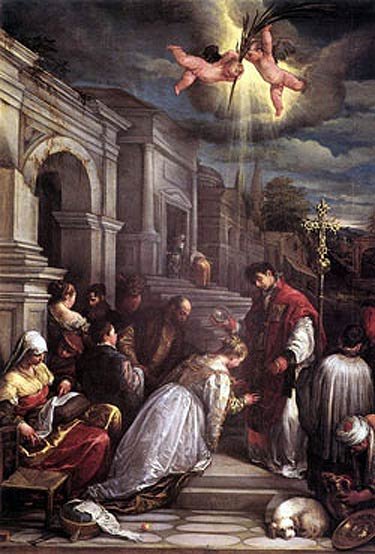
St. Valentine’s Day, formerly the LupercaliaHagiography, History, St. Valentine, Traditions, Valentine's Day
The popular customs associated with Saint Valentine’s Day undoubtedly had their origin in a conventional belief generally received in England and France during the Middle Ages, that on 14 February, i.e., half way through the second month of the year, the birds began to pair. Thus in Chaucer’s Parliament of Foules we read:
Whan every foul cometh ther to choose his mate. For this reason the day was looked upon as specially consecrated to lovers and as a proper occasion for writing love letters and sending lovers’ tokens. Both the French and English literatures of the fourteenth and fifteenth centuries contain allusions to the practice. Perhaps the earliest to be found is in the 34th and 35th Ballades of the bilingual poet, John Gower, written in French; but Lydgate and Clauvowe supply other examples. Those who chose each other under these circumstances seem to have been called by each other their Valentines. In the Paston Letters, Dame Elizabeth Brews writes thus about a match she hopes to make for her daughter (we modernize the spelling), addressing the favoured suitor:
——————————————–
ST. VALENTINE’S DAY Valentine’s Day is now almost everywhere a much degenerated festival, the only observance of any note consisting merely of the sending of jocular anonymous letters to parties whom one wishes to quiz, and this confined very much to the humbler classes. The approach of the day is now heralded by the appearance in the print-sellers’ shop windows of vast numbers of missives calculated for use on this occasion, each generally consisting of a single sheet of post paper, on the first page of which is seen some ridiculous coloured caricature of the male or female figure, with a few burlesque verses below. More rarely, the print is of a sentimental kind, such as a view of Hymen’s altar, with a pair undergoing initiation into wedded happiness before it, while Cupid flutters above, and hearts transfixed with his darts decorate the corners. Maid-servants and young fellows interchange such epistles with each other on the 14th of February, no doubt conceiving that the joke is amazingly good: and, generally, the newspapers do not fail to record that the London postmen delivered so many hundred thousand more letters on that day than they do in general. Such is nearly the whole extent of the observances now peculiar to St. Valentine’s Day. At no remote period it was very different. Ridiculous letters were unknown: and, if letters of any kind were sent, they contained only a courteous profession of attachment from some young man to some young maiden, honeyed with a few compliments to her various perfections, and expressive of a hope that his love might meet with return. But the true proper ceremony of St. Valentine’s Day was the drawing of a kind of lottery, followed by ceremonies not much unlike what is generally called the game of forfeits. Misson, a learned traveller, of the early part of the last century, gives apparently a correct account of the principal ceremonial of the day.
St. Valentine’s Day is alluded to by Shakespeare and by Chaucer, and also by the poet Lydgate (who died in 1440). The origin of these peculiar observances of St. Valentine’s Day is a subject of some obscurity. The saint himself, who was a priest of Rome, martyred in the third century, seems to have had nothing to do with the matter, beyond the accident of his day being used for the purpose. Mr. Douce, in his Illustrations of Shakespeare, says:
—————————————————- February 14th, prior to 1969, was the feast day of two, or possibly three, saints and martyrs named Valentine, all reputedly of the Third Century. The first Valentine, legend holds, was a physician and priest in Rome, arrested for giving aid to martyrs in prison, who while there converted his jailer by restoring sight to the jailer’s daughter. He was executed by being beaten with clubs, and afterwards beheaded, February 14, 270. He is traditionally the patron of affianced couples, bee keepers, lovers, travellers, young people, and greeting card manufacturers, and his special assistance may be sought in conection with epilepsy, fainting, and plague. A second St. Valentine, reportedly bishop of Interamna (modern Terni) was also allegedly martyred under Claudius II, and also allegedly buried along the Flaminian Way. A third St. Valentine is said to have also been martyred in Roman times, along with companions, in Africa. Because of a lack of historical evidence, the Roman Catholic Church dropped the February 14th feast of St. Valentine from its calendar in 1969. 08 Feb 2014
A Piece of History Closed Three Years Ago in BrooklynArchaeology, Atlantic Avenue Tunnel, Bob Diamond, Brooklyn, History
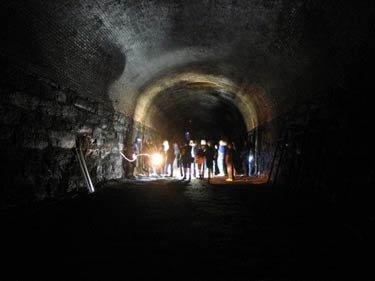
Cornelius Vanderbilt built NYC’s first subway in 1841 in order to bring steam locomotives carrying Long Island Railroad passengers from Brooklyn into Manhattan wile bypassing the traffic-filled Court Street and Atlantic Avenue intersection underground. As the Verge notes: “The Atlantic Avenue Tunnel holds the Guinness world record for “oldest subway tunnel,” predating the Tremont Street subway in Boston from 1897, the 312-foot Beach Pneumatic Transit tunnel in Manhattan from 1869, and the first subway in the London Underground, which was built in 1863.” Walt Whitman memorialized the tunnel’s closure in 1861 (after Brooklyn banned steam locomotives within its city limits): “The old tunnel, that used to lie there under ground, a passage of Acheron-like solemnity and darkness, now all closed and filled up, and soon to be utterly forgotten, with all its reminiscences.” Reputedly, the 1611-foot-long tunnel was reopened decades later for growing mushrooms, and used during Prohibition for boot-legging, but it had remained closed and forgotten for many, many years when Bob Diamond, a local amateur archaeologist, persuaded the Brooklyn Union Gas Company to open one of its manholes and allow him to explore. Diamond broke through a concrete wall and constructed his own staircase giving access to the tunnel, and operated his own small-scale business for 30 years, taking people (through the original man-hole) on tours of the historic tunnel. At the end of 2010, however, jealousy of somebody else making a dollar out of an asset over which they could claim control provoked the city authorities to shut down Diamond’s tours, closing off access to the historic tunnel permanently, on the basis of safety concerns. (No one had been injured in the course of 30 years of Diamond’s operations.) There is a bit more at Atlas Obscura. Hat tip to Fred Lapides. 02 Feb 2014
Candlemas, Demotically “Groundhog Day”Candlemas, History, Traditions
From Robert Chambers, The Book of Days, 1869: From a very early, indeed unknown date in the Christian history, the 2nd of February has been held as the festival of the Purification of the Virgin, and it is still a holiday of the Church of England. From the coincidence of the time with that of the Februation or purification of the people in pagan Rome, some consider this as a Christian festival engrafted upon a heathen one, in order to take advantage of the established habits of the people; but the idea is at least open to a good deal of doubt. The popular name Candlemass is derived from the ceremony which the Church of Rome dictates to be observed on this day; namely, a blessing of candles by the clergy, and a distribution of them amongst the people, by whom they are afterwards carried lighted in solemn procession. The more important observances were of course given up in England at the Reformation; but it was still, about the close of the eighteenth century, customary in some places to light up churches with candles on this day. At Rome, the Pope every year officiates at this festival in the beautiful chapel of the Quirinal. When he has blessed the candles, he distributes them with his own hand amongst those in the church, each of whom, going singly up to him, kneels to receive it. The cardinals go first; then follow the bishops, canons, priors, abbots, priests, &c., down to the sacristans and meanest officers of the church. According to Lady Morgan, who witnessed the ceremony in 1820: ‘When the last of these has gotten his candle, the poor conservatori, the representatives of the Roman senate and people, receive theirs. This ceremony over, the candles are lighted, the Pope is mounted in his chair and carried in procession, with hymns chanting, round the ante-chapel; the throne is stripped of its splendid hangings; the Pope and cardinals take off their gold and crimson dresses, put on their usual robes, and the usual mass of the morning is sung.’ Lady Morgan mentions that similar ceremonies take place in all the parish churches of Rome on this day. It appears that in England, in Catholic times, a meaning was attached to the size of the candles, and the manner in which they burned during the procession; that, moreover, the reserved parts of the candles were deemed to possess a strong supernatural virtue:
Where chiefest seemeth he, Whose taper greatest may be seen; And fortunate to be, Whose candle burneth clear and bright: A wondrous force and might Both in these candles lie, which if At any time they light, They sure believe that neither storm Nor tempest cloth abide, Nor thunder in the skies be heard, Nor any devil’s spide, Nor fearful sprites that walk by night, Nor hurts of frost or hail,’ &c. The festival, at whatever date it took its rise, has been designed to commemorate the churching or purification of Mary; and the candle-bearing is understood to refer to what Simeon said when he took the infant Jesus in his arms, and declared that he was a light to lighten the Gentiles. Thus literally to adopt and build upon metaphorical expressions, was a characteristic procedure of the middle ages. Apparently, in consequence of the celebration of Mary’s purification by candle-bearing, it became customary for women to carry candles with them, when, after recovery from child-birth, they went to be, as it was called, churched. A remarkable allusion to this custom occurs in English history. William the Conqueror, become, in his elder days, fat and unwieldy, was confined a considerable time by a sickness. ‘Methinks,’ said his enemy the King of France, ‘the King of England lies long in childbed.’ This being reported to William, he said, ‘When I am churched, there shall be a thousand lights in France !’ And he was as good as his word; for, as soon as he recovered, he made an inroad into the French territory, which he wasted wherever he went with fire and sword. At the Reformation, the ceremonials of Candlemass day were not reduced all at once. Henry VIII proclaimed in 1539: ‘On Candlemass day it shall be declared, that the bearing of candles is done in memory of Christ, the spiritual light, whom Simeon did prophesy, as it is read in. the church that day.’ It is curious to find it noticed as a custom down to the time of Charles II, that when lights were brought in at nightfall, people would say—’ God send us the light of heaven!’ The amiable Herbert, who notices the custom, defends it as not superstitious. Some-what before this time, we find. Herrick alluding to the customs of Candlemass eve: it appears that the plants put up in houses at Christmas were now removed.
Down with the mistletoe; Instead of holly now upraise The greener box for show. The holly hitherto did sway, Let box now domineer, Until the dancing Easter day Or Easter’s eve appear. The youthful box, which now hath grace Your houses to renew, Grown old, surrender must his place Unto the crisped yew. When yew is out, then birch comes in, And many flowers beside, Both of a fresh and fragrant kin’, To honour Whitsuntide. Green rushes then, and sweetest bents, With cooler oaken boughs, Come in for comely ornaments, To re-adorn the house. Thus times do shift; each thing in turn does hold; New things succeed, as former things grow old.’ ——————————————- ——————————————- The same poet elsewhere recommends very particular care in the thorough removal of the Christmas garnishings on this eve:
No one least branch left there behind; For look, how many leaves there be Neglected there, maids, trust to me, So many goblins you shall see.’ He also alludes to the reservation of part of the candles or torches, as calculated to have the effect of protecting from mischief:
Till sunset let it burn, Which quenched, then lay it up again, Till Christmas next return. Part must be kept, wherewith to tend The Christmas log next year; And where ‘tis safely kept, the fiend Can do no mischief there.’ Considering the importance attached to Candlemass day for so many ages, it is scarcely surprising that there is a universal superstition throughout Christendom, that good weather on this day indicates a long continuance of winter and a bad crop, and that its being foul is, on the contrary, a good omen. Sir Thomas Browne, in his “Vulgar Errors,” quotes a Latin distich expressive of this idea:
Major erit glacies post festum quam fait ante; which maybe considered as well translated in the popular Scottish rhyme:
The half o’ winter’s to come and mair; If Candlemass day be wet and foul, The half o’ winter’s gave at Yule.’ ——————————————-
——————————————- In Germany there are two proverbial expressions on this subject: 1. The shepherd would rather see the wolf enter his stable on Candlemass day than the sun; 2. The badger peeps out of his hole on Candlemass day, and when he finds snow, walks abroad; but if he sees the sun shining, he draws back into his hole. It is not improbable that these notions, like the festival of Candlemass itself, are derived from pagan times, and have existed since the very infancy of our race. So at least we may conjecture, from a curious passage in Martin’s Description of the Western Islands. On Candlemass day, according to this author, the Hebrideans observe the following curious custom: The mistress and servants of each family take a sheaf of oats and dress it up in women’s apparel, put it in a large basket, and lay a wooden club by it, and this they call BrÃd’s Bed.; and then the mistress and servants cry three times, “BrÃd is come; BrÃd is welcome!†This they do just before going to bed, and when they rise in the morning they look among the ashes, expecting to see the impression of Brad’s club there; which, if they do, they reckon it a true presage of a good crop and prosperous year, and the contrary they take as an ill omen. ———————————————————————- Groundhog Day is obviously a modern, commercialized New World adaptation of the earlier weather traditions associated with the Christian feast day with the groundhog replacing the badger. 31 Jan 2014
King Charles the MartyrHistory, King Charles I
King Charles I’s scaffold speech: “For the people. And truly I desire their Liberty and Freedom as much as any Body whomsoever. But I must tell you, That their Liberty and Freedom, consists in having of Government; those Laws, by which their Life and their goods may be most their own. It is not for having share in government, Sir, that is nothing pertaining to them. A subject and a soveraign are clean different things, and therefore until they do that, I mean, that you do put the people in that liberty as I say, certainly they will never enjoy themselves. Sirs, It was for this that now I Am come here. If I would have given way to an Arbitrary way, for to have all Laws changed according to the power of the Sword, I needed not to have come here; and therefore, I tell you, (and I pray God it be not laid to your charge) That I Am the Martyr of the People.” Hat tip to Ratak Monodosico. 30 Jan 2014
Anniversary of the Execution of King Charles IHistory, King Charles I
He nothing common did or mean 06 Jan 2014
Epiphany, or Twelfth NightEpiphany, History, Traditions
(From Robert Chambers, A Book of Days, 1869) Born: Richard II, King of England, 1366; Joan d’Arc, 1402; Peter Metastasio, poet, 1698; Benjamin Franklin, philosopher, Boston, U.S., 1706; David Dale, philanthropist, 1739; George Thomas Doo, engraver, 1800. Feast Day: St. Melanius, bishop, 490. St. Nilammon, Hermit. St. Peter, abbot of St. Austin’s, Canterbury, 608. TWELFTH-DAY This day, called Twelfth-Day, as being in that number after Christmas, and Epiphany from the Greek ‘‘ΕπιΦáνєια”, signifying appearance, is a festival of the Church, in commemoration of the Manifestation of Christ to the Gentiles; more expressly to the three Magi, or Wise Men of the East, who came, led by a star, to worship him immediately after his birth. (Matt. ii. 1-12.) The Epiphany appears to have been first observed as a separate feast in the year 813. Pope Julius I is, however, reputed to have taught the Church to distinguish the Feasts of the Nativity and Epiphany, so early as about the middle of the fourth century. The primitive Christians celebrated the Feast of the Nativity for twelve days, observing the first and last with great solemnity; and both of these days were denominated Epiphany, the first the greater Epiphany, from our Lord having on that day become Incarnate, or made his appearance in “the flesh;” the latter, the lesser Epiphany, from the three-fold manifestation of His Godhead—the first, by the appearance of the blazing star which conducted Melchior, Jasper, and Balthuzar, the three Magi, or wise men, commonly styled the three Kings of Cologne, out of the East, to worship the Messiah, and to offer him presents of “Gold, Frankincense, and Myrrh”—Melchior the Gold, in testimony of his royalty as the promised King of the Jews; Jasper the Frankincense, in token of his Divinity; and Balthuzar the Myrrh, in allusion to the sorrows which, in the humiliating condition of a man, our Redeemer vouchsafed to take upon him: the second, of the descent of the Holy Ghost in the form of a Dove, at the Baptism: and the third, of the first miracle of our Lord turning water into wine at the marriage in Cana. All of which three manifestations of the Divine nature happened on the same day, though not in the same year.
In the middle ages, the worship by the Magi was celebrated by a little drama, called the Feast of the Star:
At Milan, in 1336, the Festival of the Three Kings was celebrated in a manner that brings forcibly before us the tendency of the middle ages to fix attention on the historical externals of Christianity. The affair was got up by the Preaching Friars. The three kings appeared, crowned, on three great horses richly habited, surrounded by pages, body guards, and an innumerable retinue. A golden star was exhibited in the sky, going before them. They proceeded to the pillars of St. Lawrence, where King Herod was represented with his scribes and wise men. The three kings ask Herod where Christ should be born, and his wise men, having consulted their books, answer, at Bethlehem. On which the three kings, with their golden crowns, having in their hands golden cups filled with frankincense, myrrh, and gold, the star going before, marched to the church of St. Eustorgius, with all their attendants, preceded by trumpets, horns, asses, baboons, and a great variety of animals. In the church, on one side of the high altar, there was a manger with an ox and ass, and in it the infant Christ in the arms of his mother. Here the three kings offer Him gifts. The concourse of the people, of knights, ladies, and ecclesiastics, was such as was never before beheld. In its character as a popular festival, Twelfth-Day stands only inferior to Christmas. The leading object held in view is to do honour to the three wise men, or, as they are more generally denominated, the three kings. It is a Christian custom, ancient past memory, and probably suggested by a pagan custom, to indulge in a pleasantry called the Election of Kings by Beans. In England, in later times, a large cake was formed, with a bean inserted, and this was called Twelfth-Cake. The family and friends being assembled, the cake was divided by lot, and who-ever got the piece containing the bean was accepted as king for the day, and called King of the Bean. In England, it appears there was always a queen as well as a king on Twelfth-Night. A writer, speaking of the celebration in the south of England in 1774, says:
In the sixteenth century, it would appear that some peculiar ceremonies followed the election of the king and queen. Barnaby Goodge, in his paraphrase of the curious poem of Nagcorgus, The Popish Kingdom, 1570, states that the king, on being elected, was raised up with great cries to the ceiling, where, with chalk, he inscribed crosses on the rafters to protect the house against evil spirits. A Twelfth-Day custom, connected with Paget’s Bromley in Staffordshire, went out in the seventeenth century. A man came along the village with a mock horse fastened to him, with which he danced, at the same making a snapping noise with a bow and arrow. He was attended by half-a-dozen fellow-villagers, wearing mock deers’ heads, and displaying the arms of the several chief landlords of the town. This party danced the Hays, and other country dances, to music, amidst the sympathy and applause of the multitude. There was also a huge pot of ale with cakes by general contribution of the village, out of the very surplus of which ‘they not only repaired their church, but kept their poor too; which charges are not now, perhaps, so cheerfully borne.’ On Twelfth-Night, 1606, Ben Jonson’s masque of Hymen was preformed before the Court; and in 1613, the gentleman of Gray’s Inn were permitted by Lord Bacon to perform a Twelfth-Day masque at Whitehall. In the masque the character of Baby cake is attended by ‘an usher bearing a great cake with a bean and all with good will have spared unto your lordship, please.’ On Twelfth-Day, 1563, Mary Queen of Scots celebrated the French pastime of the King of the Bean at Holyrood, but with a queen instead of a king, as more appropriate, in consideration of herself being a female sovereign. The lot fell to the real queen’s attendant, Mary Fleming, and the mistress good-naturedly arrayed the servant in her own robes and jewels, that she might duly sustain the mimic dignity in the festivities of the night. The English resident, Randolph, who was in love with Mary Beton, another of the queen’s maids of honour, wrote in excited terms about this festival to the Earl of Leicester.
The queen of the bean was that day in a gown of cloth of silver; her head, her neck, her shoulders, the rest of her whole body, so beset with stones, that more in our whole jewel-house were not to be found. . . The cheer was great. I never found myself so happy, nor so well treated, until that it came to the point that the old queen [Mary] herself, to show her mighty power, contrary unto the assurance granted me by the younger queen [Mary Fleming], drew me into the dance, which part of the play I could with good will have spared unto your lordship, as much fitter for the purpose.” Charles I had his masque on Twelfth-Day, and the Queen hers on the Shrovetide following, the expenses exceeding £2000; and on Twelfth-Night, 1633, the Queen feasted the King at Somerset House, and presented a pastoral, in which she took part. Down to the time of the Civil Wars, the feast was observed with great splendour, not only at Court, but at the Inns of Court, and the Universities (where it was an old custom to choose the king by the bean in a cake), as well as in private mansions and smaller households. Then, too, we read of the English nobility keeping Twelfth-Night otherwise than with cake and characters, by the diversion of blowing up pasteboard castles; letting claret flow like blood, out of a stag made of paste; the castle bombarded from a pasteboard ship, with cannon, in the midst of which the company pelted each other with egg-shells filled with rose-water; and large pies were made, filled with live frogs, which hopped and flew out, upon some curious person lifting up the lid. Twelfth-Night grew to be a Court festival, in which gaming was a costly feature. Evelyn tells us that on Twelfth-Night, 1662, according to custom, his Majesty [Charles II] opened the revels of that night by throwing the dice himself in the Privy Chamber, where was a table set on purpose, and lost his £100. [The year before he won £1500.] The ladies also played very deep. Evelyn came away when the Duke of Ormond had won about £1000, and left them still at passage, cards, &c., at other tables. The Rev. Henry Teonge, chaplain of one of Charles’s ships-of-war, describes Twelfth-Night on board:
The celebrated Lord Peterborough, then a youth, was one of the party on board this ship, as Lord Mordaunt. The Lord Mayor and Aldermen and the guilds of London used to go to St. Paul’s on Twelfth-Day, to hear a sermon, which is mentioned as an old custom in the early part of Elizabeth’s reign. A century ago, the king, preceded by heralds, pursuivants, and the Knights of the Garter, Thistle, and Bath, in the collars of their respective orders, went to the Royal Chapel at St. James’s, and offered gold, myrrh, and frankincense, in imitation of the Eastern Magi offering to our Saviour. Since the illness of George III, the procession, and even the personal appearance of the monarch, have been discontinued. Two gentlemen from the Lord Chamberlain’s office now appear instead, attended by a box ornamented at top with a spangled star, from which they take the gold, frankincense, and myrrh, and place them on an alms-dish held forth by the officiating priest. In the last century, Twelfth-Night Cards represented ministers, maids of honour, and other attendants of a court, and the characters were to be supported throughout the night. John Britton, in his Autobiography, tells us he ‘ suggested and wrote a series of Twelfth-Night Characters, to be printed on cards, placed in a bag, and drawn out at parties on the memorable and merry evening of that ancient festival. They were sold in small packets to pastrycooks, and led the way to a custom which annually grew to an extensive trade. For the second year, my pen-and-ink characters were accompanied by prints of the different personages by Cruikshank (father of the inimitable George), all of a comic or ludicrous kind.’ Such characters are still printed. The celebration of Twelfth-Day with the costly and elegant Twelfth-cake has much declined within the last half-century. Formerly, in London, the confectioners’ shops on this day were entirely filled with Twelfth-cakes, ranging in price from several guineas to a few shillings; the shops were tastefully illuminated, and decorated with artistic models, transparencies, &c. We remember to have seen a huge Twelfth-cake in the form of a fortress, with sentinels and flags; the cake being so large as to fill two ovens in baking. 31 Dec 2013
New Year’s Eve, or HogmanayHistory, Hogmanay, New Year's Eve, Robert Burns, Traditions
(From Robert Chambers, A Book of Days, 1869) NEW YEAR’S EVE, OR HOGMANAY As a general statement, it may be asserted that neither the last evening of the old year nor the first day of the new one is much, observed in England as an occasion of festivity. In some parts of the country, indeed, and more especially in the northern counties, various social merry-makings take place; but for the most part, the great annual holiday-time is already past. Christmas Eve, Christmas-day, and St. Stephen’s or Boxing Day have absorbed almost entirely the tendencies and opportunities of the community at large in the direction of joviality and relaxation. Business and the ordinary routine of daily life have again been resumed; or, to apply to English habits the words of an old Scottish rhyme still current, but evidently belonging to the old times, anterior to the Reformation, when Christmas was the great popular festival: Yule’s come and Yule ‘s gane, Whilst thus the inhabitants of South Britain are settling down again quietly to work after the festivities of the Christmas season, their fellow-subjects in the northern division of the island are only commencing their annual saturnalia, which, till recently, bore, in the license and boisterous merriment which used to prevail, a most unmistakable resemblance to its ancient pagan namesake. The epithet of the Daft [mad] Days, applied to the season of the New Year in Scotland, indicates very expressively the uproarious joviality which characterized the period in question. This exuberance of joyousness—which, it must be admitted, sometimes led to great excesses—has now much declined, but New-year’s Eve and New-year’s Day constitute still the great national holiday in Scotland. Under the 1st of January, we have already detailed the various revelries by which the New Year used to be ushered in, in Scotland. It now becomes our province to notice those ceremonies and customs which are appropriate to the last day of the year, or, as it is styled in Scotland, Hogmanay. This last term has puzzled antiquaries even more than the word Yule, already adverted to; and what is of still greater consequence, has never yet received a perfectly satisfactory explanation. Some suppose it to be derived from two Greek words, άιαμηνη (the holy moon or month), and in reference to this theory it may be observed, that, in the north of England, the term used is Hagmenu, which does not seem, however, to be confined to the 31st of December, but denotes generally the period immediately preceding the New Year. Another hypothesis combines the word with another sung along with it in chorus, and asserts ‘Hogmanay, trollolay!’ to be a corruption of ‘Homma est né—Trois Bois lá” (‘A Man is born—Three Kings are there’), an allusion to the birth of our Saviour, and the visit to Bethlehem of the Wise Men, who were known in medieval times as the ‘Three Kings.’ But two additional conjectures seem much more plausible, and the reader may select for himself what he considers the most probable. One of these is, that the term under notice is derived from Hoggu-nott, Hogenat, or Hogg-night, the ancient Scandinavian name for the night preceding the feast of Yule, and so called in reference to the animals slaughtered on the occasion for sacrificial and festal purpose word hogg signifying to kill. The other derivation of Hogmanay is from ‘Au gui menez’ (‘To the mistletoe go’), or ”Au gui ľan neuf’ ‘ (‘To the mistletoe this New Year ‘), an allusion to the ancient Druidical ceremony of gathering that plant. In the patois of Touraine, in France, the word used is Aguilanneu; in Lower Normandy, and in Guernsey, poor persons and children used to solicit a contribution under the title of Hoguinanno or 0guinano; whilst in Spain the term, Aguinaldo, is employed to denote the presents made at the season of Christmas. In country places in Scotland, and also in the more retired and primitive towns, it is still customary on the morning of the last day of the year, or Hogmanay, for the children of the poorer class of people to get themselves swaddled in a great sheet, doubled up in front, so as to form a vast pocket, and then to go along the streets in little bands, calling at the doors of the wealthier classes for an expected dole of oaten-bread. Each child gets one quadrant section of oat-cake (some-times, in the case of particular favourites, improved by an addition of cheese), and this is called their hogmanay. In expectation of the large demands thus made upon them, the housewives busy themselves for several days beforehand in preparing a suitable quantity of cakes. The children on coming to the door cry, ‘Hogmanay!’ which is in itself a sufficient announcement of their demands; but there are other exclamations which either are or might be used for the same purpose. One of these is: ‘Hogmanay, Trollolay, Give us of your white bread, and none of your gray.’ And another favourite rhyme is: Get up, goodwife, and shake your feathers, The following is of a moralising character, though a good deal of a truism: Get up, goodwife, and binna sweir, The most favourite of all, however, is more to the point than any of the foregoing : My feet’s cauld, my shoon’s thin; It is no unpleasing scene, during the forenoon, to see the children going laden home, each with his large apron bellying out before him, stuffed full of cakes, and perhaps scarcely able to waddle under the load. Such a mass of oaten alms is no inconsiderable addition to the comfort of the poor man’s household, and enables him to enjoy the New-year season as much as his richer neighbours. In the primitive parish of Deerness, in Orkney, it was customary, in the beginning of the present century, for old and young of the common class of people to assemble in a great band upon the evening of the last day of the year, and commence a round of visits throughout the district. At every house they knocked at the door, and on being admitted, commenced singing, to a tune of its own, a song appropriate to the occasion. The following is what may be termed a restored version of this chant, the imagination having been called on to make up in several of the lines what was deficient in memory. The ‘Queen Mary’ alluded to is evidently the Virgin:
The very first thing which we do crave, Goodwife, gae to your butter-ark, Ten mark, ten pund, Gang to your awmrie, gin ye please, And syne bring here a sharping-stane, Ye’ll cut the cheese, and eke the round, Gae fill the three-pint cog o’ ale, We houp your ale is stark and stout, Ye ken the weather’s snow and sleet, Our shoon’s made o’ mare’s skin, The inner-door being opened, a tremendous rush was made ben the house. The inmates furnished a long table with all sorts of homely fare, and a hearty feast took place, followed by copious libations of ale, charged with all sorts of good-wishes. The party would then proceed to the next house, where a similar scene would be enacted. How they contrived to take so many suppers in one evening, heaven knows ! No slight could be more keenly felt by a Deerness farmer than to have his house passed over unvisited by the New-year singers. The doings of the guisers or guizards (that is, masquers or mummers) form a conspicuous feature in the New-year proceedings throughout Scotland. The favourite night for this exhibition is Hogmanay, though the evenings of Christmas, New-year’s Day, and Handsel Monday, enjoy like-wise a privilege in this respect. Such of the boys as can lay any claim to the possession of a voice have, for weeks before, been poring over the collection of ‘excellent new songs,’ which lies like a bunch of rags in the window-sill; and being now able to screech up ‘Barbara Allan,’ or the ‘Wee cot-house and the wee kail-yardie,’ they determine upon enacting the part of guisers. For this purpose they don old shirts belonging to their fathers, and mount mitre-shaped casques of brown paper, possibly borrowed from the Abbot of Unreason; attached to this is a sheet of the same paper, which, falling down in front, covers and conceals the whole face, except where holes are made to let through the point of the nose, and afford sight to the eyes and breath to the mouth. Each vocal guiser is, like a knight of old, attended by a sort of humble squire, who assumes the habiliments of a girl, ‘with an old-woman’s cap and a broomstick, and is styled ‘Bessie: Bessie is equal in no respect, except that she shares fairly in the proceeds of the enterprise. She goes before her principal, opens all the doors at which he pleases to exert his singing powers; and busies herself, during the time of the song, in sweeping the floor with her broomstick, or in playing any other antics that she thinks may amuse the indwellers. The common reward of this entertainment is a halfpenny, but many churlish persons fall upon the unfortunate guisers, and beat them out of the house. Let such persons, however, keep a good watch upon their cabbage-gardens next Halloween! The more important doings of the guisers are of a theatrical character. There is one rude and grotesque drama which they are accustomed to perform on each of the four above-mentioned nights; and which, in various fragments or versions, exists in every part of Lowland Scotland. The performers, who are never less than three, but sometimes as many as six, having dressed themselves, proceed in a band from house to house, generally contenting themselves with the kitchen for an arena; whither, in mansions presided over by the spirit of good-humour, the whole family will resort to witness the spectacle. Sir Walter Scott, who delighted to keep up old customs, and could condescend to simple things without losing genuine dignity, invariably had a set of guisers to perform this play before his family both at Ashestiel and Abbotsford. The drama in question bears a close resemblance, with sundry modifications, to that performed by the mummers in various parts of England, and of which we have already given a specimen. Such are the leading features of the Hogmanay festivities in Scotland. A similar custom to that above detailed of children going about from house to house, singing the Hagmena chorus, and obtaining a dole of bread or cakes, prevails in Yorkshire and the north of England; but, as we have already mentioned, the last day of the year is not in the latter country, for the most part, invested with much peculiar distinction. One or two closing ceremonies, common to both countries—the requiem, as they may be termed, of the dying year—will be more appropriately noticed in the concluding article of this work. BURNING OF THE CLAVIE A singular custom, almost unparalleled in any other part of Scotland, takes place on New-year’s Eve (old style) at the village of Burghead, on the southern shore of the Moray Firth, about nine miles from the town of Elgin. It has been observed there from time immemorial, and both its origin, and that of the peculiar appellation by which it is distinguished, form still matter of conjecture and dispute for antiquaries. The following extract from the Banffshire Journal presents a very interesting and comprehensive view of all that can be stated regarding this remarkable ceremonial: ‘Any Hogmanay afternoon, a small group of sea-men and coopers, dressed in blue overfrocks, and followed by numbers of noisy youngsters, may be seen rapidly wending their way to the south-western extremity of the village, where it is customary to build the Clavie. One of the men bears on his shoulders a stout Archangel tar-barrel, kindly presented for the occasion by one of the merchants, who has very considerately left a quantity of the resinous fluid in the bottom. Another carries a common herring-cask, while the remainder are laden with other raw materials, and the tools necessary for the construction of the Clavie. Arrived at the spot, three cheers being given for the success of the undertaking, operations are commenced forthwith. In the first place, the tar-barrel is sawn into two unequal parts; the smaller forms the groundwork of the Clavie, the other is broken up for fuel. A common fir prop, some four feet in length, called the “spoke,” being then procured, a hole is bored through the tub-like machine, that, as we have already said, is to form the basis of the unique structure, and a long nail, made for the purpose, and furnished gratuitously by the village black-smith, unites the two. Curiously enough, no hammer is allowed to drive this nail, which is “sent home” by a smooth stone. The herring-cask is next demolished, and the staves are soon under-going a diminution at both extremities, in order to fit them for their proper position. They are nailed, at intervals of about two inches all round, to the lower edge of the Clavie-barrel, while the other ends are firmly fastened to the spoke, an aperture being left sufficiently large to admit the head of a man. Amid tremendous cheering, the finished Clavie is now set up against the wall, which is mounted by two stout young men, who proceed to the business of filling and lighting. A few pieces of the split-up tar-barrel are placed in a pyramidal form in the inside of the Clavie, enclosing a small space for the reception of a burning peat, when everything is ready. The tar, which had been previously removed to another vessel, is now poured over the wood; and the same inflammable substance is freely used, while the barrel is being closely packed with timber and other combustible materials, that rise twelve or thirteen inches above the rim. ‘By this time the shades of evening have begun to descend, and soon the subdued murmur of the crowd breaks forth into one loud, prolonged cheer, as the youth who was despatched for the fiery peat (for custom says no sulphurous lucifer, no patent congreve dare approach ‘within the sacred precincts of the Clavie) arrives with his glowing charge. The master-builder relieving him of his precious trust, places it within the opening already noticed, where, revived by a hot blast from his powerful lungs, it ignites the surrounding wood and tar, which quickly bursts into a flame. During the short time the fire is allowed to gather strength, cheers are given in rapid succession for “The Queen,” “The Laird,” “The Provost,” “The Town,” “The Harbour,” and “The Railway,” and then Clavie-bearer number one, popping his head between the staves, is away with his flaming burden. Formerly, the Clavie was carried in triumph round every vessel in the harbour, and a handful of grain thrown into each, in order to insure success for the coming year; but as this part of the ceremony came to be tedious, it was dropped, and the procession confined to the boundaries of the town. As fast as his heavy load will permit him, the bearer hurries along the well-known route, followed by the shouting Burgheadians, the boiling tar meanwhile trickling down in dark sluggish streams all over his back. Nor is the danger of scalding the only one he who essays to carry the Clavie has to confront, since the least stumble is sufficient to destroy his equilibrium. Indeed, this untoward event, at one time looked on as a dire calamity, foretelling disaster to the place, and certain death to the bearer in the course of next year, not unfrequently occurs. Having reached the junction of two streets, the carrier of the Clavie is relieved; and while the change is being effected, firebrands plucked from the barrel are thrown among the crowd, who eagerly scramble for the tarry treasure, the possession of which was of old deemed a sure safeguard against all unlucky contingencies. Again the multitude bound along; again they halt for a moment as another individual takes his place as bearer—a post for the honour of which there is sometimes no little striving. The circuit of the town being at length completed, the Clavie is borne along the principal street to a small hill near the northern extremity of the promontory called the “Doorie,” on the summit of which a freestone pillar, very much resembling an ancient altar, has been built for its reception, the spoke fitting into a socket in the centre. Being now firmly seated on its throne, fresh fuel is heaped on the Clavie, while, to make the fire burn the brighter, a barrel with the ends knocked out is placed on the top. Cheer after cheer rises from the crowd below, as the efforts made to increase the blaze are crowned with success. ‘Though formerly allowed to remain on the Doorie the whole night, the Clavie is now removed when it has burned about half an hour. Then comes the most exciting scene of all. The barrel is lifted from the socket, and thrown down on the western slope of the hill, which appears to be all in one mass of flame—a state of matters that does not, however, prevent a rush to the spot in search of embers. Two stout men, instantly seizing the fallen Clavie, attempt to demolish it by dashing it to the ground: which is no sooner accomplished than a final charge is made among the blazing fragments, that are snatched up in total, in spite of all the powers of combustion, in an incredibly short space of time. Up to the present moment, the origin of this peculiar custom is involved in the deepest obscurity. Some would have us to believe that we owe its introduction to the Romans; and that the name Clavie is derived from the Latin word clavus, a nail—witches being frequently put to death in a barrel stuck full of iron spikes; or from clavis, a key—the rite being instituted when Agricola discovered that Ptoroton, i.e., Burghead, afforded the grand military key to the north of Scotland. As well might these wild speculators have remarked that Doorie, which may be spelled Durie, sprang from durus, cruel, on account of the bloody ceremony celebrated on its summit. Another opinion has been boldly advanced by one party, to the effect that the Clavie is Scandinavian in origin, being introduced by the Norwegian Vikings, during the short time they held the promontory in the beginning of the eleventh century, though the theorist advances nothing to prove his assumption, save a quotation from Scott’s Marmion; while, to crown all, we have to listen to a story that bears on its face its own condemnation, invented to confirm the belief that a certain witch, yclept, a Kitty Clavers,” bequeathed her name to the singular rite. Unfortunately, all external evidence being lost, we are compelled to rely entirely on the internal, which we have little hesitation, however, in saying points in an unmistakable manner down through the long vistas of our national history to where the mists of obscurity hang around the Druid worship of our forefathers. It is well known that the elements of fire were often present in Druidical orgies and customs (as witness their cran-tara); while it is universally admitted that the bonfires of May-day and Mid-summer eve, still kept up in different parts of the country, are vestiges of these rites. And why should not the Clavie be so too, seeing that it bears throughout the stamp of a like parentage? The carrying home of the embers, as a protection from the ills of life, as well as other parts of the ceremony, finds a counterpart in the customs of the Druids; and though the time of observance be somewhat different, yet may not the same causes (now unknown ones) that have so greatly modified the Clavie have likewise operated in altering the date, which, after all, occurs at the most solemn part of the Druidical year?’ Welcome to
NEVER YET MELTED
Another Right-Wing Web Aggregator and Purveyor of Unpopular Opinions
 David Zincavage contact: jdz@usa.net blog advertising is good for General Bullmoose and good for the USA. 


Feeds
|