BOSTON
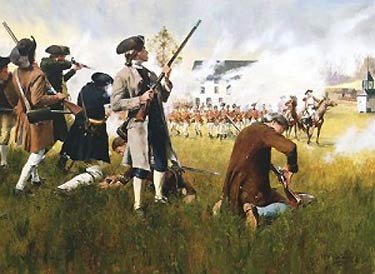
National guard units seeking to confiscate a cache of recently banned assault weapons were ambushed on April 19th by elements of a Para-military extremist faction. Military and law enforcement sources estimate that 72 were killed and more than 200 injured before government forces were compelled to withdraw.
Speaking after the clash, Massachusetts Governor Thomas Gage declared that the extremist faction, which was made up of local citizens, has links to the radical right-wing tax protest movement. Gage blamed the extremists for recent incidents of vandalism directed against internal revenue offices. The governor, who described the group’s organizers as “criminals,” issued an executive order authorizing the summary arrest of any individual who has interfered with the government’s efforts to secure law and order. The military raid on the extremist arsenal followed wide-spread refusal by the local citizenry to turn over recently outlawed assault weapons.
Gage issued a ban on military-style assault weapons and ammunition earlier in the week. This decision followed a meeting in early this month between government and military leaders at which the governor authorized the forcible confiscation of illegal arms.
One government official, speaking on condition of anonymity, pointed out that “none of these people would have been killed had the extremists obeyed the law and turned over their weapons voluntarily.” Government troops initially succeeded in confiscating a large supply of outlawed weapons and ammunition. However, troops attempting to seize arms and ammunition in Lexington met with resistance from heavily-armed extremists who had been tipped off regarding the government’s plans. During a tense standoff in Lexington ‘s town park, National Guard Colonel Francis Smith, commander of the government operation, ordered the armed group to surrender and return to their homes. The impasse was broken by a single shot, which was reportedly fired by one of the right-wing extremists. Eight civilians were killed in the ensuing exchange.
Ironically, the local citizenry blamed government forces rather than the extremists for the civilian deaths. Before order could be restored, armed citizens from surrounding areas had descended upon the guard units.
Colonel Smith, finding his forces over matched by the armed mob, ordered a retreat.
Governor Gage has called upon citizens to support the state/national joint task force in its effort to restore law and order. The governor also demanded the surrender of those responsible for planning and leading the attack against the government troops. Samuel Adams, Paul Revere, and John Hancock, who have been identified as “ringleaders” of the extremist faction, remain at large.
. . . And this, people, is how the American Revolution began .
Donald Kagan, Sterling Professor of Classics and History, retired last month after 44 years at Yale. He delivered a memorable Farewell Address, previously only available as a very, very long video, which now may be read at one’s own convenience thanks to the New Criterion.
My subject is liberal education, and today more than ever the term requires definition, especially as to the questions: What is a liberal education and what it is for? From Cicero’s artes liberales, to the attempts at common curricula in more recent times, to the chaotic cafeteria that passes for a curriculum in most American universities today, the concept has suffered from vagueness, confusion, and contradiction. From the beginning, the champions of a liberal education have thought of it as seeking at least four kinds of goals. One was as an end in itself, or at least as a way of achieving that contemplative life that Aristotle thought was the greatest happiness. Knowledge and the acts of acquiring and considering it were the ends of this education and good in themselves. A second was as a means of shaping the character, the style, the taste of a person—to make him good and better able to fit in well with and take his place in the society of others like him. A third was to prepare him for a useful career in the world, one appropriate to his status as a free man. For Cicero and Quintilian, this meant a career as an orator that would allow a man to protect the private interests of himself and his friends in the law courts and to advance the public interest in the assemblies, senate, and magistracies. The fourth was to contribute to the individual citizen’s freedom in ancient society. Servants were ignorant and parochial, so free men must be learned and cosmopolitan; servants were ruled by others, so free men must take part in their own government; servants specialized to become competent at some specific and limited task, so free men must know something of everything and understand general principles without yielding to the narrowness of expertise. The Romans’ recommended course of study was literature, history, philosophy, and rhetoric.
It was once common to think of the medieval university as very different, as a place that focused on learning for its own sake. But the medieval universities, whatever their commitment to learning for its own sake, were institutions that trained their students for professional careers. Graduates in the liberal arts were awarded a certificate that was a license to teach others what they had learned and to make a living that way. For some, the study of liberal arts was preliminary to professional study in medicine, theology, or law and was part of the road to important positions in church and state.
Boldini painting of grande horizontale subsequently sold at auction for £1.78 million
The Daily Mail describes a Belle Époque Parisian apartment, locked up at the time of the WWII German advance on the French capital which has remained unopened for over 70 years.
Inside the Paris apartment untouched for 70 years: Treasure trove finally revealed after owner locked up and fled at outbreak of WWII.
Caked in dust and full of turn-of-the century treasures, this Paris apartment is like going back in time.
Having lain untouched for seven decades the abandoned home was discovered three years ago after its owner died aged 91.
The woman who owned the flat, a Mrs De Florian, had fled for the south of France before the outbreak of the Second World War.
She never returned and in the 70 years since, it looks like no-one had set foot inside.
The property was found near a church in the French capital’s 9th arrondissement, between Pigalle red light district and Opera.
Experts were tasked with drawing up an inventory of her possessions which included a painting by the 19th century Italian artist Giovanni Boldini.
One expert said it was like stumbling into the castle of Sleeping Beauty, where time had stood still since 1900. ‘There was a smell of old dust,’ said Olivier Choppin-Janvry, who made the discovery.
But he said his heart missed a beat when he caught sight of a stunning tableau of a woman in a pink muslin evening dress.
The painting was by Boldini and the subject a beautiful Frenchwoman who turned out to be the artist’s former muse and Mrs de Florian’s grandmother, Marthe de Florian, a beautiful French actress and socialite of the Belle Époque.
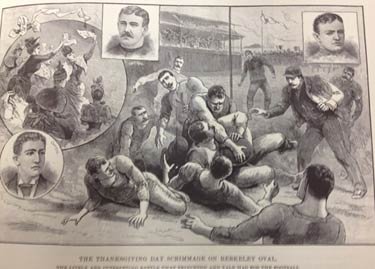
[New Editor-and-Publisher Richard K. Fox] reduced subscription rates for saloon keepers, barbers, and hotel managers — business owners that happened to cater to the Police Gazette’s target audience of young, single, urban men. Second, Fox further increased the number of illustrations and effectively created the men’s magazine tradition of featuring sexy layouts of women by introducing his “Footlight Favorites†— engravings of buxom burlesque dancers and soubrettes who showed an occasional bare arm or ankle (*wolf whistle* *cat call* *drooling*). Third, noticing America’s increasing interest in sports, Fox had the vision to create America’s first journalistic sports department in 1879 and wrote full-page stories about boxing, football, and baseball. Fourth, to provide stories for his magazine and to curry favor with his readers, Fox began sponsoring boxing prize fights. Finally, ever the marketing and branding master, Fox began printing the Police Gazette on distinctive pink paper that became a trademark for the magazine. Fox framed all these new additions and features with a cheeky irony and humor that made the magazine an easy and entertaining read.
Fox’s changes to the magazine paid off big time. In just a few short years he tripled the circulation from what it was under Matsell and ad revenue was on par with some of the largest and most popular magazines of the time. Alternatively referred to as the “bachelor bible†and the “barber shop bible,†circulation reached 150,000 a week, with special issues snatched up by more than 400,000; and these numbers really understate the magazine’s reach, as one copy of the Gazette might be read by a hundred men at a saloon or barber shop. The magazine was so firmly established as a fixture in the latter that a common joke sprung up that went like this: “Did you read The National Police Gazette?†“No, I shave myself.†(yuk, yuk, yuk.)
All this makes me feel like the Ancient Mariner. The Police Gazette was actually still a barbershop staple during my boyhood in 1950s Pennsylvania. I was already an avid reader, but the Gazette just wasn’t for me. I found it boring, old-fashioned, and slightly unsavory. I preferred Field & Stream.
Footlight Fairies were a lot tamer than Playboy Playmates.
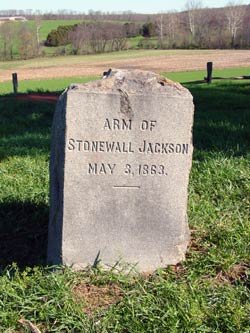
Randon Billings Noble (Now, that is a Southern name!) commemorates the 150th Anniversary of the Battle of Chancellorsville and Stonewall Jackson’s accidental wounding and death by searching for the internment site of General Jackson’s amputated arm.
I was walking through a cornfield in search of a cemetery in the middle of Virginia. A fox trotted across the path in front of me and disappeared in the forest of stalks with barely a rustle. I was searching for Stonewall Jackson’s lost arm. …
In Chancellorsville, 150 years later, the story of this arm is surprisingly well documented. A large quartz boulder marks the place where Jackson fell and signs along Route 3 mark the “Wounding of Jackson†and “Jackson’s Amputation.†But the cemetery in which the arm was buried is not marked. I knew that an aide had taken the arm to his own family graveyard, and I learned from one of the markers that the cemetery was called Ellwood, but I didn’t know where it was—only that it was nearby.
I drove through Chancellorsville National Military Park with my eyes open for anything that looked like it might lead to a cemetery. Late in the day, in a gray misty rain, having already given up, I pulled into a driveway to turn around and stopped short at a rusty iron gate with soldered block letters, E L L W O O D.
I hesitated. It was clearly a locked gate, but a faint trail led around it and continued through dense woods. While I didn’t want to trespass, I didn’t want to retreat either. The mystery of the arm was too great; I left the car in the driveway.
In the course of reviewing Aldo Schiavone’s Spartacus (just published in English translation by Harvard), Mary Beard explains just how little we actually know about the gladiator-leader of a servile revolt.
In the entrance hall of a fairly ordinary house in ancient Pompeii, buried beneath layers of later paint, are the faint traces of an intriguing sketch of two men fighting on horseback. They are named in captions above their heads, written in Oscan—one of the early languages of South Italy that was eventually wiped out by the Latin of the Romans. The name of one is scarcely legible, but probably says “Felix the Pompeian†(or “Lucky from Pompeiiâ€). The other reads clearly, in Oscan, “Spartaks,†which in Latin would be “Spartacusâ€â€”a name best known to us from the slave and gladiator who in the late 70s BC led a rebellion that, it is said, very nearly managed to defeat the power of Rome itself.
At first sight, the scene painted on the wall looks like a military battle. But the trumpeters on either side of this pair of fighters match those often found next to gladiators in ancient paintings. So this is probably meant to depict mounted gladiatorial combat. The men must be the equites, or “horsemen,†who sometimes appeared in those bloody Roman spectacles, alongside the more familiar, heavily armed characters who fought on foot.
It is, of course, possible that the painting has nothing to do with the famous Spartacus, and that it refers to some other gladiator who just happened to have the same name; that is certainly what some skeptics argue. But there are nevertheless good reasons for linking the painting to the famous rebel: it very likely dates to the lifetime of “our†Spartacus, in the early years of the first century BC (as both the archaeological setting and the use of the Oscan language suggest); and Pompeii was, in any case, less than forty miles from Capua, where Spartacus underwent training for combat and from where he is said to have launched his rebellion—the two towns were presumably on the same gladiatorial circuit. There is a fair chance that this image gives us a glimpse of the future enemy of Rome when he was still just an ordinary gladiator—and to judge from the picture, not a totally successful one. For “Felix the Pompeian†is certainly getting the better of the retreating Spartaks. In fact, we might guess that it was to celebrate the victory of the local man that the Pompeian householder put up this image in his front hall.
May 2, 1863, was one of the greatest days of Robert E. Lee’s military career. It was also one of the worst. A little after 5:00 that afternoon a Confederate flank attack led by Lt. Gen. Thomas J. “Stonewall†Jackson had slammed into the Union right flank at the Battle of Chancellorsville. It was key to what would be Lee’s greatest victory. But later that night General Jackson, Lee’s “right arm,†was badly wounded in a case of mistaken identity.
The attack should not have worked. General Lee divided his army in the face of an enemy that had more than twice his numbers. It was something a military leader should never do. The Union army even saw the flanking march being made. Instead of attacking, which likely would have brought disaster upon the Southern forces, maybe even destroying the Army of Northern Virginia, the Federals were happy with what they thought was a Confederate retreat.
When Jackson’s men burst out of the woods upon the unsuspecting Union flank, the soldiers in blue crumbled. The attack overwhelmed them and the Rebels pushed hard, taking advantage of their success. The only thing stopping them was the fading light.
The men were tired from their twelve-mile dusty march through the Wilderness and the following attack. Darkness brought on a welcome reprieve, but it wasn’t to last. Jackson, always aggressive, was not finished. He had the enemy ahead of him on the ropes and he wanted to finish him off.
Night attacks in the Civil War were rare. But Jackson saw an opportunity to inflict a damaging blow to the enemy. The following night was to be a full moon, so on the 2nd it should be quite bright. In preparation for the continued assault, Jackson, Maj. Gen. A. P. Hill, and a party of aides and guides rode out in front of the Confederate line to reconnoiter.
Two months later, had Jackson survived the Battle of Chancellorsville, he would have been in command of his Corps, which would have arrived down the Carlisle Pike in the middle of the afternoon of July 1st at Gettysburg on the flank of Buford’s Cavalry and the Union First Corps who were, at that point, beginning to retreat.
Jackson would have seized the opportunity aggressively, unlike his successor Ewell, and would undoubtedly have pursued and driven the Union forces, denying them possession of the high ground of Cemetery Ridge and Culp’s Hill. The First Day of Gettysburg would then have been the only day of Gettysburg, and would have represented a significant Confederate victory on Northern soil. There would have been no Second Day: no indecisive struggle at the Peach Orchard, Devil’s Den, and Little Round Top, and no Third Day: no Pickett’s Charge.
Mead would have retreated to the Pipe Clay Creek in Maryland, but he would soon have found himself under intense pressure from Lincoln to attack the Confederates in order to save Northern cities, like Philadelphia, from occupation. A Northern attack on well-chosen Confederate defensive position would probably have led to another debacle like Fredericksburg. Two major defeats on Northern soil, the destruction of the railroad bridge over the Susquehanna which linked the East and West, the fall of a major Northern city, such a string of events might well have brought European recognition and a negotiated peace.
The bishop of New Orleans reputedly began a prayer shortly after the war: “O Lord, when Thou didst decide to defeat the Confederate States of America, Thou first had to remove Thy servant Stonewall Jackson.”
Glen Weldon Superman’s biographer), in the New Republic, traces the Man of Steel’s history and the changes to his persona and characteristics over the decades which mirrored those of America’s changing culture.
Seventy-five years ago, every red-blooded American kid read comic books.
Churned out on cheap paper, these comics sold for ten cents a pop, a not inconsiderable amount of money considering that the Great Depression still hung in the nation’s doorway like a party guest who can’t take a hint. In exchange for their dimes, kids could spend an entire afternoon at the movies, gorge themselves at the soda fountain, or take home a comic ablaze with the four-color adventures of Tarzan, Buck Rogers, Popeye and other well-known strips hastily reprinted from the newspaper funny pages.
Then came Action Comics #1.
Like the other comics of its day, Action adopted an anthology format, offering eleven different features of varying length. These features, however, were different. They were, for the first time, original stories starring brand new characters. Despite their brawny, evocative names—Scoop Scanlon! Sticky-Mitt Stimson! Pep Morgan! Chuck Dawson, Fastest Gun in the West!—none of them would last.
Well. Except one.
The guy on the cover? That circus strongman hefting a green Studebaker over his head? That guy?
He’d hang around. In fact, he’d do much more than that. Scant months after Superman’s debut as the lead feature of Action #1, he would leap from the comics page into the funny pages and from there into the toy box, onto the radio, the movie screen, and the television. Over the course of a 75-year multimedia push, he would transcend the various media that convey him and infiltrate the collective consciousness of the country, and the world. He would construct his own archetype, powered by a uniquely American fuel mixture: our power and privilege, our violence and spectacle, our noblest ideals.
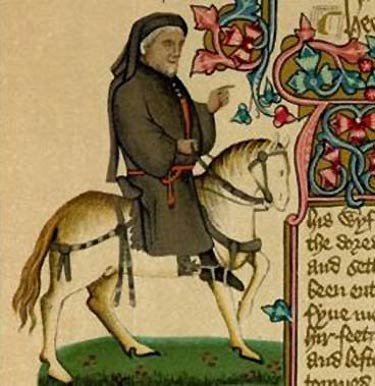
On this day (or possibly the next) in 1394, Geoffrey Chaucer’s twenty-nine pilgrims met at the Tabard Inn in Southwark to prepare for their departure to Canterbury. Chaucer’s poem condenses the four to five day trip into one, and scholars have used various textual references and astrological calculations to establish that day as the day before Easter, thus allowing the pilgrims to arrive at Canterbury Easter morning, after a fifty-five-mile hike through a pleasant English springtime.
Here begins the Book
of the Tales of Canterbury
1: Whan that aprill with his shoures soote
2: The droghte of march hath perced to the roote,
3: And bathed every veyne in swich licour
4: Of which vertu engendred is the flour;
5: Whan zephirus eek with his sweete breeth
6: Inspired hath in every holt and heeth
7: Tendre croppes, and the yonge sonne
8: Hath in the ram his halve cours yronne,
9: And smale foweles maken melodye,
10: That slepen al the nyght with open ye
11: (so priketh hem nature in hir corages);
12: Thanne longen folk to goon on pilgrimages,
13: And palmeres for to seken straunge strondes,
14: To ferne halwes, kowthe in sondry londes;
15: And specially from every shires ende
16: Of engelond to caunterbury they wende,
17: The hooly blisful martir for to seke,
18: That hem hath holpen whan that they were seeke.
19: Bifil that in that seson on a day,
20: In southwerk at the tabard as I lay
21: Redy to wenden on my pilgrymage
22: To caunterbury with ful devout corage,
23: At nyght was come into that hostelrye
24: Wel nyne and twenty in a compaignye,
25: Of sondry folk, by aventure yfalle
26: In felaweshipe, and pilgrimes were they alle,
27: That toward caunterbury wolden ryde.
28: The chambres and the stables weren wyde,
29: And wel we weren esed atte beste.
30: And shortly, whan the sonne was to reste,
31: So hadde I spoken with hem everichon
32: That I was of hir felaweshipe anon,
33: And made forward erly for to ryse,
34: To take oure wey ther as I yow devyse.
——————————-
My favorite quotation:
NPT 2805 Sir, sey somwhat of huntyng, I yow preye.
My wife Karen forwarded to me the other day Gizmodo’s story on a dry nook in the middle of a pond in Vöcklabruck, Austria, and it is certainly an eye-catching and amusing architectural gimmick.
The interesting coincidence is the location.
Vöcklabruck, in Upper Austria is my family’s ancestral home.
They were first recorded under the surname “Buchhaim,” which later became corrupted into Puchhaim and finally Pöchner. (Zienkiewicz came later.)
Seibmacher writes:
Über die Heimat der Pöchner ist nichts verlässliches bekannt. Während einige dieselben aus Schottland stammen lassen, wieder andere Steiermark als ihre Heimat nennen, kommen selbe zu Anfang des. 12. Jahrhunderts bereits in Salzburg vor, von wo sie sich nach Oberöstereich in die Gegend von Vöcklabruck wandten.
(translation:)
Concerning the homeland of the Pöchners there is no reliable information. According to some they originally emigrated from Scotland, but different sources call the Steiermark their homeland. From the beginning of the 12th Century onward they were in Salzburg, from whence they went to Upper Austria to the vicinity of Vöcklabruck.
The theory proposed by the former sources is that Buchhaim-Puchhaim-Pöchner surname comes actually from the Scottish Buchan, and that some Comyns related to the Norman Comyns who inherited via a Celtic maternal line the Scottish Earldom of Buchan moved to Austria.
This would be a plausible story if the emigration occurred in the years between 1306 and 1314 when the Comyns lost the struggle for power and the throne of Scotland to the Bruces, but the Pöchners are already in Austria two centuries earlier.
Below is the Pöchner coat of arms, which the heraldically-knowledgeable will perceive at once represents a simple reversal of the tinctures of the arms of Austria, i.e. of the Babbenburg Dukes of Austria, acquired by Leopold V (“Luitpold der Tugendhafte,” Leopold the Virtuous) in the course of the 1191 Siege of Acre.
Leopold’s arms consisted of “Gules, a fess Argent” because in the course of the fighting his tunic had become completely covered with blood except for a white band which had been covered by his belt.
Smithsonian’s Design Decoded explains the architectural origin of today’s standard Staunton-style chess men.
Prior to 1849, there was no such thing as a “normal chess set.†At least not like we think of it today. Over the centuries that chess had been played, innumerable varieties of sets of pieces were created, with regional differences in designation and appearance. As the game proliferated throughout southern Europe in the early 11th century, the rules began to evolve, the movement of the pieces were formalized, and the pieces themselves were drastically transformed from their origins in 6th century India. Originally conceived of as a field of battle, the symbolic meaning of the game changed as it gained popularity in Europe, and the pieces became stand-ins for a royal court instead of an army. Thus, the original chessmen, known as counselor, infantry, cavalry, elephants, and chariots, became the queen, pawn, knight, bishop, and rook, respectively. By the 19th century, chess clubs and competitions began to appear all around the world, it became necessary to use a standardized set that would enable players from different cultures to compete without getting confused.
In 1849, that challenge would be met by the “Staunton†Chess Set.
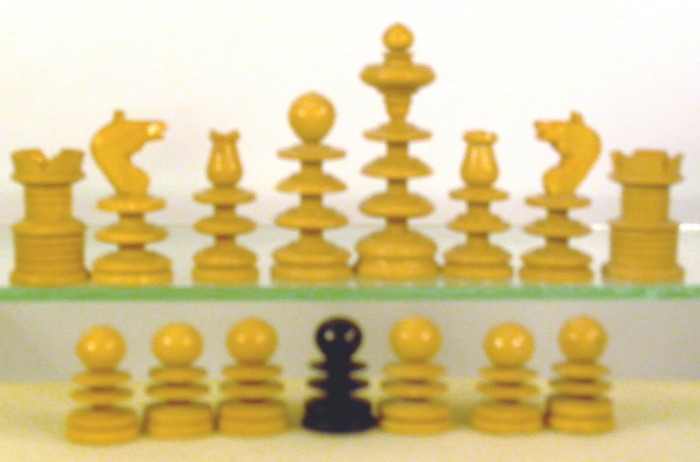
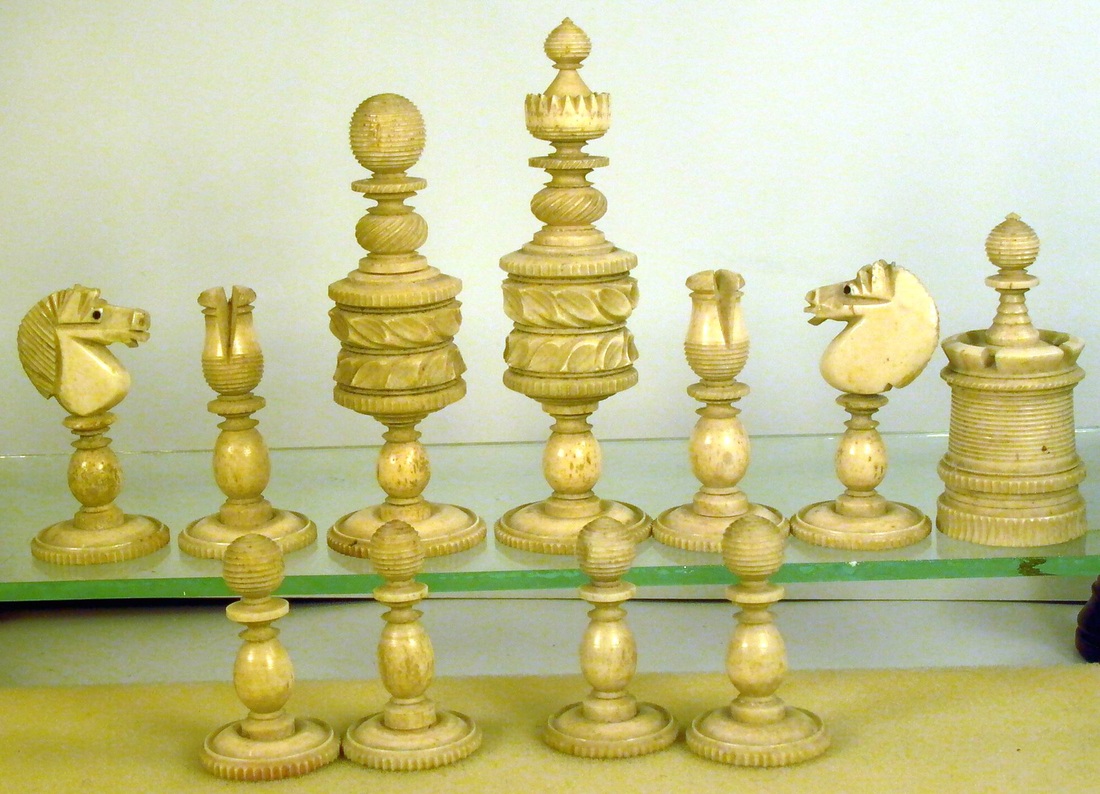
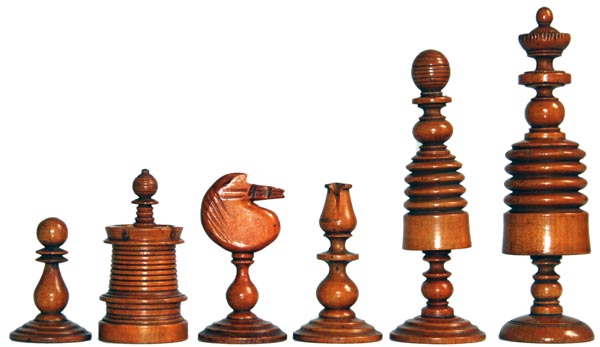
The Staunton chess pieces are the ones we know and love today, the ones we simply think of as chess pieces. Prior to its invention, there were a wide variety of popular styles in England, such as The St George, The English Barleycorn, and the Northern Upright. To say nothing of the regional and cultural variations. But the Staunton quickly would surpass them all. Howard Staunton was a chess authority who organized many tournaments and clubs in London, and was widely considered to be one of the best players in the world. Despite its name, the iconic set was not designed by Howard Staunton.
According to the most widely told origin story, the Staunton set was designed by architect Nathan Cook, who looked at a variety of popular chess sets and distilled their common traits while also, more importantly, looking at the city around him. Victorian London’s Neoclassical architecture had been influenced by a renewed interest in the ruins of ancient Greece and Rome, which captured the popular imagination after the rediscovery of Pompeii in the 18th century. The work of architects like Christopher Wren, William Chambers, John Soane, and many others inspired the column-like, tripartite division of king, queen, and bishop. A row of Staunton pawns evokes Italianate balustrades enclosing of stairways and balconies.