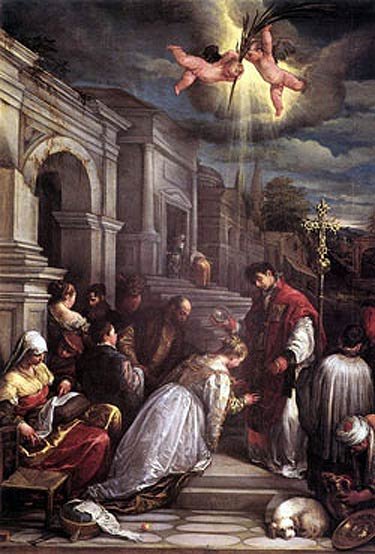
Jacopo Bassano, St Valentine Baptizing St Lucilla, 1575, oil on canvas, Museo Civico, Bassano del Grappa
The popular customs associated with Saint Valentine’s Day undoubtedly had their origin in a conventional belief generally received in England and France during the Middle Ages, that on 14 February, i.e., half way through the second month of the year, the birds began to pair. Thus in Chaucer’s Parliament of Foules we read:
For this was sent on Seynt Valentyne’s day
Whan every foul cometh ther to choose his mate.
For this reason the day was looked upon as specially consecrated to lovers and as a proper occasion for writing love letters and sending lovers’ tokens. Both the French and English literatures of the fourteenth and fifteenth centuries contain allusions to the practice. Perhaps the earliest to be found is in the 34th and 35th Ballades of the bilingual poet, John Gower, written in French; but Lydgate and Clauvowe supply other examples. Those who chose each other under these circumstances seem to have been called by each other their Valentines.
In the Paston Letters, Dame Elizabeth Brews writes thus about a match she hopes to make for her daughter (we modernize the spelling), addressing the favoured suitor:
And, cousin mine, upon Monday is Saint Valentine’s Day and every bird chooses himself a mate, and if it like you to come on Thursday night, and make provision that you may abide till then, I trust to God that ye shall speak to my husband and I shall pray that we may bring the matter to a conclusion.
——————————————–
From Robert Chambers, The Book of Days, 1869: Feast Day: St. Valentine, priest and martyr, circ. 270.
ST. VALENTINE’S DAY
Valentine’s Day is now almost everywhere a much degenerated festival, the only observance of any note consisting merely of the sending of jocular anonymous letters to parties whom one wishes to quiz, and this confined very much to the humbler classes. The approach of the day is now heralded by the appearance in the print-sellers’ shop windows of vast numbers of missives calculated for use on this occasion, each generally consisting of a single sheet of post paper, on the first page of which is seen some ridiculous coloured caricature of the male or female figure, with a few burlesque verses below. More rarely, the print is of a sentimental kind, such as a view of Hymen’s altar, with a pair undergoing initiation into wedded happiness before it, while Cupid flutters above, and hearts transfixed with his darts decorate the corners. Maid-servants and young fellows interchange such epistles with each other on the 14th of February, no doubt conceiving that the joke is amazingly good: and, generally, the newspapers do not fail to record that the London postmen delivered so many hundred thousand more letters on that day than they do in general. Such is nearly the whole extent of the observances now peculiar to St. Valentine’s Day.
At no remote period it was very different. Ridiculous letters were unknown: and, if letters of any kind were sent, they contained only a courteous profession of attachment from some young man to some young maiden, honeyed with a few compliments to her various perfections, and expressive of a hope that his love might meet with return. But the true proper ceremony of St. Valentine’s Day was the drawing of a kind of lottery, followed by ceremonies not much unlike what is generally called the game of forfeits. Misson, a learned traveller, of the early part of the last century, gives apparently a correct account of the principal ceremonial of the day.
‘On the eve of St. Valentine’s Day,’ he says, ‘the young folks in England and Scotland, by a very ancient custom, celebrate a little festival. An equal number of maids and bachelors get together: each writes their true or some feigned name upon separate billets, which they roll up, and draw by way of lots, the maids taking the men’s billets, and the men the maids’: so that each of the young men lights upon a girl that he calls his valentine, and each of the girls upon a young man whom she calls hers. By this means each has two valentines: but the man sticks faster to the valentine that has fallen to him than to the valentine to whom he is fallen. Fortune having thus divided the company into so many couples, the valentines give balls and treats to their mistresses, wear their billets several days upon their bosoms or sleeves, and this little sport often ends in love.’
St. Valentine’s Day is alluded to by Shakespeare and by Chaucer, and also by the poet Lydgate (who died in 1440).
The origin of these peculiar observances of St. Valentine’s Day is a subject of some obscurity. The saint himself, who was a priest of Rome, martyred in the third century, seems to have had nothing to do with the matter, beyond the accident of his day being used for the purpose. Mr. Douce, in his Illustrations of Shakespeare, says:
“It was the practice in ancient Rome, during a great part of the month of February, to celebrate the Lupercalia, which were feasts in honour of Pan and Juno. whence the latter deity was named Februata, Februalis, and Februlla. On this occasion, amidst a variety of ceremonies, the names of young women were put into a box, from which they were drawn by the men as chance directed. The pastors of the early Christian church, who, by every possible means, endeavoured to eradicate the vestiges of pagan superstitions, and chiefly by some commutations of their forms, substituted, in the present instance, the names of particular saints instead of those of the women: and as the festival of the Lupercalia had commenced about the middle of February, they appear to have chosen St. Valentine’s Day for celebrating the new feast, because it occurred nearly at the same time.”
February 14th, prior to 1969, was the feast day of two, or possibly three, saints and martyrs named Valentine, all reputedly of the Third Century.
The first Valentine, legend holds, was a physician and priest in Rome, arrested for giving aid to martyrs in prison, who while there converted his jailer by restoring sight to the jailer’s daughter. He was executed by being beaten with clubs, and afterwards beheaded, February 14, 270. He is traditionally the patron of affianced couples, bee keepers, lovers, travellers, young people, and greeting card manufacturers, and his special assistance may be sought in conection with epilepsy, fainting, and plague.
A second St. Valentine, reportedly bishop of Interamna (modern Terni) was also allegedly martyred under Claudius II, and also allegedly buried along the Flaminian Way.
A third St. Valentine is said to have also been martyred in Roman times, along with companions, in Africa.
Because of a lack of historical evidence, the Roman Catholic Church dropped the February 14th feast of St. Valentine from its calendar in 1969.
Congressman Joe Courtney, who represents Connecticut’s Second District (essentially the whole eastern part of the state), was, I think, understandably offended when he found that Stephen Spielberg’s “Lincoln” (2012) depicts two out of three representatives from Connecticut (presumably including his own predecessor, Augustus Brandegee), voting against the Thirteenth Amendment— you know the one abolishing Slavery.
Courtney indignantly wrote Mr. Spielberg a letter of protest, noting that the Congressional Record shows that all four Connecticut congressmen, not three, (hardly surprisingly) voted for the 13th Amendment.
People from Connecticut, at the time, were generally Abolitionists. Of Mr. Brandegee, Bonesman, DKE, Yale Class of 1849, who represented Mr. Courtney’s part of Connecticut, a eulogist wrote at the time of his death in 1904:
He stood for high ideals through all his public life. At a time when the Abolitionist met scorn and contumely, he laboured zealously to free the slave. A member of Congress through the war, he became the trusted friend of Lincoln, and rendered signal service for the cause of the Union. And then and ever after he put aside official station for the simple life.
He was a knightly man – hypocrisy, shame, expedients, pretensions – the whole brood of lies and deceits – were his enemies. He fought them all his days and when the end came, passed over God’s threshold with escutcheon unstained and with plume untarnished.
Tony Kushner, the screenwriter, said Rep. Courtney was out of line.
Kushner responded in a letter of his own, which acknowledged that the scene in question is not consistent with the historical record. However, he proceeded to defend the changes as part of the filmmaking process.
Kushner admitted the following in his letter: “We changed two of the delegation’s votes, and we made up new names for the men casting those votes, so as not to ascribe any actions to actual persons who didn’t perform them. In the movie, the voting is also organized by state, which is not the practice in the House.â€
The screenwriter further explained the reasoning behind the modifications, writing, “These alterations were made to clarify to the audience the historical reality that the Thirteenth Amendment passed by a very narrow margin that wasn’t determined until the end of the vote.â€
Kushner distinguishes “historical drama†from actual history.
“Here’s my rule: Ask yourself, ‘Did this thing happen?’ If the answer is yes, then it’s historical. Then ask, ‘Did this thing happen precisely this way?’ If the answer is yes, then it’s history; if the answer is no, not precisely this way, then it’s historical drama,†he wrote.
The screenwriter’s note contained a bit of sarcasm.
“I’m sorry if anyone in Connecticut felt insulted by these 15 seconds of the movie, although issuing a Congressional press release startlingly headlined ‘Before The Oscars…’ seems a rather flamboyant way to make that known. I’m deeply heartened that the vast majority of moviegoers seem to have understood that this is a dramatic film and not an attack on their home state.”
The Thirteenth Amendment was passed by the Senate on April 8, 1864, by a vote of 38 to 6; by the House of Representatives on January 31, 1865, by a vote of 119 to 56. Passage was by “a narrow margin” in the sense that amending the US Constitution requires a 2/3’s vote of both houses.
But, you know how it is, “the film-making process” requires the artful manipulation of the audience’s emotions and powerful appeals to their prejudices. Screenwriters and directors need to be free to take certain liberties with mere historical facts in order to get their message across.
Yesterday, the Sovereign Military Hospitaller Order of Saint John of Jerusalem of Rhodes and of Malta (SMOM), the oldest surviving crusading order, celebrated the 900th Anniversary of its receipt of the Papal Bull, “Pie postulatio voluntatis,” from Pope Paschal II which approved the founding of a hospital in Jerusalem, and recognized the foundation as a religious order under Papal Authority, free to elect its own superiors, and immune to all other secular and religious authority.
Some 4500 knights of the Order from countries all over the world marched in procession and attended a Papal mass in the Basilica of St. Peter.
Membership in the Order has been a coveted distinction for centuries. Such famous Americans as the late CIA Director William Casey and the late conservative writer William F. Buckley Jr. were knights of Malta.
The Order once enjoyed sovereignty of the islands of Rhodes and Malta in the Mediterranean. Although the Order is still recognized today as a sovereign entity, issues its own postage stamps and passports, and has diplomatic relations more than 100 countries, its territoriality is currently restricted to two buildings in Rome.
The Order of St. John is most famous historically for the heroic defense of the island of Malta by 500 knights assisted by a few thousand Spanish and Maltese auxiliaries against nearly 50,000 Turks in 1565.
In the meane time king Richard, hearing that thennemy drew neare, came first to the place of fight, a little beyond Leycester (the name of that village ys Boswoorth), and ther, pightching his tentes, refresshyd his soldiers that night from ther travale, and with many woords exhortyd them to the fyght to coome. Yt ys reportyd that king Rycherd had that night a terryble dreame; for he thowght in his slepe that he saw horryble ymages as yt wer of evell spyrytes haunting evydently abowt him, as yt wer before his eyes, and that they wold not let him rest; which visyon trewly dyd not so muche stryke into his brest a suddane feare, as replenyshe the same with heavy cares: for furthwith after, being troublyd in mynde, his hart gave him theruppon that thevent of the battale folowing wold be grevous, and he dyd not buckle himself to the conflict with such lyvelyness of corage and countenance as before, which hevynes that yt showld not be sayd he shewyd as appallyd with feare of his enemyes, he reportyd his dreame to many in the morning. But (I beleve) yt was no dreame, but a conscyence guiltie of haynous offences, a conscyence (I say) so muche the more grevous as th offences wer more great, which, thowght at none other time, yeat in the last day of owr lyfe ys woont to represent to us the memory of our sinnes commyttyd, and withall to shew unto us the paynes immynent for the same, that, being uppon good cause penytent at that instant for our evell led lyfe, we may be compellyd to go hence in heavynes of hart. Now I return to my purpose. The next day after king Richerd, furnysshyd throwghly with all maner of thinges, drew his whole hoste owt of ther tentes, and arraieth his vanward, stretching yt furth of a woonderfull lenght, so full replenyshyd both with foote men and horsemen that to the beholders afar of yt gave a terror for the multitude, and in the front wer placyd his archers, lyke a most strong trenche and bulwark; of these archers he made leder John duke of Norfolk. After this long vanward folowyd the king himself, with a choyce force of soldiers. In this meane time Henry, being departyd bak from the conference with his frinds, began to take better hart, and without any tary encampyd himself nighe his enemyes, wher he restyd all night, and well early in the morning commandyd the soldiers to arm themselves, sending withall to Thomas Stanley, who was now approchyd the place of fight, as in the mydde way betwixt the two battaylles, that he wold coom to with his forces, to sett the soldiers in aray. He awnsweryd that the earle showld set his owne folkes in order, whyle that he should coome to him with his army well apoyntyd.With which answer, geaven contrary to that was looked for, and to that which thoportunytie of time and weight of cause requyryd, thowghe Henry wer no lyttle vexyd, and began to be soomwhat appallyd, yeat withowt lingering he of necessytie orderyd his men in this sort. He made a sclender vanward for the smaule number of his people; before the same he placyd archers, of whom he made captane John erle of Oxfoord; in the right wing of the vanward he placyd Gilbert Talbot to defend the same; in the left veryly he sat John Savage; and himself, trusting to thayd of Thomas Stanley, with one troup of horsemen, and a fewe footemen dyd folow; for the number of all his soldiers, all maner of ways, was scarce v.M [5000] besydes the Stanleyans, wherof about 3.M [3000] wer at the battaill, under the conduct of William. The kings forces were twyse so many and more. Thus both the vanwardes being arrayed, as soone as the soldiers might one se an other afur of, they put on ther head peces and preparyd to the fyght, expectyng thalarme with intentyve eare. Ther was a marishe betwixt both hostes, which Henry of purpose left on the right hand, that yt might serve his men instede of a fortresse, by the doing therof also he left the soon upon his bak ; but whan the king saw thenemyes passyd the marishe, he commandyd his soldiers to geave charge uppon them. They making suddanely great showtes assaultyd thennemy first with arrowes, who wer nothing faynt unto the fyght but began also to shoote fearcely ; but whan they cam to hand strokes the matter than was delt with blades. In the meane tyme therle of Oxfoord, fearing lest hys men in fyghting might be envyronyd of the multitude, commandyd in every rang that no soldiers should go above tenfoote from the standerds; which charge being knowen, whan all men had throng thik togethers, and stayd a whyle from fighting, thadversaryes wer therwith aferd, supposing soom fraude, and so they all forbore the fight a certane space, and that veryly dyd many with right goodwill, who rather covetyd the king dead than alyve, and therfor fowght fayntly. Than therle of Oxforth in one part, and others in an other part, with the bandes of men closse one to an other, gave freshe charge uppon thenemy, and in array tryangle vehemently renewyd the conflict. Whyle the battayll contynewyd thus hote on both sydes betwixt the vanwardes, king Richard understood, first by espyalls wher erle Henry was a farre of with smaule force of soldiers abowt him; than after drawing nerer he knew yt perfytely by evydent signes and tokens that yt was Henry; wherfor, all inflamyd with ire, he strick his horse with the spurres, and runneth owt of thone syde withowt the vanwardes agaynst him. Henry perceavyd king Richerd coome uppon him, and because all his hope was than in valyancy of armes, he receavyd him with great corage. King Richerd at the first brunt killyd certane, overthrew Henryes standerd, toygther with William Brandon the standerd bearer, and matchyd also with John Cheney a man of muche fortytude, far exceeding the common sort, who encountered with
him as he cam, but the king with great force drove him to the ground, making way with weapon on every syde. But yeat Henry abode the brunt longer than ever his owne soldiers wold have wenyd, who wer now almost owt of hope of victory, whan as loe William Stanley with thre thowsand men came to the reskew: than trewly in a very moment the resydew all fled, and king Richerd alone was killyd fyghting manfully in the thickkest presse of his enemyes. In the mean time also the erle of Oxfoord after a lyttle bickering put to flight them that fowght in the forward, wherof a great company wer killed in the chase. But many mo forbare to fyght, who came to the fielde with king Richerd for aw, and for no goodwill, and departyd withowt any daunger, as men who desyryd not the safety but destruction of that prince Noblemen whom they hatyd. Ther wer killyd about a M. [1000] men, and emon est them of noblemen of warre John duke of Norfolk, Gwalter L. Ferryse, Robert Brakkenbury, Rycherd Ratclyff and many moe. Two days after at Leycester, William Catesby, lawyer, with a few that wer his felowys, were executyd. And of those that tooke them to ther fete Frauncis L. Loovell, Humfrey Staffoord, with Thomas his brother and muche more company, fled into the sayntuary of Saint John which is at Colchester, a toune by the sea syde in Essex. As for the number of captyves yt was very great; for whan king Richerd was killyd, all men furthwith threw away weapon, and frely submyttyd them selfes to Henryes obeyssance, wherof the most part wold have doone the same at the beginning, yf for king Rycherds scurryers, scowring to and fro, they myght so have doone. Emongest them the chiefe wer Henry erle of Northumberland, and Thomas erle of Surrey. This man was commyttyd to ward, wher he remaynyd long; he as frind in hart was receavyd into favor. Henry lost in that battayll scarce an hundreth soldiers, emongst whom there was one princypall man, William Brandon, who bare erle Henryes standerd. The feilde was fowghten the xj th. calends of September, in the yere of mans salvation M.cccc.lxxxvj, and the fight lasted more than two houres.
The report is that king Richerd might have sowght to save himself by flight; for they who wer abowt him, seing the soldiers even from the first stroke to lyft up ther weapons febly and fayntlye, and soome of them to depart the feild pryvyly, suspectyd treason, and exhortyd him to flye, yea and whan the matter began manyfestly to qwaile, they browght him swyft horses; but he, who was not ignorant that the people hatyd him, owt of hope to have any better hap afterward, ys sayd to have awnsweryd, that that very day he wold make end ether of warre or lyfe, suche great fearcenesse and suche huge force of mynd he had: wherfor, knowinge certanely that that day wold ether yeald him a peaceable and quyet realme from thencefurth or els perpetually bereve him the same, he came to the fielde with the crowne uppon his head that therby he might ether make a beginning or ende of his raigne. And so the myserable man had suddaynly suche end as wont ys to happen to them that have right and law both of God and man in lyke estimation, as will, irnpyetie, and wickedries. Surely these are more vehement examples by muche than ys hable to be utteryd with toong to tereyfy those men which suffer no time to passe free from soome haynous offence, creweltie, or mischief.
Henry, after the victory obtaynyd, gave furthwith thanks unto Almightie God for the same; than after, replenysshyd with joy incredible, he got himself unto the next hill, wher, after he had commendyd his solders, and commandyd to cure the woundyd, and to bury them that wer slane, he gave unto the nobylytie and gentlemen immortal thankes, promysing that he wold be myndfull of ther benyfyttes, all which meane whyle the soldiers cryed, God save king Henry, God save king Henry ! and with hart and hand utteryd all the shew of joy that might be ; which whan Thomas Stanley dyd see, he set anon king Richerds crowne, which was fownd among the spoyle in the feilde, uppon his head, as thoughe he had bene already by commandment of the people proclamyd kingafter the maner of his auncestors, and that was the first signe of prosperytie. After that, commanding to pak upp all bag and baggage, Henry with his victorious army procedyd in the evening to Leycester, wher, for refresshing of his soldiers from ther travaile and panes, and to prepare for going to London, he taryed two days. In the meane time the body of king Rycherd nakyd of all clothing, and layd uppon an horse bake with the armes and legges hanginge downe on both sydes, was browght to thabbay of monks Franciscanes at Leycester, a myserable spectacle in good sooth, but not unwoorthy for the mans lyfe, and ther was buryed two days after without any pompe or solemne funerall. He raigned two yeres and so many monethes, and one day over. He was lyttle of stature, deformyd of body, thone showlder being higher than thother, a short and sowre cowntenance, which semyd to savor of mischief, and utter evydently craft and deceyt. The whyle he was thinking of any matter, he dyd contynually byte his nether lyppe, as thowgh that crewell nature of his did so rage agaynst yt self in that lyttle carkase. Also he was woont to be ever with his right hand pulling out of the sheath to the myddest, and putting in agane, the dagger which he did alway were. Trewly he had a sharp witt, provydent and subtyle, apt both to counterfayt and dissemble; his corage also hault and fearce, which faylyd him not in the very death, which, whan his men forsooke him, he rather yealded to take with the swoord, than by fowle flyght to prolong his lyfe, uncertane what death perchance soon after by sicknes or other vyolence to suffer.
BBC: “It is the academic conclusion of the University of Leicester that, beyond reasonable doubt, the individual exhumed at Greyfriars in September 2012 is indeed Richard III, the last Plantagenet King of England.”
Dr Jo Appleby, an osteo-archaeologist from the university’s School of Archaeology and Ancient History, revealed the bones were of a man in his late 20s or early 30s. Richard was 32 when he died.
His skeleton had suffered 10 injuries, including eight to the skull, at around the time of death. Two of the skull wounds were potentially fatal.
One was a “slice” removing a flap of bone, the other was caused by bladed weapon which went through and hit the opposite side of the skull – a depth of more than 10cm (4ins).
Dr Appleby said: “Both of these injuries would have caused an almost instant loss of consciousness and death would have followed quickly afterwards.
“In the case of the larger wound, if the blade had penetrated 7cm into the brain, which we cannot determine from the bones, death would have been instantaneous.”
Other wounds included slashes or stabs to the face and the side of the head. There was also evidence of “humiliation” injuries, including a pelvic wound likely to have been caused by an upward thrust of a weapon, through the buttock.
On 22 August 1485, Richard met his rival Henry Tudor – the soon-to-be Henry VII – in fields near Market Bosworth in Leicestershire.
Most sources agree Richard’s army was larger, but it failed to sweep his enemy from the field.
Dr Steven Gunn, a fellow in modern history at Merton College, Oxford, said Tudor historian Polydore Vergil wrote a vivid account of Richard’s next, extraordinary, move.
He explained: “He says spies told Richard that Henry was riding with a small number of men, so when he sees this, Richard leads a charge straight at him.
“He then goes on to say: ‘In the first charge Richard killed several men; toppled Henry’s standard, along with the standard-bearer William Brandon; contended with John Cheney, a man of surpassing bravery, who stood in his way, and thrust him to the ground with great force; and made a path for himself through the press of steel.’
“Richard is then surrounded by enemy troops but Vergil only says he was killed ‘fighting in the thickest of the press’.
“More detail comes from a Burgundian historian Jean Molinet, who describes Richard’s horse becoming stuck in a marsh and then ‘unhorsed and overpowered, the king was hacked to death by Welsh soldiers’.”
Tintoretto, Presentation of Jesus at the Temple, 1550-1555, Gallerie dell Accademi, Venice
From Robert Chambers, The Book of Days, 1869:
From a very early, indeed unknown date in the Christian history, the 2nd of February has been held as the festival of the Purification of the Virgin, and it is still a holiday of the Church of England. From the coincidence of the time with that of the Februation or purification of the people in pagan Rome, some consider this as a Christian festival engrafted upon a heathen one, in order to take advantage of the established habits of the people; but the idea is at least open to a good deal of doubt. The popular name Candlemass is derived from the ceremony which the Church of Rome dictates to be observed on this day; namely, a blessing of candles by the clergy, and a distribution of them amongst the people, by whom they are afterwards carried lighted in solemn procession. The more important observances were of course given up in England at the Reformation; but it was still, about the close of the eighteenth century, customary in some places to light up churches with candles on this day.
At Rome, the Pope every year officiates at this festival in the beautiful chapel of the Quirinal. When he has blessed the candles, he distributes them with his own hand amongst those in the church, each of whom, going singly up to him, kneels to receive it. The cardinals go first; then follow the bishops, canons, priors, abbots, priests, &c., down to the sacristans and meanest officers of the church. According to Lady Morgan, who witnessed the ceremony in 1820:
‘When the last of these has gotten his candle, the poor conservatori, the representatives of the Roman senate and people, receive theirs. This ceremony over, the candles are lighted, the Pope is mounted in his chair and carried in procession, with hymns chanting, round the ante-chapel; the throne is stripped of its splendid hangings; the Pope and cardinals take off their gold and crimson dresses, put on their usual robes, and the usual mass of the morning is sung.’
Lady Morgan mentions that similar ceremonies take place in all the parish churches of Rome on this day.
It appears that in England, in Catholic times, a meaning was attached to the size of the candles, and the manner in which they burned during the procession; that, moreover, the reserved parts of the candles were deemed to possess a strong supernatural virtue:
‘This done, each man his candle lights,
Where chiefest seemeth he,
Whose taper greatest may be seen; And fortunate to be,
Whose candle burneth clear and bright: A wondrous force and might
Both in these candles lie, which if At any time they light,
They sure believe that neither storm Nor tempest cloth abide,
Nor thunder in the skies be heard, Nor any devil’s spide,
Nor fearful sprites that walk by night,
Nor hurts of frost or hail,’ &c.
The festival, at whatever date it took its rise, has been designed to commemorate the churching or purification of Mary; and the candle-bearing is understood to refer to what Simeon said when he took the infant Jesus in his arms, and declared that he was a light to lighten the Gentiles. Thus literally to adopt and build upon metaphorical expressions, was a characteristic procedure of the middle ages. Apparently, in consequence of the celebration of Mary’s purification by candle-bearing, it became customary for women to carry candles with them, when, after recovery from child-birth, they went to be, as it was called, churched. A remarkable allusion to this custom occurs in English history. William the Conqueror, become, in his elder days, fat and unwieldy, was confined a considerable time by a sickness. ‘Methinks,’ said his enemy the King of France, ‘the King of England lies long in childbed.’ This being reported to William, he said, ‘When I am churched, there shall be a thousand lights in France !’ And he was as good as his word; for, as soon as he recovered, he made an inroad into the French territory, which he wasted wherever he went with fire and sword.
At the Reformation, the ceremonials of Candlemass day were not reduced all at once. Henry VIII proclaimed in 1539:
‘On Candlemass day it shall be declared, that the bearing of candles is done in memory of Christ, the spiritual light, whom Simeon did prophesy, as it is read in. the church that day.’
It is curious to find it noticed as a custom down to the time of Charles II, that when lights were brought in at nightfall, people would say—’ God send us the light of heaven!’ The amiable Herbert, who notices the custom, defends it as not superstitious. Some-what before this time, we find. Herrick alluding to the customs of Candlemass eve: it appears that the plants put up in houses at Christmas were now removed.
Down with the rosemary and bays,
Down with the mistletoe;
Instead of holly now upraise The greener box for show.
The holly hitherto did sway,
Let box now domineer,
Until the dancing Easter day Or Easter’s eve appear.
The youthful box, which now hath grace
Your houses to renew,
Grown old, surrender must his place Unto the crisped yew.
When yew is out, then birch comes in,
And many flowers beside,
Both of a fresh and fragrant kin’, To honour Whitsuntide.
Greeu rushes then, and sweetest bents,
With cooler oaken boughs,
Come in for comely ornaments, To re-adorn the house.
Thus times do shift; each thing in turn does hold;
New things succeed, as former things grow old.’
The same poet elsewhere recommends very particular care in the thorough removal of the Christmas garnishings on this eve:
‘That so the superstitious find
No one least branch left there behind;
For look, how many leaves there be
Neglected there, maids, trust to me,
So many goblins you shall see.’
He also alludes to the reservation of part of the candles or torches, as calculated to have the effect of protecting from mischief:
‘Kindle the Christmas brand, and then
Till sunset let it burn,
Which quenched, then lay it up again, Till Christmas next return.
Part must be kept, wherewith to tend
The Christmas log next year;
And where ‘tis safely kept, the fiend Can do no mischief there.’
Considering the importance attached to Candlemass day for so many ages, it is scarcely surprising that there is a universal superstition throughout Christendom, that good weather on this day indicates a long continuance of winter and a bad crop, and that its being foul is, on the contrary, a good omen. Sir Thomas Browne, in his Vulgar Errors, quotes a Latin distich expressive of this idea:
‘Si sol splendescat Maria purificante,
Major erit glacies post festum quam fait ante;
which maybe considered as well translated in the popular Scottish rhyme:
If Candlemass day be dry and fair,
The half o’ winter’s to come and mair;
If Candlemass day be wet and foul,
The half o’ winter’s gave at Yule.’
In Germany there are two proverbial expressions on this subject: 1. The shepherd would rather see the wolf enter his stable on Candlemass day than the sun; 2. The badger peeps out of his hole on Candlemass day, and when he finds snow, walks abroad; but if he sees the sun shining, he draws back into his hole. It is not improbable that these notions, like the festival of Candlemass itself, are derived from pagan times, and have existed since the very infancy of our race. So at least we may conjecture, from a curious passage in Martin’s Description of the Western Islands. On Candlemass day, according to this author, the Hebrideans observe the following curious custom:
The mistress and servants of each family take a sheaf of oats and dress it up in women’s apparel, put it in a large basket, and lay a wooden club by it, and this they call BrÃd’s Bed.; and then the mistress and servants cry three times, “BrÃd is come; BrÃd is welcome!†This they do just before going to bed, and when they rise in the morning they look among the ashes, expecting to see the impression of Brad’s club there; which, if they do, they reckon it a true presage of a good crop and prosperous year, and the contrary they take as an ill omen.
——————————————–
——————————————–
Groundhog Day is obviously a modern, vulgar and commercialized adaptation of the earlier weather traditions associated with the Christian feastday.
It is always a bit disconcerting to be reminded that the distant past existed in brilliant colors and not simply in the sepia tones of of the black and white photos we are accustomed to seeing.
Some of the images go back as afar as 1909, a few are as recent as 1920 even 1930. The great majority are all from 1914.
The king had arranged, before his death, for a strengthening of the alliance and personal union between the two countries via the Union of Lublin which merged the separate Polish and Lithuanian Parliaments and which provided for his own succession by an electoral monarchy. Henceforward, the king of the Commonwealth of Poland-Lithuania would be freely elected by the nobility of both nations.
Several months prior to his election, on January 28, 1573, the Polish Parliament in Warsaw went out of parliamentary session and into the mode of a Confederacy (in order to preclude the use of the Liberum Veto.
The Confederacy of Warsaw pledged the entire nobility of Poland-Lithuania not only to refuse to enforce any measure by state or church undertaking to compel religious conformity, but to resist actively any such measure by armed force.
[W]e swear to each other, on behalf of ourselves and our descendants, in perpetuity, under oath and pledging our faith, honor, and consciences, that we who differ in matters of religion will keep the peace among ourselves, and neither shed blood on account of differences of Faith, nor punish one another by confiscation of goods, deprivation of honor, imprisonment, or exile.
During the debate, Crown Chancellor Jan Zamoyski is reported to have said: “For the heretics [Protestants] to return to the True Faith, I would give half my life’s blood, but to defend their right to obey their own consciences, I would give all my life’s blood.”
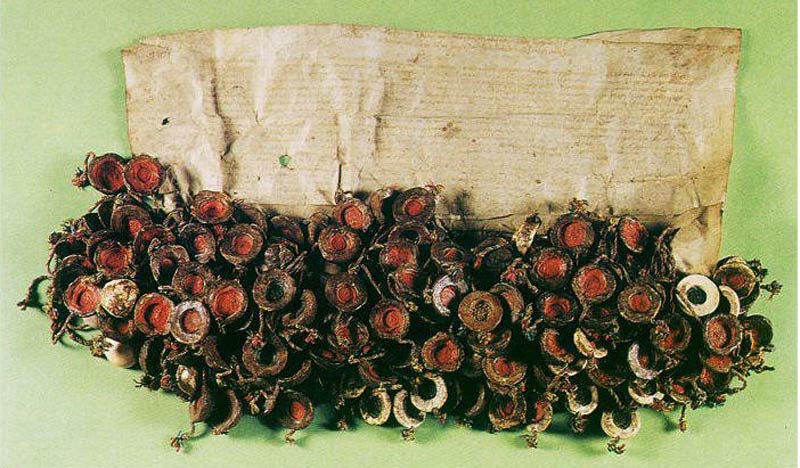
The original text of the Confederacy of Warsaw bearing signatures and wax seals.
And we all know how well that worked out for them.
———————-
90-odd years after the appearance of the above poster, we find Stanislav Mishin (in Pravda, these days a much better paper than the New York Times, urging Americans to “never give up your guns.”
[A]t one point, Russia was one of the most heavily armed societies on earth. This was, of course, when we were free under the Tsar. Weapons, from swords and spears to pistols, rifles and shotguns were everywhere, common items. People carried them concealed, they carried them holstered. Fighting knives were a prominent part of many traditional attires and those little tubes criss crossing on the costumes of Cossacks and various Caucasian peoples? Well those are bullet holders for rifles.
Various armies, such as the Poles, during the Смута (Times of Troubles), or Napoleon, or the Germans even as the Tsarist state collapsed under the weight of WW1 and Wall Street monies, found that holding Russian lands was much much harder than taking them and taking was no easy walk in the park but a blood bath all its own. In holding, one faced an extremely well armed and aggressive population Hell bent on exterminating or driving out the aggressor.
This well armed population was what allowed the various White factions to rise up, no matter how disorganized politically and militarily they were in 1918 and wage a savage civil war against the Reds. It should be noted that many of these armies were armed peasants, villagers, farmers and merchants, protecting their own. If it had not been for Washington’s clandestine support of and for the Reds, history would have gone quite differently.
Moscow fell, for example, not from a lack of weapons to defend it, but from the lying guile of the Reds. Ten thousand Reds took Moscow and were opposed only by some few hundreds of officer cadets and their instructors. Even then the battle was fierce and losses high. However, in the city alone, at that time, lived over 30,000 military officers (both active and retired), all with their own issued weapons and ammunition, plus tens of thousands of other citizens who were armed. The Soviets promised to leave them all alone if they did not intervene. They did not and for that were asked afterwards to come register themselves and their weapons: where they were promptly shot.
Of course being savages, murderers and liars does not mean being stupid and the Reds learned from their Civil War experience. One of the first things they did was to disarm the population. From that point, mass repression, mass arrests, mass deportations, mass murder, mass starvation were all a safe game for the powers that were. The worst they had to fear was a pitchfork in the guts or a knife in the back or the occasional hunting rifle. Not much for soldiers.
One sees these days the cryptic motto “Molon Labe” appearing everywhere.
“Molon Labe” is a Greek quotation. According to Plutarch, the Persian King Xerxes demanded that the 300 Spartans holding the pass at Thermopylae in the face of his enormous army should surrender their weapons.
Xerxes writing to him again thus, Send me thy arms, he returned, Come and take them. [Greek: Molon labe]
Barack Obama, when he’s thinking about issuing an executive order as a constitutional end run and ordering federal authorities to confiscate arms in the hands of American citizens, ought to pause and recall that the United States came to exist specifically because British General Thomas Gage received orders from William Legge, Earl of Dartmouth, the King’s Secretary of State ordering him to disarm the citizens of Middlesex County in Massachusetts. General Gage consequently on the 19th of April in 1775 dispatched 700 infantry in the direction of the towns of Lexington and Concord. Resistance occurred and continued until October 19, 1781 when General Cornwallis surrendered to George Washington at Yorktown. It is by no means impossible that a grand, new federal Gun Control initiative, enacted with the same energy and indifference to public opposition as Obamacare, would encounter real and organized resistance.
Born: Richard II, King of England, 1366; Joan d’Arc, 1402; Peter Metastasio, poet, 1698; Benjamin Franklin, philosopher, Boston, U.S., 1706; David Dale, philanthropist, 1739; George Thomas Doo, engraver, 1800.
Feast Day: St. Melanius, bishop, 490. St. Nilammon, Hermit. St. Peter, abbot of St. Austin’s, Canterbury, 608.
TWELFTH-DAY
This day, called Twelfth-Day, as being in that number after Christmas, and Epiphany from the Greek ‘‘ΕπιΦáνєια”, signifying appearance, is a festival of the Church, in commemoration of the Manifestation of Christ to the Gentiles; more expressly to the three Magi, or Wise Men of the East, who came, led by a star, to worship him immediately after his birth. (Matt. ii. 1-12.) The Epiphany appears to have been first observed as a separate feast in the year 813. Pope Julius I is, however, reputed to have taught the Church to distinguish the Feasts of the Nativity and Epiphany, so early as about the middle of the fourth century.
The primitive Christians celebrated the Feast of the Nativity for twelve days, observing the first and last with great solemnity; and both of these days were denominated Epiphany, the first the greater Epiphany, from our Lord having on that day become Incarnate, or made his appearance in “the flesh;” the latter, the lesser Epiphany, from the three-fold manifestation of His Godhead—the first, by the appearance of the blazing star which conducted Melchior, Jasper, and Balthuzar, the three Magi, or wise men, commonly styled the three Kings of Cologne, out of the East, to worship the Messiah, and to offer him presents of “Gold, Frankincense, and Myrrh”—Melchior the Gold, in testimony of his royalty as the promised King of the Jews; Jasper the Frankincense, in token of his Divinity; and Balthuzar the Myrrh, in allusion to the sorrows which, in the humiliating condition of a man, our Redeemer vouchsafed to take upon him: the second, of the descent of the Holy Ghost in the form of a Dove, at the Baptism: and the third, of the first miracle of our Lord turning water into wine at the marriage in Cana. All of which three manifestations of the Divine nature happened on the same day, though not in the same year.
‘To render due honour to the memory of the ancient Magi, who are supposed to have been kings, the monarch of this country himself, either personally or through his chamberlain, offers annually at the altar on this day, Gold, Frank-incense, and Myrrh; and the kings of Spain, where the Feast of Epiphany is likewise called the “Feast of the Kings,” were accustomed to make the like offerings. — Brady.
In the middle ages, the worship by the Magi was celebrated by a little drama, called the Feast of the Star:
‘Three priests, clothed as kings, with their servants carrying offerings, met from different directions before the altar. The middle one, who came from the east, pointed with his staff to a star. A dialogue then ensued; and, after kissing each other, they began to sing, “Let us go and inquire;” after which the precentor began a responsory, “Let the Magi come.” A procession then commenced; and as soon as it began to enter the nave, a crown, with a star resembling a cross, was lighted up, and pointed out to the Magi, with, “Behold the Star in the East.” This being concluded, two priests standing at each side of the altar, answered meekly, “We are those whom you seek;” and, drawing a curtain, shewed them a child, whom, falling down, they worshipped. Then the servants made the offerings of gold, frankincense, and myrrh, which were divided among the priests. The Magi, meanwhile, continued praying till they dropped asleep; when a boy, clothed in an alb, like an angel, addressed them with, “All things which the prophets said are fulfilled.” The festival concluded with chanting services, &c. At Soissons, a rope was let down from the roof of the church, to which was annexed an iron circle having seven tapers, intended to represent Lucifer, or the morning star; but this was not confined to the Feast of the Star.’ — Fosbroke’s Antiquities, ii. 700.
At Milan, in 1336, the Festival of the Three Kings was celebrated in a manner that brings forcibly before us the tendency of the middle ages to fix attention on the historical externals of Christianity. The affair was got up by the Preaching Friars. The three kings appeared, crowned, on three great horses richly habited, surrounded by pages, body guards, and an innumerable retinue. A golden star was exhibited in the sky, going before them. They proceeded to the pillars of St. Lawrence, where King Herod was represented with his scribes and wise men. The three kings ask Herod where Christ should be born, and his wise men, having consulted their books, answer, at Bethlehem. On which the three kings, with their golden crowns, having in their hands golden cups filled with frankincense, myrrh, and gold, the star going before, marched to the church of St. Eustorgius, with all their attendants, preceded by trumpets, horns, asses, baboons, and a great variety of animals. In the church, on one side of the high altar, there was a manger with an ox and ass, and in it the infant Christ in the arms of his mother. Here the three kings offer Him gifts. The concourse of the people, of knights, ladies, and ecclesiastics, was such as was never before beheld.
In its character as a popular festival, Twelfth-Day stands only inferior to Christmas. The leading object held in view is to do honour to the three wise men, or, as they are more generally denominated, the three kings. It is a Christian custom, ancient past memory, and probably suggested by a pagan custom, to indulge in a pleasantry called the Election of Kings by Beans. In England, in later times, a large cake was formed, with a bean inserted, and this was called Twelfth-Cake. The family and friends being assembled, the cake was divided by lot, and who-ever got the piece containing the bean was accepted as king for the day, and called King of the Bean.
In England, it appears there was always a queen as well as a king on Twelfth-Night. A writer, speaking of the celebration in the south of England in 1774, says:
‘After tea, a cake is produced, with two bowls containing the fortunate chances for the different sexes. The host fills up the tickets, and the whole company, except the king and queen, are to be ministers of state, maids of honour, or ladies of the bed-chamber. Often the host and hostess, more by design, than accident, become king and queen. According to Twelfth-Day law, each party is to support his character till midnight.’
In the sixteenth century, it would appear that some peculiar ceremonies followed the election of the king and queen. Barnaby Goodge, in his paraphrase of the curious poem of Nagcorgus, The Popish Kingdom, 1570, states that the king, on being elected, was raised up with great cries to the ceiling, where, with chalk, he inscribed crosses on the rafters to protect the house against evil spirits.
A Twelfth-Day custom, connected with Paget’s Bromley in Staffordshire, went out in the seventeenth century. A man came along the village with a mock horse fastened to him, with which he danced, at the same making a snapping noise with a bow and arrow. He was attended by half-a-dozen fellow-villagers, wearing mock deers’ heads, and displaying the arms of the several chief landlords of the town. This party danced the Hays, and other country dances, to music, amidst the sympathy and applause of the multitude. There was also a huge pot of ale with cakes by general contribution of the village, out of the very surplus of which ‘they not only repaired their church, but kept their poor too; which charges are not now, perhaps, so cheerfully borne.’
On Twelfth-Night, 1606, Ben Jonson’s masque of Hymen was preformed before the Court; and in 1613, the gentleman of Gray’s Inn were permitted by Lord Bacon to perform a Twelfth-Day masque at Whitehall. In the masque the character of Baby cake is attended by ‘an usher bearing a great cake with a bean and all with good will have spared unto your lordship, please.’
On Twelfth-Day, 1563, Mary Queen of Scots celebrated the French pastime of the King of the Bean at Holyrood, but with a queen instead of a king, as more appropriate, in consideration of herself being a female sovereign. The lot fell to the real queen’s attendant, Mary Fleming, and the mistress good-naturedly arrayed the servant in her own robes and jewels, that she might duly sustain the mimic dignity in the festivities of the night. The English resident, Randolph, who was in love with Mary Beton, another of the queen’s maids of honour, wrote in excited terms about this festival to the Earl of Leicester.
‘Happy was it,’ says he, ‘unto this realm, that her reign endured no longer. Two such sights, in one state, in so good accord, I believe was never seen, as to behold two worthy queens possess, without envy, one kingdom, both upon a day. I leave the rest to your lordship to be judged of. My pen staggereth, my hand faileth, further to write.’
The queen of the bean was that day in a gown of cloth of silver; her head, her neck, her shoulders, the rest of her whole body, so beset with stones, that more in our whole jewel-house were not to be found. . . The cheer was great. I never found myself so happy, nor so well treated, until that it came to the point that the old queen [Mary] herself, to show her mighty power, contrary unto the assurance granted me by the younger queen [Mary Fleming], drew me into the dance, which part of the play I could with good will have spared unto your lordship, as much fitter for the purpose.”
Charles I had his masque on Twelfth-Day, and the Queen hers on the Shrovetide following, the expenses exceeding £2000; and on Twelfth-Night, 1633, the Queen feasted the King at Somerset House, and presented a pastoral, in which she took part.
Down to the time of the Civil Wars, the feast was observed with great splendour, not only at Court, but at the Inns of Court, and the Universities (where it was an old custom to choose the king by the bean in a cake), as well as in private mansions and smaller households.
Then, too, we read of the English nobility keeping Twelfth-Night otherwise than with cake and characters, by the diversion of blowing up pasteboard castles; letting claret flow like blood, out of a stag made of paste; the castle bombarded from a pasteboard ship, with cannon, in the midst of which the company pelted each other with egg-shells filled with rose-water; and large pies were made, filled with live frogs, which hopped and flew out, upon some curious person lifting up the lid.
Twelfth-Night grew to be a Court festival, in which gaming was a costly feature. Evelyn tells us that on Twelfth-Night, 1662, according to custom, his Majesty [Charles II] opened the revels of that night by throwing the dice himself in the Privy Chamber, where was a table set on purpose, and lost his £100. [The year before he won £1500.] The ladies also played very deep. Evelyn came away when the Duke of Ormond had won about £1000, and left them still at passage, cards, &c., at other tables.
The Rev. Henry Teonge, chaplain of one of Charles’s ships-of-war, describes Twelfth-Night on board:
‘Wee had a great kake made, in which was put a beane for the king, a pease for the queen, a cloave for the knave, &c. The kake was cut into several pieces in the great cabin, and all put into a napkin, out of which every one took his piece as out of a lottery; then each piece is broaken to see what was in it, which caused much laughter, and more to see us tumble one over the other in the cabin, by reason of the ruff weather.’
The celebrated Lord Peterborough, then a youth, was one of the party on board this ship, as Lord Mordaunt.
The Lord Mayor and Aldermen and the guilds of London used to go to St. Paul’s on Twelfth-Day, to hear a sermon, which is mentioned as an old custom in the early part of Elizabeth’s reign.
A century ago, the king, preceded by heralds, pursuivants, and the Knights of the Garter, Thistle, and Bath, in the collars of their respective orders, went to the Royal Chapel at St. James’s, and offered gold, myrrh, and frankincense, in imitation of the Eastern Magi offering to our Saviour. Since the illness of George III, the procession, and even the personal appearance of the monarch, have been discontinued. Two gentlemen from the Lord Chamberlain’s office now appear instead, attended by a box ornamented at top with a spangled star, from which they take the gold, frankincense, and myrrh, and place them on an alms-dish held forth by the officiating priest.
In the last century, Twelfth-Night Cards represented ministers, maids of honour, and other attendants of a court, and the characters were to be supported throughout the night. John Britton, in his Autobiography, tells us he ‘ suggested and wrote a series of Twelfth-Night Characters, to be printed on cards, placed in a bag, and drawn out at parties on the memorable and merry evening of that ancient festival. They were sold in small packets to pastrycooks, and led the way to a custom which annually grew to an extensive trade. For the second year, my pen-and-ink characters were accompanied by prints of the different personages by Cruikshank (father of the inimitable George), all of a comic or ludicrous kind.’ Such characters are still printed.
The celebration of Twelfth-Day with the costly and elegant Twelfth-cake has much declined within the last half-century. Formerly, in London, the confectioners’ shops on this day were entirely filled with Twelfth-cakes, ranging in price from several guineas to a few shillings; the shops were tastefully illuminated, and decorated with artistic models, transparencies, &c. We remember to have seen a huge Twelfth-cake in the form of a fortress, with sentinels and flags; the cake being so large as to fill two ovens in baking.