Victor David Hanson explains that liberal social benevolence is a very old game which has led to ruin for many states before ours.
[S]tatism is not a desired outcome, but rather more a strategy for obtaining power or winning acclaim as one of the caring, by offering the narcotic of promising millions something free at the expense of others who must be seen as culpable and obligated to fund it — entitlements fueled by someone else’s money that enfeebled the state, but in the process extended power, influence, and money to a technocratic class of overseers who are exempt from the very system that they have advocated.
There are none. Only technocratic overseers who wish to give someone else’s money to others as a means of winning capitalist-style lifestyles and power for themselves — in a penultimate cycle of unsustainable spending. When this latest attempt at statism is over, Barack Obama will enjoy a sort of Clintonism, a globe-trotting post officium lifestyle of multimillion dollar honoraria to fund a lifestyle analogous to “two Americas†John Edwards, “earth in the balance†Al Gore, a tax-exempt yachting John Kerry, a revolving-door Citibank grandee like Peter Orszag, or a socialist Strauss-Kahn in $20,000 suits doling out billions to the “poor.â€
That is just the way it has been and will always be.
Robert Alexander Hillingford, Wellington at Waterloo
The Duke of Wellington disposed his forces with his customary prudence and intelligence, and Fortune came to his aid. The British victory at Waterloo left England triumphant and serene, supreme in Europe for a century.
Waterloo doomed, on the other hand, the hopes of France (and the rest of Europe) to achieve unity and pass from despotism into Modernity under the leadership of the hero of the age, who had cleansed the Revolution of its filth and covered it with glory.
(Waterloo! Waterloo! Waterloo! Gloomy plain!
Like a wave that ends in an urn too full,
In your circle of woods, hills, valleys,
Pale death mingled the dark battalions.
On one side was Europe and on the other France.
Bloody shock! God dashed these heroes’ hope
Victory deserted them, and the chance was lost.)
My Lithuanian ancestors fought on the side of France, hoping to achieve the restoration of the freedom and independence of Poland-Lithuania, partitioned and fully occupied by Russia, Prussia, and Austria in three stages: 1772, 1793, and 1795. Napoleon’s defeat condemned my ancestral homeland to occupation by Russian despotism for a century.
Waterloo was a great battle and a great victory for Britain, but not for Europe.
Walter Russell Mead argues that Barack Obama is starting to look much more like Herbert Hoover.
President Hoover brought some convictions with him to office about how the economy worked, how government worked, and what his role as President should be. As the Depression deepened, he did the best he could within those limits, but nothing seems to have made him reconsider the mix of progressive ideas that he brought with him to the White House. As months of failure and disappointment grew into years, he doesn’t seem to have questioned those core ideas or to think about ways in which the economic emergency might require steps that in normal times would not be taken. He not only failed to end the Depression; he failed to give people a sense that he understood what was happening. Over-optimistic forecasts issued in part to build confidence came back to haunt him. To the public he seemed fuddled and doctrinaire, endlessly recycling stale platitudes in the face of radically new economic problems.
That’s beginning to sound a little like the current President’s predicament. Unless Lady Luck should emerge from retirement to sprinkle some growth dust on the economy, the President could find himself looking more Hooveresque by the day. Worse, President Obama faces problems that Hoover did not have — notably the five shooting wars on his hands in Afghanistan, tribal Pakistan, Iraq, Libya and now, apparently, Yemen.
Rafal Heydel-Mankoo commemorated the anniversary of the death of King John Sobieski of Poland-Lithuania by linking this video of his Relief of the Siege of Vienna.
Walter Russell Mead (who has recently been on a roll, producing a series of very intelligent articles) argues that the imminent end of the entitlement era marks as profound a change in the American way of life as the century ago passing of the family farm and the transition to majority employment in towns and cities.
The death of the family farm didn’t kill the American republic for several reasons. First, to some degree Jefferson was wrong and Hamilton was right. A strong manufacturing and financial sector can strengthen democracy under the right conditions; ancient, slave-holding Rome was less like modern capitalist New York and London than Thomas Jefferson thought.
But under American conditions there was something else: the end of the family farm did not mean the rise of a propertyless proletariat in the United States. Bankers like A.P. Giannini made the argument that the thirty year mortgage was a weapon against Marx: if the average American family no longer owned a farm, it could still own a house.
Thanks to home ownership, post-agricultural America remained a land of mass property ownership and that experience continued to inform American political and social values. American neighborhoods are still schools of political engagement; it’s clear who keeps up their property, who takes the lead in community activities, who leads the PTA and who coaches the youth league. Property ownership continues to serve as a political tutor; American voters want better municipal services, and they don’t like high property taxes. They have to think about the relationship between the two in every election, and their experience in local affairs continues to inform their ideas about national policy.
At the same time, the fact that most Americans buy their homes through mortgages, and that they have to keep those payments up or lose the old homestead, teaches responsibility and steady habits. If the farmer didn’t get up at dawn to plow the north forty, there was nothing to eat in the winter. If the suburbanite doesn’t get in the car and head onto the freeway every morning, the bank balance sinks and the repo men will come and take the house away. Home ownership also teaches people about investments and compound interest (although lately it has been giving us a painful introduction to bubbles and downturns).
Both versions of the American Dream had this in common: the farm in the valley and the box in the burbs helped the American people develop the skills and the values necessary for successful republican government.
From this standpoint, suburban America looks like a watered down but still potent blend of the original American farmer’s republic. The inherited values and culture coming to us from the old days plus the still potent force of mass home ownership have kept the United States from retracing the steps of older democracies on their slow decline. So far.
But our consumer republic is clearly in trouble. Economically, as I wrote earlier this week, the model is breaking down. The consumer republic is based on debt and depends on high consumption. We are nearing the limits of that kind of economy. The country’s external debt, the explosive growth of federal debt and the weak balance sheets of consumer households are all pointing in the same direction.
The cultural and social weaknesses of the consumer state are if anything more troubling. While suburbia is not the kind of alienating horror show that Marxist critics make it out to be, it is a less effective school for citizenship and character than the family farm. Daniel Bell wrote about the cultural contradictions of capitalism more than thirty years ago; life in a consumer society does not support the virtues and ideas that a healthy society requires.
More broadly, Huck Finn was right and the Widow Douglass was wrong: a holistic life in which family, work, education, leisure and production are all blended and mixed is healthier than an existence in which every sphere of life is rigidly set off from the others. it is not good for children to work long hours in textile mills; it is also not good for them to grow up without participating in and learning about the productive labor that is such a big part of what it means to be human. Family bonds are weaker now that husbands and wives spend so much less time together and mostly cooperate to spend money rather than working together to make it. The family is less of a unit because the real business of each member of the family takes place in some other environment be it the office, the factory or the school.
The special shape of modern and suburban family life is part of the blue social model I’ve been posting about on this blog and the hollowing out of blue society is increasingly felt within as well as around the contemporary American family. The suburban consumption based nuclear family is increasingly under stress; family budgets and time are increasingly on the edge.
More, the very entitlements most under pressure economically are those that have allowed the multigenerational family to yield to the suburban nuclear idyll. Defined benefit pensions, Social Security, home equity and Medicare allowed older Americans to live independent lives and reduced the need for solidarity between the generations. The generations, like the widow’s vittles, were all cooking in their separate pots. …
The one thing I do know is that change is on its way — more fundamental, more challenging, and also perhaps more exhilarating than many of us are ready for. The health of the American economy is going to require us to move away from the credit card economics of the consumer republic. The health of American society and democracy require that we move beyond the life of the last eighty years.
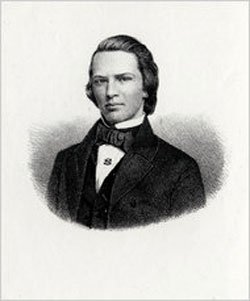
Randall Lee Gibson (above) was valedictorian of the Yale Class of 1853. He had been born a member of the planter aristocracy of Kentucky and Louisiana. He was a keen secessionist and fought for the Confederacy, serving first as an artillery captain then as colonel of the 13th Louisiana Volunteer Infantry Regiment.
Randall Gibson was the descendant of one Gideon Gibson, who arrived in the Colony of South Carolina in 1730 and who was “a skilled tradesman, had a white wife and … owned land and slaves in Virginia and North Carolina.” Gideon Gibson obtained land grants from the governor of South Carolina and he and his descendants married into the white planter class on the Western frontier. By the 1790s, the Gibson family had forgotten its African origin and ascribed a family tendency toward a dark complexion to Gypsy or Portuguese descent.
Randall Gibson fought at Shiloh. His regiment saw action with the Army of Tennessee at Chicamauga. Gibson ultimately made it all the way to the rank of Brigadier General in the Confederate Army. He fought in the Atlanta Campaign and ended the war defending the city of Mobile.
After the war and Reconstruction, Gibson was elected to Congress as a democrat from 1875 to 1883 and served as senator from 1883 to until his death in 1892. He was a trustee of Tulane and a hall at Tulane University is named for him.
Reading all this moved the Atlantic’s race blogger Ta-Nehisi Coates to observe:
The nearly 2500 year old Platean Column at the site of the former Hippodrome of Constantinople is the surviving remnant of a victory monument erected to commemorate the defeat of the Second Persian Invasion by the Greek city-states at the Battle of Plataea in August, 479 B.C.
Originally erected as an offering to Apollo at Delphi, the Platean Tripod is the best-documented surviving artifact from Antiquity, having been written of, and described by, Herodotus, Thucydides, Demosthenes, Diodorus Siculus, Pausanias, Cornelius Nepos, and Plutarch.
It was moved to Byzantium, rebuilt and renamed by the Emperor Constantine, around 330 A.D.
The Tripod was damaged when the city fell to the Turks in 1453, as
Charles W.C. Oman describes in his The Byzantine Empire (1892):
Riding through the hippodrome towards St. Sophia, Mohammed noted the Delphic tripod with its three snakes (…) Either because the menacing heads of the serpents provoked him, or merely because he wished to try the strength of his arm, the Sultan rose in his stirrups and smote away the jaws of the nearest snake with one blow of his mace. There was something typical in the deed though Mohammed knew it not. He had defaced the monument of the first great victory of the West over the East. He, the successor in spirit not only of Xerxes but of Chosroes and Moslemah and many another Oriental potentate, who had failed where he succeeded, could not better signalise the end of Greek freedom than by dealing a scornful blow at that ancient memorial, erected in the first days of Grecian greatness, to celebrate the turning back of the Persians on the field of Plataea.
The column alone still stands today. Though most of the head of one serpent survives in the collection of the Istanbul Archaeology Museum.
Piero della Francesca, Resurrection, circa 1463, Museo Civico, Sansepolcro
From Robert Chambers, The Book of Days, 1869:
Easter
Easter, the anniversary of our Lord’s resurrection from the dead, is one of the three great festivals of the Christian year,—the other two being Christmas and Whitsuntide. From the earliest period of Christianity down to the present day, it has always been celebrated by believers with the greatest joy, and accounted the Queen of Festivals. In primitive times it was usual for Christians to salute each other on the morning of this day by exclaiming, ‘Christ is risen;’ to which the person saluted replied, ‘Christ is risen indeed,’ or else, ‘And hath appeared unto Simon;’—a custom still retained in the Greek Church.
The common name of this festival in the East was the Paschal Feast, because kept at the same time as the Pascha, or Jewish passover, and in some measure succeeding to it. In the sixth of the Ancyran Canons it is called the Great Day. Our own name Easter is derived, as some suppose, from Eostre, the name of a Saxon deity, whose feast was celebrated every year in the spring, about the same time as the Christian festival—the name being retained when the character of the feast was changed; or, as others suppose, from Oster, which signifies rising. If the latter supposition be correct, Easter is in name, as well as reality, the feast of the resurrection.
Though there has never been any difference of opinion in the Christian church as to why Easter is kept, there has been a good deal as to when it ought to be kept. It is one of the moveable feasts; that is, it is not fixed to one particular day—like Christmas Day, e. g., which is always kept on the 25th of December—but moves backwards or forwards according as the full moon next after the vernal equinox falls nearer or further from the equinox. The rule given at the beginning of the Prayer-book to find Easter is this: ‘Easter-day is always the first Sunday after the full moon which happens upon or next after the twenty-first day of March; and if the full moon happens upon a Sunday, Easter-day is the Sunday after.’
The paschal controversy, which for a time divided Christendom, grew out of a diversity of custom. The churches of Asia Minor, among whom were many Judaizing Christians, kept their paschal feast on the same day as the Jews kept their passover; i. e., on the 14th of Nisan, the Jewish month corresponding to our March or April. But the churches of the West, remembering that our Lord’s resurrection took place on the Sunday, kept their festival on the Sunday following the 14th of Nisan. By this means they hoped not only to commemorate the resurrection on the day on which it actually occurred, but also to distinguish themselves more effectually from the Jews. For a time this difference was borne with mutual forbearance and charity. And when disputes began to arise, we find that Polycarp, the venerable bishop of Smyrna, when on a visit to Rome, took the opportunity of conferring with Anicetas, bishop of that city, upon the question. Polycarp pleaded the practice of St. Philip and St. John, with the latter of whom he had lived, conversed, and joined in its celebration; while Anicetas adduced the practice of St. Peter and St. Paul. Concession came from neither side, and so the matter dropped; but the two bishops continued in Christian friendship and concord. This was about A.D. 158.
Towards the end of the century, however, Victor, bishop of Rome, resolved on compelling the Eastern churches to conform to the Western practice, and wrote an imperious letter to the prelates of Asia, commanding them to keep the festival of Easter at the time observed by the Western churches. They very naturally resented such an interference, and declared their resolution to keep Easter at the time they had been accustomed to do. The dispute hence-forward gathered strength, and was the source of much bitterness during the next century. The East was divided from the West, and all who, after the example of the Asiatics, kept Easter-day on the 14th, whether that day were Sunday or not, were styled Qiccertodecimans by those who adopted the Roman custom.
One cause of this strife was the imperfection of the Jewish calendar. The ordinary year of the Jews consisted of 12 lunar months of 292 days each, or of 29 and 30 days alternately; that is, of 354 days. To make up the 11 days’ deficiency, they intercalated a thirteenth month of 30 days every third year. But even then they would be in advance of the true time without other intercalations; so that they often kept their passover before the vernal equinox. But the Western Christians considered the vernal equinox the commencement of the natural year, and objected to a mode of reckoning which might sometimes cause them to hold their paschal feast twice in one year and omit it altogether the next. To obviate this, the fifth of the apostolic canons decreed that, ’ If any bishop, priest, or deacon, celebrated the Holy Feast of Easter before the vernal equinox, as the Jews do, let him be deposed.’
At the beginning of the fourth century, matters had gone to such a length, that the Emperor Constantine thought it his duty to take steps to allay the controversy, and to insure uniformity of practice for the future. For this purpose, he got a canon passed in the great Ecumenical Council of Nice (A.D. 325), that everywhere the great feast of Easter should be observed upon one and the same day; and that not the day of the Jewish passover, but, as had been generally observed, upon the Sunday afterwards. And to prevent all future disputes as to the time, the following rules were also laid down:
‘That the twenty-first day of March shall be accounted the vernal equinox.’
‘That the full moon happening upon or next after the twenty-first of March, shall be taken for the full moon of Nisan.’
‘That the Lord’s-day next following that full moon be Easter-day.’
‘But if the full moon happen upon a Sunday, Easter-day shall be the Sunday after.’
As the Egyptians at that time excelled in astronomy, the Bishop of Alexandria was appointed to give notice of Easter-day to the Pope and other patriarchs. But it was evident that this arrangement could not last long; it was too inconvenient and liable to interruptions. The fathers of the next age began, therefore, to adopt the golden numbers of the Metonic cycle, and to place them in the calendar against those days in each month on which the new moons should fall during that year of the cycle. The Metonie cycle was a period of nineteen years. It had been observed by Meton, an Athenian philosopher, that the moon returns to have her changes on the same month and day of the month in the solar year after a lapse of nineteen years, and so, as it were, to run in a circle. He published his discovery at the Olympic Games, B.C. 433, and the cycle has ever since borne his name. The fathers hoped by this cycle to be able always to know the moon’s age; and as the vernal equinox was now fixed to the 21st of March, to find Easter for ever. But though the new moon really happened on the same day of the year after a space of nineteen years as it did before, it fell an hour earlier on that day, which, in the course of time, created a serious error in their calculations.
A cycle was then framed at Rome for 84 years, and generally received by the Western church, for it was then thought that in this space of time the moon’s changes would return not only to the same day of the month, but of the week also. Wheatley tells us that, ‘During the time that Easter was kept according to this cycle, Britain was separated from the Roman empire, and the British churches for some time after that separation continued to keep Easter according to this table of 84 years. But soon after that separation, the Church of Rome and several others discovered great deficiencies in this account, and therefore left it for another which was more perfect.’—Book on the Common Prayer, p. 40. This was the Victorian period of 532 years. But he is clearly in error here. The Victorian period was only drawn up about the year 457, and was not adopted by the Church till the Fourth Council of Orleans, A.D. 541.
Now from the time the Romans finally left Britain (A.D. 426), when he supposes both churches to be using the cycle of 84 years, till the arrival of St. Augustine (A.D. 596), the error can hardly have amounted to a difference worth disputing about. And yet the time the Britons kept Easter must have varied considerably from that of the Roman missionaries to have given rise to the statement that they were Quartodecimans, which they certainly were not; for it is a well-known fact that British bishops were at the Council of Nice, and doubtless adopted and brought home with them the rule laid down by that assembly. Dr. Hooke’s account is far more probable, that the British and Irish churches adhered to the Alexandrian rule, according to which the Easter festival could not begin before the 8th of March; while according to the rule adopted at Rome and generally in the West, it began as early as the fifth. ‘They (the Celts) were manifestly in error,’ he says; ‘but owing to the haughtiness with which the Italians had demanded an alteration in their calendar, they doggedly determined not to change.’—Lives of the Archbishops of Canterbury, vol. i. p. 14.
After a good deal of disputation had taken place, with more in prospect, Oswy, King of Northumbria, determined to take the matter in hand. He summoned the leaders of the contending parties to a conference at Whitby, A.D. 664, at which he himself presided. Colman, bishop of Lindisfarne, represented the British church. The Romish party were headed by Agilbert, bishop of Dorchester, and Wilfrid, a young Saxon. Wilfrid was spokesman. The arguments were characteristic of the age; but the manner in which the king decided irresistibly provokes a smile, and makes one doubt whether he were in jest or earnest. Colman spoke first, and urged that the custom of the Celtic church ought not to be changed, because it had been inherited from their forefathers, men beloved of God, &c. Wilfrid followed:
‘The Easter which we observe I saw celebrated by all at Rome: there, where the blessed apostles, Peter and Paul, lived, taught, suffered, and were buried.’ And concluded a really powerful speech with these words: ‘And if, after all, that Columba of yours were, which I will not deny, a holy man, gifted with the power of working miracles, is he, I ask, to be preferred before the most blessed Prince of the Apostles, to whom our Lord said, “Thou art Peter, and upon this rock will I build my church, and the gates of hell shall not prevail against it; and to thee will I give the keys of the kingdom of heaven†?’
The King, turning to Colman, asked him, ‘Is it true or not, Colman, that these words were spoken to Peter by our Lord?’ Colman, who seems to have been completely cowed, could not deny it. ‘It is true, 0 King.’ ‘Then,’ said the King, ‘can you shew me any such power given to your Columba? ’ Colman answered, ’ No.’ ‘You are both, then, agreed,’ continued the King, are you not, that these words were addressed principally to Peter, and that to him were given the keys of heaven by our Lord?’ Both assented. ‘Then,’ said the King, ‘I tell you plainly, I shall not stand opposed to the door-keeper of the kingdom of heaven; I desire, as far as in me lies, to adhere to his precepts and obey his commands, lest by offending him who keepeth the keys, I should, when I present myself at the gate, find no one to open to me.’
This settled the controversy, though poor honest Colman resigned his see rather than submit to such a decision.
On Easter-day depend all the moveable feasts and fasts throughout the year. The nine Sundays before, and the eight following after, are all dependent upon it, and form, as it were, a body-guard to this Queen of Festivals. The nine preceding are the six Sundays in Lent, Quinquagesima, Sexagesima, and Septuagesima; the eight following are the five Sundays after Easter, the Sunday after Ascension Day, Whit Sunday, and Trinity Sunday.
EASTER CUSTOMS
The old Easter customs which still linger among us vary considerably in form in different parts of the kingdom. The custom of distributing the ‘pace’ or ‘pasche ege,’ which was once almost universal among Christians, is still observed by children, and by the peasantry in Lancashire. Even in Scotland, where the great festivals have for centuries been suppressed, the young people still get their hard-boiled dyed eggs, which they roll about, or throw, and finally eat. In Lancashire, and in Cheshire, Staffordshire, and Warwickshire, and perhaps in other counties, the ridiculous custom of ‘lifting’ or ‘heaving’ is practised.
On Easter Monday the men lift the women, and on Easter Tuesday the women lift or heave the men. The process is performed by two lusty men or women joining their hands across each other’s wrists; then, making the person to be heaved sit down on their arms, they lift him up aloft two or three times, and often carry him several yards along a street. A grave clergyman who happened to be passing through a town in Lancashire on an Easter Tuesday, and having to stay an hour or two at an inn, was astonished by three or four lusty women rushing into his room, exclaiming they had come ‘to lift him.’ ‘To lift me!’ repeated the amazed divine; ‘what can you mean?’ ‘Why, your reverence, we’re come to lift you, ‘cause it’s Easter Tuesday.’ ‘Lift me because it’s Easter Tuesday? I don’t understand. Is there any such custom here?’ ‘Yes, to be sure; why, don’t you know? all us women was lifted yesterday; and us lifts the men today in turn. And in course it’s our rights and duties to lift ‘em.’
After a little further parley, the reverend traveller compromised with his fair visitors for half-a-crown, and thus escaped the dreaded compliment. In Durham, on Easter Monday, the men claim the privilege to take off the women’s shoes, and the next day the women retaliate. Anciently, both ecclesiastics and laics used to play at ball in the churches for tansy-cakes on Eastertide; and, though the profane part of this custom is happily everywhere discontinued, tansy-cakes and tansy-puddings are still favourite dishes at Easter in many parts. In some parishes in the counties of Dorset and Devon, the clerk carries round to every house a few white cakes as an Easter offering; these cakes, which are about the eighth of an inch thick, and of two sizes —the larger being seven or eight inches, the smaller about five in diameter— have a mingled bitter and sweet taste. In return for these cakes, which are always distributed after Divine service on Good Friday, the clerk receives a gratuity- according to the circumstances or generosity of the householder.
This morning at 6:45 AM (2 hours and 45 minutes late), a single mortar round was fired (from Fort Moultrie) marking the 150th Anniversary of the commencement of the bombardment of Fort Sumter in Charleston Harbor by Confederate forces under the command of General Pierre Gustave Toussaint Beauregard, the military action which both initiated the American Civil War and made practically possible the Confederate states’ conquest and defeat.
Decades of sectional rivalry, animosity, and ever-increasing friction provoked by Northern hostility toward, and demonization of, the Southern institution of Slavery were followed rapidly by, first, a terrorist attack on the civilian population of Virginia and the arsenal at Harper’s Ferry by a murderous fanatic armed and funded by some of the wealthiest and best-educated citizens of the Northern states, then by the minority election of a prominent Northern radical to the presidency.
Firebrand South Carolina responded with secession on December 20th, followed by Mississippi, Florida, Alabama, Georgia, and Louisiana in January, and Texas on February 1th. On the 8th and 9th of the same month, an Alabama convention of the seceded states adopted a Constitution forming a new Confederacy, and elected former Secretary of War and hero of the Mexican War, Jefferson Davis of Mississippi, as its president.
General Winfield Scott (who had had trouble with Davis over his expenses) remarked: “I am amazed that any man of judgment could hope for the success of any cause in which Jefferson Davis is a leader. There is contamination in his touch.”
Davis was an able man, intellectually gifted, honorable, and dignified, but prone to self-righteousness. He was, in almost every respect, his adversary Lincoln’s polar opposite. Abraham Lincoln was a cunning and flexible Machiavel, who skillfully concealed a razor-sharp, minutely calculating and selfish intelligence behind a populist masque of warmth and folksy humor. Davis was aristocratic, formal and austere. Sam Houston thought him “cold as a lizard.”
Seven states had left the union and formed a new government before Abraham Lincoln was even inaugurated.
As secession fever raged, back in December, William Tecumseh Sherman, A West Point graduate and Ohioan serving as superintendent of the Louisiana State Military Academy, exploded to a Southern guest at hearing of South Carolina’s secession:
You people of the South don’t know what you are doing. This country will be drenched in blood, and God only knows how it will end. It is all folly, madness, a crime against civilization! You people speak so lightly of war; you don’t know what you are talking about. War is a terrible thing!
You mistake, too, the people of the North. They are a peaceable people but an earnest people, and they will fight, too. They are not going to let this country be destroyed without a mighty effort to save it… Besides where are your men and appliance of war to contend with them? The North can make a steam engine, locomotive, or railway car; hardly a yard of cloth or a pair of shoes can you make. You are rushing into war with on of the most powerful, ingeniously mechanical and determined people on earth — right at your doors.
You are bound to fail. Only in your spirit and determination are you prepared for war. In all else you are totally unprepared, with a bad cause to start with. At first you will make headway, but as your limited resources begin to fail, shut out from the markets of Europe as you will be, your cause will begin to wane. If your people would stop and think, they must see that in the end you will surely fail.
Sherman resigned his post in February, came North, and was introduced to Lincoln in late March.
“How are they getting along down there?” inquired the recently inaugurated president.
“They think they are getting along swimmingly,” Sherman replied. “They are preparing for war.”
Lincoln’s expressed confidence was, however, at odds with his dilemma. If Lincoln moved to assert federal authority over the seceded states, he would test the limits of both his constitutional authority and of his political support. Moreover, any attempt to initiate force, to make war on the seven seceded states, would very probably precipitate the secession from the Union and addition to their numbers of Virgina and other slave-owning states outside the Deep South.
The only immediate, natural conflict between the new Confederacy and the government of the United States lay in the basically trivial territorial issue of sovereignty over four Federal forts located within Confederate territory: Fort Sumter in Charleston Harbor, Pickens off Pensacola Bay, Taylor at Key West, and Jefferson in the Dry Tortugas.
Possession of none of these was of vital necessity to anyone.
During mid-March, President Lincoln’s cabinet voted 5 to 2 to abandon Fort Sumter. Secretary of State Seward felt strongly that civil war might yet be averted, as long as a confrontation was avoided and passions allowed to cool. But second cabinet vote at the end of March tied 3-3, and Lincoln decided to employ the fort in Charleston Harbor as bait.
On April 8th, South Carolina’s governor was notified that the federal government would attempt to resupply Fort Sumter with provisions only.
When the Confederate cabinet in Montgomery debated, Robert Toombs of Georgia warned President Davis:
The firing on that fort will inaugurate a civil war greater than any the world has yet seen… Mr. President, at this time it is suicide, murder, and you will lose us every friend at the North. You will wantonly strike a hornets’ nest which extends from mountains to ocean. Legions now quiet will swarm out and sting us to death. It is unnecessary. It puts us in the wrong. It is fatal.
But President Davis ignored this counsel, trusting that the world would realize that President Lincoln was the real aggressor. Davis, of course, could hardly be more wrong.
Fort Sumter was reduced to defenselessness, its guns silenced, by the fire of more than 4000 rounds from 47 howitzers and mortar over a day and half. The only casualty occurred during the fort’s honorable capitulation, when a spark from the fifty gun salute to the descending US colors fell into a barrel of gunpowder producing an explosion which took the life of Private Daniel Hough, the first of more than 600,000 Americans to be killed in the Civil War.
Abraham Lincoln had his causus belli. He could call for 75,000 men to serve for 90 days against “combinations too powerful to be suppressed by the ordinary course of judicial proceedings.”
Virginia, Tennessee, Arkansas, and North Carolina seceded and joined in the defense of the Confederacy rather than participate in the conquest and subjugation of sister states. Kentucky and Missouri and Maryland were kept in the union by force.
Robert Toombs was perfectly correct. The decision of Jefferson Davis to assert Confederate authority by force made the Confederacy into the aggressor, infuriated the North, and freed Lincoln to act. In essence, Jefferson Davis’s unwise decision broke open a stalemated situation in which delay operated entirely in favor of the newly-formed Confederacy, providing it with a longer period to ready itself with supplies, training, and defensive preparations and making the new republic into ever more of a fait accompli, accepted by both foreign and domestic opinion.
Firing on Fort Sumter assured a Northern military response against an attack on US soldiers and the US flag, and transformed the role of its great adversary, Abraham Lincoln, from that of aggressor to defender.
This single bad decision represents a perfect metonymy for the differences in judgment and temperament between Davis and Lincoln explaining precisely why the latter was ultimately successful in overcoming enormous difficulties as a war leader, while the former led his cause to ruin.
Civilian spectators watched the bombardment from the Battery. (click on image to see larger version)
This week, on Tuesday, we will reach the 150th anniversary of the opening shots of the American Civil War. The left these days is continuing to fight that war at every opportunity. On the editorial page of yesterday’s Wall Street Journal, Fergus W. Bordewich offered a rather partisan interpretation of history.
Bordewich complains that Southern states “routinely denied freedom of speech, press and assembly” to abolitionists, but neglects to mention Abraham Lincoln’s forcible closure of dozens of newspapers, his illegal imprisonment (without warrant or trial) of thousands of Americans including elected officials, his unconstitutional suspension of habeus corpus and so on.
Bordewich goes on to extol the ultimate Northern victory, theorizing in the kind of leap that takes far too much for granted, that without the conquest and forcible reincorporation of the seceded states, the United States might not have intervened in WWI and WWII or won the Cold War.
Perhaps, on the other hand, one could equally easily argue, if the South had won and established the example of a successful aristocratic and conservative republic, European culture would have been moved in a better direction. There might have been no rise to power of the popular ideologies of Nationalism and Socialism and no Fascism or Communism at all. No rule by pseudo-intellectuals turning the 20th century into an abattoir. It is easy to spin that kind of theorizing in any direction you prefer.
The video below, featuring footage from 1913 to 1938 when veterans of the great conflict were still alive, represents the very different, once traditional, approach to the memory of the war, which emphasized recognition of the heroism and good faith of the men who fought on both sides of a war which only one side could win.
Almost as many countries arrogate the honour of having been the natal soil of St. Patrick, as made a similar claim with respect to Homer. Scotland, England, France, and Wales, each furnish their respective pretensions: but, whatever doubts may obscure his birthplace, all agree in stating that, as his name implies, he was of a patrician family. He was born about the year 372, and when only sixteen years of age, was carried off by pirates, who sold him into slavery in Ireland; where his master employed him as a swineherd on the well-known mountain of Sleamish, in the county of Antrim. Here he passed seven years, during which time he acquired a knowledge of the Irish language, and made himself acquainted with the manners, habits, and customs of the people. Escaping from captivity, and, after many adventures, reaching the Continent, he was successively ordained deacon, priest, and bishop: and then once more, with the authority of Pope Celestine, he returned to Ireland to preach the Gospel to its then heathen inhabitants.
The principal enemies that St. Patrick found to the introduction of Christianity into Ireland, were the Druidical priests of the more ancient faith, who, as might naturally be supposed, were exceedingly adverse to any innovation. These Druids, being great magicians, would have been formidable antagonists to any one of less miraculous and saintly powers than Patrick. Their obstinate antagonism was so great, that, in spite of his benevolent disposition, he was compelled to curse their fertile lands, so that they became dreary bogs: to curse their rivers, so that they produced no fish: to curse their very kettles, so that with no amount of fire and patience could they ever be made to boil; and, as a last resort, to curse the Druids themselves, so that the earth opened and swallowed them up. …
The greatest of St. Patrick’s miracles was that of driving the venomous reptiles out of Ireland, and rendering the Irish soil, for ever after, so obnoxious to the serpent race, that they instantaneously die on touching it. Colgan seriously relates that St. Patrick accomplished this feat by beating a drum, which he struck with such fervour that he knocked a hole in it, thereby endangering the success of the miracle. But an angel appearing mended the drum: and the patched instrument was long exhibited as a holy relic. …
When baptizing an Irish chieftain, the venerable saint leaned heavily on his crozier, the steel-spiked point of which he had unwittingly placed on the great toe of the converted heathen. The pious chief, in his ignorance of Christian rites, believing this to be an essential part of the ceremony, bore the pain without flinching or murmur; though the blood flowed so freely from the wound, that the Irish named the place St. fhuil (stream of blood), now pronounced Struill, the name of a well-known place near Downpatrick. And here we are reminded of a very remarkable fact in connection with geographical appellations, that the footsteps of St. Patrick can be traced, almost from his cradle to his grave, by the names of places called after him.
Thus, assuming his Scottish origin, he was born at Kilpatrick (the cell or church of Patrick), in Dumbartonshire. He resided for some time at Dalpatrick (the district or division of Patrick), in Lanarkshire; and visited Crag-phadrig (the rock of Patrick), near Inverness. He founded two churches, Kirkpatrick at Irongray, in Kireudbright; and Kirkpatrick at Fleming, in Dumfries: and ultimately sailed from Portpatrick, leaving behind him such an odour of sanctity, that among the most distinguished families of the Scottish aristocracy, Patrick has been a favourite name down to the present day.
Arriving in England, he preached in Patterdale (Patrick’s dale), in Westmoreland: and founded the church of Kirkpatrick, in Durham. Visiting Wales, he walked over Sarn-badrig (Patrick’s causeway), which, now covered by the sea, forms a dangerous shoal in Carnarvon Bay: and departing for the Continent, sailed from Llan-badrig (the church of Patrick), in the island of Anglesea. Undertaking his mission to convert the Irish, he first landed at Innis-patrick (the island of Patrick), and next at Holmpatrick, on the opposite shore of the mainland, in the county of Dublin. Sailing northwards, he touched at the Isle of Man, sometimes since, also, called. Innis-patrick, where he founded another church of Kirkpatrick, near the town of Peel. Again landing on the coast of Ireland, in the county of Down, he converted and baptized the chieftain Dichu, on his own threshing-floor. The name of the parish of Saul, derived from Sabbal-patrick (the barn of Patrick), perpetuates the event. He then proceeded to Temple-patrick, in Antrim, and from thence to a lofty mountain in Mayo, ever since called Croagh-patrick.
He founded an abbey in East Meath, called Domnach-Padraig (the house of Patrick), and built a church in Dublin on the spot where St. Patrick’s Cathedral now stands. In an island of Lough Deng, in the county of Donegal, there is St. Patrick’s Purgatory: in Leinster, St. Patrick’s Wood; at Cashel, St. Patrick’s Rock; the St. Patrick’s Wells, at which the holy man is said to have quenched his thirst, may be counted by dozens. He is commonly stated to have died at Saul on the 17th of March 493, in the one hundred and twenty-first year of his age.
Poteen, a favourite beverage in Ireland, is also said to have derived its name from St. Patrick: he, according to legend, being the first who instructed the Irish in the art of distillation. This, however, is, to say the least, doubtful: the most authentic historians representing the saint as a very strict promoter of temperance, if not exactly a teetotaller. We read that in 445 he commanded his disciples to abstain from drink in the day-time, until the bell rang for vespers in the evening. One Colman, though busily engaged in the severe labours of the field, exhausted with heat, fatigue, and intolerable thirst, obeyed so literally the injunction of his revered preceptor, that he refrained from indulging himself with one drop of water during a long sultry harvest day. But human endurance has its limits: when the vesper bell at last rang for evensong, Colman dropped down dead—a martyr to thirst. Irishmen can well appreciate such a martyrdom; and the name of Colman, to this day, is frequently cited, with the added epithet of Shadhack—the Thirsty.
‘In Burgo Duno, tumulo tumulantur in uno,
Brigida, Patricius, atque Columba pins.’
Which may be thus rendered:
‘In the hill of Down, buried in one tomb,
Were Bridget and Patricius, with Columba the pious.’
The shamrock, or small white clover (trifolium repens of botanists), is almost universally worn in the hat over all Ireland, on St. Patrick’s day. The popular notion is, that when St. Patrick was preaching the doctrine of the Trinity to the pagan Irish, he used this plant, bearing three leaves upon one stem, as a symbol or illustration of the great mystery. To suppose, as some absurdly hold, that he used it as an argument, would be derogatory to the saint’s high reputation for orthodoxy and good sense: but it is certainly a curious coincidence, if nothing more, that the trefoil in Arabic is called skamrakh, and was held sacred in Iran as emblematical of the Persian Triads. Pliny, too, in his Natural History, says that serpents are never seen upon trefoil, and it prevails against the stings of snakes and scorpions. This, considering St. Patrick’s connexion with snakes, is really remarkable, and we may reasonably imagine that, previous to his arrival, the Irish had ascribed mystical virtues to the trefoil or shamrock, and on hearing of the Trinity for the first time, they fancied some peculiar fitness in their already sacred plant to shadow forth the newly revealed and mysterious doctrine. …
In the Galtee or Gaultie Mountains, situated between the counties of Cork and Tipperary, there are seven lakes, in one of which, called Lough Dilveen, it is said Saint Patrick, when banishing the snakes and toads from Ireland, chained a monster serpent, telling him to remain there till Monday.
The serpent every Monday morning calls out in Irish, ‘It is a long Monday, Patrick.’
That St Patrick chained the serpent in Lough Dilveen, and that the serpent calls out to him every Monday morning, is firmly believed by the lower orders who live in the neighbourhood of the Lough.