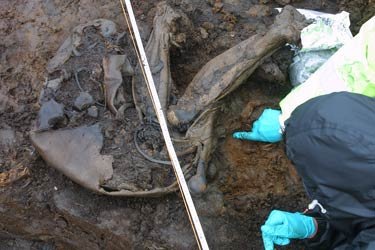
A resident of central Ireland’s County Laois came across the well-preserved “Cashel Man” — named for the bog he was found in — while milling for peat moss, which is used for a variety of farm purposes, including animal-bedding and field conditioning.
Having realized that he had come across a human body, the resident notified archaeologists at the National Museum of Ireland, who later conducted a formal excavation of the site. A summary of the dig appeared in the latest edition of the Irish journal Ossory, Laois, and Leinster.
“All that was visible to start with was a pair of legs below the knees, and a torso,” Eamonn Kelly, an archaeologist at the National Museum and lead excavator of the project, wrote in the report. “The body appeared to be naked. Later, it was possible to work out that the torso had been damaged by the milling machine, which also removed the head, neck and left arm.”
The team calculated the age of the body using radiometric carbon dating, in which the constant decay rate of radioactive carbon-14 is used to estimate age based on remaining levels of carbon-14 in the dead tissues. Surprised to find the body was roughly 4,000 years old, the team dated the peat above and below the body to confirm the results, and came up with about the same age. Previously, the oldest bog body ever found in Ireland was 1,300 years old, according to the Irish Times.
The team conducted computed tomography (CT) scans of the body after the dig, and found that the young man’s arm and spine had been broken multiple times, seemingly from sharp blows before his death.
The researchers also found cuts along the man’s back that looked like ax wounds. They uncovered axes capable of producing such wounds within the vicinity of the site.
Given this evidence of brutality, the team concluded that the young man had been killed in a ritual sacrifice, a practice commonly known in later eras, but not well documented in the Early Bronze Age of 2000 B.C., about the time this bog body would’ve lived.
“All the indications are that the human remains from Cashel Bog tell of the fate of a young king who, through folly or misadventure, was deemed to have failed to appease the goddess on whose benevolence his people depended, and who paid the ultimate price,” Kelly wrote.
What would it be like to ride, just like the late Dick Francis, on one of the famous Steeplechase race courses? Jodie Skelton’s helmet camera gives the viewer something close to the rider’s point of view. This race course looked to me like a tough version of an American Eventing course. The comments refer to “a bit of a slap off the ground,” meaning the footage even includes a fall. Ouch!
In this individual segment of a four-part series, Hector Ó hEochagáin (I think that would be “Hector O’Hogan” to you or me), as part of a personal investigation of important aspects of Irish life, goes out fox hunting with Ireland’s illustrious black-and-tan Scarteen pack.
An Cathach [“the Battler”] of St. Columba, the oldest surviving manuscript in Ireland, and the second oldest Latin psalter in the world, Royal Irish Academy.
Matt Rubinstein, in the Australian Book Review last Fall, prefaced a lengthy discussion of the impact of the arrival of the eBook and consequent issues concerning intellectual property and book piracy with a fascinating account of a 6th Century case of book piracy involving two saints which led to actual battle.
The most precious manuscript held by the Royal Irish Academy is RIA MS 12 R 33, a sixth-century book of psalms known as an Cathach (‘The Battler’), or the Psalter of St Columba. It is believed to be the oldest extant Irish psalter, the earliest example of Irish writing – and the world’s oldest pirate copy. According to tradition, St Columba secretly transcribed the manuscript from a psalter belonging to his teacher, St Finian. Finian discovered the subterfuge, demanded the copy, and brought the dispute before Diarmait, the last pagan king of Ireland. The king decreed that ‘to every cow belongs her calf’, and so the copy of a book belonged to the owner of the original. Columba appealed the decision on the battlefield, and defeated Finian in a bloody clash at Cúl Dreimhne. No trace remains of Finian’s original manuscript, if it ever existed. Only ‘The Battler’ survives.
Finian v Columba is difficult to reconcile with modern copyright law. The psalms in question were attributed to God, revealed to David, and translated by St Jerome in the fourth century, so Finian’s claim to copyright in the work is unclear. It may be that the pagan Diarmait simply free-associated his judgment from the calfskin of the Cathach’s pages. But any want of judicial rigour is surely redeemed by the king’s early intuition that there is something valuable about a book beyond its physical self, that it has spirit as well as flesh and a soul beyond its body – as well as by the delicious consequences of an actual military war being fought, at least in part, over a single illegal copy, and of that outlawed copy becoming a national treasure.
Tradition asserts that, sometime around 560, St. Columba became involved in a quarrel with Saint Finnian of Movilla Abbey over a psalter. Columba copied the manuscript at the scriptorium under Saint Finnian, intending to keep the copy. Saint Finnian disputed his right to keep the copy. The dispute eventually led to the pitched Battle of Cúl Dreimhne in 561, during which many men were killed. A synod of clerics and scholars threatened to excommunicate him for these deaths, but St. Brendan of Birr spoke on his behalf with the result that he was allowed to go into exile instead. Columba suggested that he would work as a missionary in Scotland to help convert as many people as had been killed in the battle. He exiled himself from Ireland, to return only once, many years later.
Columba’s copy of the psalter has been traditionally associated with the Cathach of St. Columba.
The comments on YouTube were interesting, featuring a good deal of concern for the safety of the horses.
Myself, I think the crossing would be accomplished better in general if one chose with some care and attention the point to be attempted, and then approached with speed and momentum (and grim determination) on one’s side. In these kind of unpropitious circumstances, I think one should follow the example of Jack Mytton, cry “Now for the Honour of Shropshire!”, direct one’s horse at the intended jump point and just go for it.
Henry Alken and T.J. Rawlings, From “Memoirs of the Life of the Late John Mytton, Esq. of Halston, Shropshire.”: Now For the Honour of Shropshire, Rudolph Ackermann, 1851.
Ireland lost to Spain 4-0 in their match in the Euro 12 European Championships, but the Irish fans won the hearts of the hosting Poles.
On Facebook, I see today posting after posting from my Polish correspondents declaring themselves to be “fans of the Irish fans.” “Irish fans are the best fans in the world.” according to many Poles. One declared admiringly: “They sing louder when they’re losing.”
Shane McGowan (of The Pogues) refuses to allow his being very far along in celebrating the evening (and unable to remember the lyrics of the well-known song) to keep him from delivering a very moving performance.
Trinity College Dublin has said it is taking seriously an incident in which a profile page, complete with image, was inserted on its website for a fake staff member named ‘Dr Conan T. Barbarian’.
The page appeared on the TCD School of English website last night and could still be accessed until about 9.30am, at which stage it was removed.
Screen shots of the page were still being circulated online, however.
The staff listings were also amended to include the name of ‘Dr Barbarian’, while his own personal page bore an image of actor Arnold Schwarzenegger in Conan guise from the 1982 movie.
His full title and academic qualifications were given as: “Dr Conan T. Barbarian, B.A.(Cimmeria) Ph.D. (UCD). F.T.C.D. (Long Room Hub Associate Professor in Hyborian Studies and Tyrant Slaying).â€
His profile indicated he had been “ripped from his mother’s womb on the corpse-strewn battlefields of his war-torn homeland, Cimmeria, and has been preparing for academic life ever sinceâ€.
“A firm believer in the dictum that ‘that which does not kill us makes us stronger,’ he took time out to avenge the death of his parents following a sojourn pursuing his strong interest in Post-Colonial theory at the Sorbonne.â€
The profile went on to say Dr Barbarian completed his PhD, entitled ‘To Hear The Lamentation of Their Women: Constructions of Masculinity in Contemporary Zamoran Literature’ at UCD and was appointed to the School of English in 2006, “after sucessfully decapitating his predecessor during a bloody battle which will long be remembered in legend and songâ€.
“In 2011/12, he will be teaching on the following courses: ‘The Relevance of Crom in the Modern World’, ‘Theories of Literature’, ‘Vengeance for Beginners’,
‘Deciphering the Riddle of Steel’ and ‘D.H. Lawrence’. …
A spokeswoman for Trinity College Dublin said the amendment to the website was not a “hackingâ€.
She said the site had not been externally hacked, but said she could not comment further as she did not have the full facts.
The page had been immediately removed once it came to the college’s attention.
In Ireland, Obama plans to visit the Irish village of Moneygall, population 300, which claims to be the birthplace of one of his great-great-great grandfathers.
Henry Healy, one of Moneygall’s many residents claiming to be a distant relative of America’s first African-American president, hopes to hoist a beer with the town’s favorite son.
“We knew that the president had interest in his Irish roots,” Healy said. “He expressed while he was seeking the Democratic nomination that he did want to visit the little village in Ireland and have a pint.”
Situated in central Ireland between Dublin and Limerick, Moneygall has undergone a patriotic facelift. With American flags hanging in front of homes and stores, Obama might feel like he’s visiting a small town in the U.S. on the Fourth of July.
Genealogists at Ancestry.com first shed light on Obama’s Irish roots when he was campaigning for the presidency. They traced his Irish ancestry several generations to a fellow by the name of Fulmoth Kearney, the president’s great-great-great grandfather on his mother’s side, who immigrated from Moneygall to Ohio in 1850.
Maybe it was that “luck o’ the Irish” — or perhaps support from some of the 40 million Irish-Americans — that helped Obama win the presidential nomination.
“It never hurts to be a little Irish when you’re running for the presidency of the United States of America,” Obama joked during a campaign stop in 2008.
—————————-
James Delingpole is derisive on the identity antics of this kind. Tony Blair evidently used to do it, too.
Ah Bejaysus and Begorrah! Oi’ll be swearin’ boi the auld shrine to the Vorgin with the shamrocks growin’ round it next to the hill where Cuchullain slew the Great Leprechaun of Kildare on St Patrick’s Day that Barack Seamus O’Toole Flaherty Joyce O’Bama is the most Irish US president that ever set foot on the Emerald Oisle, so he is, so he is.
Except, when he’s in Africa, of course, when he disappears into the dry ice and re-emerges with a grass skirt and a bone through his nose and declares himself to be Mandingo, Prince of the Bloodline of the Bonga People, Drinker of Cattle Urine, Father of A Thousand Warrior Sons, Keeper of King Solomon’s Mines, Barehanded Slayer of Lions, Undaunted Victim of the Evil Colonial British Empire.
And in the Middle East, where he is Al-Barak Hussein Obama, Protector of the Holy Shrine, Smiter of the Kuffar, Lion of the Desert, Tent-Loving-Aficionado-of-the-Oversweetened-Coffee, Chomper of Sheeps’ Eyeballs, Restorer of the Caliphate.
Etc.
Tony Blair used to do this trick too, his accent mutating from broad Glaswegian to genteel Edinburgh to Mummerset to Estuary to Richard E Grant to Sarf London Grime – often in the course of one Downing Street reception – the better to persuade his target audience that he was their kind of guy. And it is, of course, the hallmark of an unutterable charlatan