Style is manifest in language. The vocabulary of a writer is his curency but it is a paper currency and its value depends on the mind and heart that backs it. The perfect use of language is that in which every word carries the meaning that it is intended to, no less and no more. In the verbal exchange Fleet Street is a kind of Bucket Shop which unloads words on the public for less than they are worth and in consequence the more honest literary bankers, who try to use their words to mean what they say, who are always ‘good for’ the expressions they employ, find their currency constantly depreciating. There was a time when this was not so, a moment in the history of language when words expressed what they meant and when it was impossible to write badly. This time I think was at the end of the seventeenth and the beginning of the eighteenth century, when the metaphysical conceits of the one were going out and before the classical tyranny of the other was established. To write badly at that time would involve a perversion of language , to write naturally was a certain way of writing well. Dryden, Rochester, Congreve, Swift, Gay, Defoe, belong to this period and some of its freshness is still found in the Lives of the Poets and in the letters of Gray and Walpole. It is a period which is ended by the work of two great Alterers, Addison and Pope.
Addison was responsible for many of the evils from which English prose has since suffered. He made prose artful, and whimsical, he made it sonorous when sonority was not needed, affected when it did not require affectation; he enjoined the essay on us so that countless small boys are at this moment busy setting down their views on Travel, the Great Man, Courage, Gardening, Capital Punishment to wind up with a quotation from Bacon. For though essay-writing was an occasional activity of Bacon, Walton and Evelyn, Addison turned it into an industry. He was the first to write for the entertainment of the middle classes, the new great power in the reign of Anne. He wrote as a gentleman (Sir Roger is the perfect gentleman), he emphasized his gentle irony, his gentle melancholy, his gentle inanity. He was the apologist for the New Bourgeoisie who writes playfully and apologetically about nothing, casting a smoke screen over its activities to make it seem harmless, genial and sensitive in its non-acquisitive moments; he anticipated Lamb and Emerson, Stevenson, Punch and the professional humorists, the delicious middlers, the fourth leaders, and the memoirs of cabinet ministers, the orations of business magnates, and of chiefs of police. He was the first Man of Letters. Addison had the misuse of an extensive vocabulary and so was able to invalidate a great number of words and expressions; the quality of his mind was inferior to the language which he used to express it.
The Oregon Shakespeare Festival is translating William Shakespeare into English. If that seems strange, it should, because Shakespeare wrote his plays in English. All 39 of the bard’s works have been assigned a playwright and a dramaturge, who will alter its text to create a present-day, modern English version they hope will be more accessible to modern audiences.
That’s not all that lies behind this dubious effort. The Oregon Shakespeare Festival (OSF), in keeping with the spirit of modern theater, ensured that 50 percent of the artists involved are women and that 50 percent are people of color.
The mystery is: How did it come to pass that, everywhere you look in today’s America, the people in positions of power and responsibility are all the worst kind of blithering nincompoops?
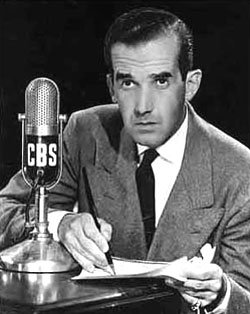
Edward R. Murrow (1908-1965) was a classic user of “Announcer Speak”
James Fallows, in the Atlantic, identifies a broadcasting convention, the use of a slightly Anglicized version of grammatically correct Standard Mid-Western English as the formal voice of news reader, announcer, or celebrity on the radio, which he contends has recently disappeared.
The narrator of [this] film [“Wings Over the Golden Gate” (1930s)](spoke in a way instantly recognizable to anyone who has seen footage of FDR-era newsreels, or for that matter listened to recordings of FDR himself. It was a style of phony-British “Announcer Speak†that dominated formal American discourse from the 1920s to maybe the 1950s—and now has entirely disappeared.
I mention this because today I was listening to a rebroadcast of a great 2012 Fresh Air interview with the musician and writer Michael Feinstein, which included a rare, brief interview that George Gershwin had done on Rudy Vallee’s hyper-popular radio show in 1933. The amazing thing was that even George Gershwin sounded this way!
The revolutionary genius of modern American music, the son of Russian-Jewish immigrants, the child of Brooklyn who moved to Hollywood, the epitome of whatever seemed jazzy about America of the Depression years—even he had that Voice of Time diction.
Here is what I asked four years ago, and would still like to know: Who was the last American to speak this way? And when and why did this accent disappear? We often think of language change as evolving over long historic periods. But this is something that has happened with comparative speed. By the time I became conscious of TV, radio, or movie voices in the late 1950s, the formal Announcer version of American English still existed. Now, no one would use it except as a joke.
When? How? Why?
———————————-
———————————-
I think the slightly more stressed consonants (British style) did tend to disappear, along with the last remnants of the British Empire, sometime in the course of the 1950s, but news broadcasters like Walter Cronkite and David Brinkley still, in my opinion, delivered the news in much the same carefully-articulated and artificially-elevated tones as 1930s announcers.
Perhaps, we can attribute a slightly more recent preference for a less formal and pretentious, a more natural kind of broadcasting diction to Culture Wars conflicts, and the wide American recognition that Voice-of-God news readers (like Cronkite) frequently served up atrociously biased reporting and outright misinformation (Cf. Cronkite’s misreporting on the supposed Viet Cong “victory” in the 1968 Tet Offensive) and that (despite those elevated accents) broadcasting talking heads had commonly in reality roughly the same I.Q. as your average box turtle.
The astonishingly dim but equally pretentious anchorman rapidly became an American comedy staple. After all that, it should not be surprising that the preferred broadcasting style has become more natural and less affected.
In Sweden, they say “yes,” by inhaling air into the mouth.
One reader adds that they do it in Northern Ireland, too.
————————–
In the neighborhood of my Allegheny foothills Pennsylvania farm, there is PA Dutch influence on speech: “That field needs mowed.” And there is the Scots Irish habit of adding a superfluous repetitive confirmatory clause, “So there is.”
So notorious is left-wing media bias in Germany, particularly with respect to reporting cases of crime by Muslim immigrants that there have been mass demonstrations, twenty-five thousand people in Dresden for example, against the Lügenpresse, what Rush Limbaugh refers to as “the Drive-By Media.”
The left has responded by trying to link the uncomplimentary term to earlier examples of its use against Allied newspapers during WWI and by the Nazis against their Communist rivals’ newspapers. The ultimate counter-attack has taken the form of a Sprachkritischen Aktion [Speech Critical Action] “jury,” consisting of four academics and two journalists, convening to declare Lügenpresse the Unwort des Jahres [the non-word of the year].
Previous un-word “award” winners have included the terms sozialtourismus (“social tourism”), referring to immigrants who come to Germany to indulge in socialist state benefits, and Döner-Morde (Gyro murder), which uses the name of a popular Turkish take-out dish to dismissively refer to murders of Turkish immigrants.
Newby Parton is a freshman at Princeton. Coming from an old-fashioned region of the country, he habitually pronounces wh-, in the Gothic manner, as hw-. He consequently came in for a bit of mockery at school.
The light of Ivy League learning falling upon Mr. Parton’s provincial mind, he was thus led to editorialize agin’ these kind of cussed aggravatin’ microaggressions. So he was.
Each time I grow a bit more self-conscious. Very few people like to have their speech mocked.
Now, I am sure the others never mean their offense. Therefore, I will play along and let them have their laugh. You wouldn’t know it from my columns, but I avoid confrontation when I can. Besides, this is not very important to me. I am a male and I am white, so I get less than my fair share of discrimination. I am ashamed to say that I have complained when I have had such fortune, but I must confess that I did. A friend of mine whom I quite like had put me through the “Cool Whip†routine, so I waited awhile and texted her this: “Making fun of regional speech is a microaggression.â€
Again, I am ashamed of that text. But I learned a lot from her response. “Better put that on TM,†she said, referring to the Tiger Microaggressions page notorious for posting inoffensive “aggressions.†There came no apology or retraction. She really did not understand that she had caused any offense, even after I had plainly told her so. That is fine with me, and I don’t blame her one bit. If I were her, I am afraid I would not have understood either.
I mean it when I say I am afraid. I am afraid that I have spent eighteen years not understanding when I have said something offensive. I am afraid that I have unwittingly hurt the feelings of people so accustomed to microaggression that they did not bother to speak up. I am afraid that I would not have taken those people seriously if they had made a stand. And I am afraid I will do it all again. I am afraid because microaggressions aren’t harmless — there’s research to show that they cause anxiety and binge drinking among the minority students who are targeted.
Somehow when I reflect on all this, it occurs to me that Owen Johnson‘s Tennessee Shad must inevitably have encountered mockery at the hands of Yankees for his regional accent at Lawrenceville School a bit over a century ago. But the Shad would have responded by whipping the asses of his tormentors (and simultaneously carefully purging his own speech of provincial features), instead of whining about it and promising to be PC holier-than-thou himself in the college newspaper.
Membership in the community of fashion elite these days inevitably seems to require a certificate of gelding accompanying the college application.