Two linguistics professors recently contended that English ought to be classified as a Scandinavian language. (Norwegian) News in English:
Jan Terje Faarlund, a professor of linguistics at the University of Oslo (UiO), told research magazine Apollon that new studies show English “as we know it today†to be a “direct descendant of the language Scandinavians used†after settling on the British Isles during and after the Viking Age. …
Faarlund and his colleague Joseph Emonds, a guest professor at UiO from Palacky University in the Czech Republic, believe they can now prove that English is a Scandinavian language belonging to the group of northern Germanic languages that also include Danish, Swedish, Icelandic and Faroese, spoken on the Faroe Islands.
Their research and conclusions are brand new and break with those of earlier linguistic professors who believe English is rooted in “Old English,†also known as the Anglo-Saxon language believed brought to the British Isles by settlers from northwestern and central Europe. Faarlund claims Scandinavians settled in the area long before French-speaking Normans conquered the British Isles in 1066.
Faarlund and Edmonds also contend that Old English and modern English are two very different languages. “We think Old English simply died out,†Faarlund told Apollon. “Instead, the Nordic language survived, strongly influenced by Old English.â€
While many native English-speakers struggle to learn Norwegian, Faarlund believes it’s no coincidence that Scandinavians, especially Norwegians, learn English relatively easily. “It’s true that many of the English words resemble our own (in Norwegian, for example),†Faarlund said. “But there’s more behind it: Even the fundamental structure of the language is amazingly similar to Norwegian. We often avoid mistakes that others (speaking other languages) make in English, because the grammar is much the same.â€
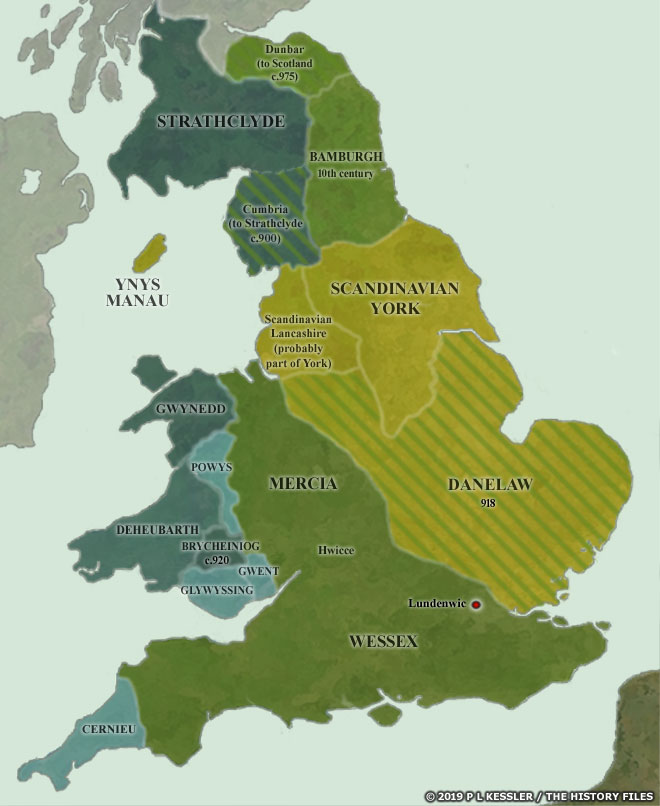
Scandinavian settlers, Faarlund notes, gained control towards the end of the 9th century of an area known as Danelagen, which forms parts of Scotland and England today. Faarlund stressed that “an extremely important geographic point in our research†is that the East Midlands in England, where he says the modern English language developed, was part of the relatively densely populated southern portion of Danelagen.
Edmonds and Faarlund also contend that sentence structure in what developed into modern English is Scandinavian, not western Germanic as previously believed. Both today’s Scandinavian languages place the object after the verb, for example, unlike German and Dutch which place the verb at the end of a sentence. Possessive forms can also be the same in both the Scandinavian languages and English, which also can end sentences with a preposition and split infinitives. While that’s sometimes frowned upon in other variations of modern English such as American English, Faarlund argues it’s not possible in German, Dutch or Old English.
All this, he claims, boosts the similarities between Norwegian and English, for example, and the differences between other Germanic languages and English. “The only reasonable explanation is that English is a Nordic language, and that this language is a continuation from the Norwegian-Danish language used in England from the Middle Ages,†Faarlund told Apollon. “Why the residents of the British Isles chose the Nordic grammar, though, is a matter of speculation.â€
jigane ga deru (地鉄ãŒå‡ºã‚‹) – Literally “the steel appears,†for example when a blade is polished so often that the shingane appears or the jigane shows more unrefined areas. As a saying, it means “to reveal one´s true character.â€
In the American Scholar, Jessica Love admits that the English language is particularly rich in words for colors, tastes, and textures, but laments our language’s “lexical void” with respect to words for smells.
The solution, she explains, would be for English to follow its usual practice and borrow some words from the vocabulary of another language. In this case, we want to plunder the language used by about 1000 hunter gatherers in West Malaysia.
[A] new study by Majid and Burenhult… [identifies] Jahai, a language spoken by a [very small] hunter-gatherer group in Malaysia that has a sizeable vocabulary to characterize scents. Jahai has more than a dozen basic odor terms, including words that translate roughly to “having a stinging smell†(used to describe the odors of petrol, bat poop, and ginger root) and “having a bloody smell that attracts tigers†(used to describe, among other things, the odor of crushed head lice).
The researchers confirmed the Jahai olfactory lexicon by comparing the performances of Jahai speakers and English speakers on two different tasks: color-naming and scent-naming. Color-naming required individuals to describe 80 different colored chips as best they could, while scent-naming required them to sniff odors extracted from lemons, turpentine, smoke, and the like, and do the same. As a group, the English speakers all tended to agree—and pithily—on color terms, just as we’d expect given how strongly color terms are encoded in English. But they were stumped by scents, offering disagreeing, and long-winded, responses. Jahai speakers, on the other hand, experienced much less difficulty describing the odors, finding them just as codable as colors (though interestingly, they showed poorer agreement on color terms than English the speakers did).
Although the volunteers tended to describe each smell and color in their own words, it quickly became clear that Jahai speakers could describe colors and odors with equal precision, while English speakers showed much less aptitude for smells than for colors. While Jahai speakers’ ability to distinguish smells averaged out just a few percentage points below their ability to distinguish colors, English speakers’ odor-naming precision averaged out to less than one tenth of their color distinction specificity.
Just as English has precise color terms like “mauve†and “cerulean,†Jahai has highly precise terms for smells – such as cŋεs, “the smell of petrol, smoke and bat droppings,†itpɨt, “the smell of durian fruit, Aquillaria wood, and bearcat,†pʔus “a musty smell, like old dwellings, mushrooms and stale food,†and plʔεŋ, “a bloody smell that attracts tigers.†English speakers, meanwhile, tended to rely on broader smell terms like “smoky,†“sweet,†“piney†and so on.
This chart shows the lexical distance — that is, the degree of overall vocabulary divergence — among the major languages of Europe.
The size of each circle represents the number of speakers for that language. Circles of the same color belong to the same language group. All the groups except for Finno-Ugric (in yellow) are in turn members of the Indo-European language family. …
The original research data for the chart comes from K. Tyshchenko (1999), Metatheory of Linguistics. (Published in Russian.)
Dan Greenfield explains how the Left’s Newspeak in the real world differs from Orwell’s prediction. Modern Newspeak does not reverse meanings. It substitutes emotions for meanings.
Newspeak’s objective was to enforce linguistic schizophrenia as a means of subdividing personalities, killing rational thought and making opposition into a form of madness. Liberal Newspeak’s is less ambitious. It settles for muddling your brain. Like modern advertising, its goal is to make you feel comfortable without actually telling you anything.
Liberal Newspeak is the chirpy announcer in a drug commercial soothingly telling you about all the fatal side effects while on screen couples have romantic picnics and go whitewater rafting. That is the job of most of the news media. Forget outliers like MSNBC which caters to a self-consciously prog crowd. The media’s real job is to be that announcer telling you that if you vote liberal, your taxes will go up, your job will go to China and you will die, without getting you upset about the terrible news.
The dictionary of Liberal Newspeak is full of empty and meaningless words. Community, Care, Access, Sharing, Concern, Affordability, Options, Communication, Listening, Engage, Innovating and a thousand others like it are wedged into sentences. Entire pages can be written almost entirely in these words without a single note of meaning intruding on the proceedings.
It’s not that these words don’t have meanings. It’s that their meanings have been rendered meaningless. The techniques of advertising have been used to pluck up words that people once felt comfortable with and wrap them around the agendas of the liberal bureaucracy.
The Awl describes an originalist approach to Shakespearian performance.
The language of Queen Elizabeth I’s England is often described as the most beautiful English ever spoken. It is an idealized tongue, synonymous with a golden age that followed the barbarism of the Middle Ages, preceded the chaos of the English Civil Wars, and shaped our understanding of what came after. As the historian Jack Lynch details in The Age of Elizabeth in the Age of Johnson, this idealization caught on during the 1700s, when writers and other thinkers were stricken with unprecedented self-consciousness about their native tongue. The language, Jonathan Swift wrote in 1712, had fallen victim to such evils as “Enthusiastick Jargon†and “Licentiousnessâ€; Samuel Johnson denounced its “Gallick structure and phraseology.†The British sought pure linguistic ancestors to emulate and found them in the Elizabethans—especially Shakespeare. “In our Halls is hung / Armoury of the invincible knights of old,†William Wordsworth wrote. “We must be free or die, who speak the tongue / That Shakespeare spake.â€
A fixation on Shakespeare’s English also emerged, later but no less fervently, in the United States. As interest in his plays surged throughout the 1800s, “American writers emphasized the ‘Anglo-Saxon’ roots of American culture and celebrated ‘our Shakespeare’ as a figurehead behind which a nation made increasingly diverse by immigration could unite,†the scholar Helen Hackett has written. “In particular, American English was claimed to be purer and closer to the English of Shakespeare’s time than was the language spoken in Victorian Britain.â€
Still, professional directors and producers didn’t embrace what became known as Original Pronunciation, even as they sometimes resurrected other aspects of historical performances. Perhaps they considered it an archaic curiosity—but it is more likely that they didn’t know of it at all, or feared, as London’s reconstructed Shakespeare’s Globe Theatre did, that it would sound so primitive that people wouldn’t understand it.
That all changed in late 2003, when a linguist named David Crystal offered to help the Globe put on three OP performances of Romeo and Juliet. A white-bearded Irishman who retired from the University of Reading in 1985 to lead a life of independent scholarship, Crystal, the preeminent detective of the modern OP community, is the author of more than 100 books—enough, and in enough editions, that even he has lost track of exactly how many—including The Cambridge Encyclopedia of the English Language.