Category Archive 'WWII'
22 Oct 2015

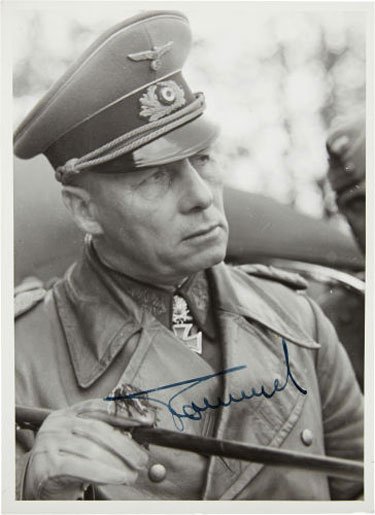
Heritage Auctions at their Historical Manuscripts Grand Format Auction #6149 in New York on November 4 – 5th, among many interesting items, will be offering several lots associated with WWII German Field Marshall Erwin Rommel:
Lot 49179: An never-sent autograph letter, written two weeks before Rommel’s death by forced suicide, dated October 1, 1944, to Hitler justifying reverses at Allied hands in Normandy and attempting to defend his Chief of Staff Lieutenant General Hans Speidel (arrested three weeks earlier for participation in the plot to kill Hitler).
Lot 49180: A typed letter to Captain Helmuth Lang,his aide-de-camp, dated September 18, 1944, thanking that officer for his letter and commenting on Rommel’s recovery from an Allied air attack two months earlier.
Lot 49181: Four Photograph Albums compiled by Hellmuth Lang containing 750 photographs, a presentation copy of Cornelius Ryan’s Book The Longest Day, and an original copy of Rommel’s Death Announcement.
Lot 49182: A signed photograph of Erwin Rommel (see above) formerly the property of his aide Helmuth Lang.
Heritage Auctions’ Thoughts on Rommel’s Last Days.
31 Aug 2015
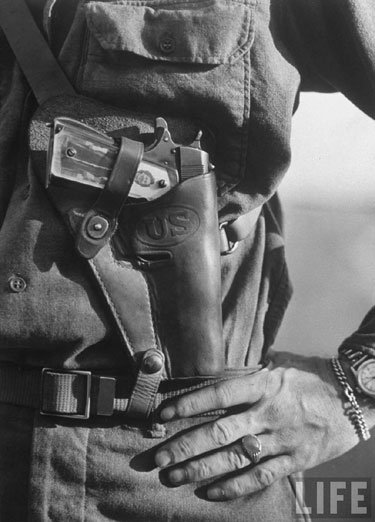
This Life magazine photo, taken at Loiano, Italy in April 1945, is a closeup by internationally-famous photographer Margaret Bourke-White of the plexiglass grip of Lieutenant John Ernser’s .45 pistol containing a photo of his girlfriend. Ernser, age 26, was commanding an infantry platoon engaged in attacking fortified German positions.
The availability of acrylic plexiglass from the canopies of crashed or shot-down aircraft during WWII led to a common practice by American troops of replacing the original standard-issue grips on pistols or fighting knives with clear plexiglass replacements over photographs.
If you were not killing an enemy soldier with the modified weapon, you could stare at the image of your girlfriend and dream of home.
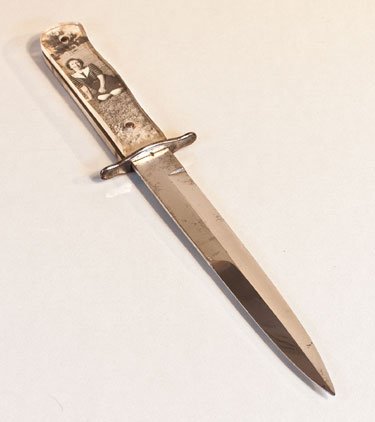
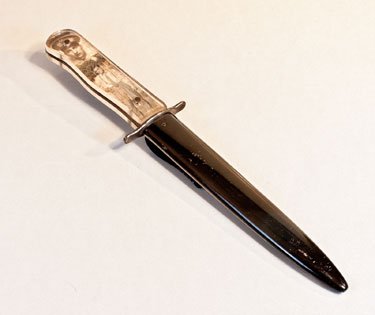
Below is a captured German trench knife (from my own collection) which has had its blade chromed and which has a girlfriend photo on one side, and two male photos on the other side.
06 Aug 2015

Slate (of all sites!) quotes approvingly a Quora answer to the question: “What Would Have Happened if Germany Had Invaded the U.S. During World War II?”
Invading the North American mainland can be safely left in the realm of bad Hollywood films. And that’s even today, with larger ships, jet cargo aircraft, and more people. While it makes for a great strategy, in the end, it’s just a nonstarter. Why?
The Germans had no forward base in the New World. If they had seized Iceland, any of the French protectorates in the Caribbean, or northern South America, then an invasion, while still a stretch, could have been conceivable. Without forward bases to deploy to and from, an invasion isn’t going to happen.
Consider that the Wehrmacht was winning while America was out of the war. One of the most idiotic things Hitler did was to declare war on the United States on Dec. 11, 1941. While the Wehrmacht was about to get thrashed in the Soviet Union, it could have stage-managed that into a negotiated settlement if it had chosen to. When the U.S. entered the war, it was all in, and Germany didn’t have the cards for that kind of bet. Invading North America would have simply brought the U.S. immediately into the war, with results that would have been more disastrous than they were.
And even if the Germans had landed a sizable force here, how where they going to be resupplied? Any such force would have been trapped here until it was defeated, destroyed, or retreated. The U.S. could play at the U-boat game, and the Germans would have needed open logistics lines to keep themselves supplied. Assuming that they were somehow able to move further inland, they still would need a corridor or corridors open to the ocean for supplies and retreat. Not seeing how that could have happened.
In addition, everybody had guns. One commonality among the nations conquered by Germany is that private firearms ownership was heavily restricted or simply banned. With no such restrictions here and given the fact that modern combined arms tactics were still in their infancy, it’s difficult to see how the Germans would have avoided taking heavy casualties. The Germans would have faced an armed force at least 10 times the size of their invasion force, who were also motivated to ensure that they (the Germans) would lose.
Whole thing.
25 May 2015
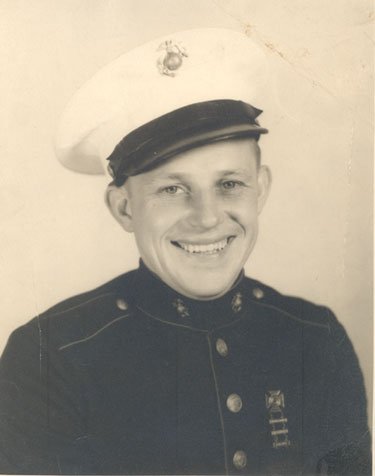
William G. Zincavage, Fall 1942, after graduating Marine Corps Boot Camp
Military Police, North Carolina, Fall 1942
First Amphibious Corps, Third Marine Division, Special Troops:
Solomon Islands Consolidation (Guadalcanal), Winter-Spring 1943
New Georgia Group Operation (Vella LaVella, Rendova), Summer 1943
Third Amphibious Corps, Third Marine Division, Special Troops:
Marianas Operation (Guam), Summer 1944
Fifth Amphibious Corps, Third Marine Division, Special Troops:
Iwo Jima Operation, February-March 1945 (Navy Unit Commendation)
North American Campaign Medal
Asiatic-Pacific Campaign Medal with Four Bronze Stars
Good Conduct Medal
——————————————————–
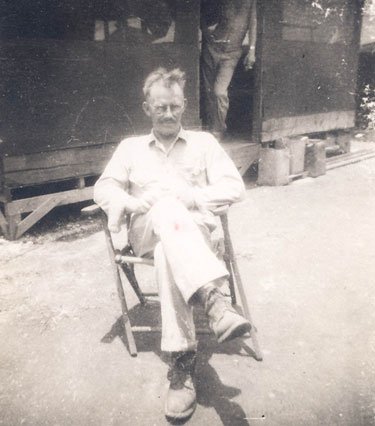
While recovering from malaria after the Battle of Iwo Jima, he looked 70 years old.
——————————————————–
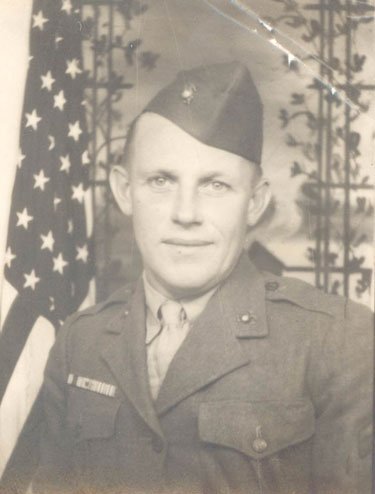
But he was back to normal in December of 1945, when this photo was taken shortly before he received his discharge.
25 May 2015

WWII Victory Medal
All of my grandparents’ sons and one daughter, now all departed, served.
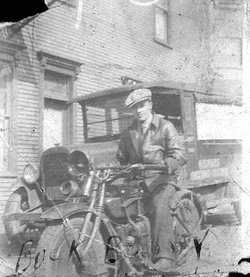
Joseph Zincavage (1907-1998) Navy
(No wartime photograph available, but he’s sitting on a Henderson Motorcycle in this one.)
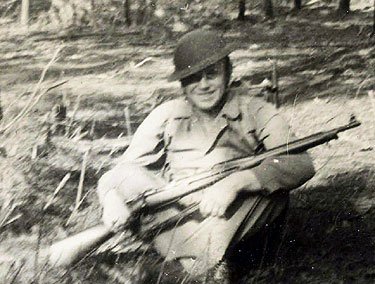
William Zincavage (1914-1997) Marine Corps

Edward Zincavage (1917-2002) Marine Corps

Eleanor Zincavage Cichetti (1922-2003) Marine Corps
30 Apr 2015
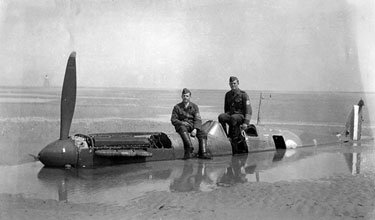
German soldiers sitting on the wreckage of Spitfire P9374, May, 1940.
The Mirror:
One of the first Spitfires ever made has gone up for sale for a staggering £2.5 million after spending 40 years buried in sand at the French beach it crashed on.
The iconic Mark 1 plane was among the first built in March 1940 as Britain scrambled to ready itself for the epic battle that took place in the skies just a few months later.
But Spitfire P9374 never made it to the Battle of Britain as it crash-landed in May 1940.
The fighter plane was being piloted by Flight Officer Peter Cazenove over Dunkirk when it was hit by a single bullet from a German Dornier bomber.
Cazenove, an Old Etonian flying his first combat mission, had no choice but to bring it down on the wet sands at Calais.
Cazenove was captured by the Nazis and taken to the Stalag Luft III prisoner of war camp, famous for ‘The Great Escape’.
His plane became consumed by the sandy beach and there it remained for the next 40 years.
In 1980 the wreckage was discovered when part of it was spotted poking out from its sandy grave.
It was corroded and covered in barnacles but amazingly still in tact. The plane was dragged from the beach and taken to the Mus e de l’Air in Paris.
Eventually it was bought by American billionaire philanthropist Thomas Kaplan, who has had the plane meticulously restored to its original condition by a team of expert engineers.
Mr Kaplan, an Oxford-educated gold trader, owns both of the surviving Mk1 Spitfires.
He has now listed the plane Cazenove piloted for sale through London auctioneers Christies 75 years since the Battle of Britain with an estimate of £2.5 million.
He plans to donate the proceeds to the RAF Benevolent Fund and wildlife charity Panthera.
—————————————————-
Don’t miss the grand presentation, complete with videos, from Christie’s.

Flight Officer Peter Cazenove
03 Apr 2015
This discussion of how to use the Soviet 91/30 PU Scope applies as well to the scopes used on German Mauser sniper rifles.
31 Mar 2015
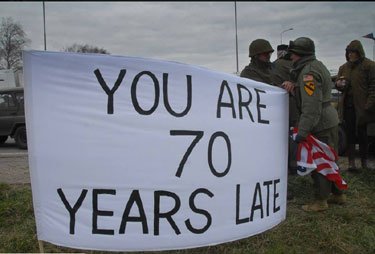
These days, the Russian aggression against Ukraine is causing NATO maneuvers all over Central Europe in an effort to send a message to Vladimir Putin. Upon arriving in the Czech Republic, US soldiers were welcomed with this sign.
19 Mar 2015

Northwestern University girls brave freezing weather to go through a Home Guard rifle drill on the campus in Evanston, Illinois on January 11, 1942.
From left to right are: Jeanne Paul, age 18, of Oak Park, Illinois,; Virginia Paisley, 18, of Lakewood, Ohio; Marian Walsh, 19, also from Lakewood; Sarah Robinson, 20, of Jonesboro, Arkansas,; Elizabeth Cooper, 17, of Chicago; Harriet Ginsberg, 17.
22 Feb 2015

Leon Kent as a young officer during WWII.
The LA Times published a pretty impressive obituary for Leon Kent.
In the first desperate hours of the Battle of the Bulge in December 1944, a young Army lieutenant was given an order that seemed impossible: stop a fast-moving column of German tanks from advancing.
The three soldiers assigned to the lieutenant were not trained in anti-tank warfare. The only artillery piece available was designed to bring down airplanes, not tanks. And the firing position provided no cover if the tanks returned fire.
A battlefield dispatch from the Associated Press described what happened:
“Anti-aircraft gunners, who stayed behind when the infantry withdrew, played a vital role in preventing a major German breakthrough in Belgium. … One battery, commanded by Lt. Leon Kent of Los Angeles, knocked out five tanks, including one King Tiger tank, in two hours.” …
Kent, who returned to a career as a lawyer and bowling-alley owner after the war, died Feb. 12 in Beverly Hills, his home for several decades. He was 99 and had pneumonia, his family said.
He always downplayed any sense that he had acted bravely during that attack. But he never dismissed the danger that his soldiers faced from German tanks.
“If they got one shot at us, we were dead,” he told The Times in 2011. “I remember thinking: Do the shells go through you or do you go up in pieces?”
By stopping the German column, Allied troops who had retreated were able to regroup and begin counter-measures.
“What Capt. Kent showed was extraordinary leadership,” retired Army Maj. Gen. John Crowe said before a 2011 ceremony at the December 1944 Historical Museum in La Gleize, Belgium. “He wouldn’t ask his troops to do anything he wouldn’t do himself. That’s the kind of leadership that inspires troops.”
After the war, locals erected in a plaque that, in French, reads: “Here the invader was stopped.” …
About that day when he was given a suicidal-sounding order to stop the enemy, Kent was blunt: “We stopped them cold.”
Read the whole thing.
01 Feb 2015
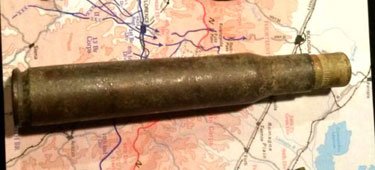


Some Italian metal detectors found a coded message inside a WWII cartridge somewhere in Southern Tuscany. Gizmodo has the story.
Hat tip to Karen L. Myers.
/div>

Feeds
|





