Archive for October, 2006
17 Oct 2006


Perhaps just a bit envious of the acclaim won by Jonathan Franzen’s recent novel The Corrections, also in last Sunday’s Times Book Review, Daniel Mendelsohn does his level best to savage Jonathan Franzen’s latest miscellaneous writings collection The Discomfort Zone.
Mendelsohn goes so far as to indict Franzen for insufficient Alzu-Karl-Braun-lichkeit.
This illumination that “The Discomfort Zone” provides about the origins of that persona helps explain, in turn, a wider failing in Franzen’s work: its lack of humanizing softness…
What can you do with someone who professes to love “Peanuts” but doesn’t understand a word of it? “The Discomfort Zone” features an odd but suggestive paean to the creator of the comic strip that, more than anything else in American popular culture for many decades, celebrated the comic side of something Franzen professes to know a lot about: discomfort — the sheer, poignant, foolish awkwardness that comes with being human. Recounting the unappealing facts of Schulz’s biography, Franzen emphasizes that the cartoonist was a difficult, embittered, resentful man — the kind of person who still seethed over perceived insults he’d received four decades before. Yet the author is quick to defend Schulz — the, um, artistically brilliant, tormented, somewhat geeky Midwestern offspring of Scandinavian parents — as a hero of Art. “To keep choosing art over the comforts of normal life … is the opposite of damaged.”
Franzen’s insistence on seeing this repugnant person as an ideal is, no doubt, what leads him to his wrongheaded interpretation of the comic strip itself. “Almost every young person experiences sorrows,” he rightly points out at the beginning of his exegesis of “Peanuts” — a sentence that gives you hope that the geeky child still hiding inside the adult Franzen is going to admit that, like everyone else, he loved “Peanuts” because he, too, identified with the perpetual awkward, perpetually failed, and yet just as perpetually optimistic Charlie Brown. But no: for Franzen, who, even as a child, “personally enjoyed winning and couldn’t see why so much fuss was made about the losers,” the real hero of “Peanuts” is not the “depressive and failure-ridden” Charlie Brown, but the grandiose beagle, Snoopy: “the protean trickster,” as Franzen calls him, “the quick-change artist who … before his virtuosity has a chance to alienate you or diminish you” can be “the eager little dog who just wants dinner.” But Snoopy’s self-proclaimed virtuosity does, in the end, alienate and diminish: he’s amusing, with his epic grudge against the Red Baron (and the Van Gogh and the spiral staircase he lost when his doghouse burned down), precisely because he represents the part of ourselves — the smugness, the avidity, the pomposity, the rank egotism — most of us know we have but try to keep decently hidden away. Franzen, like most of us, is very likely an awkward combination of Charlie and Snoopy; the difference being that whereas most of us think of ourselves as Charlie with a bit of Snoopy, Franzen clearly doesn’t mind coming off as a whole lotta Snoopy with the barest soupçon of Charlie: a person, as this lazy and perverse book demonstrates, whose very admissions of weakness, of insufficiency, smack of showboating, of grandiose self-congratulation. For my part, I’ll stick with Charlie. Who, after all, wants the company of a character so self-involved he doesn’t even realize he’s not human?
My sympathies are with Snoopy, and Franzen. I haven’t actually read the new book, but I’ve read other reviews, reviews quoting the usual sort of conformist intelligentsia condescension concerning George W. Bush, and I’d say Franzen could use a larger component of Snoopy to replace the undesirable liberal Lucy in his makeup.
17 Oct 2006
Henry Alford, on the back page of the Sunday New York Times Book Review, assembled various real obituary quotations into mock obituaries for Impossible Author (male) and Difficult Writer (female). In case you didn’t believe him, he footnoted the quotations.
Example:
[Impossible] himself began writing in the 1940’s, locking himself in a stall in the men’s room in the subway. Making his base of operations the Angle bar at 42nd Street and Eighth Avenue, he sold drugs at times and himself at others, not always with notable success.
17 Oct 2006

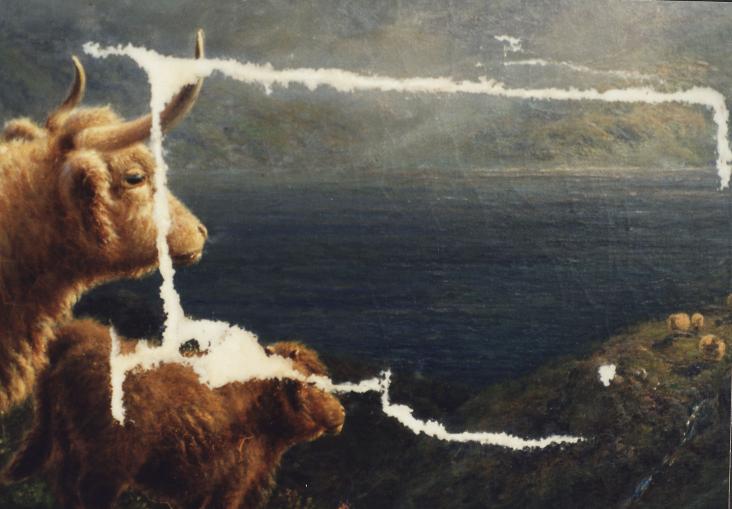
Pablo Picasso, Le Rêve (The Dream), 1932
(hole supplied by Photoshop)
Steve Wynn has a special relationship with Picasso’s famous cubist period painting Le Rêve. He purchased it at Christie’s, New York, November 10th, 1997 for $48,402,500.
Reputedly the painting served as the original inspiration for his Wynn Las Vegas resort.
Wynn, however, decided to part with the painting and had successfully negotiated a deal to sell it to Steven A. Cohen for $139 million.
The Las Vegas Review Journal reports that, in connection with the impending sale, Wynn was in the process of exhibiting the famous painting to a group of luminaries including Barbara Walters and screenwriters Nora Ephron and Nicholas Pileggi, when, gesturing, he punctured the canvas with his elbow, leaving a hole in the female figure’s left forearm. Wynn suffers from some vision problems.
The sale is not expected to proceed. The painting, of course, will be repaired.
————————–
UPDATE 10/21
Daniel Engber explains how the painting will be repaired:
It will be slow and tedious work. The torn ends of the canvas can probably be lined up, and conservators can identify matching fibers on either side of the rip by inspecting them under a microscope. In general, you can expect the wefts in the fabric—that is, the crosswise yarns of the weave—to split at the site of the impact. The lengthwise warps tend to get stretched out, but they may not break.
The rip itself can be mended in a few different ways. First, the conservator can line up the torn ends and affix them to a new piece of fabric that lines the back of the painting. She might also try to attach the torn ends to each other using a method called Rissverklebung, in which individual fibers are rewoven back into place.
To reweave the warps and wefts, you have to figure out the proper placement of each individual fiber. Bits of paint that are stuck to the fibers must be glued in place or removed until the reweaving is complete. (Conservators map out the location of each paint flake they remove so it can be replaced in precisely the right spot.) Because an accident will stretch out some fibers and fray others, you sometimes have to tie off and shorten some threads while attaching new material to lengthen others. Threads attached to the back of the canvas will reinforce the seam.
Closing the tear is only the first part of the process. An accident like Wynn’s can damage the painting in other places by stretching the fabric and distorting the image. To correct for these planar distortions, the conservators try to change the lengths of individual fibers or small patches of the canvas. Applied humidity can make a fiber expand across its diameter and shrink across its length—and tighten up distended parts of the weave.
Bits of paint that have fallen off the painting must also be replaced. Wynn might have surveyed the scene of the accident and saved any stray bits of paint for the conservators in a petri dish. (Chance are he didn’t strip much off the canvas—Ephron says he was wearing a golf shirt, which suggests a bare-elbow blow. An elbow covered with rough fabric would probably have done more damage.) Conservators have to touch up spots of missing paint with fresh material, color-matched to the surrounding area.
One more thing: Conservators always try to make their repairs reversible. That way, you won’t cause any permanent damage to the work if you screw up, and someone can always try to improve on your work in the future.
17 Oct 2006
Bethany from the realVerse videoblog hands out awards for the most amusing recent political campaign ads.
video
Hat tip to Michelle Malkin.
17 Oct 2006
Range Rover Sport attempts to get the better of a British Challenger 2 tank.
video
17 Oct 2006
It may seem a little strange that Yale 1970 classmate Garretson Beekman Trudeau, graduate of St. Paul’s (the alma mater of John Kerry) ’66, successful cartoonist, veteran only of the 1960’s Vietnam Peace Movement, and currently a vigorous opponent of the Bush Administration, has started his own milblog, open to postings from members of the armed forces currently serving in Afghanistan and Iraq.
But conspicuous public support of the troops is a consistent and studied policy on the part of the more sophisticated elements of the anti-war left. That particular maneuver allows them, when criticized for their antiwar activities, to say: “I’m patriotic. I’m not disloyal. I support our troops.” They’re only in favor of assuring the futility of all our troop’s efforts and sacrifices, the defeat of the United States, and the triumph of her adversaries.
The new military blog is part of Trudeau’s Slate site, which includes his well-known, currently humor-free and utterly tendentious leftwing cartoon, news, a debate forum, and a “Get Involved” bolshevik agitation site.
Despite its unwholesome associations, the new milblog has attracted some excellent contributions, and is definitely worth a read.
16 Oct 2006
P.J. O’Rourke contemplates the twin horrors of the upcoming election.
Watching Republicans in Washington is like watching lemmings, if lemmings jumped into cesspools instead of off cliffs. Splash! There goes Mark Foley!…
Actually, the Republicans should be grateful for their lying, thieving scum. It distracts the public from the things the Republicans have done that are honestly bad. Our postwar policy is creating Weimar Iraq. And when the Islamofascist Beer Hall Putsch comes there won’t even be beer.
Social Security privatization was presented to the electorate with a public relations and marketing flair not seen since New Coke. Intelligence collection has been given an additional bureaucracy to correct the problems created by too much bureaucracy in intelligence collection. “Homeland Security” sounds like a failed 1980s savings and loan. Didn’t Grandma lose $20,000 when Homeland Security went under? Then there’s No Child Left Behind. What if the child deserves to be left behind? What if the child deserves a smack on the behind? We have a national testing program to test whether kids are . . . what? Stupid? You’ve got kids. Kids are stupid.
Immigration policy will fence the border, providing economic stimulus to the Mexican ladder industry. The National Guard is stationed on the Rio Grande–U.S. troops standing between you and yard care…
I am so moved by principle and idealism, so indignantly high-minded, that I’m changing sides. At least the Democrats aren’t hypocritical about being scum. After Gerry Studds was censured for molesting an underaged congressional page, he was reelected six times. Therefore, in the mid term elections, I’m working to get Demo crats into office.
And work it is. There’s the problem of putative speaker of the House Nancy Pelosi, whose very name summons images of children coming home from day care madly scratching their scalps. Then, when you see Pelosi speak, it’s impossible not to think of Lucy holding the football for Charlie Brown. I hope her campaign slogan isn’t “A New Kick-Off for America.”
There is also the problem of issues for the Democrats to run on. You’re going to elect Democrats to control government spending? And you’re going to marry Angelina Jolie for her brains. The privacy issue–government spying on U.S. citizens–isn’t going to work. True, NSA has been collecting all our telephone information, but anyone who’s answered the phone during dinner knows that every telemarketer on earth has that information already. Illegal immigration? When the Democrats were in charge, the illegal immigrants were from al Qaeda. And as for Iraq, the best the Democrats have been able to do is make the high school sex promise: “I’ll pull out in time, honest.”
Read the whole thing.
16 Oct 2006
Back in the first half of the last century, too frequently the pillars of the community, and their allies in the fourth estate, stereotyped and scapegoated the Negro, and then celebrated every lynching as a victory for justice and law and order. Then, as now, a small minority of skeptics saw through the falsehood and hypocrisy so eagerly embraced by opportunistic pols, the conformist mob, and the slimey priesthood of dead tree pulp.
The identity of the victims of mob mentality and the forms of lynching have changed, but the basic process of a passionate embrace of irrational accusation precisely because it provides a yearned for excuse to punish some living representative of a hated stereotype, the vindictive pursuit and punishment of the unhappy victim drafted to serve as scapegoat, and the whole ugly affair egged on and encouraged by the press sinking to the lowest level of emotionalism, group hatred, and prejudice has not changed.
In Rape, Justice, and the “Times”, Kurt Anderson excoriatingly, and deservedly, reviews the Duke rape story, the prosecutor’s, and the New York Times’ behavior.
As a young writer at Time, whenever I’d hear “That story’ll write itself,” I wanted to reach for my revolver. The line, delivered with bluff cheer, suggests that good material makes good writing easy, which isn’t true. Its premise is the very wellspring of hackdom: The more thoroughly some set of facts reinforces the relevant preconceptions, caricatures, clichés, and conventional wisdom, the easier it makes life for everyone, journalists as well as their audiences. Most people want to be told what they already know. And in a world of murky moral grays, who doesn’t sometimes relish a black-and- white tale, with villains to loathe, victims to pity, injustice to condemn?
Thus the enthralling power of the Duke lacrosse-team story when it broke last spring. As a senior Times alumnus recently e-mailed me, “You couldn’t invent a story so precisely tuned to the outrage frequency of the modern, metropolitan, bien pensant journalist.” That is: successful white men at the Harvard of the South versus a poor single mother enrolled at a local black college, jerky superstar jocks versus $400 out-call strippers, a boozy Animal House party, shouts of “nigger,” and a three-orifice gangbang rape in a bathroom.
The story appalled us good-hearted liberal metropolitans, but absolutely galvanized the loopy left at Duke. One associate professor, Wahneema Lubiano, could barely disguise her glee. “The members of the team,” she wrote in a blog, “are almost perfect offenders” because they’re “the exemplars of the upper end of the class hierarchy … and the dominant social group on campus.”
Furthermore, she wrote, “regardless of the ‘truth’ ”—that is, regardless of whether a rape occurred—“whatever happens with the court case, what people are asking is that something changes.”
16 Oct 2006

As today’s left screams its head off over the intolerable losses in Iraq, Gateway Pundit reminds us of the little-noticed fact that peace-time losses under Clinton were actually higher.
H/T to terrye.
16 Oct 2006

Archaologists puzzle and debate over how the ancient Britons managed to move, and erect, the enormous stones used to construct the megalithic monument at Stonehenge.
Wally Wallington can show them how.
video
Simple, isn’t it?
Wallington also has a web-site, TheForgottenTechnology.com, where he sells a one hour movie via download, or on DVD.
15 Oct 2006

Pamela, of Atlas Shrugged, rejects Feminism’s and Liberalism’s ideals of the evolution of the male of the species into something closer to the feminine. She does not care for todays metrosexual males. She likes the sort of man played by Robert Mitchum in those old film noirs.
Hat tip to PJM.
/div>

Feeds
|