David Wemyss takes an anecdote from George Orwell as the title of a thoughtful essay on alienation (which he refers to as “insularity”) as seen in the writings Orwell, Woolf, and Kierkegaard, man’s alienation from his fellow man (particularly those of other classes and conditions) and the alienation of some modern intellectuals from values and self.
Virginia Woolf is treated harshly.
It was a salutary lesson for me that the pellucid beauty of “On Being Ill†led eight years later to “Three Guineasâ€, with its insistence that Britain in the thirties was a tyranny as bad as Nazi Germany, that all loyalties were false (except those emanating from the virgin forest of course), that all uniforms were evil, and that war was a male desire to dominate brought about by competitive education.
Indeed, not many people realise that Virginia Woolf in 1938 was pretty well recommending the post-1967 British comprehensive school – except that it would have been a university – one so given over to cultural destructiveness that her own books would have fallen out of the syllabus.
Theodore Dalrymple put it characteristically well in the City Journal a few years ago when he said that, had she survived to our own time, Woolf would have had the satisfaction of observing that her cast of mind – shallow, dishonest, resentful, envious, snobbish, self-absorbed, trivial, philistine, and ultimately brutal – had triumphed among the elites of the Western world. And if that seems a little harsh on someone who did I think have a considerable gift – Mrs Dalloway is surely a very good novel – just remember that she also wrote the most immitigably stupid book of the twentieth century.
From Eric Ames, at Ricochet, who goes on to observe:
It is the fundamental problem with the leftist complaint about income inequality: if they truly are worried about income inequality, then they are not worried about the actual welfare of real people. They are just mad that some people have more than others. If they take this seriously, it means that fixing poverty is no less an acceptable policy goal as making everyone poor. After all, if the gap is what is important, it shouldn’t matter how much anyone has so long as nobody has more than anybody else.
This goes right back to George Will’s point on the difference between the right and the left; the right wants equality of opportunity, the left wants equality of outcome. The whole Occupy movement, in fact, smacks of an irritating “it’s not fairism.” It’s not fair that there are winners and losers, so let’s make everyone a loser.
Newt Gingrich has taken the lead in PPP’s national polling. He’s at 28% to 25% for Herman Cain and 18% for Mitt Romney. The rest of the Republican field is increasingly looking like a bunch of also rans: Rick Perry is at 6%, Michele Bachmann and Ron Paul at 5%, Jon Huntsman at 3%, and Gary Johnson and Rick Santorum each at 1%.
Compared to a month ago Gingrich is up 13 points, while Cain has dropped by 5 points and Romney has gone down by 4.
——————————–
CNN’s poll results are nearly as good:
A new national survey of Republicans indicates that it’s basically all tied up between Mitt Romney and Newt Gingrich in the race for the GOP presidential nomination, with Gingrich on the rise and businessman Herman Cain falling due to the sexual harassment allegations he’s been facing the past two weeks.
According to a CNN/ORC International Poll released Monday, 24% of Republicans and independents who lean towards the GOP say Romney is their most likely choice for their party’s presidential nominee with Gingrich at 22%. Romney’s two-point advantage is well within the survey’s sampling error.
Wired wonders aloud what the rulers of Red China can possibly be building in one of the world’s most remote locations.
It is probably not going to be a recreational theme park.
—————————
New photos have appeared in Google Maps showing unidentified titanic structures in the middle of the Chinese desert. The first one is an intricate network of what appears to be huge metallic stripes. Is this a military experiment?
They seem to be wide lines drawn with some white material. Or maybe the dust have been dug by machinery.
It’s located in Dunhuang, Jiuquan, Gansu, north of the Shule River, which crosses the Tibetan Plateau to the west into the Kumtag Desert. It covers an area approximately one mile long by more than 3,000 feet wide.
The tracks are perfectly executed, and they seem to be designed to be seen from orbit.
——————————————-
See comments: Reliapundit thinks he knows what it is.
Nov. 15: The Daily Mail has more pictures of more things.
Harry B. Nielson, Mr. Fox’s Hunt Breakfast on Christmas Day, chromolithograph print published in Vanity Fair, Christmas, 1897
The hunter characteristically admires, and even identifies with, his quarry, and that sense of identification commonly leads to the visualization in the hunter’s imagination of the animal object of the chase as a fellow sportsman, participating in the hunt with equal pleasure and enthusiasm and equal relish of tradition.
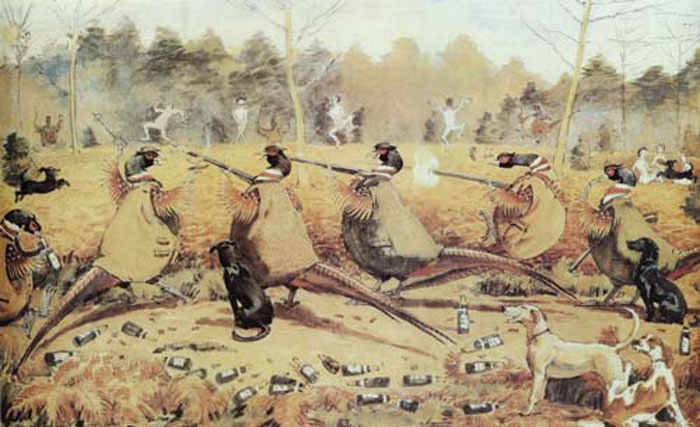
The same comedic effect, and the same sportsman’s pleasure in thinking of his adversary in the field as fellow sportsman, can be found in shooting prints, like the very well-known contemporary print by Alexander Charles-Jones “Cocks Only,” which gleefully depicts a line of Ringnecked Pheasants in hunting vests, smoking cigars and drinking while peppering a discomfited group of incoming naked men.
Another classic example of the same humorous genre by Snaffles, published in Hoghunter’s Annual in the 1930s, depicts a couple of senior ranking boars smoking cigars and admiring trophy mounts of British officers acquired in the hunting field.
I had assumed, without any special investigation or thought on the matter, that this genre of sporting humor was specifically British and Victorian, but I was decidedly wrong.
Herman Cain seems to have more or less survived his sexual harassment accusations, and Rick Perry failed to disgrace himself (thus doing much better) in last night’s debate at South Carolina’s Wofford College, but the evidence is clear that neither of these two likeable guys has the substantive knowledge or the communication abilities needed to be elected.
Michael Brendan Doughtery, just a couple of days ago, drew up a little list of Newt Gingrich’s sins, and asked How is Gingrich an improvement on Mitt Romney?
But if one accepts the viewpoint that the process is meaningful, the long series of Republican debates have seriously raised Gingrich’s status and claim to represent the viable conservative alternative to Mitt Romney. Other candidates who inspired hope have delivered disappointing performances. Mitt Romney has been polished and smooth. But only Newt Gingrich has demonstrated a superior ability to discuss issues and policies with a penetrating and original intelligence and with wit and humor. Gingrich is frequently a pleasure to listen to.
Hayward makes the point which has occurred to me as well, that Gingrich is significantly redeeming himself precisely by the old-fashioned and unconventional way that he has chosen to seek the nomination and the presidency.
Newt is doing something interesting and maybe profound: he is trying to run for president according to an older model that stresses substance over sound bytes and gimmicky, targeted campaign strategy. … It is a bid to see whether presidential politics can still be conducted along the line of the old republic that would be more familiar to the Founders, to the style of public argument more akin to what Hamilton had in mind in talking about “refining and enlarging the public view†through “reflection and choice†in Federalist #1.
It seems increasingly evident that we are going to have to oppose Barack Obama with a lesser figure than Ronald Reagan or Barry Goldwater. We simply do not have a peerless champion of Conservatism that we can nominate. But, God knows, even a mediocre, unprincipled Republican, some would argue even a syphilitic camel would represent an enormous improvement over Barack Obama.
If push came to shove, we would have to support Mitt Romney over Obama. It seems impossible to avoid concluding that the best hope of a more seriously conservative nominee is going to be Newt Gingrich. (There. It hurts, but I said it.)
WWI came to an end by an armistice arranged to occur at the eleventh hour of the eleventh day of the eleventh month of 1918. The date and time, selected at a point in history when mens’ memories ran much longer, represented a compliment to St. Martin, patron saint of soldiers, and thus a tribute to the fighting men of both sides. The feast day of St. Martin, the Martinmas, had been for centuries a major landmark in the European calendar, a date on which leases expired, rents came due; and represented, in Northern Europe, a seasonal turning point after which cold weather and snow might be normally expected.
It fell about the Martinmas-time, when the snow lay on the borders…
—-Old Song.
From Robert Chambers, The Book of Days, 1869:
St. Martin, the son of a Roman military tribune, was born at Sabaria, in Hungary, about 316. From his earliest infancy, he was remarkable for mildness of disposition; yet he was obliged to become a soldier, a profession most uncongenial to his natural character. After several years’ service, he retired into solitude, from whence he was withdrawn, by being elected bishop of Tours, in the year 374.
The zeal and piety he displayed in this office were most exemplary. He converted the whole of his diocese to Christianity, overthrowing the ancient pagan temples, and erecting churches in their stead. From the great success of his pious endeavours, Martin has been styled the Apostle of the Gauls; and, being the first confessor to whom the Latin Church offered public prayers, he is distinguished as the father of that church. In remembrance of his original profession, he is also frequently denominated the Soldier Saint.
The principal legend, connected with St. Martin, forms the subject of our illustration, which represents the saint, when a soldier, dividing his cloak with a poor naked beggar, whom he found perishing with cold at the gate of Amiens. This cloak, being most miraculously preserved, long formed one of the holiest and most valued relics of France; when war was declared, it was carried before the French monarchs, as a sacred banner, and never failed to assure a certain victory. The oratory in which this cloak or cape—in French, chape—was preserved, acquired, in consequence, the name of chapelle, the person intrusted with its care being termed chapelain: and thus, according to Collin de Plancy, our English words chapel and chaplain are derived.
The canons of St. Martin of Tours and St. Gratian had a lawsuit, for sixty years, about a sleeve of this cloak, each claiming it as their property. The Count Larochefoucalt, at last, put an end to the proceedings, by sacrilegiously committing the contested relic to the flames. …
The festival of St. Martin, happening at that season when the new wines of the year are drawn from the lees and tasted, when cattle are killed for winter food, and fat geese are in their prime, is held as a feast-day over most parts of Christendom. On the ancient clog almanacs, the day is marked by the figure of a goose; our bird of Michaelmas being, on the continent, sacrificed at Martinmas. In Scotland and the north of England, a fat ox is called a mart, clearly from Martinmas, the usual time when beeves are killed for winter use. In ‘Tusser’s Husbandry, we read:
When Easter comes, who knows not then,
That veal and bacon is the man?
And Martilmass beef doth bear good tack,
When country folic do dainties lack.’
Barnaby Googe’s translation of Neogeorgus, shews us how Martinmas was kept in Germany, towards the latter part of the fifteenth century
‘To belly chear, yet once again,
Doth Martin more incline,
Whom all the people worshippeth With roasted geese and wine.
Both all the day long, and the night, Now each man open makes
His vessels all, and of the must, Oft times, the last he takes,
Which holy Martin afterwards Alloweth to be wine,
Therefore they him, unto the skies, Extol with praise divine.’
A genial saint, like Martin, might naturally be expected to become popular in England; and there are no less than seven churches in London and Westminster, alone, dedicated to him. There is certainly more than a resemblance between the Vinalia of the Romans, and the Martinalia of the medieval period.
Indeed, an old ecclesiastical calendar, quoted by Brand, expressly states under 11th November: ‘The Vinalia, a feast of the ancients, removed to this day. Bacchus in the figure of Martin.’ And thus, probably, it happened, that the beggars were taken from St. Martin, and placed under the protection of St. Giles; while the former became the patron saint of publicans, tavern-keepers, and other ‘dispensers of good eating and drinking. In the hall of the Vintners’ Company of London, paintings and statues of St. Martin and Bacchus reign amicably together side by side.
On the inauguration, as lord mayor, of Sir Samuel Dashwood, an honoured vintner, in 1702, the company had a grand processional pageant, the most conspicuous figure in which was their patron saint, Martin, arrayed, cap-Ã -pie, in a magnificent suit of polished armour; wearing a costly scarlet cloak, and mounted on a richly plumed and caparisoned white charger: two esquires, in rich liveries, walking at each side. Twenty satyrs danced before him, beating tambours, and preceded by ten halberdiers, with rural music. Ten Roman lictors, wearing silver helmets, and carrying axes and fasces, gave an air of classical dignity to the procession, and, with the satyrs, sustained the bacchanalian idea of the affair.
A multitude of beggars, ‘howling most lamentably,’ followed the warlike saint, till the procession stopped in St. Paul’s Churchyard. Then Martin, or his representative at least, drawing his sword, cut his rich scarlet cloak in many pieces, which he distributed among the beggars. This ceremony being duly and gravely performed, the lamentable howlings ceased, and the procession resumed its course to Guildhall, where Queen Anne graciously condescended to dine with the new lord mayor.


†led eight years later to “Three Guineas
â€, with its insistence that Britain in the thirties was a tyranny as bad as Nazi Germany, that all loyalties were false (except those emanating from the virgin forest of course), that all uniforms were evil, and that war was a male desire to dominate brought about by competitive education.