Jason Stewart (a self-described Apple addict) does not have much good to say about the current (incredibly expensive) MacBook Pro.
As Dan Ackerman at CNet noted, the Retina Mac “feels like a rest stop on the road to somewhere else,†a place where we truly get thin, light and beautiful. Already, the Samsung Series 9 is smaller and lighter. And many of the rest of the radical changes are more marketing hype than features. The asymmetrical fan blades that were going to revolutionize quiet laptop cooling? If you try real hard, you might hear a trivial difference. What about the “All Flash Architecture� In other words, whereas before you had a choice between a fast, but ridiculously expensive SSD drive, or a cheaper, larger capacity conventional hard drive, now you can only have the SSD drive. Only Apple could successfully market that limitation as a revolutionary feature.
Of course, if you need to connect an Ethernet cable you better shell out extra for a dongle and hope you can find it when you need it. Need to watch a movie on disc or load a program or content the old fashioned way? Apple has just the extra accessory to sell you for that, too, since it is no longer included.
The new MacBook Pro with Retina display is a nice computer. The screen is innovative at a cost of both dollars and features. Whether it’s worth the substantial premium (more than $4,000, fully loaded) is a personal decision. Apple has never been accused of catering to the wish lists of the masses, and this is no exception. It has staked its claim on a new display standard and if that means trade-offs, take it or leave it.
———————————-
Meanwhile, Harry McCracken contends that the Mac world and the PC world are already very different and may soon becoming even more so.
When I sat down to review Apple’s new Retina-display MacBook Pro, I instinctively wanted to compare it with similar Windows laptops. I wanted to discuss how the specs stacked up and whether the price seemed fair. I hoped to contrast its industrial design with those of its closest counterparts.
Then it dawned on me: there are no similar Windows laptops. …
while Apple remains the most influential computer maker in the business, the rest of the industry has chosen to ignore some of its design innovations. When it started sealing up its portables a few years ago — eliminating the ability to easily swap in batteries, RAM and hard drives — I thought that other hardware makers might follow along. For the most part, they haven’t. …
[I]f Microsoft has its way, PCs and Macs are about to get more different than they’ve been in decades. For all of the interesting things about the new MacBook Pro, it’s a straightforward notebook computer based on a form factor that’s been around for 30 years. Apple seems to be content to let Macs be Macs, while the iPad goes places that computing devices never have before.
With Windows 8, however, Microsoft is trying to reinvent the PC from scratch. The Metro interface has little to do with the basic concepts that Windows 7 and OS X share, and it’s conceivable that a bunch of long-standing form factors that have never quite worked, such as touchscreen PCs and laptops that convert into tablets, will finally take off. If they do, and Apple doesn’t push the Mac in the same direction, the average Windows PC could end up having very little in common with any Mac.
Maybe there is a solution for the problem of out-sized tuition costs from elite universities which leave graduates hundreds of thousands of dollars in debt.
Andy Kessler, in the Wall Street Journal, describes what happened when a Stanford Computer Science professor last year decided to offer an Artificial Intelligence course over the Internet for free.
[Sebastian Thrun was] [f]rustrated that his (and fellow Googler Peter Norvig’s) Stanford artificial intelligence class only reached 200 students, they put up a website offering an online version. They got few takers. Then he mentioned the online course at a conference with 80 attendees and 80 people signed up. On a Friday, he sent an offer to the mailing list of a top AI association. On Saturday morning he had 3,000 sign-ups—by Monday morning, 14,000.
In the midst of this, there was a slight hitch, Mr. Thrun says. “I had forgotten to tell Stanford about it. There was my authority problem. Stanford said ‘If you give the same exams and the same certificate of completion [as Stanford does], then you are really messing with what certificates really are. People are going to go out with the certificates and ask for admission [at the university] and how do we even know who they really are?’ And I said: I. Don’t. Care.”
In the end, there were 160,000 people signed up, from every country in the world, he says, except North Korea. Rather than tape boring lectures, the professors asked students to solve problems and then the next course video would discuss solutions. Mr. Thrun broke the rules again. Twenty-three thousand people finished the course. Of his 200 Stanford students, 30 attended lectures and the other 170 took it online. The top 410 performers on exams were online students. The first Stanford student was No. 411.
Mr. Thrun’s cost was basically $1 per student per class. That’s on the order of 1,000 times less per pupil than for a K-12 or a college education—way more than the rule of thumb in Silicon Valley that you need a 10 times cost advantage to drive change.
So Mr. Thrun set up a company, Udacity, that joins many other companies attacking the problem of how to deliver the optimal online education. “What I see is democratizing education will change everything,” he says.
The German Savings Bank (Sparkasse) of Chemnitz in Saxony held a contest allowing customers to vote for an image to be used on its Mastercard.
Chemnitz used to be in the German Democratic Republic (aka East Germany), and the Communist regime renamed the city Karl-Marx-Stadt in 1953. The original name was restored when Communism fell in 1990.
Nostalgic Ostis evidently cast their votes for Karl Marx, proving ironically once again that Capitalism offers choices, even to those who don’t appreciate it.
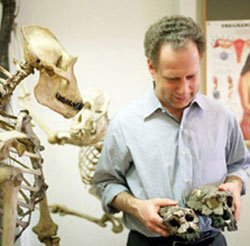
Daniel E. Lieberman, Professor of Human Evolutionary Biology, Harvard University
It was not for nothing that the late William F. Buckley, Jr. declared: “I would rather be governed by the first two thousand people in the Boston telephone directory than by the two thousand people on the faculty of Harvard University.”
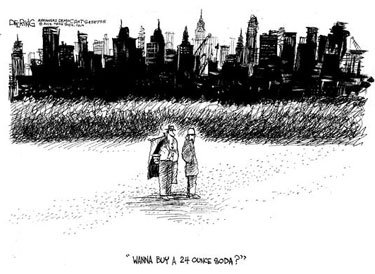
Daniel E. Lieberman, a Harvard-educated Anthropologist who has managed to segue smoothly from his native social science to teaching Evolutionary Biology, won recent top marks in Scientism, the inappropriate and hubristic application of scientific theories to political and moral issues, when in a New York Time’s editorial last week, he informed readers that Evolution was voting in favor of Mayor Bloomberg’s soft drink ban specifically and government coercion in general.
Lessons from evolutionary biology support the mayor’s plan: when it comes to limiting sugar in our food, some kinds of coercive action are not only necessary but also consistent with how we used to live. …
Since sugar is a basic form of energy in food, a sweet tooth was adaptive in ancient times, when food was limited. However, excessive sugar in the bloodstream is toxic, so our bodies also evolved to rapidly convert digested sugar in the bloodstream into fat. Our hunter-gatherer ancestors needed plenty of fat — more than other primates — to be active during periods of food scarcity and still pay for large, expensive brains and costly reproductive strategies (hunter-gatherer mothers could pump out babies twice as fast as their chimpanzee cousins).
Simply put, humans evolved to crave sugar, store it and then use it. For millions of years, our cravings and digestive systems were exquisitely balanced because sugar was rare. Apart from honey, most of the foods our hunter-gatherer ancestors ate were no sweeter than a carrot. The invention of farming made starchy foods more abundant, but it wasn’t until very recently that technology made pure sugar bountiful.
The food industry has made a fortune because we retain Stone Age bodies that crave sugar but live in a Space Age world in which sugar is cheap and plentiful. …
We humans did not evolve to eat healthily and go to the gym; until recently, we didn’t have to make such choices. But we did evolve to cooperate to help one another survive and thrive. Circumstances have changed, but we still need one another’s help as much as we ever did. For this reason, we need government on our side, not on the side of those who wish to make money by stoking our cravings and profiting from them. [Emphasis added] We have evolved to need coercion.
Professor Lieberman neglects to explain how Evolution effectively draws the line between acceptable, desirable, and morally justifiable forms of state coercion, including taxes, regulations, and special paternalistic supervision of children, and even more effective and draconian measures, for instance, the Khmer Rouge marching the overweight urban inhabitants of Cambodia back into the country at machine gun point, aimed at “restoring a natural part of our environment. ”
He doesn’t offer any general principled account of why Evolution supports this and doesn’t support that precisely because he hasn’t got one. Professor Lieberman simply assumes that Evolution and Science (and Progress and the God of History) is embodied in the world by the consensus of people like himself, by the current opinions of the educated elite community of fashion.
One can find the scientific way of deciding things simply by reading the editorial pages of the Times.
All this, of course, is rubbish. The opinions and theories of Evolutionary Biology (let alone Anthropology) are anything but set in stone. Someone may discover next week the intense Neolithic cultivation of sugar beets in the Fertile Crescent. Medicine may decide that obesity is really caused by a particular gene, and that the specifics of diet play only a small role.
In the 1950s, Evolution would have decreed that you must drink milk to cure ulcers produced by the unnatural stress of modern capitalist life. Our latest information contends that bacteria are to blame and milk-drinking doesn’t do a thing.
More importantly, though, mere scientific facts are incapable of addressing philosophical questions of individual rights and the proper role and limits of the powers of government. Those issues have nothing to do with imaginary dietary teleologies and have to be debated on an entirely different level.
Scientism, the presumptuous attempt to misapply scientific theories or data in contexts in which they cannot possibly be determinative, is actually, I would argue, decisive evidence of bad education and intellectual incompetence.
It has been recognized for many decades now, certainly back to the 1960s or 1970s when Bill Buckley offered his famous apothegm concerning the faculty of Harvard, that there exists a tremendous and thoroughly alarming disconnect between our establishment intelligentsia and wisdom and common sense. Professor Lieberman is simply the most recent in a long series of wise fools.
The photo of these 19th century shooters is from Lindsay McCrum’s Chicks with Guns.
Evidently the ladies, too, competed in Schuetzen precision shooting matches with specially-made target rifles in which the shooter fired from a standing position, typically outdoors at 200 yard targets. The photo is small, but those rifles look like Ballards to me. They would have been chambered in .32-40, the preferred American target competition cartridge.
Ireland lost to Spain 4-0 in their match in the Euro 12 European Championships, but the Irish fans won the hearts of the hosting Poles.
On Facebook, I see today posting after posting from my Polish correspondents declaring themselves to be “fans of the Irish fans.” “Irish fans are the best fans in the world.” according to many Poles. One declared admiringly: “They sing louder when they’re losing.”
Michael Yon (mercifully) takes a break from his recent role of crusading journalist telling truth to power and exposing the errors and inadequacies of the US military’s Afghanistan chain of command to share some information on one of India’s most exotic sects (and one of its American converts descended from a famous author).
The fundamentals of Aghor—perhaps the most extreme religion in the world—are fantastically simple, though nonetheless repugnant to most. Repugnance, or rather the quest to overcome it, is in fact a central tenet of this belief system. Aghor is an extreme sect of Hinduism. Its adherents principally worship Shiva, the Hindu god of destruction. Aghoris live by a simple creed: 1. The gods are perfect. 2. The gods create everything: Every thought, every action, every bird and diamond, every birth and every death. 3. Since the gods are perfect, and everything is made by the gods, everything—everything—is perfect.
Since everything is perfect, being repulsed by anything or forbidding any behavior as taboo is tantamount to rejecting the gods. While this accounts for the willingness of more moderate Aghoris to work with lepers and other so-called untouchables, it also explains why some ardent Aghoris aim to overcome some of the more gruesome targets of revulsion. In my travels I’ve met Aghoris who would just as soon pluck an eyeball from a rotten human corpse and pop it into their mouths as eat chicken. He or she might carry a rotting dead dog over their shoulder for a week, or have sex with a dead cow (holy to other Hindus) or with a rotting human corpse. One Aghori in northern India ate part of the rotting penis of a bloated, vivisected corpse on the banks of the Ganges, engaging in this “sacred ritual†in full view of onlooking police.
When conservatives struggle against the left-wing impetus toward more socialism and more statism, we have a fundamental problem because the odds are stacked against us. We are ourselves funding, through our taxes, the very same operations and organizations which constitute the real base of the democrat party.
Just look in Craigslist for Employment advertising in the not-for-profit category. The numbers of them out there are staggering.
Dan Greenfield explains that we can win in the long run by reducing the size of our adversary, simply by defunding it.
Take a look at your tax bill. Take a look at your property taxes, especially. Much of the money you pay goes to fund the infrastructure of the left, its government bureaucracies and its non-governmental organizations, which still rake in fortunes in government grants. That infrastructure is wrapped up in a thousand divisions and causes, many of which sound benign, from health to civil rights, from education to diplomacy, from the environment to better government, all of which sound nice at a distance, but exist to embed and perpetuate the power relationships of the left.
The right does not need this kind of infrastructure. A system that is not out to control everyone’s behavior all the time, that is not looking to turn every tenth person into another warm body in its endless war against individual freedom, does not need this kind of manpower or indoctrination. Grandiosity, the sheer size of the left, makes it vulnerable. That size is built on a maze of groups, agendas, laws and guidelines in the name of a thousand causes, which intersect with one another to form the beast that we are up against.
The beast is big, but it’s vulnerable. It needs power and money to live. It gains that power by serving as an intermediary between people and the government, even when it is the government. The more intermediaries it adds on, to demand one thing or another, to organize the people, while demanding that the government listen to the people it has organized, while paradoxically taking grant money from the government to organize the people to demand that the government listen to them– the more power and money it gains.
The first and most popular attack on the beast is to take away its compulsory powers. It’s popular because Americans don’t like being compelled to do things. Decades of brainwashing have gotten people to repeat some, “It’s for our own good” talking points. But it’s still unpopular, and most people are not so far gone, that they won’t cheer when given a way to opt out.




 .
.