06 Jan 2013
“We Three Kings of Orient Are”
Epiphany, King's College, Traditions, We Three Kings

|
Archive for January, 2013
06 Jan 2013
Epiphany, or Twelfth DayEpiphany, History, Traditions
(From Robert Chambers, A Book of Days, 1869) Born: Richard II, King of England, 1366; Joan d’Arc, 1402; Peter Metastasio, poet, 1698; Benjamin Franklin, philosopher, Boston, U.S., 1706; David Dale, philanthropist, 1739; George Thomas Doo, engraver, 1800. Feast Day: St. Melanius, bishop, 490. St. Nilammon, Hermit. St. Peter, abbot of St. Austin’s, Canterbury, 608. TWELFTH-DAY This day, called Twelfth-Day, as being in that number after Christmas, and Epiphany from the Greek ‘‘ΕπιΦáνєια”, signifying appearance, is a festival of the Church, in commemoration of the Manifestation of Christ to the Gentiles; more expressly to the three Magi, or Wise Men of the East, who came, led by a star, to worship him immediately after his birth. (Matt. ii. 1-12.) The Epiphany appears to have been first observed as a separate feast in the year 813. Pope Julius I is, however, reputed to have taught the Church to distinguish the Feasts of the Nativity and Epiphany, so early as about the middle of the fourth century. The primitive Christians celebrated the Feast of the Nativity for twelve days, observing the first and last with great solemnity; and both of these days were denominated Epiphany, the first the greater Epiphany, from our Lord having on that day become Incarnate, or made his appearance in “the flesh;” the latter, the lesser Epiphany, from the three-fold manifestation of His Godhead—the first, by the appearance of the blazing star which conducted Melchior, Jasper, and Balthuzar, the three Magi, or wise men, commonly styled the three Kings of Cologne, out of the East, to worship the Messiah, and to offer him presents of “Gold, Frankincense, and Myrrh”—Melchior the Gold, in testimony of his royalty as the promised King of the Jews; Jasper the Frankincense, in token of his Divinity; and Balthuzar the Myrrh, in allusion to the sorrows which, in the humiliating condition of a man, our Redeemer vouchsafed to take upon him: the second, of the descent of the Holy Ghost in the form of a Dove, at the Baptism: and the third, of the first miracle of our Lord turning water into wine at the marriage in Cana. All of which three manifestations of the Divine nature happened on the same day, though not in the same year.
In the middle ages, the worship by the Magi was celebrated by a little drama, called the Feast of the Star:
At Milan, in 1336, the Festival of the Three Kings was celebrated in a manner that brings forcibly before us the tendency of the middle ages to fix attention on the historical externals of Christianity. The affair was got up by the Preaching Friars. The three kings appeared, crowned, on three great horses richly habited, surrounded by pages, body guards, and an innumerable retinue. A golden star was exhibited in the sky, going before them. They proceeded to the pillars of St. Lawrence, where King Herod was represented with his scribes and wise men. The three kings ask Herod where Christ should be born, and his wise men, having consulted their books, answer, at Bethlehem. On which the three kings, with their golden crowns, having in their hands golden cups filled with frankincense, myrrh, and gold, the star going before, marched to the church of St. Eustorgius, with all their attendants, preceded by trumpets, horns, asses, baboons, and a great variety of animals. In the church, on one side of the high altar, there was a manger with an ox and ass, and in it the infant Christ in the arms of his mother. Here the three kings offer Him gifts. The concourse of the people, of knights, ladies, and ecclesiastics, was such as was never before beheld. In its character as a popular festival, Twelfth-Day stands only inferior to Christmas. The leading object held in view is to do honour to the three wise men, or, as they are more generally denominated, the three kings. It is a Christian custom, ancient past memory, and probably suggested by a pagan custom, to indulge in a pleasantry called the Election of Kings by Beans. In England, in later times, a large cake was formed, with a bean inserted, and this was called Twelfth-Cake. The family and friends being assembled, the cake was divided by lot, and who-ever got the piece containing the bean was accepted as king for the day, and called King of the Bean. In England, it appears there was always a queen as well as a king on Twelfth-Night. A writer, speaking of the celebration in the south of England in 1774, says:
In the sixteenth century, it would appear that some peculiar ceremonies followed the election of the king and queen. Barnaby Goodge, in his paraphrase of the curious poem of Nagcorgus, The Popish Kingdom, 1570, states that the king, on being elected, was raised up with great cries to the ceiling, where, with chalk, he inscribed crosses on the rafters to protect the house against evil spirits. A Twelfth-Day custom, connected with Paget’s Bromley in Staffordshire, went out in the seventeenth century. A man came along the village with a mock horse fastened to him, with which he danced, at the same making a snapping noise with a bow and arrow. He was attended by half-a-dozen fellow-villagers, wearing mock deers’ heads, and displaying the arms of the several chief landlords of the town. This party danced the Hays, and other country dances, to music, amidst the sympathy and applause of the multitude. There was also a huge pot of ale with cakes by general contribution of the village, out of the very surplus of which ‘they not only repaired their church, but kept their poor too; which charges are not now, perhaps, so cheerfully borne.’ On Twelfth-Night, 1606, Ben Jonson’s masque of Hymen was preformed before the Court; and in 1613, the gentleman of Gray’s Inn were permitted by Lord Bacon to perform a Twelfth-Day masque at Whitehall. In the masque the character of Baby cake is attended by ‘an usher bearing a great cake with a bean and all with good will have spared unto your lordship, please.’ On Twelfth-Day, 1563, Mary Queen of Scots celebrated the French pastime of the King of the Bean at Holyrood, but with a queen instead of a king, as more appropriate, in consideration of herself being a female sovereign. The lot fell to the real queen’s attendant, Mary Fleming, and the mistress good-naturedly arrayed the servant in her own robes and jewels, that she might duly sustain the mimic dignity in the festivities of the night. The English resident, Randolph, who was in love with Mary Beton, another of the queen’s maids of honour, wrote in excited terms about this festival to the Earl of Leicester.
The queen of the bean was that day in a gown of cloth of silver; her head, her neck, her shoulders, the rest of her whole body, so beset with stones, that more in our whole jewel-house were not to be found. . . The cheer was great. I never found myself so happy, nor so well treated, until that it came to the point that the old queen [Mary] herself, to show her mighty power, contrary unto the assurance granted me by the younger queen [Mary Fleming], drew me into the dance, which part of the play I could with good will have spared unto your lordship, as much fitter for the purpose.” Charles I had his masque on Twelfth-Day, and the Queen hers on the Shrovetide following, the expenses exceeding £2000; and on Twelfth-Night, 1633, the Queen feasted the King at Somerset House, and presented a pastoral, in which she took part. Down to the time of the Civil Wars, the feast was observed with great splendour, not only at Court, but at the Inns of Court, and the Universities (where it was an old custom to choose the king by the bean in a cake), as well as in private mansions and smaller households. Then, too, we read of the English nobility keeping Twelfth-Night otherwise than with cake and characters, by the diversion of blowing up pasteboard castles; letting claret flow like blood, out of a stag made of paste; the castle bombarded from a pasteboard ship, with cannon, in the midst of which the company pelted each other with egg-shells filled with rose-water; and large pies were made, filled with live frogs, which hopped and flew out, upon some curious person lifting up the lid. Twelfth-Night grew to be a Court festival, in which gaming was a costly feature. Evelyn tells us that on Twelfth-Night, 1662, according to custom, his Majesty [Charles II] opened the revels of that night by throwing the dice himself in the Privy Chamber, where was a table set on purpose, and lost his £100. [The year before he won £1500.] The ladies also played very deep. Evelyn came away when the Duke of Ormond had won about £1000, and left them still at passage, cards, &c., at other tables. The Rev. Henry Teonge, chaplain of one of Charles’s ships-of-war, describes Twelfth-Night on board:
The celebrated Lord Peterborough, then a youth, was one of the party on board this ship, as Lord Mordaunt. The Lord Mayor and Aldermen and the guilds of London used to go to St. Paul’s on Twelfth-Day, to hear a sermon, which is mentioned as an old custom in the early part of Elizabeth’s reign. A century ago, the king, preceded by heralds, pursuivants, and the Knights of the Garter, Thistle, and Bath, in the collars of their respective orders, went to the Royal Chapel at St. James’s, and offered gold, myrrh, and frankincense, in imitation of the Eastern Magi offering to our Saviour. Since the illness of George III, the procession, and even the personal appearance of the monarch, have been discontinued. Two gentlemen from the Lord Chamberlain’s office now appear instead, attended by a box ornamented at top with a spangled star, from which they take the gold, frankincense, and myrrh, and place them on an alms-dish held forth by the officiating priest. In the last century, Twelfth-Night Cards represented ministers, maids of honour, and other attendants of a court, and the characters were to be supported throughout the night. John Britton, in his Autobiography, tells us he ‘ suggested and wrote a series of Twelfth-Night Characters, to be printed on cards, placed in a bag, and drawn out at parties on the memorable and merry evening of that ancient festival. They were sold in small packets to pastrycooks, and led the way to a custom which annually grew to an extensive trade. For the second year, my pen-and-ink characters were accompanied by prints of the different personages by Cruikshank (father of the inimitable George), all of a comic or ludicrous kind.’ Such characters are still printed. The celebration of Twelfth-Day with the costly and elegant Twelfth-cake has much declined within the last half-century. Formerly, in London, the confectioners’ shops on this day were entirely filled with Twelfth-cakes, ranging in price from several guineas to a few shillings; the shops were tastefully illuminated, and decorated with artistic models, transparencies, &c. We remember to have seen a huge Twelfth-cake in the form of a fortress, with sentinels and flags; the cake being so large as to fill two ovens in baking. 06 Jan 2013
“Don’t Listen to St. Paul!”Amusement, Christianity, Female Ordination, Feminism, Feminist Issues, InfidelityVia Bird Dog and Steven Hayward. 06 Jan 2013
Jay Leno to Current TV Host Joyce Behar: “Osama bin Ladin’s Your New Boss?”Al Jazeera, Albert Gore, Current TV, Jay Leno, al Jazeera———————————— And then there’s former one-heart-beat-from-the-Presidency Al Gore, America’s Caligula. Having obtained the second most ridiculous Nobel Peace Prize in history and a hundred million dollars or so for using junk science and shameless demagogy to erect a rationale for governmental parasitism on the productive economy on an unprecedented scale, Al Gore jets off, spewing carbon emissions profusely all the way, to use his high-level political clout to secure cable distribution for a new “progressive” television network. Current TV was supposed to become the American left’s great new weapons platform, allowing them to compete successfully for public influence with conservative AM talk radio (Rush Limbaugh) and Fox News. The problem is that Americans weren’t interested in left-wing propaganda, and Current TV’s rating numbers compared with those obtained by late night test screens. But was polú-tropos* Al Gore discouraged? Not he. He simply turned around and sold the network he developed to subvert America via domestic treason to a foreign enemy. His share? Another hundred million. Now Americans will be able to tune into a televised equivalent of Tokyo Rose right in the middle of their cable programming list. Thank you, Albert Gore. ———————————— *applied by Homer to Odysseus, “man of many twists and turnings.”
06 Jan 2013
Awww, Give that Poor Bear a Can Opener, She’s Hungry!Darwin Awards, Photography, Polar Bear
Perverse Nature fun From the Daily Mail, teasing hungry bear with food that is withheld: So THAT’S what it’s like to be eaten by a polar bear! Photographer inches from animal’s jaws as he takes wildlife shots from safety of perspex cage. (The video is currently “unavailable,” but I find that they usually get these running again a day later. Try it again tomorrow.) 05 Jan 2013
What the Left Got From the CliffBush Tax Cuts, Fiscal Cliff, Politics
Yuval Levin, at NR, assesses the denouement of the “Fiscal Cliff” confrontation, and concludes that the democrats played their best card and did not really win all that much.
05 Jan 2013
“The Taxing Thing”History, Taxes, William Cobbett
Hurstbourne Tarrant (or Uphusband),
— William Cobbett, Rural Rides (1830). 04 Jan 2013
Greece Doesn’t Want to Reduce Entitlements and Neither Does AmericaFederal Deficit, Federal Spending, Inevitable Doom, Matthew Yglesias, Welfare State
I missed the part about there being some democrat president who actually wanted to cut retirement programs, but that (flattering-to-his-own-side) detail aside, I think Mr. Yglesias is basically right. A kind of all-time first. The welfare state has entropy, Original Sin, and Man’s Fallen Nature on its side. Opposing it, reducing it, reforming it is hard. Being a liberal is like ordering a second Martini or agreeing to have dessert, easy. That’s actually why there are so many liberal politicians. The guys determined to be elected, at any cost, figured out long ago which side has the easier task.
04 Jan 2013
Dan Greenfield: America Gave Away the World’s Leading Industrial Economy in Return for Cheaper Goods and No Ugly Industrial SitesBad News, China, Decadence, Decline of the West, Irrationality
He’s perfectly correct, of course. Read the whole thing. 03 Jan 2013
Gun Control: It’s For People Who Don’t Have BodyguardsGun Control, Hoplophobia, Hypocrisy
Business Insider reports that the fanatically anti-gun Gannett paper which published maps showing the homes of licensed gun owners in two suburban New York counties became worried about violent retaliation, so its management naturally hired armed guards.
————————— And, what do you know? it turns out that anti-gun documentary film maker Michael Moore also goes around protected by an armed bodyguard. (BizPacReview)
03 Jan 2013
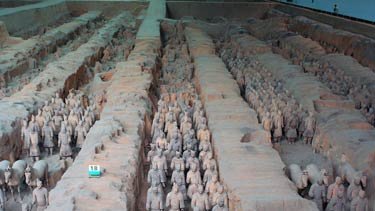
Chinese Archaeologists Reported Frightened to Enter First Emperor’s Hidden TombAmusement, Archaeology, China, Journalistic Tall Tales, Shi Huang
Here’s an interesting item from Gizmodo, essentially translated from the Spanish-language paper El Pais: (some typos corrected
If the Chinese archaeologists are indeed afraid of two-thousand-years-in-the-ground working crossbows and alleged “rivers of mercury,” I’ll be glad to enter the hidden palace first and take a look around for them. All they have to do is cover my expenses. Welcome to
NEVER YET MELTED
Another Right-Wing Web Aggregator and Purveyor of Unpopular Opinions
 David Zincavage contact: jdz@usa.net blog advertising is good for General Bullmoose and good for the USA. 


Feeds
|