Smithsonian’s Design Decoded explains the architectural origin of today’s standard Staunton-style chess men.
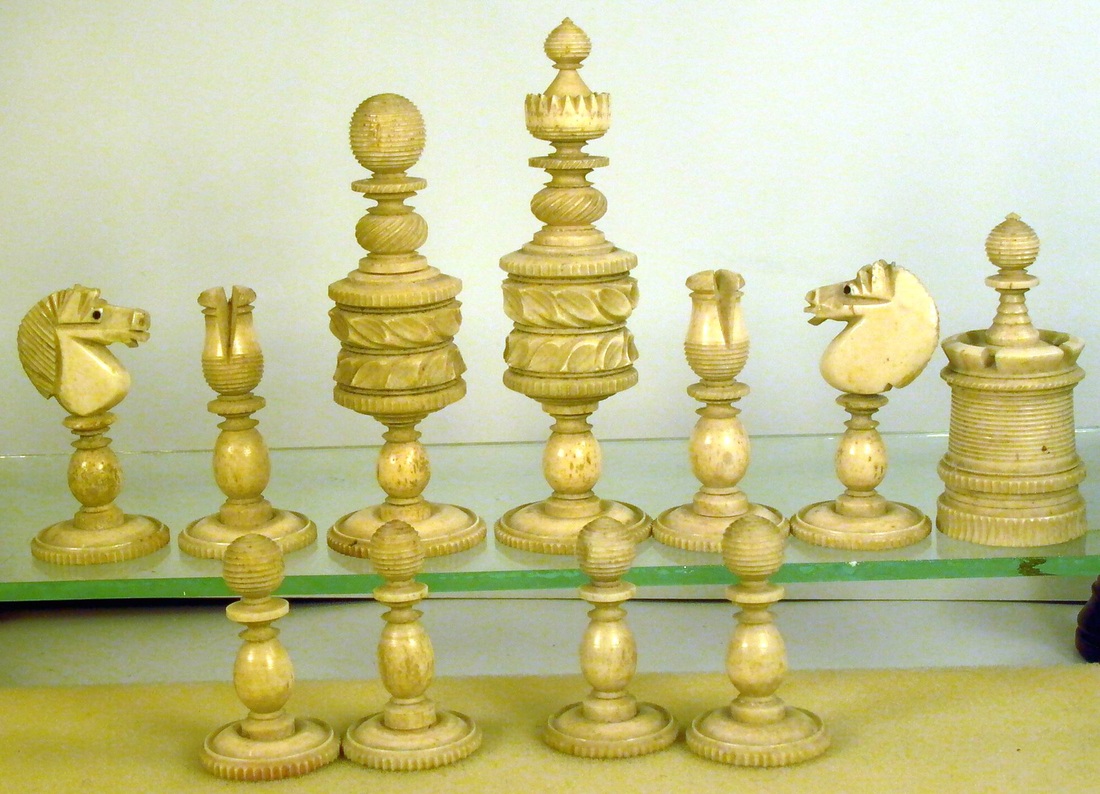
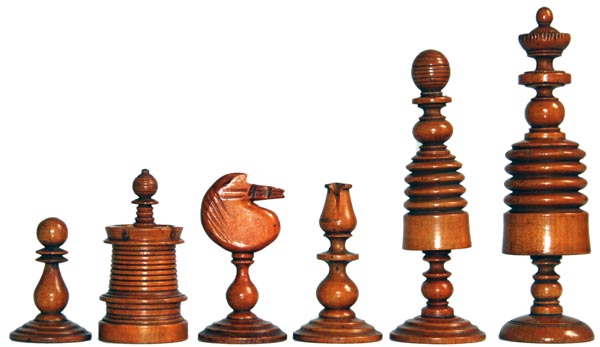
Prior to 1849, there was no such thing as a “normal chess set.†At least not like we think of it today. Over the centuries that chess had been played, innumerable varieties of sets of pieces were created, with regional differences in designation and appearance. As the game proliferated throughout southern Europe in the early 11th century, the rules began to evolve, the movement of the pieces were formalized, and the pieces themselves were drastically transformed from their origins in 6th century India. Originally conceived of as a field of battle, the symbolic meaning of the game changed as it gained popularity in Europe, and the pieces became stand-ins for a royal court instead of an army. Thus, the original chessmen, known as counselor, infantry, cavalry, elephants, and chariots, became the queen, pawn, knight, bishop, and rook, respectively. By the 19th century, chess clubs and competitions began to appear all around the world, it became necessary to use a standardized set that would enable players from different cultures to compete without getting confused.
In 1849, that challenge would be met by the “Staunton†Chess Set.
The Staunton chess pieces are the ones we know and love today, the ones we simply think of as chess pieces. Prior to its invention, there were a wide variety of popular styles in England, such as The St George, The English Barleycorn, and the Northern Upright. To say nothing of the regional and cultural variations. But the Staunton quickly would surpass them all. Howard Staunton was a chess authority who organized many tournaments and clubs in London, and was widely considered to be one of the best players in the world. Despite its name, the iconic set was not designed by Howard Staunton.
According to the most widely told origin story, the Staunton set was designed by architect Nathan Cook, who looked at a variety of popular chess sets and distilled their common traits while also, more importantly, looking at the city around him. Victorian London’s Neoclassical architecture had been influenced by a renewed interest in the ruins of ancient Greece and Rome, which captured the popular imagination after the rediscovery of Pompeii in the 18th century. The work of architects like Christopher Wren, William Chambers, John Soane, and many others inspired the column-like, tripartite division of king, queen, and bishop. A row of Staunton pawns evokes Italianate balustrades enclosing of stairways and balconies.
Klaus Pichler found a variety of opportunities for striking photographic images just walking through the back rooms and corridors of the Vienna Natural History Museum. [Slate]
Richard Fernandez reminds us that we need to mourn not only Margaret Thatcher’s departure, but even more the failure of the Trans-Atlantic democracies to live up to, and properly value, the legacy of greatness of the three leaders who defeated Communism.
Margaret Thatcher will not be remembered for that minor conflict which we call the Falklands War. It will be for her role in the fall of the Soviet Union.
And therein lies the crux of the matter. To understand the challenge — to hear the question — is perhaps the greatest obstacle to greatness on history’s stage.
The great achievement of Reagan, Thatcher, and the Pope lay in remembering that Communism was an evil thing. By that time it was conventional wisdom that the Soviet Union was permanent. And therefore their revolutionary act consisted, in the first place, of understanding the question. The reply they gave was not remarkable, just what most of us would say had we known the interrogative.
The three were poorly instructed in the by-then perfected art of moral relativism. The archived punditry is full of jibes attacking their failure to understand that their human imperfections disqualified them from exercising judgment, or that the defects of their societies necessarily compelled them into inaction.
To the chagrin of the intelligensia, the three still thought in the obsolete categories of “oughts†and “shoulds,†in the distinction between the normative and the normal. Fortunately for the world, they understood that the mud of creation was not a bar to the quest for paradise.
If there was greatness in Thatcher, it lay in the ability to hear the signal hidden from those too obsessed with their own greatness. It lay in being able to see the fastball over home plate that nobody else could see. Clinton, who lived in the aftermath of Reagan, John Paul II, and Thatcher, approached the problem as a question of how to spend the Peace Dividend; as a matter of how to remake the world now that his predecessors had cleared the way for him.
And he hit the ball he saw out of the park. Too bad if it was the wrong ball and the wrong park.
But if he wasn’t listening to history, maybe it wasn’t listening to him. And that’s too bad. Perhaps no one truly attains greatness by believing “it is in me.†Everyone who eventually gets there reaches it in surprise.
What made Margaret Thatcher noteworthy will not lie with her in the coffin, either to praise or — as is almost as certain — for her enemies to revile. The essence of her accomplishment was external to her. She only gave it a medium; a voice. Ronald Reagan perhaps put it best when he said: “There is no limit to what you can accomplish if you don’t care who gets the credit.â€
Thatcher ends her long life, the last of the three, at a moment when everyone is out of credit, or rather living on it. She passes in an uncertain hour, the story of her life and times a pointed reminder of how far we have fallen from those days.
Thatcher reversed the course of Britain’s economic stagnation and decline, ending the long post-war reign of Socialism over Britain. Unfortunately, like her American counterpart Ronald Reagan, she failed to leave behind a worthy successor, and Labour was able to regain power and resume its work of destroying Britain’s culture, economy, civilization, and traditions.
In 1972 Andrei Tarkovsky told Leonid Kozlov about his favorite films. Tom Lasica recently talked with the critic.
I remember that wet, grey day in April 1972 very well. We were sitting by an open window and talking about various things when the conversation turned to Otar Ioseliani’s film Once Upon a Time There Lived a Singing Blackbird. “It’s a good film,†said Tarkovsky and immediately added, drawing out his words, “though it’s, well, a little bit too… too…†He fell silent with the sentence half finished, his eyes screwed up. After a moment of intense reflection, he bit his fingernails and continued decisively, “No! No, it’s a very good film!†It was at this point that I asked Tarkovsky if he would compile a list of his favorite ten or so films. He took my proposition very seriously and for a few minutes sat deep in thought with his head bent over a piece of paper. Then he began to write down a list of directors’ names – Buñuel, Mizoguchi, Bergman, Bresson, Kurosawa, Antonioni, Vigo. One more, Dreyer, followed after a pause. Next he made a list of films and put them carefully in a numbered order. The list, it seemed, was ready, but suddenly and unexpectedly Tarkovsky added another title – City Lights.
After the list had been typed and signed “16.4.72 A. Tarkovsky,†we returned to our conversation, during which he quite naturally changed the subject and started with his gentle sense of humor to talk about something of no importance. Looking back at the list today, 20 years on, it strikes me how clearly his choices characterize Tarkovsky the artist. Like the numerous top ten lists submitted by directors to various magazines over the years, Tarkovsky’s list is highly revealing. Its main feature is the severity of its choice – with the exception of City Lights, it does not contain a single silent film or any from the 30s or 40s. The reason for this is simply that Tarkovsky saw the cinema’s first 50 years as a prelude to what he considered to be real film-making. And though he rated highly both Dovzhenko and Barnet, the complete absence of Soviet films from his list is perhaps indicative of the fact that he saw real film-making as something that went on elsewhere. When considering this point, one also needs to bear in mind the polemical attitude that Tarkovsky became imbued with through his experience as a film-maker in the Soviet Union.
For Tarkovsky, the question lay not in how beautiful a film-maker’s art can be, but in the heights that Art can reach. The director of Andrei Rublov strove for the most profound spiritual tension and extreme existential self-exposure in all his work and was ready to reject anything and everything that was incompatible with this end. His list, which includes three films by Bergman, undoubtedly reflects his taste both as a director and as a viewer – but the latter is subordinate to the former. As the way he began to compile his top ten shows, this is not only a list of Tarkovsky’s favorite films, but equally one of his favorite directors.
Not my “Top Ten” list, but certainly not an implausible collection, one particularly indicative of Tarkovsky’s metaphysical obsession. What I found curious was the omission of The Passion of Joan of Arc, and Tarkovsky’s apparent unfamiliarity with the films of Eric Rohmer and Yasujiro Ozu.
Those London firemen must have stopped for a cup of tea before arriving to extinguish the fire.
They only made 764 Miuras between 1968 and 1972. This one was a P400SV, probably made after 1970.
British sports cars were notorious for a wilingness to rust, and for every kind of electrical problem. (Famous joke: “Why do the British drink warm beer? Because Lucas made the refrigerators.”) But members of the exclusive club rich enough to own an Italian exotic car could apparently get with it really exotic issues… like a propensity to catch fire at idle(!).
Lamborghini [Miura]’s use[d] Weber 40 IDL 3C1 carburetors which were designed exclusively for racing applications and weren’t suitable for road use. The problem occurred when the car sat idling (e.g. at a stoplight), the area above the throttles filled with fuel which often ignited when the car accelerated away from the stop.
—————————————-
Peter Orosz was allowed to examine and sit in one at a collectible car company, and he was moved to rhapsodize:
There is a menacing beauty to the Miura up close. The roofline is so low the car would be inadequate to cover the private parts of a man were he to approach it naked. The cute eyelashes of the ventilation ducts surrounding the headlights begin to look like alien claws. As you make your way into the snug cabin, the velocity trumpets of that great engine tower over your head, mere inches away. If not for the thin plate of glass between you and the six carburetors, a blip of the gas pedal would send loose strands of your hair down their throats, ready to combine with gasoline. And burn.
My girlfriend Natalie, described the driving position as “basically perfectâ€, quite a surprise when you consider the monkey-boy ergonomics of most Italian cars. The cabin is simple yet full of gorgeous detail, a combination of fine materials and charming reminders of low-volume handmade production.
But said perfection combines with much imperfection: The Miura has an annoying tendency to catch on fire at idle. The front end tends to lose traction at speed. And its spotty relationship with reliability is most likely a direct function of being an Italian car, built in a small factory almost half a century ago.
Still, being up close to one makes it more desirable to me than ever. No matter how many times I see a Miura—and I haven’t seen many, and this is the first one I’ve actually sat in—I am always in awe of its impeccable proportions, its wonderful punk history, and its sheer sense of speed and style. Inside, you dream of gently twisting motorways with no speed limits, and no traffic. Of mountain roads and plains and electric blue lakes. Of tunnels to amplify the shriek of that V12. Driving a Miura is one of life’s great petrolhead fantasies. But to enjoy it, you don’t even have to drive. Just climb inside, close your eyes, and dream your merry automotive dreams.
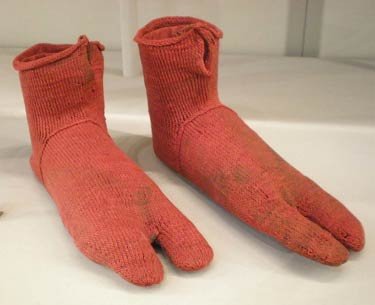
The Romano-Egyptian socks were excavated in the burial grounds of ancient Oxyrhynchus, a Greek colony on the Nile in central Egypt at the end of the 19th century. They were given to the Museum in 1900 by Robert Taylor Esq., ‘Kytes,’ Watford. He was executor of the estate of the late Major Myers and these items were selected among others from a list of textiles as ‘a large number of very useful examples.’
Particularly intriguing about these “very useful examples†is the technique used to construct these red wool socks. Called nÃ¥lbindning, or single-needle knitting, this time-consuming process required only a single thread. The technique was frequently used for close-fitting garments for the head, feet and hands because of its elastic qualities. Primarily from prehistoric times, nÃ¥lbindning came before the two-needle knitting that’s standard today; each needle was crafted from wood or bone that was “flat, blunt and between 6-10 cm long, relatively large-eyed at one end or the eye is near the middle.â€
We don’t know for sure whether these socks were for everyday use, worn with a pair of sandals to do the ancient Egyptian equivalent of running errands or heading to work—or if they were used as ceremonial offerings to the dead (they were found by burial grounds, after all).
For sandals? They look to me to have been made for someone (the ibis-headed god Thoth?) who had feet like a stork.
Nicholas Poussin, The Victory of Joshua Over the Amalekites, 1624-1625, Hermitage, St. Petersburg
Eratosthenes notices that the culture wars are being waged relentlessly and with unlimited persistence, by one side which is absolutely and unequivocally determined to win everything it wants every time and which, whenever it wins, will then proceed to move the goal posts even further.
Somehow, somewhere, it has been decided that this one culture should reign supreme. It must ALWAYS win; there can be no exceptions. What do we call this culture, now. We should try to define it, if it always has to win! That’s a lot of influence. We know it by the offenses it takes. Bullying, homophobic remarks, guns. It isn’t “politically correct,†for the politically-correct culture, while also defined according to the offenses it takes, is confined to offenses taken against verbal or written statements. Guns aren’t statements. Ass-kickings are not statements either, although I suppose that may be debatable. But this is not political-correctness, and it isn’t “women over men†since it takes just as vicious umbrage against a woman brandishing a firearm in self-defense, as against any man doing likewise.
It isn’t modern liberalism, either. It doesn’t have an opinion about labor-versus-management, or minimum wage, or affirmative action, or school vouchers. It holds a lot of appeal for people who do not self-identify as liberals. And its field of interest is very narrow. I can summarize it with a phrasing almost bumper-sticker-sized:
“When we make everything safe enough, nothing bad will happen, to anyone, ever again.â€
Just outside a school on a 55 mph county highway, it isn’t good enough to take the limit down to 25. My recent experiences here in upstate New York show it has to be 15. I guess twenty-five wouldn’t show how much we care. This culture cares about children arriving at adulthood with all their limbs and with their hearts still beating, but with not too much else.
Can we call it “the nanny state†and be done with it? There is certainly some overlap. The Mayor of New York City trying to ban soda sales fits into the object of my inspection here, and it is certainly part of the nanny state. Pondering it some more, though, I find this doesn’t quite work. There are differences, and the differences matter. The nanny state is an organization, and it is a sale. It is narcissists in office who have power, trying to accumulate some more. …
This culture — which always must win — is endangering our very society… As the nanny-state seeks to everlastingly grow by way of creating more and more rules, this culture seeks to everlastingly grow by altering the definition of “bad things happening.†It has progressed so far now, without anyone consciously noticing it evidently, that bad-feeling evidently qualifies. If nothing bad really happens, but someone feels slighted, then action is required. This, of course, has to be a selective thing. It’s okay to make a guy “feel bad†when he approaches the State Fair with a Leatherman on his belt, by commanding him to walk a mile and a half back to his car, and back again, to stow the threatening-looking device. And a twelve-year-old girl who wins a pistol shooting contest might feel good with a little bit of extra applause, but this feel-good-all-the-time culture will refrain from that, and command everyone else to refrain as well.
The Leatherman is not dangerous and the pistol is not dangerous. In some situations, they both have the potential to make someone safe.
So this culture is not concerned with safety or danger. It has definite ideas about individuals and what, or how, the individuals should be.
He’s perfectly right. It goes way beyond politics. It is a religious crusade and “the side which must always win” is determined to forcibly convert everyone else to its own entire worldview, values, and perspective.