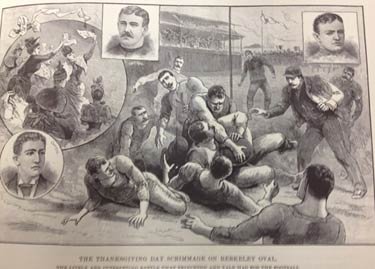
[New Editor-and-Publisher Richard K. Fox] reduced subscription rates for saloon keepers, barbers, and hotel managers — business owners that happened to cater to the Police Gazette’s target audience of young, single, urban men. Second, Fox further increased the number of illustrations and effectively created the men’s magazine tradition of featuring sexy layouts of women by introducing his “Footlight Favorites†— engravings of buxom burlesque dancers and soubrettes who showed an occasional bare arm or ankle (*wolf whistle* *cat call* *drooling*). Third, noticing America’s increasing interest in sports, Fox had the vision to create America’s first journalistic sports department in 1879 and wrote full-page stories about boxing, football, and baseball. Fourth, to provide stories for his magazine and to curry favor with his readers, Fox began sponsoring boxing prize fights. Finally, ever the marketing and branding master, Fox began printing the Police Gazette on distinctive pink paper that became a trademark for the magazine. Fox framed all these new additions and features with a cheeky irony and humor that made the magazine an easy and entertaining read.
Fox’s changes to the magazine paid off big time. In just a few short years he tripled the circulation from what it was under Matsell and ad revenue was on par with some of the largest and most popular magazines of the time. Alternatively referred to as the “bachelor bible†and the “barber shop bible,†circulation reached 150,000 a week, with special issues snatched up by more than 400,000; and these numbers really understate the magazine’s reach, as one copy of the Gazette might be read by a hundred men at a saloon or barber shop. The magazine was so firmly established as a fixture in the latter that a common joke sprung up that went like this: “Did you read The National Police Gazette?†“No, I shave myself.†(yuk, yuk, yuk.)
All this makes me feel like the Ancient Mariner. The Police Gazette was actually still a barbershop staple during my boyhood in 1950s Pennsylvania. I was already an avid reader, but the Gazette just wasn’t for me. I found it boring, old-fashioned, and slightly unsavory. I preferred Field & Stream.
Footlight Fairies were a lot tamer than Playboy Playmates.
Sex appeal versus philosophical depth, the ultimate libertarian showdown. In order to be fair, let’s have a sample of both Hayeks at their best:
VERSUS
“It would be impossible to assert that a free society will always and necessarily develop values of which we would approve, or even, as we shall see, that it will maintain values which are compatible with the preservaÂtion of freedom. All that we can say is that the values we hold are the product of freedom, that in particular the Christian values had to assert themselves through men who successfully resisted coercion by government, and that it is to the desire to be able to follow one’s own moral convictions that we owe the modern safeÂguards of individual freedom. PerÂhaps we can add to this that only societies which hold moral values essentially similar to our own have survived as free societies, while in others freedom has perished.”
Jim Treacher reports possibly the most devastating rejoinder in the history of Twitter.
Meghan McCain (John McCain’s oldest daughter by his second marriage) claims to be Republican, but votes for democrats and blogs conspicuously on the liberal side, particularly on Culture Wars issues. Last night, she was reacting negatively on Twitter (Her tweet has been since deleted) to Mark Sanford the philanderer’s Congressional race victory in South Carolina.
@meghanmccain Mark Sanford is what is wrong with American politics.
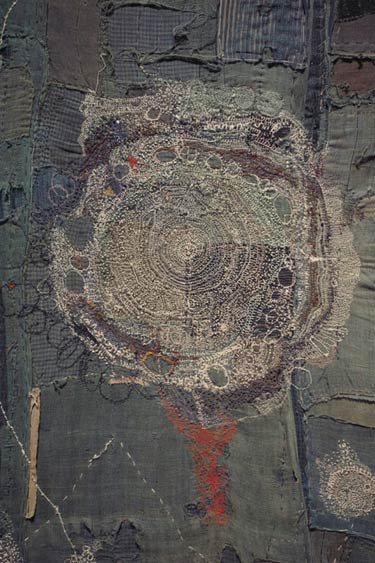
Seeing the above extraordinary image on Ka-Ching!, I was puzzled. Was this a strikingly interesting patch on a pair of blue jeans? some new kind of Amish quilt-making? Maybe I was looking at it wrong. Perhaps it was really some culture on a microscope slide. Or maybe it was some kind of geologic feature seen from Outer Space. No, it really did look like embroidery… What in hell was going on here?
So I looked and looked, and I found that this is a photograph of a piece of fibre art by the Japanese artist Junko Oki. She calls her work Woky Shoten, which name apparently refers to the “free movement of the line to make a simple repetition of workâ€, and relates to her grandfather’s memories.
She published a book in 2011 in which she describes her artistic vocation (quoted by Julie B. Boot):
(translation by Toshiaki Komuro)
Poesy
I have always dreamed of becoming a poet.
It is still my dearest wish.
Upon seeing one of my works one woman had tears in her eyes.
I had never come upon such a scene before.
What had made her cry?
“That is the power of poetry,†said a wise friend.
“You have become a poetâ€
When I have needles, threads, and other special materials in front of me, something stirs deep inside my unconscious mind in spite of myself,
and I am filled with strong emotion.
That is when I regain my true self.
When I was afraid to move forward,
I came upon a book of paintings by Antoni Tapies.
When I chant his name, I feel fully armored, even with a dagger in my belt.
In an instance I know clearly which way to go and I will my legs to move forward.
The joy of meeting and the sorrow of separation
have given me strength and courage.
Another day, another walk, I will resume my steps.
I will always be myself as a willow tree is true to its nature.
I will make today another good day.
July 2011
Junko Oki
————————————————
Poesy can apparently be ordered from the author via mmtukj@nifty.com.
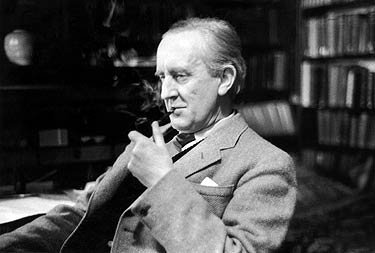
Tolkien wrote Philomythus to Misomythus as a rejoinder to one [C.S. Lewis] who said that myths were lies and therefore worthless, even though ‘breathed through silver’.
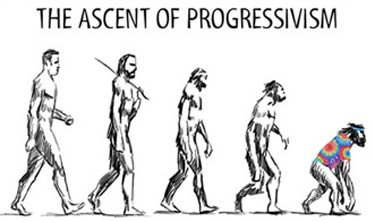
I will not walk with your progressive apes,
erect and sapient. Before them gapes
the dark abyss to which their progress tends
if by God’s mercy progress ever ends,
and does not ceaselessly revolve the same
unfruitful course with changing of a name.
Not all linguistic scholars by a long shot subscribe to Joseph Greenberg‘s theory of a single Euroasiatic language serving as the ancestral source of Etruscan, Indo-European, Uralic–Yukaghir, Altaic, Korean-Japanese-Ainu, Gilyak, Chukotian, and Eskimo–Aleut, but the Washington Post, in the manner of popular journalism, hails a new statistical word study described in a paper, Ultraconserved Words Point to Deep Language Ancestry Across Eurasia, published today in the Proceedings of the National Academy of Sciences of the United States of America, as establishing the facticity of all this.
You, hear me! Give this fire to that old man. Pull the black worm off the bark and give it to the mother. And no spitting in the ashes!
It’s an odd little speech. But if you went back 15,000 years and spoke these words to hunter-gatherers in Asia in any one of hundreds of modern languages, there is a chance they would understand at least some of what you were saying.
That’s because all of the nouns, verbs, adjectives and adverbs in the four sentences are words that have descended largely unchanged from a language that died out as the glaciers retreated at the end of the last Ice Age. Those few words mean the same thing, and sound almost the same, as they did then.
The traditional view is that words can’t survive for more than 8,000 to 9,000 years. Evolution, linguistic “weathering†and the adoption of replacements from other languages eventually drive ancient words to extinction, just like the dinosaurs of the Jurassic era.
A new study, however, suggests that’s not always true.
A team of researchers has come up with a list of two dozen “ultraconserved words†that have survived 150 centuries. It includes some predictable entries: “mother,†“not,†“what,†“to hear†and “man.†It also contains surprises: “to flow,†“ashes†and “worm.â€
The existence of the long-lived words suggests there was a “proto-Eurasiatic†language that was the common ancestor to about 700 contemporary languages that are the native tongues of more than half the world’s people.
“We’ve never heard this language, and it’s not written down anywhere,†said Mark Pagel, an evolutionary theorist at the University of Reading in England who headed the study published Monday in the Proceedings of the National Academy of Sciences. “But this ancestral language was spoken and heard. People sitting around campfires used it to talk to each other.â€
In all, “proto-Eurasiatic†gave birth to seven language families.
The usual count of allegedly descended languages families is eight. Greenberg, of course, might have been right, but only time and further research will tell whether his theory succeeds in gaining general acceptance.
The latest wrinkle in the contemporary Jane Austen boom is described at Science Blog:
Austen’s novels are game theory textbooks,†Michael Suk-Young Chwe writes in “Jane Austen, Game Theorist,†which Princeton University Press published April 21. “She’s trying to get readers to use their higher thinking skills and to think strategically.â€
At its most basic level, game theory assesses all the choices available to two (or more) people in a given situation and assigns a numerical value to the benefit each person reaps from each choice. Often, the choice that is most valuable to one player comes at the expense of the other; hence, game theory’s best-known phrase — “zero-sum game.†But just as frequently, there is a choice with unexpected benefits for both players.
“In game theory, you make choices by anticipating the payoffs for others,†Chwe explains.
Chwe argues that Austen explores this concept in all six of her novels, albeit with a different vocabulary than the one used by Nash, von Neumann and other game theory greats some 150 years later. In Austen’s romantic fiction, this type of strategic thinking is described as “penetration,†“foresight†or “a good scheme.â€
In “Pride and Prejudice,†for instance, Mrs. Bennet, a mother eager to marry off her five daughters, sends her oldest, Jane, on horseback to a neighboring estate, even though she’s aware a storm is on the way. “Mrs. Bennet knows full well that because of the rain, Jane’s hosts will invite her to spend the night, thus maximizing face time with the eligible bachelor there, Charles Bingley, whom Jane eventually marries,†Chwe said.
In “Persuasion,†the unmarried heroine, Anne Elliot, is approached by Sophia Croft, the sister of a man whose marriage proposal Anne spurned eight years earlier — a decision she still bitterly regrets. Mrs. Croft casually asks Anne whether she’s heard that her brother has married. Anne flinches, thinking the reference is to her former beau, Captain Frederick Wentworth, but relaxes upon learning that Mrs. Croft is actually referring to their younger brother, Edward.
“It’s hard to imagine a better way for Mrs. Croft to gauge Anne’s visceral interest in her unmarried brother,†said Chwe, a UCLA associate professor of political science (whose last name is pronounced like “chess†without the “ssâ€). The rest of the novel involves schemes to give Captain Wentworth so many signals of Anne’s enduring love that he finds the courage to propose to her again.
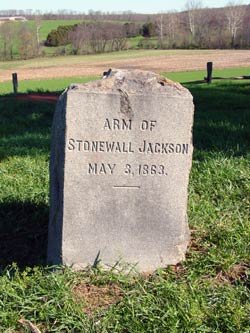
Randon Billings Noble (Now, that is a Southern name!) commemorates the 150th Anniversary of the Battle of Chancellorsville and Stonewall Jackson’s accidental wounding and death by searching for the internment site of General Jackson’s amputated arm.
I was walking through a cornfield in search of a cemetery in the middle of Virginia. A fox trotted across the path in front of me and disappeared in the forest of stalks with barely a rustle. I was searching for Stonewall Jackson’s lost arm. …
In Chancellorsville, 150 years later, the story of this arm is surprisingly well documented. A large quartz boulder marks the place where Jackson fell and signs along Route 3 mark the “Wounding of Jackson†and “Jackson’s Amputation.†But the cemetery in which the arm was buried is not marked. I knew that an aide had taken the arm to his own family graveyard, and I learned from one of the markers that the cemetery was called Ellwood, but I didn’t know where it was—only that it was nearby.
I drove through Chancellorsville National Military Park with my eyes open for anything that looked like it might lead to a cemetery. Late in the day, in a gray misty rain, having already given up, I pulled into a driveway to turn around and stopped short at a rusty iron gate with soldered block letters, E L L W O O D.
I hesitated. It was clearly a locked gate, but a faint trail led around it and continued through dense woods. While I didn’t want to trespass, I didn’t want to retreat either. The mystery of the arm was too great; I left the car in the driveway.
I’ve owned expensive rifles from top-end gun makers like Rigby, Jeffrey, and Griffin and Howe, but rifles don’t necessarily have to feature superb walnut, skilled engraving, or lots of hand work to be functional and pleasing.
I recently bought a little sporterized Model 1898 .30-40 Krag carbine for about as little money as you can spend these days and obtain a rifle that shoots.
What prompted this particular purchase was a lot of Krag carbine shopping on on-line Gun Auction sites in order to replace an old NRA Krag carbine my father acquired decades and decades ago. That old Krag must have a shot-out barrel because it produces 2-foot groups at 25 yards.
I have tried cleaning it and then shooting it again several times, but its accuracy didn’t improve. I have often thought of getting rid of it, but its action is so smooth, its carbine length is so handy, and the whole ensemble has a historic charm so potent that whenever I handle it, I can’t bring myself to part with it.
I thought of getting it sleeved or rebarreling it, but it seemed obvious that I could go and buy replacement Krags all day and spend less money. So I decided to buy another Krag carbine.
This one is sporterized, i.e. someone removed the upper handguard and the military ladder sight, then added a Redfield 102 aperture receiver sight which required no drilling. The Redfield just inserts into the hole used by the magazine cut-off and then locks into position with a set screw.
It’s probably my specific age that causes me to find guns from the period of the early 20th century, a few decades before I was around, terribly romantic and evocative. These old Krags were very popular out West. Krags shot best with round nosed 220 grain bullets and made good rifles for elk and bear.
The Krag gets a bad rap in the literature. The conventional wisdom is that the Spaniards’ 7×57 Mauser was the better rifle. And people generally find the Krag’s box magazine, sticking out on the right side, unprepossessing. Myself, I seem to have a weakness for the Krag action. Sure, Mausers and Springfields are better, but the Krag is slicker. That action may be weaker, but the fewer the bolt lugs, the smoother it works. And the action is certainly strong enough for the cartridge it was built for.
As to the box magazine, I absolutely love the crisp, military sound it makes when you snap it open or slam it shut. It is not the most intuitively obvious or logical magazine design, I will admit, but I suggest looking on it as a luxury item. Can you even begin to imagine what it would cost to get that magazine manufactured today, all that milling, all the hand-fitting?
I watched this amusing video yesterday. You know, there is a certain distinctive PING! associated with working the action of the Krag.
Maria Popova discusses lists and shares a 1977 list of Susan Sontag’s likes and dislikes.
Things I like: fires, Venice, tequila, sunsets, babies, silent films, heights, coarse salt, top hats, large long-haired dogs, ship models, cinnamon, goose down quilts, pocket watches, the smell of newly mown grass, linen, Bach, Louis XIII furniture, sushi, microscopes, large rooms, ups, boots, drinking water, maple sugar candy.
Things I dislike: sleeping in an apartment alone, cold weather, couples, football games, swimming, anchovies, mustaches, cats, umbrellas, being photographed, the taste of licorice, washing my hair (or having it washed), wearing a wristwatch, giving a lecture, cigars, writing letters, taking showers, Robert Frost, German food.
Things I like: ivory, sweaters, architectural drawings, urinating, pizza (the Roman bread), staying in hotels, paper clips, the color blue, leather belts, making lists, Wagon-Lits, paying bills, caves, watching ice-skating, asking questions, taking taxis, Benin art, green apples, office furniture, Jews, eucalyptus trees, pen knives, aphorisms, hands.
Things I dislike: Television, baked beans, hirsute men, paperback books, standing, card games, dirty or disorderly apartments, flat pillows, being in the sun, Ezra Pound, freckles, violence in movies, having drops put in my eyes, meatloaf, painted nails, suicide, licking envelopes, ketchup, traversins [“bolstersâ€], nose drops, Coca-Cola, alcoholics, taking photographs.
Things I like: drums, carnations, socks, raw peas, chewing on sugar cane, bridges, Dürer, escalators, hot weather, sturgeon, tall people, deserts, white walls, horses, electric typewriters, cherries, wicker / rattan furniture, sitting cross-legged, stripes, large windows, fresh dill, reading aloud, going to bookstores, under-furnished rooms, dancing, Ariadne auf Naxos.
In the course of reviewing Aldo Schiavone’s Spartacus (just published in English translation by Harvard), Mary Beard explains just how little we actually know about the gladiator-leader of a servile revolt.
In the entrance hall of a fairly ordinary house in ancient Pompeii, buried beneath layers of later paint, are the faint traces of an intriguing sketch of two men fighting on horseback. They are named in captions above their heads, written in Oscan—one of the early languages of South Italy that was eventually wiped out by the Latin of the Romans. The name of one is scarcely legible, but probably says “Felix the Pompeian†(or “Lucky from Pompeiiâ€). The other reads clearly, in Oscan, “Spartaks,†which in Latin would be “Spartacusâ€â€”a name best known to us from the slave and gladiator who in the late 70s BC led a rebellion that, it is said, very nearly managed to defeat the power of Rome itself.
At first sight, the scene painted on the wall looks like a military battle. But the trumpeters on either side of this pair of fighters match those often found next to gladiators in ancient paintings. So this is probably meant to depict mounted gladiatorial combat. The men must be the equites, or “horsemen,†who sometimes appeared in those bloody Roman spectacles, alongside the more familiar, heavily armed characters who fought on foot.
It is, of course, possible that the painting has nothing to do with the famous Spartacus, and that it refers to some other gladiator who just happened to have the same name; that is certainly what some skeptics argue. But there are nevertheless good reasons for linking the painting to the famous rebel: it very likely dates to the lifetime of “our†Spartacus, in the early years of the first century BC (as both the archaeological setting and the use of the Oscan language suggest); and Pompeii was, in any case, less than forty miles from Capua, where Spartacus underwent training for combat and from where he is said to have launched his rebellion—the two towns were presumably on the same gladiatorial circuit. There is a fair chance that this image gives us a glimpse of the future enemy of Rome when he was still just an ordinary gladiator—and to judge from the picture, not a totally successful one. For “Felix the Pompeian†is certainly getting the better of the retreating Spartaks. In fact, we might guess that it was to celebrate the victory of the local man that the Pompeian householder put up this image in his front hall.
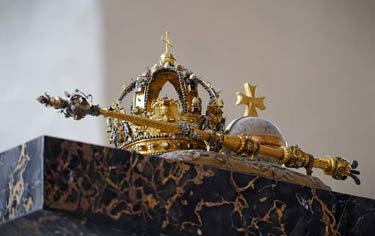
A scepter, a crown and an orb in the form of an apple were stolen from Erik XIV‘s tomb in VästerÃ¥s. The items are priceless funeral regalia from the 1500s. “I am outraged and shocked that it’s such a deliberate crime.” said cathedral chaplain Johan Sköld
A crypt in the church was shattered in Vasteras Cathedral on Friday morning leaving a gaping void in the high marble sarcophagus. Stolen was a unique set of regalia, which was linked to Erik XIV’s half brother John III’s funeral.
Funeral regalia, copies of the normal regalia worn by the Swedish kings, was used at royal funerals and placed in or on the casket.
“It’s a loss for everyone, this is our common heritage. We work hard to improve security, but the objects must also be accessible to all. It is a difficult balancing act.” said John Rothlind, chief curator at the Swedish Church in VästerÃ¥s.
Erik XIV was buried in Vasteras after his death in 1577 with little ceremony and without regalia.
Much later, his remains were moved to a more appropriate tomb. Gustav III at that time arranged that a scepter and a crown of Uppsala, which might have been used in ceremonies at John III‘s funeral, were moved to VästerÃ¥s around the year 1800.
A second set of funeral regalia, in gold, which is also linked to Johan III’s funeral, is still held in Uppsala.
The stolen set was made in the Netherlands in the 1500s, in gilt bronze with silver details. The apple, in gilded wood, was manufactured around 1800.
The three objects were in or on a ?träkudde?, also stolen, adorned with Vasa sheaves.
Additional sets of funeral regalia are in Straengnaes (Charles IX), Uppsala Cathedral (Gustav Vasa), the Royal Armoury in Stockholm (Karl X Gustav) and in Uppsala (John III’s second set).