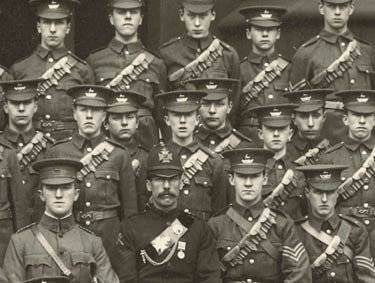
A school photo of the schoolboy J.R.R. Tolkien in Cadet Corps uniform recently made the British papers after being unearthed from the archives of his old school in Birmingham.
The Kind Edward School Cadet Corps had just been founded in march of 1907, and had the honor of being inspected by Lord Roberts of Kandahar in April.
Not many years later, most of these boys would find themselves as junior officers with the life expectancy of a mayfly on the Western Front. Tolkien participated in the Battle of the Somme, specifically in the assaults on the Schwaben Redoudt and the Leipzig salient, but happily survived, when so many others did not, because he was incapacitated by trench fever. He spent the rest of the war alternating between hospitals and garrison duty, having been found medically unfit for further front-line service.
Michael W. Hannon, in First Things, serves up some serious history demonstrating that Americans have recently been legislating privileges and remodeling the fundamental institutions of Society in favor of an imaginary category of beings.
Heterosexuals, like typewriters and urinals …, were an invention of the 1860s. Contrary to our cultural preconceptions and the lies of what has come to be called “orientation essentialism,†“straight†and “gay†are not ageless absolutes. Sexual orientation is a conceptual scheme with a history, and a dark one at that. It is a history that began far more recently than most people know, and it is one that will likely end much sooner than most people think.
Over the course of several centuries, the West had progressively abandoned Christianity’s marital architecture for human sexuality. Then, about one hundred and fifty years ago, it began to replace that longstanding teleological tradition with a brand new creation: the absolutist but absurd taxonomy of sexual orientations. Heterosexuality was made to serve as this fanciful framework’s regulating ideal, preserving the social prohibitions against sodomy and other sexual debaucheries without requiring recourse to the procreative nature of human sexuality.
On this novel account, same-sex sex acts were wrong not because they spurn the rational-animal purpose of sex—namely the family—but rather because the desire for these actions allegedly arises from a distasteful psychological disorder. As queer theorist Hanne Blank recounts, “This new concept [of heterosexuality], gussied up in a mangled mix of impressive-sounding dead languages, gave old orthodoxies a new and vibrant lease on life by suggesting, in authoritative tones, that science had effectively pronounced them natural, inevitable, and innate.â€
Sexual orientation has not provided the dependable underpinning for virtue that its inventors hoped it would, especially lately. Nevertheless, many conservative-minded Christians today feel that we should continue to enshrine the gay–straight divide and the heterosexual ideal in our popular catechesis, since that still seems to them the best way to make our moral maxims appear reasonable and attractive.
These Christian compatriots of mine are wrong to cling so tightly to sexual orientation, confusing our unprecedented and unsuccessful apologia for chastity with its eternal foundation. We do not need “heteronormativity†to defend against debauchery. On the contrary, it is just getting in our way.
Michel Foucault, an unexpected ally, details the pedigree of sexual orientation in his History of Sexuality. Whereas “sodomy†had long identified a class of actions, suddenly for the first time, in the second half of the nineteenth century, the term “homosexual†appeared alongside it. This European neologism was used in a way that would have struck previous generations as a plain category mistake, designating not actions, but people—and so also with its counterpart and foil “heterosexual.â€
Psychiatrists and legislators of the mid- to late-1800s, Foucault recounts, rejected the classical convention in which the “perpetrator†of sodomitical acts was “nothing more than the juridical subject of them.†With secular society rendering classical religious beliefs publicly illegitimate, pseudoscience stepped in and replaced religion as the moral foundation for venereal norms. To achieve secular sexual social stability, the medical experts crafted what Foucault describes as “a natural order of disorder.â€
“The nineteenth-century homosexual became a personage,†“a type of life,†“a morphology,†Foucault writes. This perverted psychiatric identity, elevated to the status of a mutant “life form†in order to safeguard polite society against its disgusting depravities, swallowed up the entire character of the afflicted: “Nothing that went into [the homosexual’s] total composition was unaffected by his sexuality. It was everywhere present in him: at the root of all his actions because it was their insidious and indefinitely active principle.â€
The imprudent aristocrats encouraging these medical innovations changed the measure of public morality, substituting religiously colored human nature with the secularly safer option of individual passion. In doing so, they were forced also to trade the robust natural law tradition for the recently constructed standard of “psychiatric normality,†with “heterosexuality†serving as the new normal for human sexuality. Such a vague standard of normality, unsurprisingly, offered far flimsier support for sexual ethics than did the classical natural law tradition.
There is a similar piece, looking at homosexuality from an anthropological perspective by David Benkof at Daily Caller.
[B]efore the 19th century nobody was called “gay.†… While various societies had different ways of thinking about and expressing gender, love, and desire, homosexuality was generally something one could do, not something one could be.
Road & Track simply marvels at the astounding overreach of proposed eco-tyranny.
In an effort to further reduce pollution in Great Britain, new regulations have been proposed that would effectively ban all classic cars from London’s city center. R&T understands that the mandate, which was first floated last February, would establish an Ultra Low Emissions Zone (ULEZ), disallowing all pre-2005-registered vehicles from entering a prime area of downtown London effective 2020. …
Britain, always fertile ground for irony, also seems to have forgotten that its auto industry hasn’t contributed anything truly noteworthy to the motoring zeitgeist in roughly half a century (with a few notable exceptions, such as the McLaren F1). Thus, the ULEZ would take every great English car ever made—the Jaguar E-Type, Aston Martin DB5, Rolls-Royce Silver Shadow, the Lotus Esprit Series 1, and even the original city car, Issigonis’s Mini—and promptly ban them all from entering the most visible area of the nation’s capital.
Take a moment to let that sink in.
Well-intentioned? Sure, but the proposed ULEZ is ignorant at best and outright draconian at worst.
Sid Vicious plus William Butler Yeats equals Shane MacGowan.
Matthew Hennessey, meanwhile, in the City Journal notes that you couldn’t kill Shane MacGowan with a stick.
They say God takes care of fools and drunks. If so, he’s been working overtime the last few decades taking care of Shane MacGowan. As the frontman and principal songwriter of the Irish rock band the Pogues, MacGowan is as famous for his lyrics and whiskey-timbered voice as for his unlikely longevity, despite a Homeric appetite for intoxicating substances, especially, but not limited to, alcohol. Though he cuts a shambolic figure, MacGowan is still upright at 56, a feat many view as a minor miracle. His rheumy eyes and distinctive throat-clearing cackle suggest not genius, necessarily, but late-stage dipsomania; there is nary a tooth left in his head. God or something like God must be taking care of MacGowan. He’s not been doing the job himself.
Clarissa Dickson Wright, “the larger of the Two Fat Ladies,” passed away recently aged 66.
She was the daughter of very rich, but alcoholic and abusive, father. At age 26, she inherited 2.8 million pounds, thereupon embarking “on almost a decade of extravagance and debauchery.â€
By age 40, she had blown it all on “yachts in the Caribbean, yachts in the Aegean, aeroplanes to the races – and drinkâ€. “If I’d had another £100,000,†she conceded, “I’d have been dead.â€
She had studied successfully for a law degree, and been the first woman admitted to the Admiralty Bar, but in 1980, she was charged with professional incompetence and practicing without chambers. She was disbarred three years later.
At rock bottom she went to the DSS to ask for somewhere to live, only to be told: “We’re not here for the likes of you, you know. You’re upper class, you’ve got a Law degree.â€
She began to cook in other people’s houses. “Of course it’s only the upper classes who will become domestic servants now,†she reflected. “Other people feel it demeans them.†One day, when preparing to cook for a house party, she was on her knees, cleaning the floor. “I looked up,†she remembered, “and said ‘Dear God, if you are up there, please do something.’†The next day she was arrested for refusing a breathalyser. “I was carted down the long drive just as the house party was coming up it. From then on, I was inexorably swept into recovery.â€
BBC producer Patricia Llewellyn found her running a bookshop in Edinburgh and teamed her with the also colorful and eccentric Jennifer Paterson, then a columnist at The Spectator. Their program, Two Fat Ladies, achieved enormous popularity by flying in the face of healthy eating and enthusiastically embracing traditional items of cuisine, loaded with fat, sugar, calories, and cholesterol.
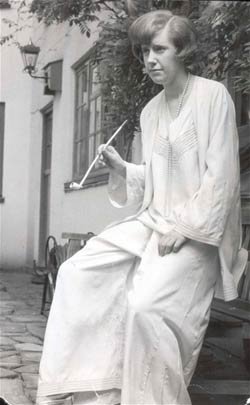
She smoked a pipe, boasted of having had sex behind the Speaker’s Chair in the House of Commons, and defied the Hunt Ban by attending a greyhound coursing exhibition, and when prosecuted told the Press that she would be glad to go to prison “for hunting.”